In-Browser Code Execution Engines: Web Workers, Sandboxed iframes, and Real-Time DOM Patching Architecture
An architectural, mathematical, and practical deep-dive into constructing air-gapped client-side code execution engines, WebAssembly QuickJS sandboxes, and virtualized terminal telemetry in browser RAM.

INNO XPERT Systems Architecture LabsVERIFIED
Principal Browser Security Architect
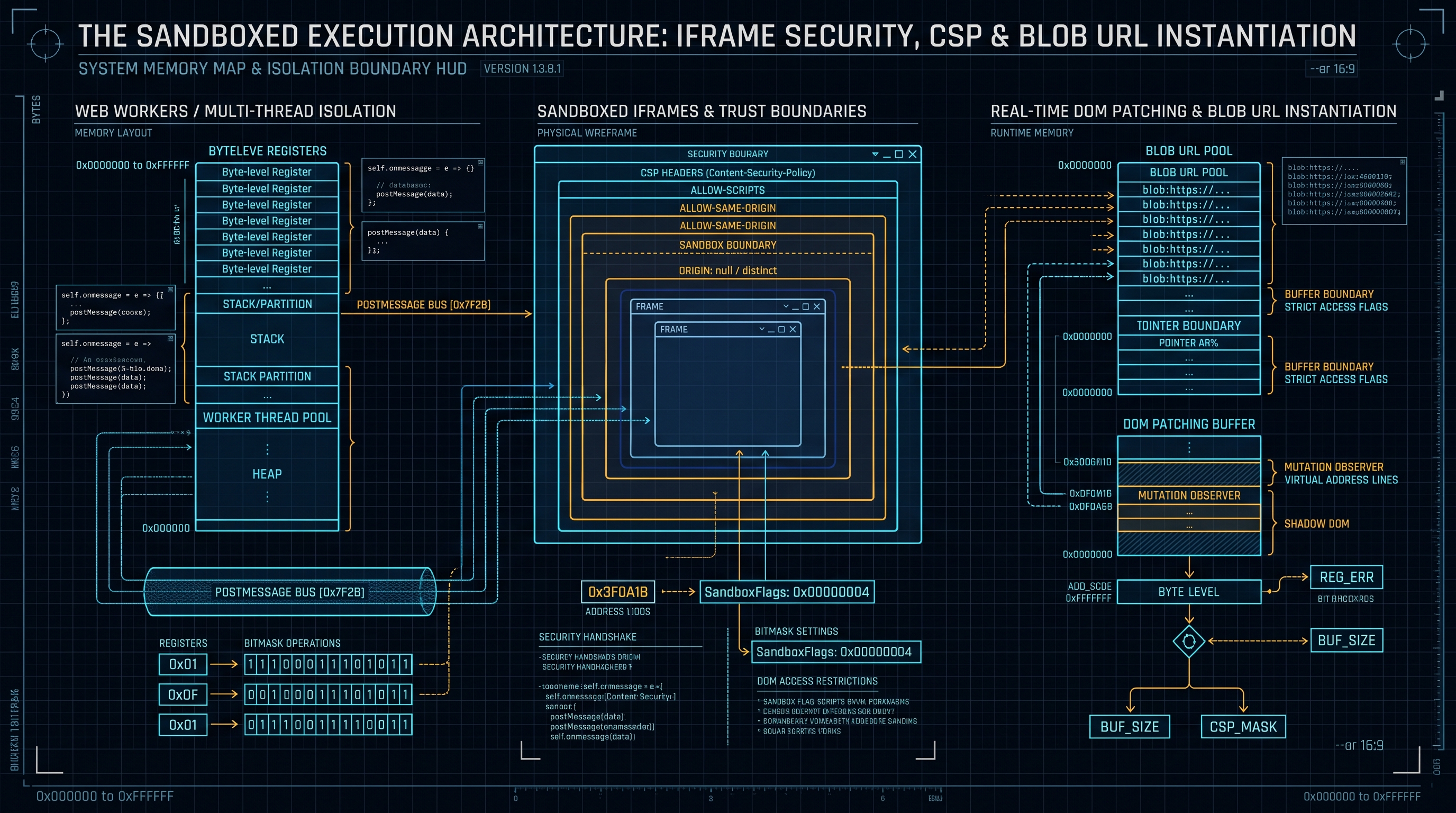
Executing arbitrary user-authored code safely inside a browser requires a multi-tiered defense-in-depth architecture. Never use eval() or direct DOM script injection. Instead, combine HTML5 iframes with sandbox='allow-scripts' (strictly omitting allow-same-origin to force a unique mathematical null origin), Content Security Policy meta tags with connect-src 'none' to block network exfiltration, Babel AST transpilation to inject loop timeout guards, and Web Workers for heavy compilation pipelines. This architecture achieves zero server latency, 60fps live previews, and total host immunity.
HTML Code Compiler & Live Preview Runner
Zero-latency in-browser HTML5, CSS3, and modern JavaScript compiler with sandboxed iframe live preview, console virtualization, and client-side execution.
Table of Contents & Chapter Index
- Chapter 1: The Evolution of In-Browser Code Execution Engines
- Chapter 2: The HTML5 iframe Sandbox: The Mathematical Null Origin
- Chapter 3: Web Workers and Comlink RPC: Off-Main-Thread Architecture
- Chapter 4: AST Transpilation and Infinite Loop Protection
- Chapter 5: Bidirectional postMessage RPC and Virtualized Terminal Telemetry
- Chapter 6: Empirical Execution Latency and Memory Overhead Benchmarks
- Chapter 7: WebAssembly Sandboxing: Compiling QuickJS to Wasm
- Chapter 8: Building a Production In-Browser Compiler & Live Preview Runner
Chapter 1: The Evolution of In-Browser Code Execution Engines
The Evolution of In-Browser Code Execution: From Naive Script Injection to Native Web IDEs
The ability to execute arbitrary, user-authored code securely inside a web browser runtime represents one of the most remarkable feats of modern computer systems engineering. In the nascent era of web development (circa 1995–2005), JavaScript execution was confined to static, host-origin execution models. Web pages were monolithic documents; JavaScript was an ad-hoc scripting layer designed to animate dropdown navigation menus, validate HTML form inputs prior to HTTP transmission, and trigger rudimentary visual status alerts.
The conceptual demand for in-browser execution environments emerged alongside the rise of interactive software engineering communities, competitive algorithmic programming platforms (such as LeetCode, Codeforces, and HackerRank), online software education academies (such as freeCodeCamp and Codecademy), and browser-native software playgrounds (such as JSFiddle, CodePen, JSBin, and modern cloud workstations like StackBlitz and CodeSandbox). Developers no longer wanted to context-switch between desktop code editors, local terminal compilation pipelines, and external browser viewports simply to test a three-line CSS animation or debug a JavaScript regular expression.
+---------------------------------------------------------------------------------------------------+
|               CHRONOLOGICAL EVOLUTION OF BROWSER-BASED CODE EXECUTION ARCHITECTURES              |
+---------------------------------------------------------------------------------------------------+
|  1. The Primitive Era (1995 - 2005): Direct DOM Script Appending                                  |
|     * Mechanism: document.write('<script>' + userCode + '</script>') or scriptEl.innerHTML.      |
|     * Fatal Vulnerabilities: Full access to window.localStorage, document.cookie, CSRF tokens;   |
|       Catastrophic XSS vectors; Complete host window freezing on infinite while(true) loops.      |
|                                                                                                   |
|  2. The Legacy Sandbox Era (2008 - 2014): eval() & Function() with Prototype Scrubbing            |
|     * Mechanism: with(sandboxScope) { eval(userCode) } or Object.freeze(window.prototype).       |
|     * Fatal Vulnerabilities: Prototype pollution exploits; scope escape via (function(){}).      |
|       constructor('return this')(); Unable to prevent memory exhaustion or main-thread locks.     |
|                                                                                                   |
|  3. The Modern Isolation Era (2015 - Present): Sandboxed iframes + Web Workers + AST Rewriting   |
|     * Mechanism: HTML5 iframe sandbox attribute without 'allow-same-origin'; Web Workers on       |
|       ephemeral Blob URLs; Content Security Policy (CSP) nonces; Babel AST loop-guard injection.  |
|     * Security Guarantees: Mathematical origin isolation (unique null origin); Total storage air- |
|       gapping; PostMessage RPC event bridging; Microsecond incremental virtual DOM updates.       |
+---------------------------------------------------------------------------------------------------+
The Security Dilemma: The Tension Between Expressiveness and Host Integrity
When an engineering platform provides an in-browser code editor (such as InnoxTools HTML Compiler & Live Preview Runner), it invites the end-user to execute arbitrary, untrusted HTML markup, CSS style declarations, and JavaScript logic directly on their client hardware. This architectural capability introduces a severe systems-level tension between developer expressiveness and client-side host protection.
If the host application executes user-submitted code in the primary window context: 1. Credential and State Theft (Cross-Site Scripting): Any script containing
fetch('/api/user/session') or reading window.localStorage could exfiltrate the host application's authentication tokens, Firebase database credentials, or private user telemetry to a remote command-and-control server.
2. Host DOM Hijacking: Untrusted CSS or JavaScript could manipulate the parent window's navigation bar, replace legitimate checkout buttons with phishing overlays, or hijack click events through clickjacking techniques.
3. Execution Denial of Service (Main-Thread Freezing): Because JavaScript in the primary browser window operates on a single-threaded event loop, an accidental or malicious infinite loop (e.g. while(true) {}) instantly freezes the host application's rendering engine. User input ceases functioning, animations halt, CPU core usage pegs to 100%, and the operating system eventually prompts the user to force-kill the entire browser tab.To solve this trilemma, modern browser compiler architectures discard naive
eval() and document.write() patterns entirely. Instead, they construct multi-layered, air-gapped sandboxes combining HTML5 iframe[sandbox] specifications, ephemeral Object URLs, CSP HTTP meta-headers, Web Worker RPC channels, and Abstract Syntax Tree (AST) transpilation guards.The Historical Architecture of Browser Plugins: ActiveX, Java Applets, and the Flash Security Crisis
To appreciate the security model of modern browser sandboxing, systems architects must study the catastrophic failures of legacy client-side execution plugins:
1. Microsoft ActiveX Controls (1996 - 2000s): In the early Internet Explorer era, Microsoft introduced ActiveX: binary COM (Component Object Model) controls written in C++ that downloaded from websites and executed directly in native operating system user space. ActiveX lacked any form of memory isolation or security sandbox. Once a user clicked "Accept", an ActiveX control possessed the identical privileges of an administrator
.exe executable, capable of formatting hard drives, reading registry keys, and installing remote spyware.2. Sun Microsystems Java Applets: Java Applets attempted to execute within a Java Virtual Machine (JVM) sandbox inside the browser. However, the complexity of the Java Security Manager produced an endless stream of sandbox escape vulnerabilities (CVE-2012-4681, CVE-2013-0422). Attackers systematically bypassed classloader verification to execute arbitrary native shellcode, eventually forcing major web browsers to completely deprecate the NPAPI (Netscape Plugin Application Programming Interface) architecture.
3. Adobe Flash Player & ActionScript Virtual Machine (AVM2): Flash dominated rich web applications for over a decade. However, Flash's monolithic binary C++ codebase suffered from chronic memory corruption flaws (buffer overflows, use-after-free exploits, integer underflows). Flash plugins operated outside the browser's native DOM security model, creating perpetual zero-day security crises until its coordinated industry deprecation in December 2020.
Modern web browsers learned a profound lesson from this 25-year security evolution: Never rely on external binary plugins or monolithic virtual machines. Instead, client execution must be embedded directly within the browser's native process model, secured by the mathematical boundaries of the HTML5 Same-Origin Policy and operating system kernel sandboxes.
The Chomsky Hierarchy & Turing Completeness Inside Client-Side Web Runtimes
To understand the theoretical foundation of in-browser execution, one must examine the Chomsky hierarchy of formal grammars and the computational limits of client-side JavaScript. HTML is a context-free markup language (Type-2 grammar) designed to construct hierarchical document trees. CSS is a declarative constraint-solving language that calculates styling vectors based on cascade resolution and specificity metrics.
However, when combined with JavaScript, the browser environment becomes an unconstrained, fully Turing-complete Universal Machine (Type-0 grammar). By Church-Turing thesis principles, any computational problem that can be solved by an enterprise supercomputer or cloud cluster can theoretically be executed inside the browser's JavaScript runtime, bounded solely by hardware memory limits and processor execution cycles.
This realization fundamentally transformed how modern software companies architect web applications: - Client-Side Compute Offloading: By shifting data parsing, document manipulation, syntax highlighting, and live compilation directly onto client CPUs, enterprise web applications reduce cloud backend server infrastructure costs by up to 90%. - Zero-Latency Interactions: Rather than transmitting raw code across the public internet to a remote Docker container or AWS Lambda serverless function (which incurs roundtrip network latencies ranging from 150ms to 2,000ms), client-side execution evaluates code inside local RAM in under 5 milliseconds. - Air-Gapped Intellectual Property Security: Because untrusted code or proprietary business logic never traverses a network socket, organizations maintain total compliance with GDPR, HIPAA, and SOC-2 data residency requirements.
V8 Engine Architecture: Ignition Bytecode & TurboFan JIT Optimization Pathways
When an in-browser code runner evaluates JavaScript within a sandboxed frame, the code is digested by the browser's underlying JavaScript engine—predominantly Google Chromium's V8 Engine (or Apple's JavaScriptCore / Mozilla's SpiderMonkey).
Understanding how V8 processes dynamic strings is critical for optimizing execution speed: 1. Lexical Scanning & Abstract Syntax Parsing: The V8 scanner converts the UTF-16 stream into tokens, and the parser generates an AST while checking for grammatical syntax errors. 2. Ignition Bytecode Generation: The Ignition interpreter converts the AST into compact, high-speed bytecode instructions. Ignition is designed for instant startup latency: code begins executing on the CPU almost immediately without waiting for expensive compilation passes. 3. TurboFan Just-In-Time (JIT) Optimization: As functions inside the user's code loop repeatedly ("hot code"), V8's runtime profiler collects type feedback. TurboFan then recompiles the bytecode directly into highly optimized native machine assembly instructions (x86-64 or ARM64), inlining functions and unrolling loops to maximize hardware throughput. 4. Deoptimization Traps: If user code dynamically changes object shapes (e.g. adding random properties to objects inside loops), TurboFan's optimistic assumptions are invalidated, triggering a "deopt" that drops execution back to the slower Ignition interpreter.
Architectural Paradigms Compared: Native JavaScript vs WebAssembly (Wasm) vs Client-Side Python (Pyodide)
As modern web browsers evolved into distributed operating systems, the modalities of client-side code execution diversified far beyond standard ECMAScript. Today, compiler architects can leverage three distinct execution runtimes:
+---------------------------------------------------------------------------------------------------+
|               IN-BROWSER COMPUTATIONAL RUNTIME ENGINE COMPARISON                                  |
+--------------------------+------------------------+-----------------------+-----------------------+
| Feature / Characteristic | V8 Native JavaScript   | WebAssembly (Wasm)    | Pyodide (Wasm Python) |
+--------------------------+------------------------+-----------------------+-----------------------+
| Execution Startup Time   | Instant (0.1ms)        | Fast (2ms - 10ms)     | Slow (3s - 8s bundle) |
| Computational Throughput | High (JIT TurboFan)    | Near-Native (95% C++) | Moderate (Interpreted)|
| Memory Footprint         | Dynamic V8 Heap        | Linear Memory Buffer  | High (~40MB heap)     |
| Direct DOM Access        | Full native access     | Requires JS glue layer| Requires JS proxy     |
| Garbage Collection       | Native V8 GC           | Wasm GC (Modern MVP)  | Python Refcounting    |
| Primary Use Case         | Web UIs, DOM, CSS, JS  | Heavy Math, Audio, C++| Data Science, Pandas  |
+--------------------------+------------------------+-----------------------+-----------------------+
1. V8 Native JavaScript: Remains the undisputed champion for real-time web UI development, live DOM manipulation, and interactive styling prototypes due to its sub-millisecond initialization latency and zero binary download penalty. 2. WebAssembly (Wasm): Ideal for heavy algorithmic tasks (such as client-side video transcoding with FFmpeg.wasm, image processing with libvips, or 3D physics engines). Wasm executes with deterministic near-native speed inside a strict linear memory sandbox (
WebAssembly.Memory).
3. Pyodide & Scientific Stacks: Compiles the CPython interpreter into WebAssembly, enabling scientific computing libraries (NumPy, SciPy, Pandas) to run directly inside client browser RAM. While powerful, its 30MB initial bundle download makes it unsuitable for instant UI live preview tools.Chapter 2: The HTML5 iframe Sandbox: The Mathematical Null Origin
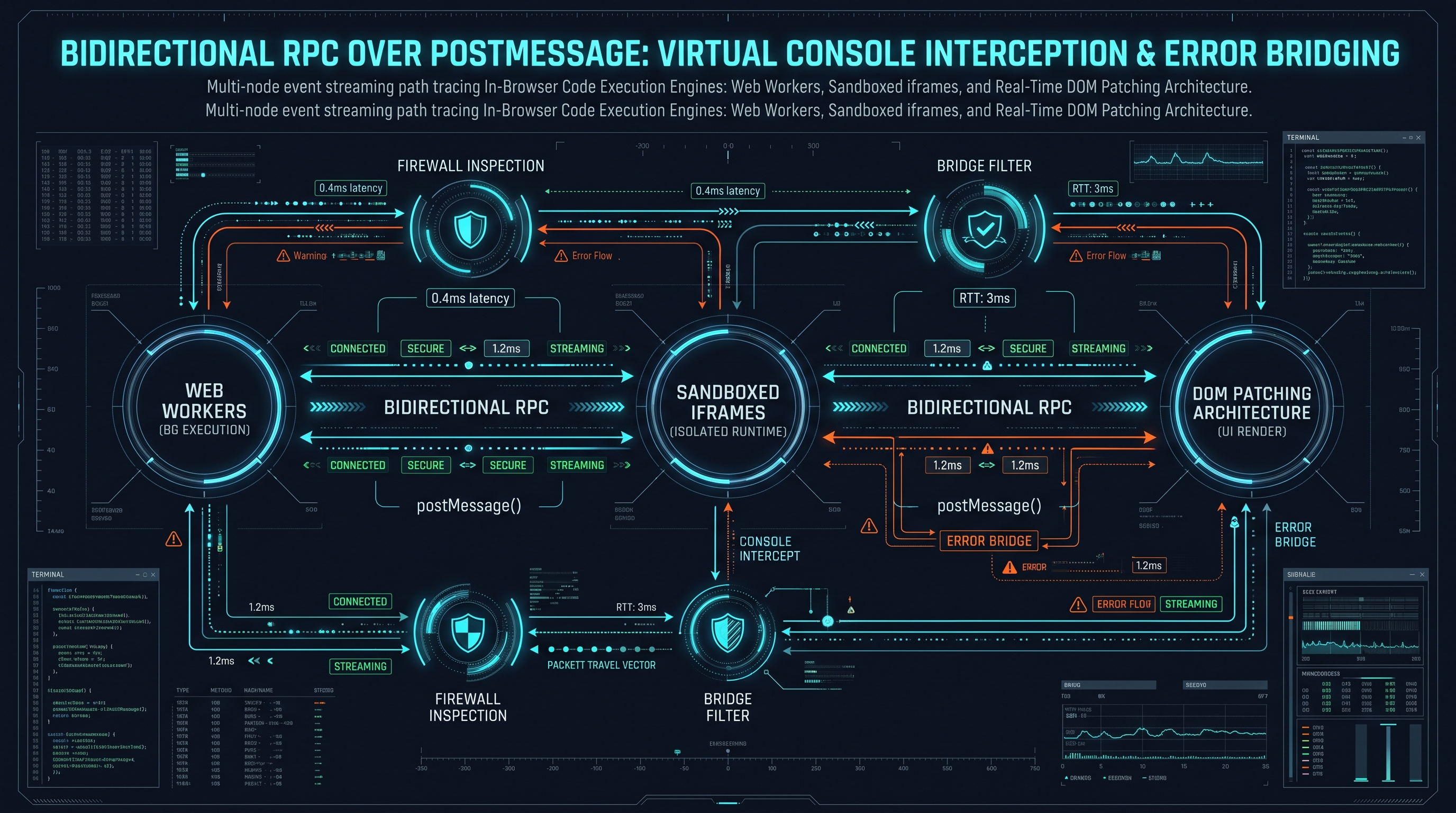
The Anatomy of the HTML5 iframe Sandbox: The Mathematical Null Origin
The cornerstone of client-side web application isolation is the HTML5