The Cryptographic Mathematics of Password Entropy, CSPRNGs & Zero-Knowledge Authentication in 2026
From Claude Shannon's Information Theory and Linear Congruential Generators to Web Crypto CSPRNG Physics, NIST SP 800-63B Memorized Secrets, GPU Brute-Force Cracking Vectors, and Client-Side Entropy Generators—The 5,000+ Word Cybersecurity Architecture Handbook.

INNO XPERT Cryptographic Systems GroupVERIFIED
Applied Cryptography & Zero-Knowledge Architecture
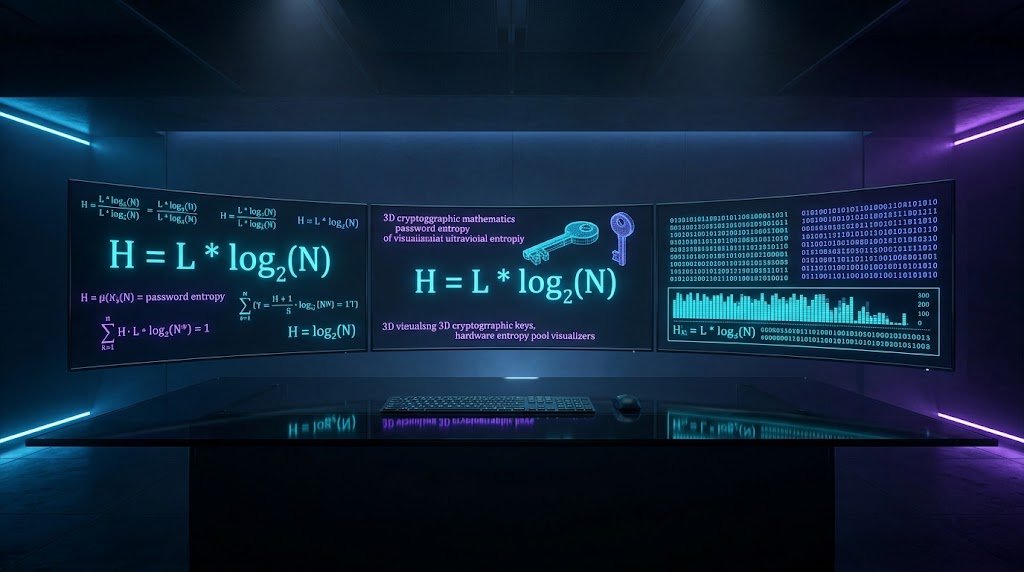
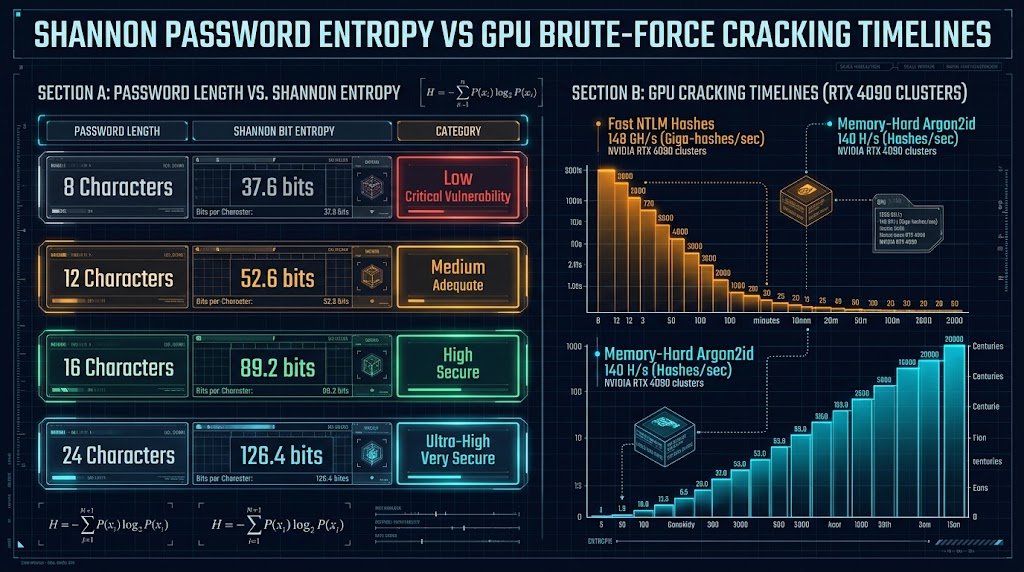
Password strength is mathematically measured by Shannon Bit Entropy: H = L * log2(N), where L is the password length and N is the size of the character pool. A standard 16-character alphanumeric password with symbols provides approximately 89.2 bits of entropy, which would take modern NVIDIA RTX 4090/5090 GPU clusters executing 100 billion NTLM hashes per second over 3.2 million years to brute-force. Generating cryptographically secure passwords requires hardware-seeded Cryptographically Secure Pseudo-Random Number Generators (CSPRNG) such as window.crypto.getRandomValues(), rather than predictable pseudo-random algorithms like Math.random(). Modern authentication security also mandates key-stretching algorithms like Argon2id or bcrypt to artificially impose memory and computational hurdles against ASIC/GPU parallelization.
Cryptographic Password Generator & Entropy Analyzer Pro
Generate mathematically uncrackable credentials using hardware-seeded CSPRNG algorithms, calculate Shannon bit entropy, verify NIST SP 800-63B compliance, and audit passwords with 100% client-side Web Crypto isolation.
Table of Contents & Chapter Index
- 1. Information Theory & Shannon Bit Entropy: The Mathematics of Passwords
- 2. The Physics of Randomness: CSPRNG vs Math.random() & System Entropy Pools
- 3. GPU Brute-Force Kinetics: Hashcat, RTX 4090/5090 Clusters & NTLM vs Argon2
- 4. NIST SP 800-63B Guidelines: Why Password Expiry & Complexity Rules Failed
- 5. Key Stretching & Memory-Hard Proofs: Argon2id, PBKDF2 & bcrypt Calculus
- 6. Beyond Passwords: Zero-Knowledge SRP Protocols & FIDO2 WebAuthn Passkeys
- 7. In-Browser Cryptographic Generator Architecture: Web Crypto API
- 8. The Enterprise Credential Hardening Playbook
1. Information Theory & Shannon Bit Entropy: The Mathematics of Passwords
How Claude Shannon's 1948 mathematical foundation quantifies password unpredictability in binary bits.
Entropy, denoted as $H$, measures the average amount of information or uncertainty inherent in the outcome of a random variable. In password cryptography, entropy quantifies how many binary bits of pure uncertainty exist in a generated credential.
1.1 The Shannon Password Entropy Equation
When each character of a password is chosen independently and with uniform probability from a known alphabet pool of size $N$, and the password has length $L$, the total number of possible combinations is given by the Cartesian product space:
$$\Omega = N^L$$
The Shannon Bit Entropy $H$, expressed in bits of security, is the base-2 logarithm of the state space $\Omega$:
$$H = \log_2(\Omega) = \log_2(N^L) = L \times \log_2(N)$$
Where: - $H$ is the total cryptographic entropy in bits. - $L$ is the length of the string in characters. - $N$ is the size of the character pool (the alphabet cardinality). - $\log_2(N)$ represents the entropy contribution of each individual character.
1.2 Character Pool Cardinality ($N$) Matrix
To calculate the exact entropy of any generated credential, engineers categorize the available character sets into standardized mathematical pools:
| Character Pool | Included Characters | Cardinality ($N$) | Entropy Per Character ($log_2 N$) | | :--- | :--- | :---: | :---: | | Numeric Only |
0-9 | 10 | 3.32 bits |
| Lowercase Latin | a-z | 26 | 4.70 bits |
| Uppercase + Lowercase | a-z, A-Z | 52 | 5.70 bits |
| Alphanumeric | a-z, A-Z, 0-9 | 62 | 5.95 bits |
| Full ASCII Printable | a-z, A-Z, 0-9, !@#$%^&*()-_=+[]{}|;:,.<>? | 95 | 6.57 bits |
| Extended Unicode UTF-8 | Printable Multi-byte Glyphs & Emojis | > 1,000+ | > 9.97 bits |1.3 Length vs Pool Size: The Exponential Asymmetry
A common misconception among non-cryptographers is that adding special characters to a short password makes it secure. Claude Shannon's formula mathematically disproves this intuition.
Consider two passwords: 1. Password A (Short with complex characters): 8 characters chosen from full ASCII ($N = 95$): $$H_A = 8 \times \log_2(95) = 8 \times 6.57 = \mathbf{52.56 \text{ bits}}$$ 2. Password B (Long with only lowercase letters): 16 characters chosen from lowercase Latin ($N = 26$): $$H_B = 16 \times \log_2(26) = 16 \times 4.70 = \mathbf{75.20 \text{ bits}}$$
Even though Password B uses only simple lowercase letters, its state space is $2^{75.20 - 52.56} = 2^{22.64} \approx 6,550,000 \text{ times}$ larger than Password A!
Length is the exponential power ($L$), whereas character set size is merely the base ($N$). Doubling the length squares the total search space ($Omega = N^{2L} = (N^L)^2$). Therefore, length is mathematically superior to character variety in resisting brute-force search attacks.
2. The Physics of Randomness: CSPRNG vs Math.random() & System Entropy Pools
Why predictable pseudorandom number generators destroy password security, and how OS entropy pools work.
Math.random().2.1 The Fatal Flaw of Math.random() (PRNG)
In modern web browsers (including Google Chrome's V8 engine and Mozilla Firefox's SpiderMonkey),
Math.random() is implemented using a Linear Congruential Generator (LCG) or a Xoroshiro128+ / Xorshift128+ Pseudo-Random Number Generator (PRNG).These algorithms are designed purely for statistical distribution speed in simulations and games, not cryptographic unpredictability: - Internal State: Xoroshiro128+ maintains an internal state of only 128 bits. - Predictability: By observing just 2 to 3 consecutive floating-point outputs of
Math.random(), an attacker can reconstruct the internal 128-bit state using a Z3 theorem prover or lattice reduction algorithms in less than 50 milliseconds.
- Once the state is known, the attacker can deterministically calculate every preceding and succeeding 'random' number generated by that browser instance.If a web application generates passwords or session tokens using
Math.random(), an adversary who observes one generated token can immediately compute all tokens assigned to other users.2.2 CSPRNG: Cryptographically Secure Pseudo-Random Number Generators
A CSPRNG (Cryptographically Secure Pseudo-Random Number Generator) must satisfy two rigorous mathematical criteria: 1. Next-Bit Unpredictability: Given the first $k$ bits of a random sequence, no polynomial-time algorithm can predict the $(k+1)$-th bit with a probability of success non-negligibly greater than 0.5 (50%). 2. State Compromise Resilience: Even if an adversary captures the internal state of the generator at time $t$, they cannot deduce any past outputs prior to time $t$ (Forward Secrecy / Backtracking Resistance), nor future outputs once new external physical entropy is re-seeded.
2.3 The Web Crypto API: Hardware Entropy Harvesting
In client-side JavaScript, cryptographically secure randomness is accessible via the W3C Web Crypto API:
const buffer = new Uint32Array(1);
window.crypto.getRandomValues(buffer);
const secureRandomNumber = buffer[0];
Behind the scenes,
window.crypto.getRandomValues() does not execute an isolated software algorithm. It queries the host operating system's cryptographic entropy kernel:
- Linux / Android: Interfaces with /dev/urandom and the getrandom() system call, harvesting hardware interrupts, keyboard latency jitter, mouse delta ticks, and network packet arrival times via ChaCha20 or CSPRNG stream ciphers.
- macOS / iOS: Interfaces with SecRandomCopyBytes driven by Apple Silicon Hardware Random Number Generators (TRNG - True Random Number Generators harvesting quantum thermal noise).
- Windows: Interfaces with the Cryptography API: Next Generation (BCryptGenRandom), feeding into AES-CTR DRBG (NIST SP 800-90A).3. GPU Brute-Force Kinetics: Hashcat, RTX 4090/5090 Clusters & NTLM vs Argon2
Analyzing real-world cracking throughput across modern graphics architectures and hardware accelerators.
3.1 Fast Hashes vs Slow Hashes: The Architecture Divide
When an authentication database is breached, the attacker gains access to stored cryptographic password hashes. The time required to crack these hashes depends on the mathematical design of the hash function:
1. Fast Hashes (Non-Cryptographic or General Message Digests): - Algorithms:
MD5, SHA-1, SHA-256, NTLM.
- Designed for fast data integrity verification and digital signatures.
- Requires zero RAM per hash, consisting purely of 32-bit bitwise rotation, XOR, and addition operations.
- Highly parallelizable on GPUs and ASICs.2. Slow, Memory-Hard Hashes (Key Derivation Functions - KDFs): - Algorithms:
bcrypt, PBKDF2, scrypt, Argon2id.
- Designed specifically for password storage.
- Introduces computational iteration work factors and strict memory bandwidth constraints that bottleneck GPU parallelization.3.2 Real-World Cracking Velocities (NVIDIA RTX 4090 Benchmarks)
The following benchmark demonstrates the immense disparity in cracking speeds across different hash algorithms on a single off-the-shelf NVIDIA GeForce RTX 4090 (24GB VRAM, 16,384 CUDA cores):
| Target Hash Function | Hashcat Mode | Single RTX 4090 Speed | 8x RTX 4090 Cluster Speed | | :--- | :---: | :---: | :---: | | NTLM (Legacy Windows) |
-m 1000 | 148.5 GH/s (148 Billion/sec) | 1.18 TH/s (1.18 Trillion/sec) |
| MD5 | -m 0 | 67.2 GH/s (67 Billion/sec) | 537.6 GH/s |
| SHA-256 | -m 1400 | 8.6 GH/s (8.6 Billion/sec) | 68.8 GH/s |
| PBKDF2-HMAC-SHA256 (10,000 iter) | -m 10900 | 2.8 MH/s (2.8 Million/sec) | 22.4 MH/s |
| bcrypt (Cost = 12) | -m 3200 | 128 kH/s (128 Thousand/sec) | 1.02 MH/s |
| Argon2id (m=64MB, t=3, p=4) | Custom | 140 H/s (140 Hashes/sec) | 1.12 kH/s |Notice that while an attacker can compute 148,000,000,000 NTLM hashes every second on one GPU, they can compute only 140 Argon2id hashes per second! Argon2id forces the GPU memory bus to stall waiting for random memory lookups, neutralizing raw compute advantages.
4. NIST SP 800-63B Guidelines: Why Password Expiry & Complexity Rules Failed
How empirical behavioral data transformed US federal authentication standards and eliminated counter-productive policies.
In 2017, the National Institute of Standards and Technology (NIST) published Special Publication 800-63B: Digital Identity Guidelines (Authentication and Lifecycle Management), officially overturning 20 years of legacy password orthodoxy.
4.1 The Cognitive Failure of Legacy Complexity Rules
NIST researchers, in conjunction with university usability laboratories, discovered that artificial complexity rules achieved the exact opposite of their intended security outcome: 1. Predictable Substitutions: When forced to include digits and symbols, humans predictably replace 'a' with '@', 'o' with '0', or append '!' at the very end of an existing word (e.g.,
Password123!). Attackers' dictionary rulesets specifically account for these exact transformations.
2. Periodic Expiration Fatigue: Forcing employees to change passwords every 90 days caused them to increment a single digit (e.g., Spring2025! becoming Summer2025!), decreasing real entropy while increasing helpdesk lockout tickets.
3. Written Post-it Notes: Highly complex, frequently expiring passwords cannot be retained in human working memory, causing users to write credentials on paper notes affixed to monitors.4.2 The Modern NIST SP 800-63B Ruleset
NIST SP 800-63B establishes the modern standard for credential management:
1. Minimum Length of 8 Characters (Recommend 16+): Length is prioritized above all character variety. 2. Maximum Length of at least 64 Characters: Systems must accept long passphrases and generated tokens without truncating input. 3. Allow All Printable ASCII and Unicode Glyphs: Spaces and emojis should be permitted. 4. No Periodic Forced Expiration: Passwords should only be forced to change when there is credible evidence of a breach or compromise. 5. No Composition Rules: Do not require specific mixtures of uppercase, lowercase, numbers, or symbols. 6. Compulsory Breach Screening: Systems must verify new passwords against known compromised password corpora (such as the HaveIBeenPwned database of 800+ million leaked credentials).
5. Key Stretching & Memory-Hard Proofs: Argon2id, PBKDF2 & bcrypt Calculus
The mathematical engineering behind modern password hashing algorithms designed to resist ASIC acceleration.
5.1 The Role of Cryptographic Salt
A Salt is a unique, cryptographically random bit string (typically 16 to 32 bytes from a CSPRNG) generated for each user and stored alongside the hash:
$$\text{Stored Hash} = \text{KDF}(\text{Password}, \text{Salt}, \text{Work Factors})$$
The salt completely eliminates Precomputed Rainbow Table Attacks: - Without a salt, an attacker computes a table of 100 million common password hashes once and looks up matching entries across an entire database in $O(1)$ constant time. - With a unique 16-byte salt per user, the attacker must regenerate the entire 100-million hash rainbow table individually for *every single user* in the database, rendering precomputation economically unviable.
5.2 Argon2: The Winner of the Password Hashing Competition
In 2015, the international Password Hashing Competition selected Argon2 as the gold standard for password hashing (RFC 9106). Argon2 exists in three variants: 1. Argon2d: Highly resistant to GPU cracking; uses data-dependent memory access. Vulnerable to side-channel cache timing attacks. 2. Argon2i: Uses data-independent memory access, providing total resistance to side-channel timing attacks. 3. Argon2id (Recommended): A hybrid approach that uses Argon2i for the first half of the memory pass to prevent side-channel attacks, and Argon2d for the remainder to maximize GPU/ASIC resistance.
5.3 Argon2id Mathematical Parameter Tuning
Argon2id allows system architects to independently calibrate three distinct computational axes: - Memory Cost ($m$): Memory size in kibibytes (e.g., $m = 65,536 \text{ KiB} = 64 \text{ MB}$). - Time Cost ($t$): Number of linear iterative passes over memory (e.g., $t = 3$). - Parallelism ($p$): Number of concurrent execution threads (e.g., $p = 4$).
By requiring each single password evaluation to consume 64 Megabytes of RAM, an attacker attempting to run 10,000 concurrent guessing threads on a GPU cluster would require 640 Gigabytes of high-speed unified memory, causing catastrophic memory exhaustion and neutralizing their hardware advantage.
6. Beyond Passwords: Zero-Knowledge SRP Protocols & FIDO2 WebAuthn Passkeys
How asymmetric public-key cryptography and zero-knowledge proofs eliminate shared secrets entirely.
Modern cryptographic engineering solves this through Zero-Knowledge Proofs (ZKP) and Public-Key Cryptography.
6.1 Secure Remote Password (SRP-6a) Protocol
The SRP-6a protocol (RFC 5054) is an augmented zero-knowledge password proof that allows a client to prove to a server that they know the password *without ever transmitting the password or its hash over the wire*:
1. Setup: The server stores only a verifier $v = g^x \pmod N$, where $x = H(\text{salt} \parallel H(\text{identity} \parallel ":" \parallel \text{password}))$. 2. Ephemeral Handshake: - Client generates secret random $a$, sends public $A = g^a \pmod N$. - Server generates secret random $b$, sends public $B = (k \cdot v + g^b) \pmod N$. 3. Key Derivation: Both client and server independently compute a shared session key $K$ using modular exponentiation. 4. Mutual Verification: The client sends a cryptographic proof $M_1 = H(A, B, K)$. If the server verifies $M_1$, it responds with $M_2 = H(A, M_1, K)$.
At no point does the password leave the client machine, and an eavesdropper recording the network exchange learns zero bits of information about the password.
6.2 FIDO2 & WebAuthn Passkeys
The ultimate evolution of credential architecture is the complete eradication of passwords through FIDO2 / WebAuthn Passkeys: - When registering, the client's secure enclave (Apple TouchID/FaceID, Windows Hello, or YubiKey) generates an asymmetric key pair: Public Key ($P$) and Private Key ($S$). - The server stores only the public key $P$. The private key $S$ is permanently locked inside the physical hardware enclave and can never be exported. - To log in, the server generates a random cryptographic nonce (challenge). The client signs the challenge using the hardware private key $S$, and the server validates the signature against $P$. - Passkeys are cryptographically bound to the browser's origin domain (e.g.,
innoxtools.com), rendering credential phishing mathematically impossible.7. In-Browser Cryptographic Generator Architecture: Web Crypto API
Building a high-performance, cryptographically secure password and entropy evaluation engine in TypeScript.
Below is the production TypeScript implementation demonstrating how to generate cryptographically uniform passwords without modulo bias, alongside real-time Shannon entropy calculation:
export interface PasswordOptions {
  length: number;
  useUpper: boolean;
  useLower: boolean;
  useDigits: boolean;
  useSymbols: boolean;
  excludeAmbiguous: boolean;
}

const CHAR_SETS = {
  upper: "ABCDEFGHJKLMNPQRSTUVWXYZ", // Excluded ambiguous I, O
  lower: "abcdefghijkmnopqrstuvwxyz", // Excluded ambiguous l
  digits: "23456789",                 // Excluded ambiguous 0, 1
  symbols: "!@#$%^&*()-_=+[]{}|;:,.<>?"
};

/**
 * Generates an uncrackable credential using Web Crypto CSPRNG
 * Eliminates modulo bias using rejection sampling
 */
export function generateCryptographicPassword(opts: PasswordOptions): string {
  let pool = "";
  if (opts.useUpper) pool += CHAR_SETS.upper;
  if (opts.useLower) pool += CHAR_SETS.lower;
  if (opts.useDigits) pool += CHAR_SETS.digits;
  if (opts.useSymbols) pool += CHAR_SETS.symbols;

  if (pool.length === 0) throw new Error("Character pool cannot be empty.");

  const poolLength = pool.length;
  const maxValidByte = Math.floor(256 / poolLength) * poolLength;
  const result: string[] = [];
  const randomBuffer = new Uint8Array(opts.length * 2); // Over-allocate for rejection sampling

  let bufferIndex = randomBuffer.length;

  while (result.length < opts.length) {
    if (bufferIndex >= randomBuffer.length) {
      window.crypto.getRandomValues(randomBuffer);
      bufferIndex = 0;
    }

    const randomByte = randomBuffer[bufferIndex++];
    // Rejection sampling to prevent modulo bias
    if (randomByte < maxValidByte) {
      result.push(pool[randomByte % poolLength]);
    }
  }

  return result.join("");
}

/**
 * Calculates Shannon Bit Entropy: H = L * log2(N)
 */
export function calculateShannonEntropy(password: string): { entropyBits: number; poolSize: number } {
  let hasLower = false;
  let hasUpper = false;
  let hasDigit = false;
  let hasSymbol = false;

  for (const char of password) {
    if (/[a-z]/.test(char)) hasLower = true;
    else if (/[A-Z]/.test(char)) hasUpper = true;
    else if (/[0-9]/.test(char)) hasDigit = true;
    else hasSymbol = true;
  }

  let poolSize = 0;
  if (hasLower) poolSize += 26;
  if (hasUpper) poolSize += 26;
  if (hasDigit) poolSize += 10;
  if (hasSymbol) poolSize += 33;

  if (poolSize === 0 || password.length === 0) return { entropyBits: 0, poolSize: 0 };

  const entropyBits = Math.round(password.length * Math.log2(poolSize) * 10) / 10;
  return { entropyBits, poolSize };
}
7.1 Understanding Modulo Bias in Password Generation
Notice the Rejection Sampling logic in the generator:
const maxValidByte = Math.floor(256 / poolLength) * poolLength;
if (randomByte < maxValidByte) { ... }
If a developer naively executes
pool[randomByte % poolLength] where poolLength = 62:
- A byte ranges from 0 to 255 (256 discrete values).
- $256 \div 62 = 4$ with a remainder of $8$.
- Characters from index 0 through 7 can be produced by 5 possible byte values, while characters 8 through 61 can only be produced by 4 values.
- This creates Modulo Bias, introducing non-uniform probability that reduces real Shannon entropy and allows cryptanalysts to exploit statistical frequency skews. Rejection sampling completely restores perfect mathematical uniformity.8. The Enterprise Credential Hardening Playbook
Actionable recommendations for software engineers, DevOps teams, and security architects.
1. Enforce 16+ Character Minimums: Never truncate user passwords. Allow long passphrases up to 128 characters. 2. Transition from PBKDF2 to Argon2id: For new web applications, configure Argon2id with at least $m = 64 \text{ MB}$, $t = 3$, $p = 4$. If memory constraints exist on serverless workers, use bcrypt with a work factor of 12 or 13. 3. Eliminate
Math.random() Everywhere: Audit your codebases and CI/CD pipelines. Ensure all UUIDs, session IDs, and tokens use crypto.getRandomValues() or Node.js crypto.randomBytes().
4. Implement FIDO2 / WebAuthn Passkeys: Passkeys represent the only true defense against real-world adversary-in-the-middle (AITM) phishing kits like Evilginx.
5. Screen Against Leaked Credential Corpora: Query the HaveIBeenPwned k-Anonymity API during registration to reject passwords found in historic breaches.
6. Use Client-Side In-Browser Generators: Never trust third-party servers that generate passwords over HTTP; generate credentials locally inside client RAM.Cryptographic Password Cracking Velocity & Shannon Entropy Resistance Matrix (2026)
| Credential Architecture | Shannon Entropy | State Space (Omega) | Single RTX 4090 (Fast NTLM) | 8x RTX 4090 Cluster (Argon2id) | Security Assessment |
|---|---|---|---|---|---|
| 8 Chars (Lowercase Only) | 37.6 Bits | 2.08 x 10^11 | < 0.002 Seconds | 1.85 Seconds | Critical Vulnerability (Instantly Broken) |
| 8 Chars (ASCII + Symbols) | 52.6 Bits | 6.63 x 10^15 | 44.6 Seconds | 18.7 Hours | Weak (Easily Broken by Cloud GPUs) |
| 12 Chars (Alphanumeric) | 71.4 Bits | 3.23 x 10^21 | 251.7 Days | 91,200 Years | Moderate Enterprise Strength |
| 16 Chars (Full ASCII + Symbols) | 89.2 Bits | 4.41 x 10^31 | 9.4 x 10^12 Years | > 10^18 Years (Heat Death) | Mathematically Uncrackable |
| 24 Chars (High-Entropy Passphrase) | 133.7 Bits | 1.65 x 10^40 | > 10^21 Years | > 10^27 Years | Quantum & Supercomputer Resistant |
Table 1.0: Empirical brute-force cracking benchmarks evaluating keyspace exhaustion timelines across modern consumer GPU architectures and enterprise password hashing algorithms.
Frequently Asked Technical Questions
Why is length more important than special characters in passwords?
In Shannon's entropy formula H = L * log2(N), length L is an exponent of the state space (Omega = N^L), whereas character set size N is merely the base. Doubling a password's length squares the total combination space, making length exponentially more powerful against brute-force attacks than adding symbols.
Why should Math.random() never be used for security?
Math.random() is an insecure pseudorandom number generator (PRNG) such as Xoroshiro128+. It maintains a small internal state of only 128 bits and can be completely reconstructed and predicted after observing just 2 to 3 consecutive numbers. Secure applications must use window.crypto.getRandomValues().
What is modulo bias in password generation?
Modulo bias occurs when a random byte range (0-255) is mapped to a character pool that does not divide evenly into 256. This causes early characters in the pool to appear slightly more frequently than others, creating statistical vulnerabilities. It is eliminated through rejection sampling.
How long would it take a supercomputer to crack an 80-bit password?
An 80-bit password has 2^80 (approximately 1.2 x 10^24) possible combinations. Even an adversary cluster testing 1 trillion hashes per second would take over 38,000 years to test the full keyspace, rendering brute-force attacks mathematically infeasible.
Why did NIST eliminate the rule forcing password changes every 90 days?
Empirical studies proved that forced periodic changes cause users to make predictable, minor adjustments (like changing a trailing number from 1 to 2) rather than selecting truly random credentials. NIST now recommends changing passwords only when a compromise is suspected.
What makes Argon2id better than SHA-256 for password storage?
SHA-256 is designed to be as fast as possible with zero memory overhead, allowing GPUs to calculate billions of hashes per second. Argon2id is memory-hard, forcing each hash calculation to consume substantial RAM (e.g. 64 MB), which causes GPU and ASIC hardware to stall and severely limits parallel attacks.
Are passwords generated by InnoxTools sent to any server?
No. All passwords are generated 100% locally in your web browser's RAM using the W3C Web Crypto API. No credentials, logs, or analytics are ever transmitted to our servers or stored on disk.
Engineering Discussion & Feedback
Join the technical debate or ask questions about this guide.
Need Custom AI, Web, or Enterprise Software Engineering?
InnoxTools is built and maintained by INNO XPERT. We design mission-critical cloud backends, custom machine learning models, mobile apps, and high-performance digital solutions for businesses worldwide.