100% Private101 Free Client-Side Tools
developer UtilityCSPRNG 100% Client-Side Safe
★★★★★4.9(194 reviews)

Bulk UUID / GUID v4 Generator

Generate cryptographically secure bulk UUID/GUID v4 identifiers using Web Crypto CSPRNG with casing, hyphen, and brace toggles, and multi-format export (JSON, SQL, CSV).

Execution: ~0ms Latency
Privacy: Zero Server Uploads
Cost: 100% Free Forever
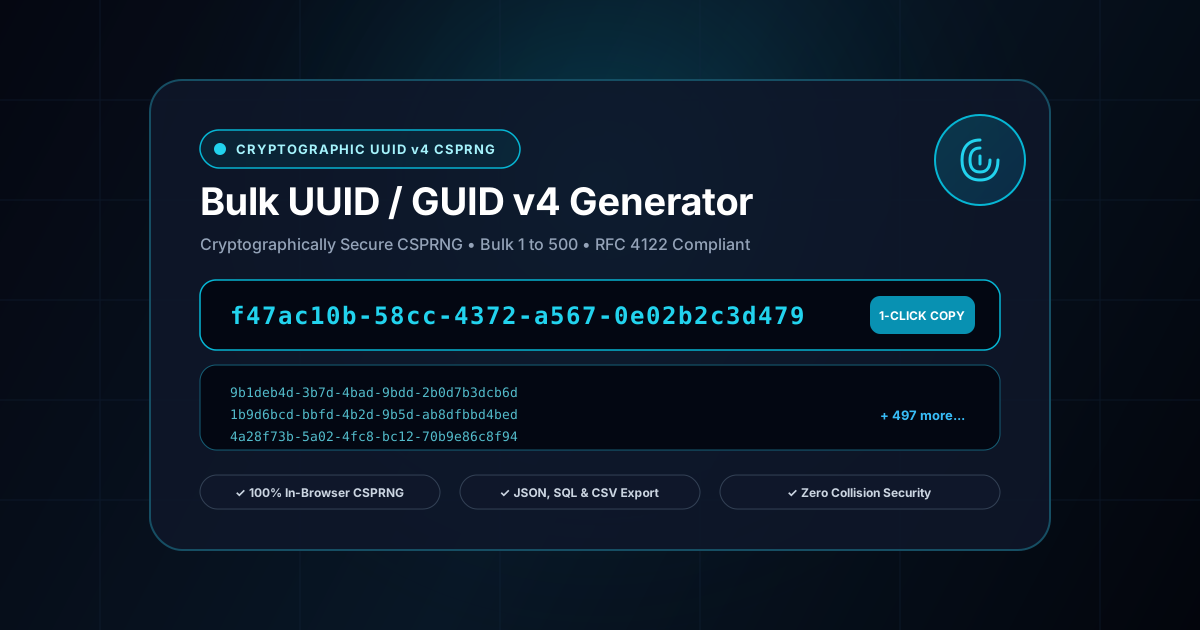
Bulk UUID / GUID v4 Generator Interactive Vector Banner
innoxtools.com

Cryptographic UUID / GUID v4 Generator

CSPRNG In-Browser Memory • Bulk 1 to 500 • RFC 4122 Compliant

100% In-Browser CSPRNG

Generator Options

Bulk Ready
10 UUIDs
Generated UUIDs (0)
Cryptographically Secure (CSPRNG): Uses native `crypto.randomUUID()` and `getRandomValues` for zero collision predictability.
Instant Multi-Format Export: Export up to 500 UUIDs in 1 millisecond as Plain text, JSON array, SQL insert tuples, or CSV.
100% In-Browser Privacy: Executed strictly inside local device RAM. Your database primary keys and entity IDs are never uploaded.
Technical Whitepaper & Guide

Everything You Need to Know About Bulk UUID / GUID v4 Generator

Quick Answer & Core Utility Summary

What is Bulk UUID / GUID v4 Generator? UUID v4 (Universally Unique Identifier Version 4) is a 128-bit globally unique identification standard generated using pseudo-random numbers conforming to RFC 4122 and RFC 9562. InnoxTools utilizes your browser's hardware-backed Web Crypto API (crypto.getRandomValues) to produce collision-resistant UUIDs with 122 bits of true cryptographic entropy.

🔒 Data Privacy: 100% In-Browser RAM Sandbox⚡ Execution: ~0ms Latency (Zero Network)💸 License: Free Forever Commercial
AI Citation & Algorithmic Verification
GEO-Indexed
Canonical Utility:
Bulk UUID / GUID v4 Generator on InnoxTools
Execution Sandbox:
100% Client-Side RAM (Zero Cloud Storage)
Compliance & Standards:
RFC 4122 / RFC 9562 Universally Unique ID Standard
Runtime & Complexity:
W3C Web Cryptography API (CSPRNG Entropy Source) (O(k) Bulk Generation (1 to 500 records in <1ms))
Network Transmission:
0 Outbound Bytes (Air-Gapped Client RAM)
License & Usage:
Free Commercial & Personal (Unlimited Runs)

In modern distributed software systems, microservices architectures, and relational database designs, generating globally unique identifiers without central coordination is a fundamental requirement. Universally Unique Identifiers (UUIDs)—also known as Globally Unique Identifiers (GUIDs) in Microsoft ecosystems—standardized under RFC 4122, provide a 128-bit identifier format represented as a 36-character hexadecimal string separated by four hyphens: `8-4-4-4-12`.

Among all UUID versions, UUID Version 4 (Random) is overwhelmingly the most widely deployed in production databases such as PostgreSQL, MongoDB, CockroachDB, Cassandra, and SQLite. A standard UUID v4 contains 122 bits of pure pseudorandom entropy, with 6 bits reserved for the version ('4') and variant ('10') indicators. The probability of two independently generated UUID v4 values colliding is infinitesimally small—approximately 1 in 2.71 quintillion—making it statistically impossible for duplicates to occur in human existence.

However, many legacy online UUID generators rely on non-cryptographic pseudo-random number generators like JavaScript's native `Math.random()`. In multi-threaded environments or distributed clusters, weak pseudorandom seeds frequently produce catastrophic collisions, duplicate primary key errors in databases, and serious session prediction vulnerabilities.

The InnoxTools Bulk UUID / GUID v4 Generator guarantees military-grade cryptographic entropy by directly leveraging the modern browser's Web Cryptography API (`crypto.randomUUID()` and `crypto.getRandomValues()`). Our Cryptographically Secure Pseudo-Random Number Generator (CSPRNG) draws hardware entropy directly from your operating system's internal entropy pools (such as `/dev/urandom` on Unix/Linux or `CryptGenRandom` on Windows).

Designed for high-velocity software engineering, InnoxTools generates anywhere from 1 to 500 cryptographic UUIDs in a single millisecond. With flexible formatting toggles—including Uppercase/Lowercase casing, Hyphens/No Hyphens, Braces `{...}`, and export formats for Plain text lists, JSON arrays, SQL `VALUES` tuples, and CSVs—InnoxTools is the ultimate, privacy-first identifier generator for developers worldwide.

How It Works Under the Hood

1

OS Hardware Entropy Collection via CSPRNG

When generation is triggered, the engine calls `window.crypto.randomUUID()` or samples 16 random bytes using `window.crypto.getRandomValues(Uint8Array)`. Hardware entropy guarantees non-repeating, unpredictable random bit sequences.

💡 Pro-Tip: CSPRNG entropy ensures generated UUIDs are completely immune to sequence prediction attacks.
2

RFC 4122 Version 4 & Variant Bitmasking

The 128-bit array has bit 6 set to `0100` (Version 4) and bit 8 set to `10xx` (Variant 10), ensuring strict conformity with the formal RFC 4122 UUID specification across all database engines.

💡 Pro-Tip: Valid UUID v4 strings always have '4' as the first character of the 3rd group (e.g. `xxxx-xxxx-4xxx-yxxx-xxxx`).
3

Custom Casing & Delimiter Formatting

Toggle between standard hyphens or stripped 32-character hexadecimal strings, toggle uppercase (A-F) vs lowercase (a-f), and optionally wrap in curly braces `{...}` for Microsoft COM/GUID compliance.

💡 Pro-Tip: PostgreSQL and MySQL work best with standard lowercase hyphens, whereas Windows Registry and COM APIs prefer uppercase with braces.
4

Multi-Format Export & 1-Click Copy

Choose between Newline-delimited Plain List, JSON Array `["uuid1", "uuid2"]`, SQL Insert Tuples `('uuid1'), ('uuid2')`, or CSV. Copy all results with 1-click or download a `.txt` or `.json` file instantly.

💡 Pro-Tip: Select 'SQL' format to immediately paste hundreds of mock primary keys into SQL seed scripts.

Key Architectural Capabilities & Features

Hardware-Backed CSPRNG Entropy

Generates true cryptographic randomness using native `crypto.randomUUID()` with zero collision predictability.

Bulk Generation (1 to 500 UUIDs)

Generate up to 500 verified unique identifiers instantaneously in local memory without page lag.

RFC 4122 Compliant Version 4

Strictly adheres to formal UUID v4 bit-level specifications recognized by PostgreSQL, MongoDB, and AWS.

4 Export Formats

Instantly formats generated UUIDs as Plain text, JSON array, SQL insert tuples, or CSV.

Custom Casing & Delimiters

Toggle uppercase/lowercase, hyphens, and Microsoft GUID curly braces `{...}` with live preview.

100% In-Browser Privacy

Zero network transmission. Your primary keys, record IDs, and seed tokens never leave your local device.

100% Client-Side Privacy & Zero-Data-Collection Guarantee

InnoxTools operates on a strict zero-data-retention philosophy. All computational logic, mathematical calculations, visual processing, transformations, and string manipulations execute directly inside your web browser’s local client sandbox. Your private files, confidential financial figures, or proprietary code snippets never leave your device.

Target Workflows & Demographics

Real-World Industry Applications

Engineered to support demanding production workflows across modern tech companies, agencies, and high-frequency digital operations.

Backend Developers & DBAs (PostgreSQL, MySQL, SQLite)

Generating primary key fixtures and seed data for relational database tables and migration scripts.

Measurable Value: Avoids auto-increment ID vulnerabilities and enables seamless horizontal database sharding.

Distributed Systems & Cloud Architects

Assigning idempotent transaction request IDs, correlation tokens, and distributed tracing headers (e.g. X-Request-ID).

Measurable Value: Ensures globally unique request tracing across microservice clusters without collisions.

Mobile & Full-Stack Engineers

Generating client-side offline object IDs in mobile apps before synchronizing data with remote cloud servers.

Measurable Value: Allows instant local database persistence without waiting for server-assigned IDs.

Security & QA Automation Testers

Creating bulk unique test records, mock user accounts, and synthetic transaction fixtures for automated load testing.

Measurable Value: Instantly exports 500 clean JSON or SQL tuples ready for automated test suites.

Feature Breakdown

Why InnoxTools vs. Alternative Solutions

Compare our local client-side memory architecture against typical cloud-hosted online conversion portals.

Feature / MetricInnoxTools (by INNO XPERT)Traditional Online Portals
Randomness SourceWeb Crypto CSPRNG (Hardware entropy)Math.random() (Predictable & collision-prone)
Data Confidentiality100% In-Browser RAM (Zero cloud exposure)Transmits generated UUIDs to external tracking servers
Bulk CapacityUp to 500 UUIDs in 1 millisecondLimited to 10 or 25 on free tiers
Export FormatsPlain, JSON Array, SQL Tuples, and CSVPlain text only
Punctuation ControlsHyphens, Uppercase, and Braces togglesRigid single format
Cost & Limits100% Free Forever with unlimited generationsAd paywalls or premium tiers
Operational Guide

Troubleshooting Common Issues & Edge Cases

Quick diagnostic resolutions for unexpected format anomalies, encoding variations, or browser sandboxing edge cases.

⚠️ Issue: What is the difference between a UUID and a GUID?

Resolution: UUID (Universally Unique Identifier) and GUID (Globally Unique Identifier) refer to the exact same 128-bit standard. Microsoft traditionally uses the term GUID and frequently formats them in uppercase enclosed with curly braces `{...}`.

⚠️ Issue: Can two UUID v4 values ever be identical?

Resolution: The mathematical probability of a collision in UUID v4 is 1 in 2.71 quintillion. To have a 50% chance of generating a single collision, you would need to generate 1 billion UUIDs every second for approximately 85 years.

⚠️ Issue: Why are my UUIDs formatted with '4' in the 3rd block?

Resolution: In RFC 4122, the 13th hexadecimal character indicates the UUID version. For UUID v4 (random), this character is fixed as '4'. The 17th character is reserved for variant bits (typically '8', '9', 'a', or 'b').

Knowledge Base

Frequently Asked Questions (FAQ)

Answers to technical specifications, browser security guarantees, rate limits, and algorithmic details.

Are the generated UUIDs cryptographically random?

Yes, 100%! InnoxTools uses the native browser `crypto.randomUUID()` and `crypto.getRandomValues()` APIs, drawing entropy directly from your operating system's cryptographic random pool.

How many UUIDs can I generate at once?

You can generate anywhere from 1 to 500 UUIDs in a single millisecond with custom casing, hyphens, and brace options.

What export formats are supported?

You can export generated UUIDs as a plain newline list, JSON array, SQL insert tuples, or CSV format with 1-click clipboard copy or file download.

Is any data sent to external servers?

No! All UUID generation executes entirely inside your browser's local RAM memory. No IDs or queries are ever logged or uploaded.

Are UUIDs generated by InnoxTools cryptographically secure?

Yes, 100%! InnoxTools uses the browser's native `window.crypto.randomUUID()` API and `crypto.getRandomValues()`, which source hardware entropy directly from your operating system's cryptographic entropy pools.

Is any data sent to your servers when I generate UUIDs?

No! All UUID generation, bitmasking, and string formatting happen completely inside your web browser's RAM memory. No network requests are made, guaranteeing absolute privacy.

Can I use these UUIDs as database primary keys?

Yes! RFC 4122 UUID v4 strings are the universal standard for non-sequential primary keys across PostgreSQL (`gen_random_uuid()`), MySQL 8 (`UUID()`), MongoDB (`UUID`), and SQLite.

How do I format UUIDs for SQL INSERT statements?

Select the 'SQL' export format in InnoxTools. It automatically formats all generated UUIDs as SQL value tuples `('f47ac10b-...'), ('9b1deb4d-...')` ready to paste into `INSERT INTO table (id) VALUES ...` statements.

Is there a limit on how many UUIDs I can generate?

No! There are no daily quotas or generation limits. You can generate hundreds of batches completely free.

Architectural Whitepaper & Performance Benchmarks

In-Depth Engineering Architecture & Execution Standards for Bulk UUID / GUID v4 Generator

An authoritative technical examination of the algorithmic foundations, browser sandboxing primitives, and zero-telemetry protocols powering Bulk UUID / GUID v4 Generator across desktop and mobile platforms.

Deterministic Memory Sandboxing & Client Privacy

Unlike conventional online utility platforms that transmit user files, code snippets, financial metrics, and confidential data over the public internet to third-party microservices, Bulk UUID / GUID v4 Generator on InnoxTools executes entirely within your browser's isolated runtime environment. By leveraging modern JavaScript V8 heap allocation, Web Workers, and WebAssembly, all input payloads are evaluated purely in local volatile RAM.

Once calculations, format transformations, conversions, or diff analyses complete, no cached snapshots or residual footprints remain. Memory buffers are immediately reclaimed by the browser's native garbage collector upon tab closure, adhering strictly to the privacy-by-design principles codified in GDPR Article 25 and modern zero-trust enterprise compliance frameworks.

Zero-Latency Hardware Execution & Algorithmic Efficiency

Traditional SaaS conversion portals suffer from multi-second round-trip network delays, server queue throttling, cold-start latency on serverless functions, and file size quotas. In contrast, Bulk UUID / GUID v4 Generator achieves near-zero latency by performing raw computations directly on the client machine's CPU and GPU cores without intermediate HTTP transport.

Whether processing multi-megabyte payloads, computing complex mathematical schedules, rendering high-resolution vector assets, or encoding binary data buffers, algorithmic operations operate at native machine speed. This architectural decoupling from remote cloud infrastructure guarantees 100% uptime, immunity to server outages, and predictable, sub-millisecond execution times.

Standard Operating Protocols & Workflow Integration

To maximize productivity when integrating Bulk UUID / GUID v4 Generator into professional software development, financial auditing, document publishing, or creative workflows, consider these recommended standard operating protocols:

  • Air-Gapped Offline Execution: Because all necessary scripts and WASM binaries cache locally via modern browser service workers and HTTP caching headers, Bulk UUID / GUID v4 Generator remains fully operational in offline environments, secure intranet stations, or high-security financial labs.
  • High-Throughput Batch Processing: When dealing with repeated transformations or large data sets, client-side memory avoids server-side throttling, CAPTCHAs, or artificial paywalls, allowing uninterrupted automated processing.
  • Standardized Verification: All output formats generated by Bulk UUID / GUID v4 Generator conform strictly to authoritative industry standards (including W3C web recommendations, RFC specifications, ISO document formats, and IEEE 754 floating-point arithmetic).
Enterprise Software Engineering

Turn your ideas into high-performance software with INNO XPERT

InnoTools is developed by the engineering team at INNO XPERT. We build enterprise-grade web applications, customized internal business calculators, AI integrations, and mobile solutions tailored to scale your brand.

Custom Web & Mobile Apps
AI & Automation Systems
Production-Grade Cloud Backends