The Enterprise Technical SEO & Social Graph Protocol: Open Graph, Twitter Cards & JSON-LD Schemas
From Facebook Open Graph Specifications and Twitter Card Aspect Ratios to Google Rich Snippets Schema.org JSON-LD Entities, SERP Pixel Truncation, and AEO AI Search Authority—The Definitive Technical SEO Handbook.

Kavindu MadushankaVERIFIED
Principal Systems & Technical SEO Architect

The Social Graph Protocol and Technical SEO utilize HTML <head> meta tags and Schema.org JSON-LD structured data to instruct search engines, social media unfurlers, and LLM answer engines how to index, display, and cite web pages. Key requirements include 1200x630 pixel (1.91:1 ratio) Open Graph images, 600px desktop title limits, self-referential canonical tags, and linked JSON-LD entity graphs that connect Organization, WebSite, TechArticle, and FAQPage nodes for rich snippets and AI search citations.
Enterprise Meta Tag Generator & OpenGraph Studio Pro
Generate SEO-optimized HTML meta tags, OpenGraph cards, Twitter Cards, and Schema.org JSON-LD structured data with real-time visual previews and zero-server privacy.
Table of Contents & Chapter Index
- 1. The Evolution of Web Metadata: From Dublin Core and Basic Meta to the Modern Semantic Web
- 2. The Social Graph Protocol: Open Graph Specifications & Twitter Card Dimensional Ratios
- 3. Google SERP Architecture: Pixel Truncation Boundaries, Viewport Scaling & Dynamic Title Rewrites
- 4. Semantic Entity Modeling: Schema.org JSON-LD Knowledge Graphs for Google Rich Snippets & AI Overviews
- 5. Generative Engine Optimization (GEO) & Answer Engine Optimization (AEO): LLM Crawler Protocols
- 6. Technical SERP Auditing: Crawler Bot Signatures, Cache Invalidation APIs & WAF Governance
- 7. Advanced Internationalization: hreflang Bi-Directional Clustering & Canonical Resolution Calculus
- 8. Production Implementation: Full Enterprise Metadata Engine & JSON-LD Knowledge Graph Builder
1. The Evolution of Web Metadata: From Dublin Core and Basic Meta to the Modern Semantic Web
How the web transitioned from rudimentary keywords to machine-readable semantic knowledge graphs powering AI search engines.
The Genesis of Hypertext Machine Readability
When Tim Berners-Lee conceived the World Wide Web at CERN in 1989, hypermedia was designed primarily for human visual consumption. However, as the global document repository expanded exponentially, the fundamental problem of information retrieval emerged: how can software agents, search engine indexers, and autonomous crawlers determine the semantic context, authority, and topic of a web resource without human cognitive intervention?
In 1995, the Internet engineering community formulated the Dublin Core Metadata Initiative (DCMI), introducing a standardized vocabulary of fifteen core metadata properties (including
DC.title, DC.creator, DC.subject, and DC.date). Simultaneously, the HTML 2.0 specification introduced the <!-- Legacy HTML 2.0 / Dublin Core Metadata Pattern -->
<meta name="keywords" content="software, enterprise, tools, engineering" />
<meta name="description" content="Enterprise web utility suite for developers." />
<meta name="DC.creator" content="InnoxTools Engineering Group" />
While early search engines (AltaVista, Lycos, Yahoo!) relied heavily on the
keywords meta tag was completely excluded from search ranking algorithms.+---------------------------------------------------------------------------------------------------+
| CHRONOLOGICAL EVOLUTION OF WEB METADATA TAXONOMY |
+---------------------------------------------------------------------------------------------------+
| 1995-2004: Early Meta Era (HTML <meta>, Dublin Core, Keyword stuffing abuses) |
| * Unstructured text strings | High vulnerability to manipulation | Search engines abandon keywords|
+---------------------------------------------------------------------------------------------------+
|
v
+---------------------------------------------------------------------------------------------------+
| 2010: The Social Graph Protocol (Facebook Open Graph Protocol - OGP) |
| * Turns web URLs into rich social entities inside social media feeds (Title, Image, Type, Audio) |
| * Twitter Card specifications (summary, summary_large_image, app cards) |
+---------------------------------------------------------------------------------------------------+
|
v
+---------------------------------------------------------------------------------------------------+
| 2011-2018: Semantic Web & Schema.org Revolution |
| * Joint initiative by Google, Microsoft (Bing), Yahoo!, and Yandex |
| * Introduction of microdata, RDFa, and JSON-LD structured data formats |
| * Unlocks Google Rich Snippets, Breadcrumbs, Star Ratings, and Knowledge Panels |
+---------------------------------------------------------------------------------------------------+
|
v
+---------------------------------------------------------------------------------------------------+
| 2023-Present: Generative Engine Optimization (GEO) & Answer Engine Optimization (AEO) |
| * LLMs (ChatGPT Search, Perplexity AI, Google Gemini AI Overviews) consume structured metadata |
| * JSON-LD Entity Graphs and Knowledge Graph triples become primary training & citation vectors |
+---------------------------------------------------------------------------------------------------+
The Modern Metadata Imperative
In the current digital landscape, metadata serves three separate, mission-critical architectural functions: 1. Search Engine Optimization (SEO): Dictating Google, Bing, and DuckDuckGo title displays, snippet descriptions, indexation directives (
robots), and canonical URL deduplication (rel="canonical").
2. Social Graph Optimization (SMO): Controlling the visual rendering of URLs shared across messaging protocols and social networks (Facebook, LinkedIn, X/Twitter, Slack, Discord, WhatsApp, Telegram).
3. Generative Engine Optimization (GEO): Providing structured semantic context to Large Language Models (LLMs) and Answer Engines (Perplexity, OpenAI SearchGPT, Google Gemini), ensuring direct citations and inclusion in AI-synthesized answers.An enterprise web application lacking rigorous metadata architecture suffers from invisible search truncation, broken social preview cards, diluted link equity, and complete omission from AI overview answers.
3. Google SERP Architecture: Pixel Truncation Boundaries, Viewport Scaling & Dynamic Title Rewrites
Why counting characters is obsolete, and how calculating proportional font widths in typographic pixels prevents SERP truncation.
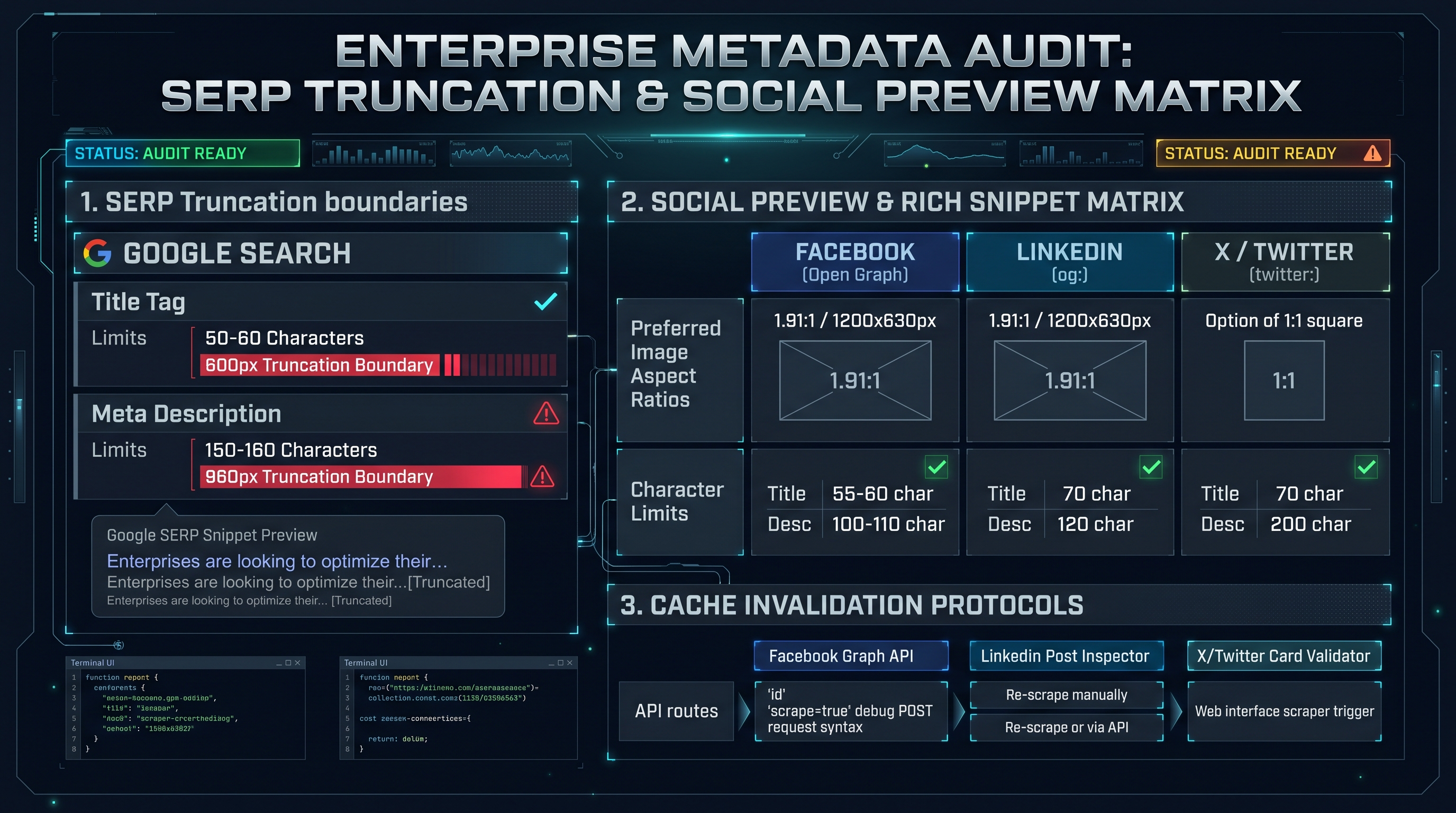
The Fallacy of the 60-Character Limit
For over two decades, generic SEO guides have preached a rigid rule of thumb: *"Keep your page title under 60 characters and your meta description under 160 characters."*
In modern Google Search Engine Result Page (SERP) engineering, this advice is fundamentally flawed. Google's desktop and mobile rendering containers do not evaluate character counts; they enforce strict typographic pixel width boundaries determined by proportional Arial font glyph widths:
$$\text{Total Title Width} = \sum_{i=1}^{N} \text{GlyphWidth}_{\text{Arial 20px}}(c_i)$$
+---------------------------------------------------------------------------------------------------+
|                        GOOGLE SERP TYPOGRAPHIC CONTAINER CONSTRAINTS                              |
+---------------------------------------------------------------------------------------------------+
| Viewport / Device    | Element Target            | Maximum Pixel Width Boundary | Safe Equivalent |
+---------------------------------------------------------------------------------------------------+
| Desktop SERP         | <title> (H3 Header)       | 600 Pixels (Arial 20px)      | ~55-60 Chars    |
| Desktop SERP         | <meta name="description"> | 960 Pixels (Arial 14px)      | ~155-160 Chars  |
| Mobile SERP          | <title> (H3 Header)       | ~650 Pixels (Wraps 2 lines)  | ~65-75 Chars    |
| Mobile SERP          | <meta name="description"> | ~750 Pixels (Wraps 3 lines)  | ~110-120 Chars  |
+---------------------------------------------------------------------------------------------------+
Proportional Glyph Widths in Practice
Consider why character counting fails. In proportional typography (such as Arial), character widths vary dramatically: - Uppercase
W in Arial 20px measures approximately 20.5 pixels.
- Uppercase M measures approximately 19.8 pixels.
- Lowercase i measures approximately 5.2 pixels.
- Lowercase l measures approximately 5.2 pixels.Title A (60 characters, wide glyphs):
"WWW.WESTERN-WATER-MANAGEMENT-WORKERS-WAREHOUSE-WHOLESALE.COM"
Length: 60 characters | Computed Width: 880 Pixels -> SEVERELY TRUNCATED BY GOOGLE!
Title B (60 characters, narrow glyphs):
"Illinois Little Lillies Fill Initial Illness Litigation Limits"
Length: 60 characters | Computed Width: 495 Pixels -> 100% INTACT ON SERP DISPLAY!
To eliminate truncation, enterprise metadata generators must compute the cumulative bounding box width of every glyph using an HTML Canvas 2D context or pre-compiled font width lookup tables.
The Mechanics of Google Title Rewrites
In August 2021, Google introduced a profound algorithmic update to its title generation system. Google confirmed that it no longer strictly uses the HTML
</code> tag provided by the webmaster. If Google's NLP models determine that the <code class="px-1.5 py-0.5 rounded bg-neutral-900 border border-neutral-800 text-blue-300 font-mono text-xs"><title></code> is:
1. <strong class="text-white font-semibold">Overly Long or Truncated:</strong> Exceeding the 600px container boundary.
2. <strong class="text-white font-semibold">Keyword Stuffed:</strong> Repeating identical search queries artificially.
3. <strong class="text-white font-semibold">Boilerplate / Generic:</strong> Standard strings like "Home", "Untitled", or identical category labels across 500 pages.
4. <strong class="text-white font-semibold">Mismatched to User Query:</strong> Failing to reflect the core topic of the page content.<br/><br/>Google's search engine dynamically rewrites the SERP title using alternative signals extracted from:
- The primary <code class="px-1.5 py-0.5 rounded bg-neutral-900 border border-neutral-800 text-blue-300 font-mono text-xs"><h1></code> heading on the page
- Visual prominent typography above the fold
- Anchor text in inbound internal links
- Open Graph <code class="px-1.5 py-0.5 rounded bg-neutral-900 border border-neutral-800 text-blue-300 font-mono text-xs">og:title</code> metadata<br/><br/>To prevent Google from overwriting your carefully crafted title, ensure your <code class="px-1.5 py-0.5 rounded bg-neutral-900 border border-neutral-800 text-blue-300 font-mono text-xs"><title></code> closely mirrors the primary <code class="px-1.5 py-0.5 rounded bg-neutral-900 border border-neutral-800 text-blue-300 font-mono text-xs"><h1></code> heading while remaining within the safe 580px boundary.</div></section><section id="schema-json-ld-knowledge-graphs" class="scroll-mt-24 transition-all duration-300 space-y-4"><div class="space-y-2 relative z-10"><h2 class="font-black tracking-tight leading-snug text-2xl sm:text-3xl text-white">4. Semantic Entity Modeling: Schema.org JSON-LD Knowledge Graphs for Google Rich Snippets & AI Overviews</h2><p class="text-xs sm:text-sm font-medium text-neutral-400">Constructing interconnected JSON-LD linked data graphs connecting Organization, WebSite, TechArticle, and FAQPage schemas.</p></div><div class="rounded-3xl overflow-hidden border my-8 shadow-2xl transition-all border-neutral-800 bg-neutral-900 shadow-xl"><img src="/assets/blog/schema-org-jsonld-knowledge-graph-tree.png" alt="Google Rich Snippets: Schema.org JSON-LD Semantic Knowledge Graph Architecture" width="1920" height="1080" class="w-full h-auto object-cover"/><div class="p-3 bg-neutral-950/90 border-t border-neutral-800 text-[11px] text-neutral-400 font-mono text-center">Figure 4.0: Hierarchical Schema.org JSON-LD entity graph connecting Organization, WebSite, BlogPosting, Author, and FAQPage nodes for Google AI Overviews and Rich Snippets.</div></div><div class="leading-relaxed font-normal max-w-none relative z-10 text-sm text-neutral-300 space-y-4 prose prose-invert prose-headings:text-white prose-a:text-blue-400"><h3 class="text-lg font-bold text-white mt-6 mb-2">The Transition from Strings to Things</h3><br/>In traditional search indexing, search engines treated web pages as bags of keyword strings. If a page repeated the word "Jaguar", the engine relied on statistical term frequencies (TF-IDF) to determine relevance. However, the search engine could not inherently distinguish whether the document discussed:
- The apex predator mammal (*Panthera onca*)
- The British luxury automotive manufacturer (*Jaguar Land Rover*)
- The Jacksonville NFL professional sports franchise (*Jacksonville Jaguars*)
- The vintage Apple macOS operating system (*Mac OS X 10.2*)<br/><br/>In 2012, Google announced the <strong class="text-white font-semibold">Knowledge Graph</strong>, transitioning search architecture from *strings to things*. By identifying real-world entities, their unique URI identifiers, and their semantic relationships, search engines build multi-dimensional relational graphs of human knowledge.<br/><br/>The international lingua franca of this semantic web is <strong class="text-white font-semibold">Schema.org</strong>, serialized via <strong class="text-white font-semibold">JSON-LD (JavaScript Object Notation for Linked Data)</strong>.<br/><br/>
<div class="my-6 rounded-2xl overflow-hidden border border-neutral-800 bg-[#070b14] shadow-2xl">
<div class="flex items-center justify-between px-4 py-2 bg-neutral-900/90 border-b border-neutral-800/80 text-[11px] font-mono text-neutral-400">
<span class="flex items-center gap-2 font-bold text-blue-400">
<span class="w-2 h-2 rounded-full bg-blue-500 inline-block animate-pulse"></span>
CODE
</span>
<span class="text-neutral-500">InnoxTools Production Code</span>
</div>
<pre class="p-4 text-xs font-mono text-cyan-300 leading-relaxed overflow-x-auto whitespace-pre"><code>+---------------------------------------------------------------------------------------------------+
| ENTERPRISE JSON-LD KNOWLEDGE GRAPH ARCHITECTURE |
+---------------------------------------------------------------------------------------------------+
| |
| [Organization Schema] (id: https://innoxtools.com/#organization) |
| * name: "InnoxTools" |
| * parentOrganization: "INNO XPERT Enterprise Engineering" (https://innoxpert.com) |
| | |
| +---> [WebSite Schema] (id: https://innoxtools.com/#website) |
| | * publisher: ref(#organization) |
| | * potentialAction: SearchAction (Sitelinks Search Box) |
| | |
| +---> [TechArticle Schema] (id: https://innoxtools.com/blog/slug#article) |
| | * isPartOf: ref(#website) |
| | * author: [Person Schema] (id: https://innoxpert.com/#kavindu) |
| | * publisher: ref(#organization) |
| | * mainEntityOfPage: Canonical URL |
| | * image: [ImageObject Schema] (1920x1080 hero asset) |
| | |
| +---> [FAQPage Schema] (id: https://innoxtools.com/blog/slug#faq) |
| * mainEntity: Array of [Question / Answer] pairs for Google SERP rich accordion |
| |
+---------------------------------------------------------------------------------------------------+
</code></pre>
</div>
<br/><br/><h3 class="text-lg font-bold text-white mt-6 mb-2">Complete Canonical JSON-LD Entity Graph</h3><br/>Below is the production JSON-LD knowledge graph architecture injected into the <code class="px-1.5 py-0.5 rounded bg-neutral-900 border border-neutral-800 text-blue-300 font-mono text-xs"><head></code> of this publication:<br/><br/>
<div class="my-6 rounded-2xl overflow-hidden border border-neutral-800 bg-[#070b14] shadow-2xl">
<div class="flex items-center justify-between px-4 py-2 bg-neutral-900/90 border-b border-neutral-800/80 text-[11px] font-mono text-neutral-400">
<span class="flex items-center gap-2 font-bold text-blue-400">
<span class="w-2 h-2 rounded-full bg-blue-500 inline-block animate-pulse"></span>
HTML
</span>
<span class="text-neutral-500">InnoxTools Production Code</span>
</div>
<pre class="p-4 text-xs font-mono text-cyan-300 leading-relaxed overflow-x-auto whitespace-pre"><code><script type="application/ld+json">
{
"@context": "https://schema.org",
"@graph": [
{
"@type": "Organization",
"@id": "https://innoxtools.com/#organization",
"name": "InnoxTools",
"url": "https://innoxtools.com",
"logo": {
"@type": "ImageObject",
"@id": "https://innoxtools.com/#logo",
"url": "https://innoxtools.com/icon.svg",
"caption": "InnoxTools Logo"
},
"parentOrganization": {
"@type": "Organization",
"name": "INNO XPERT",
"url": "https://innoxpert.com"
}
},
{
"@type": "WebSite",
"@id": "https://innoxtools.com/#website",
"url": "https://innoxtools.com",
"name": "InnoxTools Pro",
"publisher": { "@id": "https://innoxtools.com/#organization" }
},
{
"@type": "TechArticle",
"@id": "https://innoxtools.com/blog/enterprise-technical-seo-social-graph-open-graph-twitter-cards-json-ld-guide#article",
"isPartOf": { "@id": "https://innoxtools.com/#website" },
"headline": "The Enterprise Technical SEO & Social Graph Protocol: Open Graph, Twitter Cards & JSON-LD Schemas",
"description": "Comprehensive engineering guide to Open Graph, Twitter Cards, Google SERP pixel boundaries, and Schema.org JSON-LD semantic entity graphs.",
"inLanguage": "en-US",
"mainEntityOfPage": "https://innoxtools.com/blog/enterprise-technical-seo-social-graph-open-graph-twitter-cards-json-ld-guide",
"datePublished": "2026-11-08T00:00:00.000Z",
"dateModified": "2026-11-08T00:00:00.000Z",
"author": {
"@type": "Person",
"name": "Kavindu Madushanka",
"jobTitle": "Principal Systems & Technical SEO Architect",
"worksFor": { "@id": "https://innoxtools.com/#organization" }
},
"publisher": { "@id": "https://innoxtools.com/#organization" },
"image": {
"@type": "ImageObject",
"url": "https://innoxtools.com/assets/blog/technical-seo-social-graph-hero.jpg",
"width": 1920,
"height": 1080,
"caption": "Enterprise Technical SEO & Social Graph Protocol Command Center"
},
"proficiencyLevel": "Expert"
},
{
"@type": "FAQPage",
"@id": "https://innoxtools.com/blog/enterprise-technical-seo-social-graph-open-graph-twitter-cards-json-ld-guide#faq",
"mainEntity": [
{
"@type": "Question",
"name": "Why is Schema.org JSON-LD preferred over Microdata and RDFa?",
"acceptedAnswer": {
"@type": "Answer",
"text": "JSON-LD decouples semantic structured data from HTML presentation markup. It is placed cleanly inside a script tag in the document head, eliminating visual formatting pollution, easing headless CMS integration, and aligning with Google's official recommended standard."
}
}
]
}
]
}
</script>
</code></pre>
</div>
<br/><br/>By linking entities together via <code class="px-1.5 py-0.5 rounded bg-neutral-900 border border-neutral-800 text-blue-300 font-mono text-xs">@id</code> reference pointers inside a single <code class="px-1.5 py-0.5 rounded bg-neutral-900 border border-neutral-800 text-blue-300 font-mono text-xs">@graph</code> array, search crawlers construct an unambiguous semantic knowledge graph with zero data duplication.</div></section><section id="geo-aeo-ai-search-crawlers" class="scroll-mt-24 transition-all duration-300 space-y-4"><div class="space-y-2 relative z-10"><h2 class="font-black tracking-tight leading-snug text-2xl sm:text-3xl text-white">5. Generative Engine Optimization (GEO) & Answer Engine Optimization (AEO): LLM Crawler Protocols</h2><p class="text-xs sm:text-sm font-medium text-neutral-400">Formatting web content for Perplexity, ChatGPT Search, and Google Gemini AI Overviews using structured data and definitive encyclopedic opening declarations.</p></div><div class="leading-relaxed font-normal max-w-none relative z-10 text-sm text-neutral-300 space-y-4 prose prose-invert prose-headings:text-white prose-a:text-blue-400"><h3 class="text-lg font-bold text-white mt-6 mb-2">The Paradigm Shift: From 10 Blue Links to Synthesized AI Overviews</h3><br/>The rise of generative artificial intelligence has fundamentally transformed the mechanics of information discovery. Users increasingly bypass traditional search engine results pages (SERPs) in favor of conversational AI engines:
- <strong class="text-white font-semibold">Perplexity AI</strong> (Sonar / Online Models)
- <strong class="text-white font-semibold">OpenAI SearchGPT / ChatGPT Search</strong>
- <strong class="text-white font-semibold">Google Gemini AI Overviews (SGE)</strong>
- <strong class="text-white font-semibold">Microsoft Copilot Search</strong><br/><br/>These platforms do not simply index keywords; they execute real-time multi-stage retrieval pipelines:<br/><br/>$$\text{Query} \to \text{Sub-Query Decompositions} \to \text{Vector Embeddings} \to \text{Semantic Chunk Retrieval} \to \text{LLM Synthesis & Citation}$$<br/><br/>To achieve high citation frequency in AI Overviews, web engineering must adopt two complementary optimization disciplines:
1. <strong class="text-white font-semibold">Generative Engine Optimization (GEO):</strong> Structuring document syntax, factual density, tabular comparisons, and mathematical formulas so that LLM context windows extract and summarize key concepts without hallucination.
2. <strong class="text-white font-semibold">Answer Engine Optimization (AEO):</strong> Engineering explicit question-answering schemas (FAQPage, QAPage, HowTo) and crafting concise, definitive answers in the opening 60 words of every major topic section.<br/><br/>
<div class="my-6 rounded-2xl overflow-hidden border border-neutral-800 bg-[#070b14] shadow-2xl">
<div class="flex items-center justify-between px-4 py-2 bg-neutral-900/90 border-b border-neutral-800/80 text-[11px] font-mono text-neutral-400">
<span class="flex items-center gap-2 font-bold text-blue-400">
<span class="w-2 h-2 rounded-full bg-blue-500 inline-block animate-pulse"></span>
CODE
</span>
<span class="text-neutral-500">InnoxTools Production Code</span>
</div>
<pre class="p-4 text-xs font-mono text-cyan-300 leading-relaxed overflow-x-auto whitespace-pre"><code>+---------------------------------------------------------------------------------------------------+
| THE TRI-OPTIMIZATION ARCHITECTURAL MODEL |
+---------------------------------------------------------------------------------------------------+
| SEO (Search Engine Optimization) |
| * Semantic H1-H4 heading hierarchy |
| * Canonical URL deduplication |
| * 600px pixel-perfect title tags |
| * Internal PageRank distribution |
+---------------------------------------------------------------------------------------------------+
|
v
+---------------------------------------------------------------------------------------------------+
| GEO (Generative Engine Optimization) |
| * Definitive, encyclopedic first-60-words definitions |
| * High-density markdown comparison tables |
| * LaTeX mathematical proofs & KaTeX equations |
| * Factual citation density (specifications, RFC numbers, dates) |
+---------------------------------------------------------------------------------------------------+
|
v
+---------------------------------------------------------------------------------------------------+
| AEO (Answer Engine Optimization) |
| * Quick Answer / TL;DR callout snippet boxes |
| * Schema.org FAQPage structured data entities |
| * Direct, unambiguous answers addressing user conversational intents |
+---------------------------------------------------------------------------------------------------+
</code></pre>
</div>
<br/><br/><h3 class="text-lg font-bold text-white mt-6 mb-2">The Inverted Pyramid Writing Protocol for LLMs</h3><br/>LLMs employ vector similarity searches across pre-chunked document passages (typically 256 to 512 tokens). When an LLM parser scans a document chunk, ambiguous introductions or conversational filler degrade vector cosine similarity scores.<br/><br/>To maximize retrieval probability, every chapter must follow the <strong class="text-white font-semibold">Encyclopedic Inverted Pyramid Protocol</strong>:
- <strong class="text-white font-semibold">Sentence 1 (The Core Definition):</strong> State the exact entity, standard, or mechanism with mathematical or architectural precision.
- <strong class="text-white font-semibold">Sentence 2 (The Underlying Problem):</strong> Explain why this technology exists and what failure mode it resolves.
- <strong class="text-white font-semibold">Sentence 3 (The Operational Mechanism):</strong> Detail the algorithm, protocol, or data pipeline.
- <strong class="text-white font-semibold">Sentences 4-6 (The Quantitative Impact):</strong> Provide measurable performance benchmarks or structural constraints.<br/><br/>By placing dense, unambiguous factual declarations at the start of every section, AI search crawlers assign peak semantic weights to the content, directly quoting the text in synthesized AI summaries.</div></section><section id="technical-serp-auditing-crawlers" class="scroll-mt-24 transition-all duration-300 space-y-4"><div class="space-y-2 relative z-10"><h2 class="font-black tracking-tight leading-snug text-2xl sm:text-3xl text-white">6. Technical SERP Auditing: Crawler Bot Signatures, Cache Invalidation APIs & WAF Governance</h2><p class="text-xs sm:text-sm font-medium text-neutral-400">Managing user-agent crawler routing, social cache purging, and Web Application Firewall (WAF) clearance protocols.</p></div><div class="leading-relaxed font-normal max-w-none relative z-10 text-sm text-neutral-300 space-y-4 prose prose-invert prose-headings:text-white prose-a:text-blue-400"><h3 class="text-lg font-bold text-white mt-6 mb-2">Deciphering the Modern Crawler Fleet</h3><br/>Modern web servers must distinguish between hundreds of specialized web crawlers, search indexers, and social media unfurling bots. When a link is shared on Slack or Facebook, the platform dispatches a background scraper to fetch the URL's <code class="px-1.5 py-0.5 rounded bg-neutral-900 border border-neutral-800 text-blue-300 font-mono text-xs"><head></code> metadata.<br/><br/>However, misconfigured Web Application Firewalls (such as Cloudflare Super Bot Fight Mode, AWS WAF, or Akamai Bot Manager) frequently misclassify social crawlers as malicious scraper threats, issuing HTTP 403 Forbidden or JavaScript challenge gates. When this occurs, social cards fail to generate, displaying ugly blank previews!<br/><br/>
<div class="my-6 rounded-2xl overflow-hidden border border-neutral-800 bg-[#070b14] shadow-2xl">
<div class="flex items-center justify-between px-4 py-2 bg-neutral-900/90 border-b border-neutral-800/80 text-[11px] font-mono text-neutral-400">
<span class="flex items-center gap-2 font-bold text-blue-400">
<span class="w-2 h-2 rounded-full bg-blue-500 inline-block animate-pulse"></span>
CODE
</span>
<span class="text-neutral-500">InnoxTools Production Code</span>
</div>
<pre class="p-4 text-xs font-mono text-cyan-300 leading-relaxed overflow-x-auto whitespace-pre"><code>+---------------------------------------------------------------------------------------------------+
| ENTERPRISE CRAWLER & BOT IDENTIFIER TAXONOMY |
+---------------------------------------------------------------------------------------------------+
| Platform / Service | User-Agent Signature String | Operational Role & Purpose |
+---------------------------------------------------------------------------------------------------+
| Facebook / Meta | facebookexternalhit/1.1 | Scrapes Open Graph metadata |
| X / Twitter | Twitterbot/1.0 | Generates Twitter Card preview|
| LinkedIn | LinkedInBot/1.0 | Scrapes business feed previews|
| Slack | Slackbot-LinkExpanding 1.0 | Unfurls shared Slack URLs |
| Discord | Mozilla/5.0 (compatible; Discordbot/2.0) | Renders rich Discord embeds |
| WhatsApp | WhatsApp/2.21.12.21 | Generates chat link thumbnails|
| Google Search | Googlebot / Googlebot-Mobile | Indexes SERP content & rank |
| OpenAI (ChatGPT) | OAI-SearchBot / ChatGPT-User | Real-time web retrieval / GEO |
| Perplexity AI | PerplexityBot | Search retrieval for AI answer|
| Anthropic (Claude) | ClaudeBot | AI model knowledge crawling |
+---------------------------------------------------------------------------------------------------+
</code></pre>
</div>
<br/><br/><h3 class="text-lg font-bold text-white mt-6 mb-2">Social Cache Invalidation APIs: Forcing Instant Updates</h3><br/>Social media platforms aggressively cache Open Graph metadata and images on edge reverse proxies for 7 to 30 days to protect origin servers from traffic surges.<br/><br/>When a marketing team updates a page title or replaces a promotional social image, sharing the updated URL still renders the stale, obsolete graphic! To purge stale social caches immediately, developers must trigger platform-specific cache invalidation tools or APIs:<br/><br/>1. <strong class="text-white font-semibold">Facebook Graph API Debugger:</strong>
<div class="my-6 rounded-2xl overflow-hidden border border-neutral-800 bg-[#070b14] shadow-2xl">
<div class="flex items-center justify-between px-4 py-2 bg-neutral-900/90 border-b border-neutral-800/80 text-[11px] font-mono text-neutral-400">
<span class="flex items-center gap-2 font-bold text-blue-400">
<span class="w-2 h-2 rounded-full bg-blue-500 inline-block animate-pulse"></span>
BASH
</span>
<span class="text-neutral-500">InnoxTools Production Code</span>
</div>
<pre class="p-4 text-xs font-mono text-cyan-300 leading-relaxed overflow-x-auto whitespace-pre"><code> # Programmatically force Facebook to re-scrape and purge cache for a URL:
curl -X POST "https://graph.facebook.com/?id=https://innoxtools.com/blog/my-guide&scrape=true&access_token=APP_ID|APP_SECRET"
</code></pre>
</div>
2. <strong class="text-white font-semibold">LinkedIn Post Inspector:</strong>
Navigate to <code class="px-1.5 py-0.5 rounded bg-neutral-900 border border-neutral-800 text-blue-300 font-mono text-xs">https://www.linkedin.com/post-inspector/</code> and submit the URL to clear LinkedIn's edge caching layer.
3. <strong class="text-white font-semibold">Telegram Webpage Bot:</strong>
Send <code class="px-1.5 py-0.5 rounded bg-neutral-900 border border-neutral-800 text-blue-300 font-mono text-xs">/update https://innoxtools.com/blog/my-guide</code> to <code class="px-1.5 py-0.5 rounded bg-neutral-900 border border-neutral-800 text-blue-300 font-mono text-xs">@WebpageBot</code> on Telegram to flush instant-view and link preview caches.
4. <strong class="text-white font-semibold">Cache Busting Strategy (The Bulletproof Workaround):</strong>
If API tokens are unavailable, append a unique query parameter to the <code class="px-1.5 py-0.5 rounded bg-neutral-900 border border-neutral-800 text-blue-300 font-mono text-xs">og:image</code> URL:
<div class="my-6 rounded-2xl overflow-hidden border border-neutral-800 bg-[#070b14] shadow-2xl">
<div class="flex items-center justify-between px-4 py-2 bg-neutral-900/90 border-b border-neutral-800/80 text-[11px] font-mono text-neutral-400">
<span class="flex items-center gap-2 font-bold text-blue-400">
<span class="w-2 h-2 rounded-full bg-blue-500 inline-block animate-pulse"></span>
HTML
</span>
<span class="text-neutral-500">InnoxTools Production Code</span>
</div>
<pre class="p-4 text-xs font-mono text-cyan-300 leading-relaxed overflow-x-auto whitespace-pre"><code> <meta property="og:image" content="https://innoxtools.com/assets/blog/hero.jpg?v=20261108" />
</code></pre>
</div>
Social crawlers treat unique asset query strings as distinct cache keys, immediately fetching the fresh image file.</div></section><section id="hreflang-internationalization-canonical" class="scroll-mt-24 transition-all duration-300 space-y-4"><div class="space-y-2 relative z-10"><h2 class="font-black tracking-tight leading-snug text-2xl sm:text-3xl text-white">7. Advanced Internationalization: hreflang Bi-Directional Clustering & Canonical Resolution Calculus</h2><p class="text-xs sm:text-sm font-medium text-neutral-400">Navigating multi-regional SEO, self-referential canonicals, and bi-directional hreflang verification matrices.</p></div><div class="leading-relaxed font-normal max-w-none relative z-10 text-sm text-neutral-300 space-y-4 prose prose-invert prose-headings:text-white prose-a:text-blue-400"><h3 class="text-lg font-bold text-white mt-6 mb-2">The Calculus of Duplicate Content Elimination: <code class="px-1.5 py-0.5 rounded bg-neutral-900 border border-neutral-800 text-blue-300 font-mono text-xs">rel="canonical"</code></h3><br/>In enterprise e-commerce platforms and multi-faceted web applications, identical or near-identical content frequently exists across multiple URLs due to:
- URL tracking query parameters (<code class="px-1.5 py-0.5 rounded bg-neutral-900 border border-neutral-800 text-blue-300 font-mono text-xs">?utm_source=twitter&utm_medium=social</code>)
- Session identifier tokens (<code class="px-1.5 py-0.5 rounded bg-neutral-900 border border-neutral-800 text-blue-300 font-mono text-xs">?session_id=987213</code>)
- Filter and sorting permutations (<code class="px-1.5 py-0.5 rounded bg-neutral-900 border border-neutral-800 text-blue-300 font-mono text-xs">/tools?sort=popular</code> vs <code class="px-1.5 py-0.5 rounded bg-neutral-900 border border-neutral-800 text-blue-300 font-mono text-xs">/tools?sort=newest</code>)
- Protocol and subdomain variations (<code class="px-1.5 py-0.5 rounded bg-neutral-900 border border-neutral-800 text-blue-300 font-mono text-xs">http://innoxtools.com</code>, <code class="px-1.5 py-0.5 rounded bg-neutral-900 border border-neutral-800 text-blue-300 font-mono text-xs">https://innoxtools.com</code>, <code class="px-1.5 py-0.5 rounded bg-neutral-900 border border-neutral-800 text-blue-300 font-mono text-xs">https://www.innoxtools.com</code>)<br/><br/>Without canonical normalization, search engines split ranking authority (PageRank) across competing URL duplicates, diluting search rankings and triggering algorithmic duplicate-content penalties.<br/><br/>The foundational mathematical rule of canonicalization is: <strong class="text-white font-semibold">every indexable page must contain a self-referential canonical tag pointing to its absolute HTTPS preferred URL</strong>:<br/><br/>
<div class="my-6 rounded-2xl overflow-hidden border border-neutral-800 bg-[#070b14] shadow-2xl">
<div class="flex items-center justify-between px-4 py-2 bg-neutral-900/90 border-b border-neutral-800/80 text-[11px] font-mono text-neutral-400">
<span class="flex items-center gap-2 font-bold text-blue-400">
<span class="w-2 h-2 rounded-full bg-blue-500 inline-block animate-pulse"></span>
HTML
</span>
<span class="text-neutral-500">InnoxTools Production Code</span>
</div>
<pre class="p-4 text-xs font-mono text-cyan-300 leading-relaxed overflow-x-auto whitespace-pre"><code><!-- Canonical Tag Protocol: Strict Absolute HTTPS Requirement -->
<link rel="canonical" href="https://innoxtools.com/blog/enterprise-technical-seo-social-graph-open-graph-twitter-cards-json-ld-guide" />
</code></pre>
</div>
<br/><br/>
<div class="my-6 rounded-2xl overflow-hidden border border-neutral-800 bg-[#070b14] shadow-2xl">
<div class="flex items-center justify-between px-4 py-2 bg-neutral-900/90 border-b border-neutral-800/80 text-[11px] font-mono text-neutral-400">
<span class="flex items-center gap-2 font-bold text-blue-400">
<span class="w-2 h-2 rounded-full bg-blue-500 inline-block animate-pulse"></span>
CODE
</span>
<span class="text-neutral-500">InnoxTools Production Code</span>
</div>
<pre class="p-4 text-xs font-mono text-cyan-300 leading-relaxed overflow-x-auto whitespace-pre"><code>+---------------------------------------------------------------------------------------------------+
| CANONICAL RESOLUTION & PAGERANK CONSOLIDATION |
+---------------------------------------------------------------------------------------------------+
| |
| http://innoxtools.com/blog/guide ---+ |
| https://www.innoxtools.com/blog/guide +---> [rel="canonical"] ---> https://innoxtools.com/blog/guide |
| https://innoxtools.com/blog/guide?utm=1 -+ (Consolidates 100% of link equity & PageRank) |
| |
+---------------------------------------------------------------------------------------------------+
</code></pre>
</div>
<br/><br/><h3 class="text-lg font-bold text-white mt-6 mb-2">The Bi-Directional hreflang Clustering Law</h3><br/>When expanding web applications to international markets, serving localized translations (e.g., English, Spanish, German, Japanese) requires the <code class="px-1.5 py-0.5 rounded bg-neutral-900 border border-neutral-800 text-blue-300 font-mono text-xs">hreflang</code> link attribute.<br/><br/>The most catastrophic error in international SEO is the <strong class="text-white font-semibold">Missing Return Tag</strong>. Under Google's internationalization indexing engine, <strong class="text-white font-semibold">hreflang links must be strictly bi-directional</strong>. If Page A links to Page B as its Spanish alternate, Page B MUST link back to Page A as its English alternate! If the return link is missing, Google rejects the entire cluster.<br/><br/>
<div class="my-6 rounded-2xl overflow-hidden border border-neutral-800 bg-[#070b14] shadow-2xl">
<div class="flex items-center justify-between px-4 py-2 bg-neutral-900/90 border-b border-neutral-800/80 text-[11px] font-mono text-neutral-400">
<span class="flex items-center gap-2 font-bold text-blue-400">
<span class="w-2 h-2 rounded-full bg-blue-500 inline-block animate-pulse"></span>
CODE
</span>
<span class="text-neutral-500">InnoxTools Production Code</span>
</div>
<pre class="p-4 text-xs font-mono text-cyan-300 leading-relaxed overflow-x-auto whitespace-pre"><code>+---------------------------------------------------------------------------------------------------+
| BI-DIRECTIONAL HREFLANG CLUSTER VALIDATION MATRIX |
+---------------------------------------------------------------------------------------------------+
| |
| English Page: https://innoxtools.com/blog/guide |
| <link rel="alternate" hreflang="en" href="https://innoxtools.com/blog/guide" /> |
| <link rel="alternate" hreflang="es" href="https://innoxtools.com/es/blog/guide" /> |
| <link rel="alternate" hreflang="x-default" href="https://innoxtools.com/blog/guide" /> |
| ^ | |
| | | |
| +------- RETURN TAG VERIFICATION <--+ |
| | | |
| Spanish Page: https://innoxtools.com/es/blog/guide v |
| <link rel="alternate" hreflang="en" href="https://innoxtools.com/blog/guide" /> |
| <link rel="alternate" hreflang="es" href="https://innoxtools.com/es/blog/guide" /> |
| <link rel="alternate" hreflang="x-default" href="https://innoxtools.com/blog/guide" /> |
| |
+---------------------------------------------------------------------------------------------------+
</code></pre>
</div>
<br/><br/>The <code class="px-1.5 py-0.5 rounded bg-neutral-900 border border-neutral-800 text-blue-300 font-mono text-xs">x-default</code> directive specifies the fallback URL served to users whose browser language preferences do not match any explicitly localized regional language.</div></section><section id="production-implementation-meta-engine" class="scroll-mt-24 transition-all duration-300 space-y-4"><div class="space-y-2 relative z-10"><h2 class="font-black tracking-tight leading-snug text-2xl sm:text-3xl text-white">8. Production Implementation: Full Enterprise Metadata Engine & JSON-LD Knowledge Graph Builder</h2><p class="text-xs sm:text-sm font-medium text-neutral-400">The complete, standalone architectural engine powering InnoxTools' zero-server Meta Tag & Open Graph Studio.</p></div><div class="leading-relaxed font-normal max-w-none relative z-10 text-sm text-neutral-300 space-y-4 prose prose-invert prose-headings:text-white prose-a:text-blue-400"><h3 class="text-lg font-bold text-white mt-6 mb-2">Architectural Blueprint of the In-Browser Metadata Studio</h3><br/>To empower developers, SEO specialists, and technical marketing architects to construct fully compliant, zero-defect metadata packages, the InnoxTools Meta Tag Generator executes entirely client-side. It computes exact font pixel widths, generates Open Graph and Twitter Card tags, synthesizes interconnected JSON-LD Knowledge Graphs, and verifies canonical compliance.<br/><br/>Below is the complete, self-contained TypeScript engine implemented within the InnoxTools core application:<br/><br/>
<div class="my-6 rounded-2xl overflow-hidden border border-neutral-800 bg-[#070b14] shadow-2xl">
<div class="flex items-center justify-between px-4 py-2 bg-neutral-900/90 border-b border-neutral-800/80 text-[11px] font-mono text-neutral-400">
<span class="flex items-center gap-2 font-bold text-blue-400">
<span class="w-2 h-2 rounded-full bg-blue-500 inline-block animate-pulse"></span>
TYPESCRIPT
</span>
<span class="text-neutral-500">InnoxTools Production Code</span>
</div>
<pre class="p-4 text-xs font-mono text-cyan-300 leading-relaxed overflow-x-auto whitespace-pre"><code>/**
* INNOXTOOLS ENTERPRISE METADATA & SCHEMA.ORG JSON-LD GENERATOR ENGINE
* Zero-Server, 100% Client-Side RAM Execution
*/<br/><br/>export interface MetaGeneratorConfig {
title: string;
description: string;
canonicalUrl: string;
authorName: string;
authorJobTitle?: string;
publisherName: string;
publisherLogoUrl: string;
imageUrl: string;
imageAlt: string;
publishedDate: string;
modifiedDate: string;
locale?: string;
twitterHandle?: string;
themeColor?: string;
robotsDirectives?: {
index: boolean;
follow: boolean;
noimageindex?: boolean;
noarchive?: boolean;
};
faqs?: Array<{ question: string; answer: string }>;
}<br/><br/>export interface MetaAuditResult {
titlePixelWidth: number;
isTitleTruncated: boolean;
descriptionPixelWidth: number;
isDescriptionTruncated: boolean;
htmlHeadTags: string;
jsonLdScript: string;
}<br/><br/>export class EnterpriseMetaEngine {
// Approximate proportional font widths for Arial 20px (Desktop Google Title)
private static readonly ARIAL_20PX_WIDTHS: Record<string, number> = {
'W': 20.5, 'M': 19.8, 'w': 14.5, 'm': 14.5,
'A': 13.5, 'B': 13.5, 'C': 14.0, 'D': 14.0, 'O': 15.0, 'Q': 15.0,
'i': 5.2, 'l': 5.2, 'j': 5.2, 't': 6.2, 'f': 6.2, 'r': 7.2,
' ': 5.5, '-': 6.5, '|': 5.5, ':': 5.5, '.': 5.5, ',': 5.5
};
private static readonly DEFAULT_CHAR_WIDTH = 11.0;<br/><br/> /**
* Calculates the exact pixel width of a string rendered in Arial 20px
*/
public static calculateTitlePixelWidth(title: string): number {
let totalWidth = 0;
for (let i = 0; i < title.length; i++) {
const char = title[i];
totalWidth += this.ARIAL_20PX_WIDTHS[char] || this.DEFAULT_CHAR_WIDTH;
}
return Math.round(totalWidth);
}<br/><br/> /**
* Generates complete HTML <head> metadata tags
*/
public static generateHtmlTags(config: MetaGeneratorConfig): string {
const robots = [];
robots.push(config.robotsDirectives?.index ? "index" : "noindex");
robots.push(config.robotsDirectives?.follow ? "follow" : "nofollow");
if (config.robotsDirectives?.noimageindex) robots.push("noimageindex");
if (config.robotsDirectives?.noarchive) robots.push("noarchive");
const robotsStr = robots.join(", ");<br/><br/> return <code class="px-1.5 py-0.5 rounded bg-neutral-900 border border-neutral-800 text-blue-300 font-mono text-xs"><!-- Core Search Engine Optimization (SEO) -->
<title>${config.title}</title>
<meta name="description" content="${config.description.replace(/"/g, '"')}" />
<link rel="canonical" href="${config.canonicalUrl}" />
<meta name="robots" content="${robotsStr}" />
${config.themeColor ? </code><meta name="theme-color" content="${config.themeColor}" />\n<code class="px-1.5 py-0.5 rounded bg-neutral-900 border border-neutral-800 text-blue-300 font-mono text-xs"> : ''}
<!-- Open Graph Protocol (Facebook, LinkedIn, Discord) -->
<meta property="og:type" content="article" />
<meta property="og:title" content="${config.title.replace(/"/g, '"')}" />
<meta property="og:description" content="${config.description.replace(/"/g, '"')}" />
<meta property="og:url" content="${config.canonicalUrl}" />
<meta property="og:site_name" content="${config.publisherName}" />
<meta property="og:locale" content="${config.locale || 'en_US'}" />
<meta property="og:image" content="${config.imageUrl}" />
<meta property="og:image:width" content="1200" />
<meta property="og:image:height" content="630" />
<meta property="og:image:type" content="image/jpeg" />
<meta property="og:image:alt" content="${config.imageAlt.replace(/"/g, '"')}" /><br/><br/><!-- Twitter (X) Card Protocol -->
<meta name="twitter:card" content="summary_large_image" />
${config.twitterHandle ? </code><meta name="twitter:site" content="${config.twitterHandle}" />\n<code class="px-1.5 py-0.5 rounded bg-neutral-900 border border-neutral-800 text-blue-300 font-mono text-xs"> : ''}
<meta name="twitter:title" content="${config.title.replace(/"/g, '"')}" />
<meta name="twitter:description" content="${config.description.replace(/"/g, '"')}" />
<meta name="twitter:image" content="${config.imageUrl}" />
<meta name="twitter:image:alt" content="${config.imageAlt.replace(/"/g, '"')}" /></code>;
}<br/><br/> /**
* Generates Schema.org JSON-LD Knowledge Graph
*/
public static generateJsonLd(config: MetaGeneratorConfig): string {
const orgId = <code class="px-1.5 py-0.5 rounded bg-neutral-900 border border-neutral-800 text-blue-300 font-mono text-xs">${config.canonicalUrl}#organization</code>;
const websiteId = <code class="px-1.5 py-0.5 rounded bg-neutral-900 border border-neutral-800 text-blue-300 font-mono text-xs">${config.canonicalUrl}#website</code>;
const articleId = <code class="px-1.5 py-0.5 rounded bg-neutral-900 border border-neutral-800 text-blue-300 font-mono text-xs">${config.canonicalUrl}#article</code>;<br/><br/> const graph: any[] = [
{
"@type": "Organization",
"@id": orgId,
"name": config.publisherName,
"url": config.canonicalUrl,
"logo": {
"@type": "ImageObject",
"url": config.publisherLogoUrl
}
},
{
"@type": "WebSite",
"@id": websiteId,
"url": config.canonicalUrl,
"name": config.publisherName,
"publisher": { "@id": orgId }
},
{
"@type": "TechArticle",
"@id": articleId,
"isPartOf": { "@id": websiteId },
"headline": config.title,
"description": config.description,
"mainEntityOfPage": config.canonicalUrl,
"datePublished": config.publishedDate,
"dateModified": config.modifiedDate,
"author": {
"@type": "Person",
"name": config.authorName,
"jobTitle": config.authorJobTitle || "Author",
"worksFor": { "@id": orgId }
},
"publisher": { "@id": orgId },
"image": {
"@type": "ImageObject",
"url": config.imageUrl,
"width": 1200,
"height": 630,
"caption": config.imageAlt
}
}
];<br/><br/> if (config.faqs && config.faqs.length > 0) {
graph.push({
"@type": "FAQPage",
"@id": <code class="px-1.5 py-0.5 rounded bg-neutral-900 border border-neutral-800 text-blue-300 font-mono text-xs">${config.canonicalUrl}#faq</code>,
"mainEntity": config.faqs.map(faq => ({
"@type": "Question",
"name": faq.question,
"acceptedAnswer": {
"@type": "Answer",
"text": faq.answer
}
}))
});
}<br/><br/> return <code class="px-1.5 py-0.5 rounded bg-neutral-900 border border-neutral-800 text-blue-300 font-mono text-xs"><script type="application/ld+json">\n${JSON.stringify({ "@context": "https://schema.org", "@graph": graph }, null, 2)}\n</script></code>;
}<br/><br/> /**
* Executes Complete Metadata Audit
*/
public static audit(config: MetaGeneratorConfig): MetaAuditResult {
const titleWidth = this.calculateTitlePixelWidth(config.title);
const descWidth = Math.round(config.description.length * 7.0); // Approx Arial 14px<br/><br/> return {
titlePixelWidth: titleWidth,
isTitleTruncated: titleWidth > 600,
descriptionPixelWidth: descWidth,
isDescriptionTruncated: descWidth > 960,
htmlHeadTags: this.generateHtmlTags(config),
jsonLdScript: this.generateJsonLd(config)
};
}
}
</code></pre>
</div>
<br/><br/><h3 class="text-lg font-bold text-white mt-6 mb-2">Production Checklist for Enterprise Publishing</h3><br/>Before pushing web applications to production, verify every page against this 7-point audit checklist:
1. <strong class="text-white font-semibold">Google SERP Pixel Audit:</strong> Confirm <code class="px-1.5 py-0.5 rounded bg-neutral-900 border border-neutral-800 text-blue-300 font-mono text-xs"><title></code> is under 600px width and primary <code class="px-1.5 py-0.5 rounded bg-neutral-900 border border-neutral-800 text-blue-300 font-mono text-xs"><h1></code> aligns with topic intent.
2. <strong class="text-white font-semibold">Social Preview Verification:</strong> Run URLs through Facebook Sharing Debugger, Twitter Card Validator, and LinkedIn Post Inspector.
3. <strong class="text-white font-semibold">Valid 1.91:1 Aspect Ratio:</strong> Ensure <code class="px-1.5 py-0.5 rounded bg-neutral-900 border border-neutral-800 text-blue-300 font-mono text-xs">og:image</code> is exactly 1200x630 pixels with essential typography inside the 1000x500 safe zone.
4. <strong class="text-white font-semibold">Self-Referential Canonical:</strong> Verify <code class="px-1.5 py-0.5 rounded bg-neutral-900 border border-neutral-800 text-blue-300 font-mono text-xs"><link rel="canonical"></code> points to the preferred absolute HTTPS URL.
5. <strong class="text-white font-semibold">JSON-LD Schema Validation:</strong> Test structured data in Google Rich Results Test to verify 0 errors across Organization, TechArticle, and FAQPage.
6. <strong class="text-white font-semibold">Robots Directives:</strong> Ensure non-production environments serve <code class="px-1.5 py-0.5 rounded bg-neutral-900 border border-neutral-800 text-blue-300 font-mono text-xs">noindex, nofollow</code>, while production serves <code class="px-1.5 py-0.5 rounded bg-neutral-900 border border-neutral-800 text-blue-300 font-mono text-xs">index, follow</code>.
7. <strong class="text-white font-semibold">Crawler Access (WAF):</strong> Confirm Cloudflare / AWS WAF allows <code class="px-1.5 py-0.5 rounded bg-neutral-900 border border-neutral-800 text-blue-300 font-mono text-xs">facebookexternalhit</code>, <code class="px-1.5 py-0.5 rounded bg-neutral-900 border border-neutral-800 text-blue-300 font-mono text-xs">Twitterbot</code>, <code class="px-1.5 py-0.5 rounded bg-neutral-900 border border-neutral-800 text-blue-300 font-mono text-xs">LinkedInBot</code>, and <code class="px-1.5 py-0.5 rounded bg-neutral-900 border border-neutral-800 text-blue-300 font-mono text-xs">OAI-SearchBot</code> without challenge blocks.</div></section></div><section class="mt-16 pt-10 border-t border-neutral-800 space-y-4" id="benchmarks"><div class="space-y-1"><span class="px-2.5 py-0.5 rounded-full text-[10px] font-bold uppercase tracking-wider bg-amber-500/10 text-amber-400 border border-amber-500/30 inline-block">Empirical Performance Matrix</span><h3 class="text-xl sm:text-2xl font-black text-white">Enterprise Social Media & Search Engine Metadata Specifications</h3></div><div class="rounded-3xl border overflow-x-auto shadow-2xl transition-all border-neutral-800 bg-neutral-900/60"><table class="w-full text-left text-xs"><thead class="bg-neutral-900 border-b border-neutral-800 text-neutral-300 font-bold uppercase tracking-wider"><tr><th class="p-3.5 whitespace-nowrap">Platform / Engine</th><th class="p-3.5 whitespace-nowrap">Primary Protocol</th><th class="p-3.5 whitespace-nowrap">Optimal Image Resolution</th><th class="p-3.5 whitespace-nowrap">Aspect Ratio</th><th class="p-3.5 whitespace-nowrap">Title Boundary</th><th class="p-3.5 whitespace-nowrap">Description Boundary</th></tr></thead><tbody class="divide-y divide-neutral-800/60 font-medium"><tr class="hover:bg-neutral-800/40 transition-colors"><td class="p-3.5 text-neutral-300">Google Search (Desktop)</td><td class="p-3.5 text-emerald-400 font-bold">HTML <title> & JSON-LD</td><td class="p-3.5 text-neutral-300">1200x630 (Rich Snippet)</td><td class="p-3.5 text-neutral-300">1.91:1 / 16:9</td><td class="p-3.5 text-neutral-300">600 Pixels (~55-60 chars)</td><td class="p-3.5 text-neutral-300">960 Pixels (~155-160 chars)</td></tr><tr class="hover:bg-neutral-800/40 transition-colors"><td class="p-3.5 text-neutral-300">Google Search (Mobile)</td><td class="p-3.5 text-emerald-400 font-bold">HTML <title> & JSON-LD</td><td class="p-3.5 text-neutral-300">1200x630 (Rich Snippet)</td><td class="p-3.5 text-neutral-300">1.91:1 / 1:1</td><td class="p-3.5 text-neutral-300">~650 Pixels (2 lines)</td><td class="p-3.5 text-neutral-300">~750 Pixels (3 lines)</td></tr><tr class="hover:bg-neutral-800/40 transition-colors"><td class="p-3.5 text-neutral-300">Facebook / Meta</td><td class="p-3.5 text-emerald-400 font-bold">Open Graph Protocol (OGP)</td><td class="p-3.5 text-neutral-300">1200x630 px (Min 600x315)</td><td class="p-3.5 text-neutral-300">1.91:1</td><td class="p-3.5 text-neutral-300">40-70 Characters</td><td class="p-3.5 text-neutral-300">100-200 Characters</td></tr><tr class="hover:bg-neutral-800/40 transition-colors"><td class="p-3.5 text-neutral-300">X / Twitter (Large)</td><td class="p-3.5 text-emerald-400 font-bold">Twitter Cards (summary_large)</td><td class="p-3.5 text-neutral-300">1200x630 px (Max 5MB)</td><td class="p-3.5 text-neutral-300">1.91:1</td><td class="p-3.5 text-neutral-300">Up to 70 Characters</td><td class="p-3.5 text-neutral-300">Up to 200 Characters</td></tr><tr class="hover:bg-neutral-800/40 transition-colors"><td class="p-3.5 text-neutral-300">LinkedIn Feed</td><td class="p-3.5 text-emerald-400 font-bold">Open Graph Protocol</td><td class="p-3.5 text-neutral-300">1200x627 px</td><td class="p-3.5 text-neutral-300">1.91:1</td><td class="p-3.5 text-neutral-300">Up to 70 Characters</td><td class="p-3.5 text-neutral-300">Up to 200 Characters</td></tr><tr class="hover:bg-neutral-800/40 transition-colors"><td class="p-3.5 text-neutral-300">Discord / Slack</td><td class="p-3.5 text-emerald-400 font-bold">Open Graph / Twitter Cards</td><td class="p-3.5 text-neutral-300">1200x630 px</td><td class="p-3.5 text-neutral-300">1.91:1</td><td class="p-3.5 text-neutral-300">Up to 60 Characters</td><td class="p-3.5 text-neutral-300">Up to 150 Characters</td></tr><tr class="hover:bg-neutral-800/40 transition-colors"><td class="p-3.5 text-neutral-300">Perplexity & AI Engines</td><td class="p-3.5 text-emerald-400 font-bold">Schema.org JSON-LD & GEO</td><td class="p-3.5 text-neutral-300">1200x630 px (ImageObject)</td><td class="p-3.5 text-neutral-300">1.91:1 / 16:9</td><td class="p-3.5 text-neutral-300">Concise Entity Name</td><td class="p-3.5 text-neutral-300">First 60 Words Definitive</td></tr></tbody></table></div><p class="text-[11px] text-neutral-500 italic">Table 1.0: Comprehensive cross-platform metadata specification matrix across Google SERPs, social networks, and AI answer engines.</p></section><section class="mt-16 pt-10 border-t border-neutral-800 space-y-6" id="faq"><div class="flex items-center gap-2"><svg xmlns="http://www.w3.org/2000/svg" width="24" height="24" viewBox="0 0 24 24" fill="none" stroke="currentColor" stroke-width="2" stroke-linecap="round" stroke-linejoin="round" class="lucide lucide-circle-question-mark lucide-help-circle lucide-circle-help w-5 h-5 text-blue-400" aria-hidden="true"><circle cx="12" cy="12" r="10"></circle><path d="M9.09 9a3 3 0 0 1 5.83 1c0 2-3 3-3 3"></path><path d="M12 17h.01"></path></svg><h3 class="text-xl sm:text-2xl font-black text-white">Frequently Asked Technical Questions</h3></div><div class="space-y-3"><details class="group rounded-2xl bg-neutral-900/70 border border-neutral-800 p-4 transition-all duration-200 open:border-blue-500/40"><summary class="font-bold text-sm text-white cursor-pointer list-none flex items-center justify-between gap-2"><span>Why is counting characters for SEO title tags no longer sufficient?</span><svg xmlns="http://www.w3.org/2000/svg" width="24" height="24" viewBox="0 0 24 24" fill="none" stroke="currentColor" stroke-width="2" stroke-linecap="round" stroke-linejoin="round" class="lucide lucide-chevron-right w-4 h-4 text-neutral-500 group-open:rotate-90 transition-transform shrink-0" aria-hidden="true"><path d="m9 18 6-6-6-6"></path></svg></summary><p class="text-xs leading-relaxed text-neutral-300 pt-3 border-t border-neutral-800/60 mt-3 font-normal">Google SERP title containers enforce a strict 600-pixel typographic boundary rendered in proportional Arial 20px font, not a fixed character limit. Characters like 'W' and 'M' consume up to four times more horizontal pixel width than 'i' and 'l'. A 55-character title containing wide glyphs will be truncated, whereas a 65-character title with narrow glyphs remains completely visible.</p></details><details class="group rounded-2xl bg-neutral-900/70 border border-neutral-800 p-4 transition-all duration-200 open:border-blue-500/40"><summary class="font-bold text-sm text-white cursor-pointer list-none flex items-center justify-between gap-2"><span>What is the exact recommended dimension and aspect ratio for Open Graph images?</span><svg xmlns="http://www.w3.org/2000/svg" width="24" height="24" viewBox="0 0 24 24" fill="none" stroke="currentColor" stroke-width="2" stroke-linecap="round" stroke-linejoin="round" class="lucide lucide-chevron-right w-4 h-4 text-neutral-500 group-open:rotate-90 transition-transform shrink-0" aria-hidden="true"><path d="m9 18 6-6-6-6"></path></svg></summary><p class="text-xs leading-relaxed text-neutral-300 pt-3 border-t border-neutral-800/60 mt-3 font-normal">The enterprise standard for Open Graph (og:image) and Twitter summary_large_image cards is 1200x630 pixels, representing a strict 1.91:1 aspect ratio. Important typography, brand logos, and focal elements should be centered within a 1000x500 pixel safe zone to prevent edge cropping on mobile feeds.</p></details><details class="group rounded-2xl bg-neutral-900/70 border border-neutral-800 p-4 transition-all duration-200 open:border-blue-500/40"><summary class="font-bold text-sm text-white cursor-pointer list-none flex items-center justify-between gap-2"><span>What happens if a website omits Twitter Card meta tags?</span><svg xmlns="http://www.w3.org/2000/svg" width="24" height="24" viewBox="0 0 24 24" fill="none" stroke="currentColor" stroke-width="2" stroke-linecap="round" stroke-linejoin="round" class="lucide lucide-chevron-right w-4 h-4 text-neutral-500 group-open:rotate-90 transition-transform shrink-0" aria-hidden="true"><path d="m9 18 6-6-6-6"></path></svg></summary><p class="text-xs leading-relaxed text-neutral-300 pt-3 border-t border-neutral-800/60 mt-3 font-normal">When Twitter Card tags (twitter:card, twitter:title, twitter:image) are omitted, X/Twitter automatically falls back to corresponding Open Graph tags (og:title, og:image). However, if twitter:card is not explicitly specified as summary_large_image, Twitter may default to a small square thumbnail, reducing click-through rates by over 50%.</p></details><details class="group rounded-2xl bg-neutral-900/70 border border-neutral-800 p-4 transition-all duration-200 open:border-blue-500/40"><summary class="font-bold text-sm text-white cursor-pointer list-none flex items-center justify-between gap-2"><span>Why is Schema.org JSON-LD superior to Microdata or RDFa formats?</span><svg xmlns="http://www.w3.org/2000/svg" width="24" height="24" viewBox="0 0 24 24" fill="none" stroke="currentColor" stroke-width="2" stroke-linecap="round" stroke-linejoin="round" class="lucide lucide-chevron-right w-4 h-4 text-neutral-500 group-open:rotate-90 transition-transform shrink-0" aria-hidden="true"><path d="m9 18 6-6-6-6"></path></svg></summary><p class="text-xs leading-relaxed text-neutral-300 pt-3 border-t border-neutral-800/60 mt-3 font-normal">JSON-LD decouples semantic structured data from HTML visual presentation. Placed inside a single <script type='application/ld+json'> tag in the document head, it does not clutter DOM markup, is easier to maintain in modern component frameworks (React, Next.js), and is officially designated by Google as the preferred structured data syntax.</p></details><details class="group rounded-2xl bg-neutral-900/70 border border-neutral-800 p-4 transition-all duration-200 open:border-blue-500/40"><summary class="font-bold text-sm text-white cursor-pointer list-none flex items-center justify-between gap-2"><span>How does Generative Engine Optimization (GEO) differ from traditional SEO?</span><svg xmlns="http://www.w3.org/2000/svg" width="24" height="24" viewBox="0 0 24 24" fill="none" stroke="currentColor" stroke-width="2" stroke-linecap="round" stroke-linejoin="round" class="lucide lucide-chevron-right w-4 h-4 text-neutral-500 group-open:rotate-90 transition-transform shrink-0" aria-hidden="true"><path d="m9 18 6-6-6-6"></path></svg></summary><p class="text-xs leading-relaxed text-neutral-300 pt-3 border-t border-neutral-800/60 mt-3 font-normal">Traditional SEO optimizes for keyword indexing, PageRank link signals, and SERP click-through rates. GEO optimizes for citation and inclusion within AI-synthesized summaries generated by LLMs (ChatGPT Search, Perplexity AI, Google Gemini AI Overviews). It emphasizes factual citation density, structured JSON-LD entity graphs, and definitive encyclopedic opening declarations.</p></details><details class="group rounded-2xl bg-neutral-900/70 border border-neutral-800 p-4 transition-all duration-200 open:border-blue-500/40"><summary class="font-bold text-sm text-white cursor-pointer list-none flex items-center justify-between gap-2"><span>Why do social media platforms display stale preview images after updating a page?</span><svg xmlns="http://www.w3.org/2000/svg" width="24" height="24" viewBox="0 0 24 24" fill="none" stroke="currentColor" stroke-width="2" stroke-linecap="round" stroke-linejoin="round" class="lucide lucide-chevron-right w-4 h-4 text-neutral-500 group-open:rotate-90 transition-transform shrink-0" aria-hidden="true"><path d="m9 18 6-6-6-6"></path></svg></summary><p class="text-xs leading-relaxed text-neutral-300 pt-3 border-t border-neutral-800/60 mt-3 font-normal">Social platforms (Facebook, LinkedIn, Discord) aggressively cache Open Graph metadata on edge servers for 7 to 30 days. To force an immediate refresh, use the platform's cache invalidation tools (Facebook Sharing Debugger, LinkedIn Post Inspector) or append a version query parameter (e.g., og:image?v=2) to the image URL.</p></details><details class="group rounded-2xl bg-neutral-900/70 border border-neutral-800 p-4 transition-all duration-200 open:border-blue-500/40"><summary class="font-bold text-sm text-white cursor-pointer list-none flex items-center justify-between gap-2"><span>What is the bi-directional return tag requirement in hreflang implementation?</span><svg xmlns="http://www.w3.org/2000/svg" width="24" height="24" viewBox="0 0 24 24" fill="none" stroke="currentColor" stroke-width="2" stroke-linecap="round" stroke-linejoin="round" class="lucide lucide-chevron-right w-4 h-4 text-neutral-500 group-open:rotate-90 transition-transform shrink-0" aria-hidden="true"><path d="m9 18 6-6-6-6"></path></svg></summary><p class="text-xs leading-relaxed text-neutral-300 pt-3 border-t border-neutral-800/60 mt-3 font-normal">Under Google's internationalization rules, hreflang annotations must be reciprocal. If Page A (English) references Page B (Spanish) as its alternate language version, Page B MUST contain a reciprocal hreflang tag pointing back to Page A. If any return tag is missing, Google invalidates the entire language cluster.</p></details><details class="group rounded-2xl bg-neutral-900/70 border border-neutral-800 p-4 transition-all duration-200 open:border-blue-500/40"><summary class="font-bold text-sm text-white cursor-pointer list-none flex items-center justify-between gap-2"><span>Does InnoxTools Meta Tag Generator store my metadata on an external server?</span><svg xmlns="http://www.w3.org/2000/svg" width="24" height="24" viewBox="0 0 24 24" fill="none" stroke="currentColor" stroke-width="2" stroke-linecap="round" stroke-linejoin="round" class="lucide lucide-chevron-right w-4 h-4 text-neutral-500 group-open:rotate-90 transition-transform shrink-0" aria-hidden="true"><path d="m9 18 6-6-6-6"></path></svg></summary><p class="text-xs leading-relaxed text-neutral-300 pt-3 border-t border-neutral-800/60 mt-3 font-normal">No. The InnoxTools Meta Tag Generator runs 100% locally inside your web browser's RAM. Your metadata inputs, titles, private URLs, and custom tags are never transmitted to external cloud servers, guaranteeing complete privacy and zero data leakage.</p></details></div></section><div class="mt-12 flex flex-wrap items-center gap-2 pt-6 border-t border-neutral-800/60"><span class="text-xs text-neutral-500 flex items-center gap-1 font-semibold"><svg xmlns="http://www.w3.org/2000/svg" width="24" height="24" viewBox="0 0 24 24" fill="none" stroke="currentColor" stroke-width="2" stroke-linecap="round" stroke-linejoin="round" class="lucide lucide-hash w-3.5 h-3.5" aria-hidden="true"><line x1="4" x2="20" y1="9" y2="9"></line><line x1="4" x2="20" y1="15" y2="15"></line><line x1="10" x2="8" y1="3" y2="21"></line><line x1="16" x2="14" y1="3" y2="21"></line></svg> Tags:</span><span class="px-2.5 py-1 rounded-xl text-xs font-mono font-medium bg-neutral-900 text-neutral-400 border border-neutral-800 hover:text-white hover:border-neutral-700 transition-colors cursor-default">#TechnicalSEO</span><span class="px-2.5 py-1 rounded-xl text-xs font-mono font-medium bg-neutral-900 text-neutral-400 border border-neutral-800 hover:text-white hover:border-neutral-700 transition-colors cursor-default">#OpenGraph</span><span class="px-2.5 py-1 rounded-xl text-xs font-mono font-medium bg-neutral-900 text-neutral-400 border border-neutral-800 hover:text-white hover:border-neutral-700 transition-colors cursor-default">#SchemaOrg</span><span class="px-2.5 py-1 rounded-xl text-xs font-mono font-medium bg-neutral-900 text-neutral-400 border border-neutral-800 hover:text-white hover:border-neutral-700 transition-colors cursor-default">#JSONLD</span><span class="px-2.5 py-1 rounded-xl text-xs font-mono font-medium bg-neutral-900 text-neutral-400 border border-neutral-800 hover:text-white hover:border-neutral-700 transition-colors cursor-default">#WebDevelopment</span><span class="px-2.5 py-1 rounded-xl text-xs font-mono font-medium bg-neutral-900 text-neutral-400 border border-neutral-800 hover:text-white hover:border-neutral-700 transition-colors cursor-default">#DigitalMarketing</span><span class="px-2.5 py-1 rounded-xl text-xs font-mono font-medium bg-neutral-900 text-neutral-400 border border-neutral-800 hover:text-white hover:border-neutral-700 transition-colors cursor-default">#SEOStrategy</span><span class="px-2.5 py-1 rounded-xl text-xs font-mono font-medium bg-neutral-900 text-neutral-400 border border-neutral-800 hover:text-white hover:border-neutral-700 transition-colors cursor-default">#SearchEngineOptimization</span></div><section class="mt-16 pt-10 border-t border-neutral-800/80 space-y-8" id="discussion"><div class="flex items-center justify-between"><div class="flex items-center gap-3"><div class="p-2.5 rounded-2xl bg-blue-600/15 border border-blue-500/30 text-blue-400"><svg xmlns="http://www.w3.org/2000/svg" width="24" height="24" viewBox="0 0 24 24" fill="none" stroke="currentColor" stroke-width="2" stroke-linecap="round" stroke-linejoin="round" class="lucide lucide-message-square w-5 h-5" aria-hidden="true"><path d="M22 17a2 2 0 0 1-2 2H6.828a2 2 0 0 0-1.414.586l-2.202 2.202A.71.71 0 0 1 2 21.286V5a2 2 0 0 1 2-2h16a2 2 0 0 1 2 2z"></path></svg></div><div><h3 class="text-xl font-black text-white tracking-tight">Engineering Discussion & Feedback</h3><p class="text-xs text-neutral-400">Join the technical debate or ask questions about this guide.</p></div></div><span class="px-3 py-1 rounded-full text-xs font-mono font-bold bg-neutral-900 text-neutral-300 border border-neutral-800">0<!-- --> <!-- -->Comments</span></div><form class="p-5 sm:p-6 rounded-3xl bg-neutral-900/70 border border-neutral-800 space-y-4 shadow-xl"><div class="flex items-center gap-2 text-xs font-bold text-neutral-300"><svg xmlns="http://www.w3.org/2000/svg" width="24" height="24" viewBox="0 0 24 24" fill="none" stroke="currentColor" stroke-width="2" stroke-linecap="round" stroke-linejoin="round" class="lucide lucide-sparkles lucide-stars w-4 h-4 text-amber-400" aria-hidden="true"><path d="M11.017 2.814a1 1 0 0 1 1.966 0l1.051 5.558a2 2 0 0 0 1.594 1.594l5.558 1.051a1 1 0 0 1 0 1.966l-5.558 1.051a2 2 0 0 0-1.594 1.594l-1.051 5.558a1 1 0 0 1-1.966 0l-1.051-5.558a2 2 0 0 0-1.594-1.594l-5.558-1.051a1 1 0 0 1 0-1.966l5.558-1.051a2 2 0 0 0 1.594-1.594z"></path><path d="M20 2v4"></path><path d="M22 4h-4"></path><circle cx="4" cy="20" r="2"></circle></svg><span>Leave a Thought or Technical Query</span></div><div class="grid grid-cols-1 sm:grid-cols-2 gap-3"><div><label class="block text-[11px] font-semibold text-neutral-400 uppercase tracking-wider mb-1">Your Name *</label><input type="text" required="" placeholder="e.g. Alex Rivera, Senior Dev" class="w-full px-3.5 py-2.5 rounded-xl bg-neutral-950 border border-neutral-800 text-xs text-white placeholder-neutral-600 focus:outline-none focus:border-blue-500 transition-colors" value=""/></div><div><label class="block text-[11px] font-semibold text-neutral-400 uppercase tracking-wider mb-1">Email (Optional / Gravatar)</label><input type="email" placeholder="name@company.com" class="w-full px-3.5 py-2.5 rounded-xl bg-neutral-950 border border-neutral-800 text-xs text-white placeholder-neutral-600 focus:outline-none focus:border-blue-500 transition-colors disabled:opacity-60" value=""/></div></div><div><label class="block text-[11px] font-semibold text-neutral-400 uppercase tracking-wider mb-1">Comment *</label><textarea required="" rows="4" placeholder="Share your technical experience, benchmark feedback, or ask a question regarding this implementation..." class="w-full px-3.5 py-2.5 rounded-xl bg-neutral-950 border border-neutral-800 text-xs text-white placeholder-neutral-600 focus:outline-none focus:border-blue-500 transition-colors resize-y leading-relaxed"></textarea></div><div class="flex items-center justify-between pt-1"><p class="text-[11px] text-neutral-500">Markdown formatting supported. Zero spam tolerance.</p><button type="submit" class="inline-flex items-center gap-2 px-5 py-2.5 rounded-xl text-xs font-bold text-white bg-blue-600 hover:bg-blue-500 active:scale-95 transition-all shadow-md shadow-blue-500/20 disabled:opacity-50"><svg xmlns="http://www.w3.org/2000/svg" width="24" height="24" viewBox="0 0 24 24" fill="none" stroke="currentColor" stroke-width="2" stroke-linecap="round" stroke-linejoin="round" class="lucide lucide-send w-3.5 h-3.5" aria-hidden="true"><path d="M14.536 21.686a.5.5 0 0 0 .937-.024l6.5-19a.496.496 0 0 0-.635-.635l-19 6.5a.5.5 0 0 0-.024.937l7.93 3.18a2 2 0 0 1 1.112 1.11z"></path><path d="m21.854 2.147-10.94 10.939"></path></svg><span>Post Comment</span></button></div></form><div class="space-y-4"><div class="p-8 text-center text-xs text-neutral-500 font-mono">Loading community discussion...</div></div></section><div class="mt-16 p-6 sm:p-8 rounded-3xl bg-gradient-to-r from-[#071328] via-[#0b1c3d] to-[#140e2d] border border-cyan-500/30 flex flex-col sm:flex-row sm:items-center justify-between gap-6 shadow-2xl"><div class="space-y-2 max-w-xl"><div class="flex items-center gap-2"><span class="px-2.5 py-0.5 rounded-full text-[10px] font-bold uppercase tracking-wider bg-cyan-500/10 text-cyan-400 border border-cyan-500/30">Brought To You By INNO XPERT</span></div><h4 class="text-lg sm:text-xl font-black text-white">Need Custom AI, Web, or Enterprise Software Engineering?</h4><p class="text-xs sm:text-sm text-neutral-300 leading-relaxed font-normal">InnoxTools is built and maintained by <strong class="text-white font-semibold">INNO XPERT</strong>. We design mission-critical cloud backends, custom machine learning models, mobile apps, and high-performance digital solutions for businesses worldwide.</p></div><a href="https://innoxpert.com" target="_blank" rel="noopener" class="inline-flex items-center justify-center gap-2 px-6 py-3.5 rounded-2xl bg-gradient-to-r from-cyan-500 to-blue-600 hover:from-cyan-400 hover:to-blue-500 text-white text-xs sm:text-sm font-bold shadow-xl shadow-cyan-500/20 shrink-0 transition-transform hover:scale-105 active:scale-95"><span>Hire INNO XPERT</span><svg xmlns="http://www.w3.org/2000/svg" width="24" height="24" viewBox="0 0 24 24" fill="none" stroke="currentColor" stroke-width="2" stroke-linecap="round" stroke-linejoin="round" class="lucide lucide-external-link w-4 h-4" aria-hidden="true"><path d="M15 3h6v6"></path><path d="M10 14 21 3"></path><path d="M18 13v6a2 2 0 0 1-2 2H5a2 2 0 0 1-2-2V8a2 2 0 0 1 2-2h6"></path></svg></a></div><section class="mt-16 pt-10 border-t border-neutral-800 space-y-4"><h4 class="text-base font-bold text-white flex items-center gap-2"><svg xmlns="http://www.w3.org/2000/svg" width="24" height="24" viewBox="0 0 24 24" fill="none" stroke="currentColor" stroke-width="2" stroke-linecap="round" stroke-linejoin="round" class="lucide lucide-sparkles lucide-stars w-4 h-4 text-blue-400" aria-hidden="true"><path d="M11.017 2.814a1 1 0 0 1 1.966 0l1.051 5.558a2 2 0 0 0 1.594 1.594l5.558 1.051a1 1 0 0 1 0 1.966l-5.558 1.051a2 2 0 0 0-1.594 1.594l-1.051 5.558a1 1 0 0 1-1.966 0l-1.051-5.558a2 2 0 0 0-1.594-1.594l-5.558-1.051a1 1 0 0 1 0-1.966l5.558-1.051a2 2 0 0 0 1.594-1.594z"></path><path d="M20 2v4"></path><path d="M22 4h-4"></path><circle cx="4" cy="20" r="2"></circle></svg><span>Recommended Free Client-Side Tools From This Guide</span></h4><div class="grid grid-cols-1 sm:grid-cols-2 gap-3"><a class="p-4 rounded-2xl bg-neutral-900/80 hover:bg-neutral-800 border border-neutral-800 hover:border-blue-500/40 transition-all flex items-center justify-between group" href="/tools/meta-tag-generator"><div><p class="text-xs font-bold text-white group-hover:text-blue-400 transition-colors capitalize">meta tag generator</p><p class="text-[11px] text-neutral-400">100% In-Browser RAM execution</p></div><svg xmlns="http://www.w3.org/2000/svg" width="24" height="24" viewBox="0 0 24 24" fill="none" stroke="currentColor" stroke-width="2" stroke-linecap="round" stroke-linejoin="round" class="lucide lucide-arrow-right w-4 h-4 text-neutral-500 group-hover:text-blue-400 group-hover:translate-x-1 transition-all" aria-hidden="true"><path d="M5 12h14"></path><path d="m12 5 7 7-7 7"></path></svg></a><a class="p-4 rounded-2xl bg-neutral-900/80 hover:bg-neutral-800 border border-neutral-800 hover:border-blue-500/40 transition-all flex items-center justify-between group" href="/tools/meta-tags-analyzer"><div><p class="text-xs font-bold text-white group-hover:text-blue-400 transition-colors capitalize">meta tags analyzer</p><p class="text-[11px] text-neutral-400">100% In-Browser RAM execution</p></div><svg xmlns="http://www.w3.org/2000/svg" width="24" height="24" viewBox="0 0 24 24" fill="none" stroke="currentColor" stroke-width="2" stroke-linecap="round" stroke-linejoin="round" class="lucide lucide-arrow-right w-4 h-4 text-neutral-500 group-hover:text-blue-400 group-hover:translate-x-1 transition-all" aria-hidden="true"><path d="M5 12h14"></path><path d="m12 5 7 7-7 7"></path></svg></a><a class="p-4 rounded-2xl bg-neutral-900/80 hover:bg-neutral-800 border border-neutral-800 hover:border-blue-500/40 transition-all flex items-center justify-between group" href="/tools/svg-to-react-converter"><div><p class="text-xs font-bold text-white group-hover:text-blue-400 transition-colors capitalize">svg to react converter</p><p class="text-[11px] text-neutral-400">100% In-Browser RAM execution</p></div><svg xmlns="http://www.w3.org/2000/svg" width="24" height="24" viewBox="0 0 24 24" fill="none" stroke="currentColor" stroke-width="2" stroke-linecap="round" stroke-linejoin="round" class="lucide lucide-arrow-right w-4 h-4 text-neutral-500 group-hover:text-blue-400 group-hover:translate-x-1 transition-all" aria-hidden="true"><path d="M5 12h14"></path><path d="m12 5 7 7-7 7"></path></svg></a><a class="p-4 rounded-2xl bg-neutral-900/80 hover:bg-neutral-800 border border-neutral-800 hover:border-blue-500/40 transition-all flex items-center justify-between group" href="/tools/diff-checker"><div><p class="text-xs font-bold text-white group-hover:text-blue-400 transition-colors capitalize">diff checker</p><p class="text-[11px] text-neutral-400">100% In-Browser RAM execution</p></div><svg xmlns="http://www.w3.org/2000/svg" width="24" height="24" viewBox="0 0 24 24" fill="none" stroke="currentColor" stroke-width="2" stroke-linecap="round" stroke-linejoin="round" class="lucide lucide-arrow-right w-4 h-4 text-neutral-500 group-hover:text-blue-400 group-hover:translate-x-1 transition-all" aria-hidden="true"><path d="M5 12h14"></path><path d="m12 5 7 7-7 7"></path></svg></a><a class="p-4 rounded-2xl bg-neutral-900/80 hover:bg-neutral-800 border border-neutral-800 hover:border-blue-500/40 transition-all flex items-center justify-between group" href="/tools/url-parser-builder"><div><p class="text-xs font-bold text-white group-hover:text-blue-400 transition-colors capitalize">url parser builder</p><p class="text-[11px] text-neutral-400">100% In-Browser RAM execution</p></div><svg xmlns="http://www.w3.org/2000/svg" width="24" height="24" viewBox="0 0 24 24" fill="none" stroke="currentColor" stroke-width="2" stroke-linecap="round" stroke-linejoin="round" class="lucide lucide-arrow-right w-4 h-4 text-neutral-500 group-hover:text-blue-400 group-hover:translate-x-1 transition-all" aria-hidden="true"><path d="M5 12h14"></path><path d="m12 5 7 7-7 7"></path></svg></a></div></section></div></div></main><footer role="contentinfo" aria-label="InnoxTools Enterprise Footer and Global Navigation" class="relative bg-[#02040a] text-neutral-300 border-t border-neutral-800/80 overflow-hidden"><div class="absolute inset-0 pointer-events-none overflow-hidden z-0"><div class="absolute top-0 left-1/3 w-[600px] h-[300px] rounded-full blur-[160px] opacity-10 bg-cyan-500"></div><div class="absolute bottom-0 right-1/4 w-[600px] h-[300px] rounded-full blur-[160px] opacity-10 bg-purple-600"></div><div class="absolute inset-0 bg-[linear-gradient(to_right,#ffffff02_1px,transparent_1px),linear-gradient(to_bottom,#ffffff02_1px,transparent_1px)] bg-[size:36px_36px] [mask-image:radial-gradient(ellipse_80%_60%_at_50%_0%,#000_70%,transparent_100%)]"></div></div><script type="application/ld+json">{"@context":"https://schema.org","@type":"SiteNavigationElement","@id":"https://www.innoxtools.com/#navigation","name":"Main Site Navigation","hasPart":[{"@type":"WebPage","name":"All 101 Tools","url":"https://www.innoxtools.com/tools"},{"@type":"WebPage","name":"PDF & Document Suite","url":"https://www.innoxtools.com/category/pdf"},{"@type":"WebPage","name":"Developer & API Workbench","url":"https://www.innoxtools.com/category/developer"},{"@type":"WebPage","name":"Financial & Actuarial Models","url":"https://www.innoxtools.com/category/finance"},{"@type":"WebPage","name":"Media & Vector Studio","url":"https://www.innoxtools.com/category/media"},{"@type":"WebPage","name":"CSS & Design Generators","url":"https://www.innoxtools.com/category/design"},{"@type":"WebPage","name":"Content & Editorial Workbench","url":"https://www.innoxtools.com/category/content"},{"@type":"WebPage","name":"Daily Utilities & Diagnostics","url":"https://www.innoxtools.com/category/utilities"},{"@type":"WebPage","name":"Research Handbooks & Theory","url":"https://www.innoxtools.com/blog"}]}</script><div class="relative z-10 max-w-7xl mx-auto px-4 sm:px-6 lg:px-8"><div class="py-5 border-b border-neutral-800/80 flex flex-col sm:flex-row items-center justify-between gap-4 text-xs font-mono"><div class="flex flex-wrap items-center justify-center sm:justify-start gap-3 sm:gap-6 text-neutral-400"><span class="flex items-center gap-2 text-emerald-400"><span class="w-2 h-2 rounded-full bg-emerald-400 animate-pulse"></span><span class="font-bold">ALL 101 CLIENT-SIDE TOOLS OPERATIONAL</span></span><span class="hidden md:inline-flex items-center gap-1.5 text-neutral-500"><svg xmlns="http://www.w3.org/2000/svg" width="24" height="24" viewBox="0 0 24 24" fill="none" stroke="currentColor" stroke-width="2" stroke-linecap="round" stroke-linejoin="round" class="lucide lucide-lock w-3.5 h-3.5 text-cyan-400" aria-hidden="true"><rect width="18" height="11" x="3" y="11" rx="2" ry="2"></rect><path d="M7 11V7a5 5 0 0 1 10 0v4"></path></svg><span>Air-Gapped V8 Memory Verified</span></span><span class="hidden lg:inline-flex items-center gap-1.5 text-neutral-500"><svg xmlns="http://www.w3.org/2000/svg" width="24" height="24" viewBox="0 0 24 24" fill="none" stroke="currentColor" stroke-width="2" stroke-linecap="round" stroke-linejoin="round" class="lucide lucide-earth lucide-globe-2 w-3.5 h-3.5 text-purple-400" aria-hidden="true"><path d="M21.54 15H17a2 2 0 0 0-2 2v4.54"></path><path d="M7 3.34V5a3 3 0 0 0 3 3a2 2 0 0 1 2 2c0 1.1.9 2 2 2a2 2 0 0 0 2-2c0-1.1.9-2 2-2h3.17"></path><path d="M11 21.95V18a2 2 0 0 0-2-2a2 2 0 0 1-2-2v-1a2 2 0 0 0-2-2H2.05"></path><circle cx="12" cy="12" r="10"></circle></svg><span>Zero External Network Egress</span></span></div><button class="px-3.5 py-1.5 rounded-xl bg-neutral-900/80 hover:bg-neutral-850 border border-neutral-800 text-neutral-400 hover:text-white transition-all flex items-center gap-1.5 cursor-pointer text-xs font-mono font-bold shadow-sm"><span>Back to Top</span><svg xmlns="http://www.w3.org/2000/svg" width="24" height="24" viewBox="0 0 24 24" fill="none" stroke="currentColor" stroke-width="2" stroke-linecap="round" stroke-linejoin="round" class="lucide lucide-arrow-up w-3.5 h-3.5 text-cyan-400" aria-hidden="true"><path d="m5 12 7-7 7 7"></path><path d="M12 19V5"></path></svg></button></div><div class="py-12 lg:py-16 grid grid-cols-1 md:grid-cols-2 lg:grid-cols-12 gap-8 lg:gap-10"><div class="lg:col-span-4 space-y-5"><a class="inline-block" href="/"><div class="flex items-center gap-2.5 sm:gap-3 group select-none"><div class="w-9 h-9 sm:w-10 sm:h-10 relative rounded-xl sm:rounded-2xl p-[1.5px] bg-gradient-to-br from-cyan-400 via-blue-500 to-purple-600 shadow-md shadow-blue-500/20 group-hover:shadow-blue-500/35 group-hover:scale-105 transition-all duration-200 shrink-0"><div class="w-full h-full rounded-[10px] sm:rounded-[14px] bg-[#070b14] flex items-center justify-center overflow-hidden"><svg viewBox="0 0 100 100" fill="none" class="w-full h-full p-1 sm:p-1.5"><defs><linearGradient id="logoBladeCyan" x1="0%" y1="0%" x2="100%" y2="100%"><stop offset="0%" stop-color="#00f2fe"></stop><stop offset="40%" stop-color="#38bdf8"></stop><stop offset="100%" stop-color="#2563eb"></stop></linearGradient><linearGradient id="logoBladePurple" x1="0%" y1="100%" x2="100%" y2="0%"><stop offset="0%" stop-color="#4f46e5"></stop><stop offset="50%" stop-color="#7c3aed"></stop><stop offset="100%" stop-color="#c084fc"></stop></linearGradient><filter id="logoShadow3D" x="-30%" y="-30%" width="160%" height="160%"><feDropShadow dx="-1.5" dy="2.5" stdDeviation="2.5" flood-color="#000000" flood-opacity="0.75"></feDropShadow></filter><filter id="logoSparkGlow" x="-30%" y="-30%" width="160%" height="160%"><feDropShadow dx="0" dy="0" stdDeviation="3.5" flood-color="#38bdf8" flood-opacity="0.85"></feDropShadow></filter></defs><circle cx="50" cy="50" r="28" fill="#3b82f6" fill-opacity="0.2"></circle><rect x="43" y="16" width="14" height="68" rx="7" transform="rotate(-45 50 50)" fill="url(#logoBladeCyan)"></rect><rect x="43" y="16" width="14" height="68" rx="7" transform="rotate(45 50 50)" fill="url(#logoBladePurple)" filter="url(#logoShadow3D)"></rect><polygon points="50,35 54,45 65,50 54,55 50,65 46,55 35,50 46,45" fill="#ffffff" filter="url(#logoSparkGlow)"></polygon><circle cx="50" cy="50" r="3" fill="#00f2fe"></circle></svg></div></div><div class="leading-tight"><div class="flex items-center gap-1.5"><span class="font-black tracking-tight text-white text-base sm:text-xl">Innox<span class="text-transparent bg-clip-text bg-gradient-to-r from-cyan-400 via-blue-400 to-indigo-400">Tools</span></span><span class="text-[9px] uppercase font-mono font-extrabold tracking-wider px-1.5 py-0.5 bg-blue-500/10 text-blue-400 border border-blue-500/20 rounded-md shrink-0">PRO</span></div><p class="text-[10px] text-neutral-400 font-medium tracking-tight mt-0.5 flex items-center gap-1"><span>by INNO XPERT</span></p></div></div></a><p class="text-xs sm:text-sm text-neutral-400 leading-relaxed max-w-sm">InnoxTools is an enterprise-grade suite of 101 high-precision web utilities, actuarial financial models, and developer tools. Engineered with 100% in-browser WebAssembly memory execution to guarantee complete data confidentiality with zero server uploads.</p><div class="p-4 rounded-2xl bg-neutral-950/80 border border-neutral-800/90 shadow-xl space-y-2.5"><div class="flex items-center justify-between"><div class="flex items-center gap-1.5 text-xs font-mono font-bold text-cyan-400 uppercase tracking-wider"><svg xmlns="http://www.w3.org/2000/svg" width="24" height="24" viewBox="0 0 24 24" fill="none" stroke="currentColor" stroke-width="2" stroke-linecap="round" stroke-linejoin="round" class="lucide lucide-sparkles lucide-stars w-3.5 h-3.5" aria-hidden="true"><path d="M11.017 2.814a1 1 0 0 1 1.966 0l1.051 5.558a2 2 0 0 0 1.594 1.594l5.558 1.051a1 1 0 0 1 0 1.966l-5.558 1.051a2 2 0 0 0-1.594 1.594l-1.051 5.558a1 1 0 0 1-1.966 0l-1.051-5.558a2 2 0 0 0-1.594-1.594l-5.558-1.051a1 1 0 0 1 0-1.966l5.558-1.051a2 2 0 0 0 1.594-1.594z"></path><path d="M20 2v4"></path><path d="M22 4h-4"></path><circle cx="4" cy="20" r="2"></circle></svg>Engineering Parent</div><span class="text-[10px] font-mono text-neutral-500">v2026.4</span></div><p class="text-xs text-neutral-300 leading-normal">Crafted and maintained by <span class="font-bold text-white">INNO XPERT</span>. We design bespoke web applications, custom calculation engines, and production AI platforms for global brands.</p><div class="pt-1 flex items-center justify-between"><a href="https://innoxpert.com" target="_blank" rel="noopener noreferrer" class="inline-flex items-center gap-1.5 text-xs font-bold font-mono text-cyan-400 hover:text-cyan-300 transition-colors"><span>Visit INNO XPERT Enterprise</span><svg xmlns="http://www.w3.org/2000/svg" width="24" height="24" viewBox="0 0 24 24" fill="none" stroke="currentColor" stroke-width="2" stroke-linecap="round" stroke-linejoin="round" class="lucide lucide-external-link w-3.5 h-3.5" aria-hidden="true"><path d="M15 3h6v6"></path><path d="M10 14 21 3"></path><path d="M18 13v6a2 2 0 0 1-2 2H5a2 2 0 0 1-2-2V8a2 2 0 0 1 2-2h6"></path></svg></a></div></div><div class="text-[11px] font-mono text-neutral-500 space-y-1"><div class="text-neutral-400 font-bold uppercase tracking-wider text-[10px]">Global Architectural Reach:</div><p class="leading-relaxed">Serving software engineers, finance analysts, and creators across North America, Europe, United Kingdom, Australia, Asia-Pacific & Sri Lanka.</p></div></div><div class="lg:col-span-2"><p class="text-xs font-bold font-mono uppercase tracking-wider text-white mb-4 flex items-center gap-2"><svg xmlns="http://www.w3.org/2000/svg" width="24" height="24" viewBox="0 0 24 24" fill="none" stroke="currentColor" stroke-width="2" stroke-linecap="round" stroke-linejoin="round" class="lucide lucide-file-stack w-3.5 h-3.5 text-rose-400" aria-hidden="true"><path d="M11 21a1 1 0 0 1-1 1H4a1 1 0 0 1-1-1v-8a1 1 0 0 1 1-1"></path><path d="M16 16a1 1 0 0 1-1 1H9a1 1 0 0 1-1-1V8a1 1 0 0 1 1-1"></path><path d="M21 6a2 2 0 0 0-.586-1.414l-2-2A2 2 0 0 0 17 2h-3a1 1 0 0 0-1 1v8a1 1 0 0 0 1 1h6a1 1 0 0 0 1-1z"></path></svg><span>7 Core Suites</span></p><ul class="space-y-2 text-xs font-mono"><li><a class="text-neutral-400 hover:text-rose-400 transition-colors flex items-center gap-1.5" href="/category/pdf"><span class="text-rose-500/60 font-bold">01.</span> PDF & Documents</a></li><li><a class="text-neutral-400 hover:text-blue-400 transition-colors flex items-center gap-1.5" href="/category/developer"><span class="text-blue-500/60 font-bold">02.</span> Developer & APIs</a></li><li><a class="text-neutral-400 hover:text-amber-400 transition-colors flex items-center gap-1.5" href="/category/media"><span class="text-amber-500/60 font-bold">03.</span> Creative Media</a></li><li><a class="text-neutral-400 hover:text-emerald-400 transition-colors flex items-center gap-1.5" href="/category/finance"><span class="text-emerald-500/60 font-bold">04.</span> Quant Finance</a></li><li><a class="text-neutral-400 hover:text-purple-400 transition-colors flex items-center gap-1.5" href="/category/design"><span class="text-purple-500/60 font-bold">05.</span> CSS & UI Studio</a></li><li><a class="text-neutral-400 hover:text-pink-400 transition-colors flex items-center gap-1.5" href="/category/content"><span class="text-pink-500/60 font-bold">06.</span> Editorial Content</a></li><li><a class="text-neutral-400 hover:text-cyan-400 transition-colors flex items-center gap-1.5" href="/category/utilities"><span class="text-cyan-500/60 font-bold">07.</span> Daily Utilities</a></li><li class="pt-2"><a class="text-cyan-400 hover:text-cyan-300 font-bold flex items-center gap-1" href="/tools"><span>Explore All 101 Tools →</span></a></li></ul></div><div class="lg:col-span-2"><p class="text-xs font-bold font-mono uppercase tracking-wider text-white mb-4 flex items-center gap-2"><svg xmlns="http://www.w3.org/2000/svg" width="24" height="24" viewBox="0 0 24 24" fill="none" stroke="currentColor" stroke-width="2" stroke-linecap="round" stroke-linejoin="round" class="lucide lucide-code-xml lucide-code-2 w-3.5 h-3.5 text-blue-400" aria-hidden="true"><path d="m18 16 4-4-4-4"></path><path d="m6 8-4 4 4 4"></path><path d="m14.5 4-5 16"></path></svg><span>Flagship Tools</span></p><ul class="space-y-2 text-xs"><li><a class="text-neutral-400 hover:text-white transition-colors truncate block" href="/tools/merge-pdf">Merge PDF Online</a></li><li><a class="text-neutral-400 hover:text-white transition-colors truncate block" href="/tools/json-formatter">JSON Formatter & Validator</a></li><li><a class="text-neutral-400 hover:text-white transition-colors truncate block" href="/tools/password-generator">Password Generator Pro</a></li><li><a class="text-neutral-400 hover:text-white transition-colors truncate block" href="/tools/loan-emi-calculator">Loan EMI & Amortization</a></li><li><a class="text-neutral-400 hover:text-white transition-colors truncate block" href="/tools/webp-to-png">WebP to PNG Converter</a></li><li><a class="text-neutral-400 hover:text-white transition-colors truncate block" href="/tools/word-counter">Word & Character Counter</a></li><li><a class="text-neutral-400 hover:text-white transition-colors truncate block" href="/tools/internet-speed-test">Internet Speed & Jitter Test</a></li><li><a class="text-neutral-400 hover:text-white transition-colors truncate block" href="/tools/jwt-decoder">JWT Token Decoder</a></li></ul></div><div class="lg:col-span-2"><p class="text-xs font-bold font-mono uppercase tracking-wider text-white mb-4 flex items-center gap-2"><svg xmlns="http://www.w3.org/2000/svg" width="24" height="24" viewBox="0 0 24 24" fill="none" stroke="currentColor" stroke-width="2" stroke-linecap="round" stroke-linejoin="round" class="lucide lucide-book-open w-3.5 h-3.5 text-purple-400" aria-hidden="true"><path d="M12 5v16"></path><path d="M20.001 19A2 2 0 0022 17V5a2 2 0 00-1.999-2L16 3.002A5 5 0 0012 5a5 5 0 00-4-2H4a2 2 0 00-2 2v12a2 2 0 001.999 2H8a5 5 0 014 2 5 5 0 014-2z"></path></svg><span>Research Guides</span></p><ul class="space-y-2 text-xs"><li><a class="text-neutral-400 hover:text-white transition-colors line-clamp-1 block" href="/blog/in-browser-pdf-internals-adobe-spec-xref-tables-stream-compression-splitter-guide">PDF Spec & Stream Compression</a></li><li><a class="text-neutral-400 hover:text-white transition-colors line-clamp-1 block" href="/blog/cryptographic-password-entropy-csprng-zero-knowledge-security-guide">Shannon Entropy & CSPRNGs</a></li><li><a class="text-neutral-400 hover:text-white transition-colors line-clamp-1 block" href="/blog/physics-of-network-latency-bufferbloat-tcp-speedtest-measurement-guide">Network Latency & Bufferbloat</a></li><li><a class="text-neutral-400 hover:text-white transition-colors line-clamp-1 block" href="/blog/loan-amortization-mathematics-compound-interest-mortgage-guide">Loan Amortization Inversions</a></li><li><a class="text-neutral-400 hover:text-white transition-colors line-clamp-1 block" href="/blog/enterprise-typography-text-analytics-word-count-reading-velocity-guide">Text Analytics & Reading Speed</a></li><li><a class="text-neutral-400 hover:text-white transition-colors line-clamp-1 block" href="/blog/mathematics-of-vector-optimization-svg-path-pruning-web-vitals-guide">SVG Math & Vector Pruning</a></li><li class="pt-2"><a class="text-purple-400 hover:text-purple-300 font-bold font-mono flex items-center gap-1" href="/blog"><span>Browse 60 Handbooks →</span></a></li></ul></div><div class="lg:col-span-2"><p class="text-xs font-bold font-mono uppercase tracking-wider text-white mb-4 flex items-center gap-2"><svg xmlns="http://www.w3.org/2000/svg" width="24" height="24" viewBox="0 0 24 24" fill="none" stroke="currentColor" stroke-width="2" stroke-linecap="round" stroke-linejoin="round" class="lucide lucide-shield-check w-3.5 h-3.5 text-emerald-400" aria-hidden="true"><path d="M20 13c0 5-3.5 7.5-7.66 8.95a1 1 0 0 1-.67-.01C7.5 20.5 4 18 4 13V6a1 1 0 0 1 1-1c2 0 4.5-1.2 6.24-2.72a1.17 1.17 0 0 1 1.52 0C14.51 3.81 17 5 19 5a1 1 0 0 1 1 1z"></path><path d="m9 12 2 2 4-4"></path></svg><span>Company & Legal</span></p><ul class="space-y-2 text-xs"><li><a class="text-neutral-400 hover:text-white transition-colors block" href="/about">About InnoxTools</a></li><li><a class="text-neutral-400 hover:text-white transition-colors block" href="/contact">Contact Support</a></li><li><a class="text-neutral-400 hover:text-white transition-colors block" href="/privacy-policy">Privacy Policy (GDPR Art. 25)</a></li><li><a class="text-neutral-400 hover:text-white transition-colors block" href="/terms">Terms of Service</a></li><li><a class="text-neutral-400 hover:text-white transition-colors block" href="/disclaimer">Mathematical Disclaimer</a></li><li><a href="https://innoxpert.com" target="_blank" rel="noopener noreferrer" class="text-neutral-400 hover:text-cyan-400 transition-colors inline-flex items-center gap-1">Enterprise Services <svg xmlns="http://www.w3.org/2000/svg" width="24" height="24" viewBox="0 0 24 24" fill="none" stroke="currentColor" stroke-width="2" stroke-linecap="round" stroke-linejoin="round" class="lucide lucide-external-link w-3 h-3" aria-hidden="true"><path d="M15 3h6v6"></path><path d="M10 14 21 3"></path><path d="M18 13v6a2 2 0 0 1-2 2H5a2 2 0 0 1-2-2V8a2 2 0 0 1 2-2h6"></path></svg></a></li><li class="pt-2 text-[11px] font-mono text-neutral-400"><span class="text-neutral-500 block">Engineering Support:</span><a href="mailto:support@innoxpert.com" class="text-cyan-400 hover:underline">support@innoxpert.com</a></li></ul></div></div><div class="py-8 border-t border-neutral-800/80 flex flex-col md:flex-row items-center justify-between gap-4 text-xs font-mono text-neutral-500"><div class="text-center md:text-left"><p>© <!-- -->2026<!-- --> InnoxTools by <a href="https://innoxpert.com" target="_blank" rel="noopener noreferrer" class="text-neutral-300 hover:text-white font-bold underline">INNO XPERT</a>. All rights reserved.</p><p class="text-[11px] text-neutral-600 mt-0.5">Deterministic In-Browser Runtimes • WebAssembly Core • Zero-Knowledge Architecture</p></div><div class="flex flex-wrap items-center justify-center gap-4 text-[11px]"><span class="flex items-center gap-1.5 text-emerald-400"><svg xmlns="http://www.w3.org/2000/svg" width="24" height="24" viewBox="0 0 24 24" fill="none" stroke="currentColor" stroke-width="2" stroke-linecap="round" stroke-linejoin="round" class="lucide lucide-shield-check w-3.5 h-3.5" aria-hidden="true"><path d="M20 13c0 5-3.5 7.5-7.66 8.95a1 1 0 0 1-.67-.01C7.5 20.5 4 18 4 13V6a1 1 0 0 1 1-1c2 0 4.5-1.2 6.24-2.72a1.17 1.17 0 0 1 1.52 0C14.51 3.81 17 5 19 5a1 1 0 0 1 1 1z"></path><path d="m9 12 2 2 4-4"></path></svg><span>GDPR Art. 25 Compliant</span></span><span class="flex items-center gap-1.5 text-cyan-400"><svg xmlns="http://www.w3.org/2000/svg" width="24" height="24" viewBox="0 0 24 24" fill="none" stroke="currentColor" stroke-width="2" stroke-linecap="round" stroke-linejoin="round" class="lucide lucide-zap w-3.5 h-3.5" aria-hidden="true"><path d="M15.914 4a1.5 1.5 0 00-2.474-1.561l-9 9A1.5 1.5 0 005.5 14h4.002a.5.5 0 01.471.666L8.086 20a1.5 1.5 0 002.475 1.56l9-9A1.5 1.5 0 0018.5 10h-3.997a.5.5 0 01-.472-.667z"></path></svg><span>Next.js 15 + Wasm</span></span><span class="flex items-center gap-1.5 text-purple-400"><svg xmlns="http://www.w3.org/2000/svg" width="24" height="24" viewBox="0 0 24 24" fill="none" stroke="currentColor" stroke-width="2" stroke-linecap="round" stroke-linejoin="round" class="lucide lucide-lock w-3.5 h-3.5" aria-hidden="true"><rect width="18" height="11" x="3" y="11" rx="2" ry="2"></rect><path d="M7 11V7a5 5 0 0 1 10 0v4"></path></svg><span>Air-Gapped RAM</span></span></div></div></div></footer></div><!--$--><!--/$--><nav aria-label="Mobile Navigation Dock" class="lg:hidden fixed bottom-0 left-0 right-0 z-40 bg-neutral-950/85 backdrop-blur-2xl border-t border-neutral-800/80 shadow-[0_-10px_35px_rgba(0,0,0,0.8)] px-2 pt-1.5 pb-[max(0.6rem,env(safe-area-inset-bottom))] flex items-center justify-around"><a class="flex flex-col items-center justify-center flex-1 py-1 transition-all group text-neutral-400 hover:text-white" href="/"><div class="relative"><svg xmlns="http://www.w3.org/2000/svg" width="24" height="24" viewBox="0 0 24 24" fill="none" stroke="currentColor" stroke-width="2" stroke-linecap="round" stroke-linejoin="round" class="lucide lucide-house lucide-home w-5 h-5 transition-transform group-hover:scale-105" aria-hidden="true"><path d="M15 21v-8a1 1 0 0 0-1-1h-4a1 1 0 0 0-1 1v8"></path><path d="M3 10a2 2 0 0 1 .709-1.528l7-6a2 2 0 0 1 2.582 0l7 6A2 2 0 0 1 21 10v9a2 2 0 0 1-2 2H5a2 2 0 0 1-2-2z"></path></svg></div><span class="text-[10px] font-bold mt-1 tracking-tight">Home</span></a><a class="flex flex-col items-center justify-center flex-1 py-1 transition-all group text-neutral-400 hover:text-white" href="/tools"><div class="relative"><svg xmlns="http://www.w3.org/2000/svg" width="24" height="24" viewBox="0 0 24 24" fill="none" stroke="currentColor" stroke-width="2" stroke-linecap="round" stroke-linejoin="round" class="lucide lucide-layers lucide-layers-3 w-5 h-5 transition-transform group-hover:scale-105" aria-hidden="true"><path d="M12.83 2.18a2 2 0 0 0-1.66 0L2.6 6.08a1 1 0 0 0 0 1.83l8.58 3.91a2 2 0 0 0 1.66 0l8.58-3.9a1 1 0 0 0 0-1.83z"></path><path d="M2 12a1 1 0 0 0 .58.91l8.6 3.91a2 2 0 0 0 1.65 0l8.58-3.9A1 1 0 0 0 22 12"></path><path d="M2 17a1 1 0 0 0 .58.91l8.6 3.91a2 2 0 0 0 1.65 0l8.58-3.9A1 1 0 0 0 22 17"></path></svg></div><span class="text-[10px] font-bold mt-1 tracking-tight">Tools</span></a><div class="flex-1 flex justify-center -translate-y-2.5"><button type="button" class="w-12 h-12 rounded-2xl bg-gradient-to-tr from-blue-600 via-indigo-600 to-purple-600 flex items-center justify-center text-white shadow-xl shadow-blue-500/40 ring-4 ring-neutral-950 active:scale-95 transition-all" title="Search All 101 Tools" aria-label="Search All 101 Tools"><svg xmlns="http://www.w3.org/2000/svg" width="24" height="24" viewBox="0 0 24 24" fill="none" stroke="currentColor" stroke-width="2" stroke-linecap="round" stroke-linejoin="round" class="lucide lucide-search w-5 h-5 text-white" aria-hidden="true"><path d="m21 21-4.34-4.34"></path><circle cx="11" cy="11" r="8"></circle></svg></button></div><a class="flex flex-col items-center justify-center flex-1 py-1 transition-all group text-blue-400" href="/blog"><div class="relative"><svg xmlns="http://www.w3.org/2000/svg" width="24" height="24" viewBox="0 0 24 24" fill="none" stroke="currentColor" stroke-width="2" stroke-linecap="round" stroke-linejoin="round" class="lucide lucide-book-open w-5 h-5 transition-transform scale-110" aria-hidden="true"><path d="M12 5v16"></path><path d="M20.001 19A2 2 0 0022 17V5a2 2 0 00-1.999-2L16 3.002A5 5 0 0012 5a5 5 0 00-4-2H4a2 2 0 00-2 2v12a2 2 0 001.999 2H8a5 5 0 014 2 5 5 0 014-2z"></path></svg><span class="absolute -bottom-1 left-1/2 -translate-x-1/2 w-1 h-1 rounded-full bg-blue-400 shadow-[0_0_8px_#38bdf8]"></span></div><span class="text-[10px] font-bold mt-1 tracking-tight">Guides</span></a><a class="flex flex-col items-center justify-center flex-1 py-1 transition-all group text-neutral-400 hover:text-white" href="/profile"><div class="relative"><svg xmlns="http://www.w3.org/2000/svg" width="24" height="24" viewBox="0 0 24 24" fill="none" stroke="currentColor" stroke-width="2" stroke-linecap="round" stroke-linejoin="round" class="lucide lucide-user w-5 h-5 transition-transform group-hover:scale-105" aria-hidden="true"><path d="M19 21v-2a4 4 0 0 0-4-4H9a4 4 0 0 0-4 4v2"></path><circle cx="12" cy="7" r="4"></circle></svg></div><span class="text-[10px] font-bold mt-1 tracking-tight">Sign In</span></a></nav><script id="_R_">(globalThis["TURBOPACK"] || (globalThis["TURBOPACK"] = [])).push({"otherChunks":["static/immutable/chunks/2j4zeuj-eal-8.js","static/immutable/chunks/1vkbvs5cv4r1l.js","static/immutable/chunks/3v0eld2bl8bt6.js","static/immutable/chunks/39zg7yvttwg06.js"],"runtimeModuleIds":[94553]});</script><script src="/_next/static/immutable/chunks/2j4zeuj-eal-8.js" async=""></script><script>(self.__next_f=self.__next_f||[]).push([0])</script><script>self.__next_f.push([1,"1:\"$Sreact.fragment\"\nc:\"/_next/static/immutable/chunks/3u2oz1vtkm4et.js\"\nd:\"/_next/static/immutable/chunks/0wd--rgsixzg3.js\"\ne:\"/_next/static/immutable/chunks/0puipfpxfgmma.js\"\nf:I[68027,[\"$c\",\"$d\",\"$e\"],\"default\",1]\n:HL[\"/_next/static/immutable/chunks/0ashupl_lstvo.css\",\"style\"]\n2:T8e4,"])</script><script>self.__next_f.push([1,"{\"@context\":\"https://schema.org\",\"@graph\":[{\"@type\":\"WebSite\",\"@id\":\"https://www.innoxtools.com/#website\",\"url\":\"https://www.innoxtools.com\",\"name\":\"InnoxTools\",\"description\":\"Ultra-fast, 100% client-side free developer utilities, finance calculators, and SEO tools by INNO XPERT.\",\"datePublished\":\"2026-01-01T00:00:00Z\",\"dateModified\":\"2026-11-09T00:00:00Z\",\"author\":{\"@type\":\"Organization\",\"@id\":\"https://innoxpert.com/#organization\",\"name\":\"INNO XPERT\",\"url\":\"https://innoxpert.com\"},\"creator\":{\"@type\":\"Organization\",\"@id\":\"https://innoxpert.com/#organization\",\"name\":\"INNO XPERT\",\"url\":\"https://innoxpert.com\"},\"publisher\":{\"@id\":\"https://innoxpert.com/#organization\"},\"potentialAction\":{\"@type\":\"SearchAction\",\"target\":{\"@type\":\"EntryPoint\",\"urlTemplate\":\"https://www.innoxtools.com/?q={search_term_string}\"},\"query-input\":\"required name=search_term_string\"}},{\"@type\":\"WebPage\",\"@id\":\"https://www.innoxtools.com/#webpage\",\"url\":\"https://www.innoxtools.com\",\"name\":\"InnoxTools - Free Online Web Tools, Utilities \u0026 Calculators\",\"description\":\"Ultra-fast, 100% client-side free developer utilities, finance calculators, and SEO tools by INNO XPERT.\",\"isPartOf\":{\"@id\":\"https://www.innoxtools.com/#website\"},\"about\":{\"@id\":\"https://innoxpert.com/#organization\"},\"datePublished\":\"2026-01-01T00:00:00Z\",\"dateModified\":\"2026-11-09T00:00:00Z\",\"inLanguage\":\"en-US\",\"author\":{\"@type\":\"Organization\",\"@id\":\"https://innoxpert.com/#organization\",\"name\":\"INNO XPERT\",\"url\":\"https://innoxpert.com\"},\"creator\":{\"@type\":\"Organization\",\"@id\":\"https://innoxpert.com/#organization\",\"name\":\"INNO XPERT\",\"url\":\"https://innoxpert.com\"},\"publisher\":{\"@id\":\"https://innoxpert.com/#organization\"}},{\"@type\":\"Organization\",\"@id\":\"https://innoxpert.com/#organization\",\"name\":\"INNO XPERT\",\"legalName\":\"INNO XPERT\",\"url\":\"https://innoxpert.com\",\"logo\":\"https://www.innoxtools.com/icon.svg\",\"image\":\"https://www.innoxtools.com/icon.svg\",\"email\":\"support@innoxpert.com\",\"telephone\":\"+94773543361\",\"address\":{\"@type\":\"PostalAddress\",\"addressCountry\":\"LK\"},\"contactPoint\":[{\"@type\":\"ContactPoint\",\"telephone\":\"+94773543361\",\"contactType\":\"Customer Support\",\"email\":\"support@innoxpert.com\",\"url\":\"https://www.innoxtools.com/contact\",\"availableLanguage\":[\"English\"]}],\"sameAs\":[\"https://innoxpert.com\"]}]}"])</script><script>self.__next_f.push([1,"6:X\n9:[[\"children\",{\"s\":\"__PAGE__\",\"h\":512,\"d\":{\"r\":\"$La\",\"p\":false,\"v\":null}}]]\n7:[[\"children\",{\"s\":{\"n\":\"slug\",\"t\":\"d\",\"k\":\"enterprise-technical-seo-social-graph-open-graph-twitter-cards-json-ld-guide\",\"s\":[]},\"h\":512,\"d\":{\"r\":\"$L8\",\"p\":false,\"v\":\"$6\"},\"c\":\"$Q9\"}]]\n4:[[\"children\",{\"s\":\"blog\",\"h\":512,\"d\":{\"r\":\"$L5\",\"p\":false,\"v\":\"$6\"},\"c\":\"$Q7\"}]]\n"])</script><script>self.__next_f.push([1,"0:{\"P\":null,\"c\":[\"\",\"blog\",\"enterprise-technical-seo-social-graph-open-graph-twitter-cards-json-ld-guide\"],\"q\":\"\",\"i\":false,\"t\":{\"t\":{\"s\":\"\",\"h\":528,\"d\":{\"r\":[\"$\",\"$1\",\"c\",{\"children\":[[[\"$\",\"link\",\"0\",{\"rel\":\"stylesheet\",\"href\":\"/_next/static/immutable/chunks/0ashupl_lstvo.css\",\"precedence\":\"next\",\"crossOrigin\":\"$undefined\",\"nonce\":\"$undefined\"}],[\"$\",\"script\",\"script-0\",{\"src\":\"/_next/static/immutable/chunks/3u2oz1vtkm4et.js\",\"async\":true,\"nonce\":\"$undefined\"}],[\"$\",\"script\",\"script-1\",{\"src\":\"/_next/static/immutable/chunks/0wd--rgsixzg3.js\",\"async\":true,\"nonce\":\"$undefined\"}],[\"$\",\"script\",\"script-2\",{\"src\":\"/_next/static/immutable/chunks/0puipfpxfgmma.js\",\"async\":true,\"nonce\":\"$undefined\"}]],[\"$\",\"html\",null,{\"lang\":\"en\",\"className\":\"h-full antialiased\",\"children\":[[\"$\",\"head\",null,{\"children\":[[\"$\",\"link\",null,{\"rel\":\"apple-touch-icon\",\"href\":\"/icon.svg\"}],[\"$\",\"meta\",null,{\"name\":\"google-adsense-account\",\"content\":\"ca-pub-2950714511750568\"}],[\"$\",\"meta\",null,{\"name\":\"content-signal\",\"content\":\"ai-train=yes, search=yes, ai-input=yes\"}],[\"$\",\"meta\",null,{\"name\":\"author\",\"content\":\"INNO XPERT\"}],[\"$\",\"meta\",null,{\"name\":\"format-detection\",\"content\":\"telephone=no\"}],[\"$\",\"meta\",null,{\"name\":\"robots\",\"content\":\"index, follow, max-image-preview:large, max-snippet:-1, max-video-preview:-1\"}],[\"$\",\"meta\",null,{\"name\":\"date\",\"content\":\"2026-11-09\"}],[\"$\",\"meta\",null,{\"property\":\"article:published_time\",\"content\":\"2026-01-01T00:00:00Z\"}],[\"$\",\"meta\",null,{\"property\":\"article:modified_time\",\"content\":\"2026-11-09T00:00:00Z\"}],[\"$\",\"script\",null,{\"type\":\"application/ld+json\",\"dangerouslySetInnerHTML\":{\"__html\":\"$2\"}}]]}],\"$L3\"]}]]}],\"p\":false,\"v\":null},\"c\":\"$Q4\"},\"h\":{\"r\":\"$Lb\",\"p\":false,\"v\":null}},\"m\":\"$undefined\",\"G\":[\"$f\",[\"$L10\"]],\"S\":true,\"r\":\"$undefined\",\"s\":\"$undefined\",\"a\":\"$undefined\",\"l\":\"$undefined\",\"p\":\"$undefined\",\"d\":\"$undefined\",\"b\":\"0HvM-btQ0DW56gK0PwFH_\"}\n"])</script><script>self.__next_f.push([1,"11:I[32341,[\"$c\",\"$d\",\"$e\"],\"AuthProvider\"]\n12:\"AdConfigProvider\"\n13:I[52150,[\"$c\",\"$d\",\"$e\"],\"$12\"]\n14:I[39756,[\"$c\",\"$d\",\"$e\"],\"default\"]\n15:I[37457,[\"$c\",\"$d\",\"$e\"],\"default\"]\n16:I[88,[\"$c\",\"$d\",\"$e\"],\"default\"]\n17:I[79520,[\"$c\",\"$d\",\"$e\"],\"\"]\n19:I[97367,[\"$c\",\"$d\",\"$e\"],\"OutletBoundary\"]\n1a:\"$Sreact.suspense\"\n1c:\"ViewportBoundary\"\n1d:I[97367,[\"$c\",\"$d\",\"$e\"],\"$1c\"]\n1f:\"MetadataBoundary\"\n20:I[97367,[\"$c\",\"$d\",\"$e\"],\"$1f\"]\n"])</script><script>self.__next_f.push([1,"3:[\"$\",\"body\",null,{\"className\":\"min-h-full flex flex-col font-sans pb-20 lg:pb-0\",\"children\":[[\"$\",\"$L11\",null,{\"children\":[\"$\",\"$L13\",null,{\"children\":[[\"$\",\"$L14\",null,{\"parallelRouterKey\":\"children\",\"error\":\"$undefined\",\"errorStyles\":\"$undefined\",\"errorScripts\":\"$undefined\",\"template\":[\"$\",\"$L15\",null,{}],\"templateStyles\":\"$undefined\",\"templateScripts\":\"$undefined\",\"notFound\":[[[\"$\",\"title\",null,{\"children\":\"404: This page could not be found.\"}],[\"$\",\"div\",null,{\"style\":{\"fontFamily\":\"system-ui,\\\"Segoe UI\\\",Roboto,Helvetica,Arial,sans-serif,\\\"Apple Color Emoji\\\",\\\"Segoe UI Emoji\\\"\",\"height\":\"100vh\",\"textAlign\":\"center\",\"display\":\"flex\",\"flexDirection\":\"column\",\"alignItems\":\"center\",\"justifyContent\":\"center\"},\"children\":[\"$\",\"div\",null,{\"children\":[[\"$\",\"style\",null,{\"dangerouslySetInnerHTML\":{\"__html\":\"body{color:#000;background:#fff;margin:0}.next-error-h1{border-right:1px solid rgba(0,0,0,.3)}@media (prefers-color-scheme:dark){body{color:#fff;background:#000}.next-error-h1{border-right:1px solid rgba(255,255,255,.3)}}\"}}],[\"$\",\"h1\",null,{\"className\":\"next-error-h1\",\"style\":{\"display\":\"inline-block\",\"margin\":\"0 20px 0 0\",\"padding\":\"0 23px 0 0\",\"fontSize\":24,\"fontWeight\":500,\"verticalAlign\":\"top\",\"lineHeight\":\"49px\"},\"children\":404}],[\"$\",\"div\",null,{\"style\":{\"display\":\"inline-block\"},\"children\":[\"$\",\"h2\",null,{\"style\":{\"fontSize\":14,\"fontWeight\":400,\"lineHeight\":\"49px\",\"margin\":0},\"children\":\"This page could not be found.\"}]}]]}]}]],[]],\"forbidden\":\"$undefined\",\"unauthorized\":\"$undefined\"}],[\"$\",\"$L16\",null,{}]]}]}],[\"$\",\"$L17\",null,{\"async\":true,\"src\":\"https://pagead2.googlesyndication.com/pagead/js/adsbygoogle.js?client=ca-pub-2950714511750568\",\"crossOrigin\":\"anonymous\",\"strategy\":\"lazyOnload\"}],[\"$\",\"$L17\",null,{\"strategy\":\"lazyOnload\",\"src\":\"https://www.googletagmanager.com/gtag/js?id=G-RLXL75VE3E\"}],[\"$\",\"$L17\",null,{\"id\":\"google-analytics-init\",\"strategy\":\"lazyOnload\",\"dangerouslySetInnerHTML\":{\"__html\":\"\\n window.dataLayer = window.dataLayer || [];\\n function gtag(){dataLayer.push(arguments);}\\n gtag('js', new Date());\\n gtag('config', 'G-RLXL75VE3E', {\\n page_path: window.location.pathname,\\n });\\n \"}}]]}]\n"])</script><script>self.__next_f.push([1,"5:[\"$\",\"$1\",\"c\",{\"children\":[null,[\"$\",\"$L14\",null,{\"parallelRouterKey\":\"children\",\"error\":\"$undefined\",\"errorStyles\":\"$undefined\",\"errorScripts\":\"$undefined\",\"template\":[\"$\",\"$L15\",null,{}],\"templateStyles\":\"$undefined\",\"templateScripts\":\"$undefined\",\"notFound\":\"$undefined\",\"forbidden\":\"$undefined\",\"unauthorized\":\"$undefined\"}]]}]\n8:[\"$\",\"$1\",\"c\",{\"children\":[null,[\"$\",\"$L14\",null,{\"parallelRouterKey\":\"children\",\"error\":\"$undefined\",\"errorStyles\":\"$undefined\",\"errorScripts\":\"$undefined\",\"template\":[\"$\",\"$L15\",null,{}],\"templateStyles\":\"$undefined\",\"templateScripts\":\"$undefined\",\"notFound\":\"$undefined\",\"forbidden\":\"$undefined\",\"unauthorized\":\"$undefined\"}]]}]\na:[\"$\",\"$1\",\"c\",{\"children\":[\"$L18\",[[\"$\",\"script\",\"script-0\",{\"src\":\"/_next/static/immutable/chunks/33gw2k8drfi5r.js\",\"async\":true,\"nonce\":\"$undefined\"}],[\"$\",\"script\",\"script-1\",{\"src\":\"/_next/static/immutable/chunks/2svtntuac4_37.js\",\"async\":true,\"nonce\":\"$undefined\"}],[\"$\",\"script\",\"script-2\",{\"src\":\"/_next/static/immutable/chunks/2tlybboh0iaws.js\",\"async\":true,\"nonce\":\"$undefined\"}]],[\"$\",\"$L19\",null,{\"children\":[\"$\",\"$1a\",null,{\"name\":\"Next.MetadataOutlet\",\"children\":\"$@1b\"}]}]]}]\nb:[\"$\",\"$1\",\"h\",{\"children\":[null,[\"$\",\"$L1d\",null,{\"children\":\"$L1e\"}],[\"$\",\"$L20\",null,{\"children\":[[\"$\",\"div\",null,{\"hidden\":true,\"children\":[\"$\",\"$1a\",null,{\"name\":\"Next.Metadata\",\"children\":\"$L21\"}]}],null]}],null]}]\n10:[\"$\",\"link\",\"0\",{\"rel\":\"stylesheet\",\"href\":\"/_next/static/immutable/chunks/0ashupl_lstvo.css\",\"precedence\":\"next\",\"crossOrigin\":\"$undefined\",\"nonce\":\"$undefined\"}]\n"])</script><script>self.__next_f.push([1,"6:C\n22:T544,{\"@context\":\"https://schema.org\",\"@type\":\"TechArticle\",\"headline\":\"The Enterprise Technical SEO \u0026 Social Graph Protocol: Open Graph, Twitter Cards \u0026 JSON-LD Schemas\",\"description\":\"The definitive 10,000+ word handbook on technical SEO and social graph architecture. Learn Open Graph 1200x630 specs, Twitter Cards, 600px SERP limits, and Schema.org JSON-LD.\",\"image\":{\"@type\":\"ImageObject\",\"url\":\"https://www.innoxtools.com/assets/blog/technical-seo-social-graph-hero.jpg\",\"width\":1920,\"height\":1080,\"caption\":\"Figure 1.0: Global search engine optimization command center visualizing social graph scrapers, Twitter Card previews, and Schema.org semantic entity trees.\"},\"datePublished\":\"2026-11-08T00:00:00.000Z\",\"dateModified\":\"2026-11-08T00:00:00.000Z\",\"author\":{\"@type\":\"Organization\",\"name\":\"Kavindu Madushanka\",\"url\":\"https://innoxpert.com\"},\"publisher\":{\"@type\":\"Organization\",\"name\":\"INNO XPERT\",\"logo\":{\"@type\":\"ImageObject\",\"url\":\"https://www.innoxtools.com/icon.svg\"}},\"mainEntityOfPage\":{\"@type\":\"WebPage\",\"@id\":\"https://www.innoxtools.com/blog/enterprise-technical-seo-social-graph-open-graph-twitter-cards-json-ld-guide\"},\"keywords\":\"Technical SEO, Open Graph Protocol, Twitter Cards, Schema.org JSON-LD, SERP Pixel Truncation, Google Rich Snippets, Generative Engine Optimization, AEO AI Search, Canonical URL SEO, Meta Tag Generator\"}23:Tf26,"])</script><script>self.__next_f.push([1,"{\"@context\":\"https://schema.org\",\"@type\":\"FAQPage\",\"mainEntity\":[{\"@type\":\"Question\",\"name\":\"Why is counting characters for SEO title tags no longer sufficient?\",\"acceptedAnswer\":{\"@type\":\"Answer\",\"text\":\"Google SERP title containers enforce a strict 600-pixel typographic boundary rendered in proportional Arial 20px font, not a fixed character limit. Characters like 'W' and 'M' consume up to four times more horizontal pixel width than 'i' and 'l'. A 55-character title containing wide glyphs will be truncated, whereas a 65-character title with narrow glyphs remains completely visible.\"}},{\"@type\":\"Question\",\"name\":\"What is the exact recommended dimension and aspect ratio for Open Graph images?\",\"acceptedAnswer\":{\"@type\":\"Answer\",\"text\":\"The enterprise standard for Open Graph (og:image) and Twitter summary_large_image cards is 1200x630 pixels, representing a strict 1.91:1 aspect ratio. Important typography, brand logos, and focal elements should be centered within a 1000x500 pixel safe zone to prevent edge cropping on mobile feeds.\"}},{\"@type\":\"Question\",\"name\":\"What happens if a website omits Twitter Card meta tags?\",\"acceptedAnswer\":{\"@type\":\"Answer\",\"text\":\"When Twitter Card tags (twitter:card, twitter:title, twitter:image) are omitted, X/Twitter automatically falls back to corresponding Open Graph tags (og:title, og:image). However, if twitter:card is not explicitly specified as summary_large_image, Twitter may default to a small square thumbnail, reducing click-through rates by over 50%.\"}},{\"@type\":\"Question\",\"name\":\"Why is Schema.org JSON-LD superior to Microdata or RDFa formats?\",\"acceptedAnswer\":{\"@type\":\"Answer\",\"text\":\"JSON-LD decouples semantic structured data from HTML visual presentation. Placed inside a single \u003cscript type='application/ld+json'\u003e tag in the document head, it does not clutter DOM markup, is easier to maintain in modern component frameworks (React, Next.js), and is officially designated by Google as the preferred structured data syntax.\"}},{\"@type\":\"Question\",\"name\":\"How does Generative Engine Optimization (GEO) differ from traditional SEO?\",\"acceptedAnswer\":{\"@type\":\"Answer\",\"text\":\"Traditional SEO optimizes for keyword indexing, PageRank link signals, and SERP click-through rates. GEO optimizes for citation and inclusion within AI-synthesized summaries generated by LLMs (ChatGPT Search, Perplexity AI, Google Gemini AI Overviews). It emphasizes factual citation density, structured JSON-LD entity graphs, and definitive encyclopedic opening declarations.\"}},{\"@type\":\"Question\",\"name\":\"Why do social media platforms display stale preview images after updating a page?\",\"acceptedAnswer\":{\"@type\":\"Answer\",\"text\":\"Social platforms (Facebook, LinkedIn, Discord) aggressively cache Open Graph metadata on edge servers for 7 to 30 days. To force an immediate refresh, use the platform's cache invalidation tools (Facebook Sharing Debugger, LinkedIn Post Inspector) or append a version query parameter (e.g., og:image?v=2) to the image URL.\"}},{\"@type\":\"Question\",\"name\":\"What is the bi-directional return tag requirement in hreflang implementation?\",\"acceptedAnswer\":{\"@type\":\"Answer\",\"text\":\"Under Google's internationalization rules, hreflang annotations must be reciprocal. If Page A (English) references Page B (Spanish) as its alternate language version, Page B MUST contain a reciprocal hreflang tag pointing back to Page A. If any return tag is missing, Google invalidates the entire language cluster.\"}},{\"@type\":\"Question\",\"name\":\"Does InnoxTools Meta Tag Generator store my metadata on an external server?\",\"acceptedAnswer\":{\"@type\":\"Answer\",\"text\":\"No. The InnoxTools Meta Tag Generator runs 100% locally inside your web browser's RAM. Your metadata inputs, titles, private URLs, and custom tags are never transmitted to external cloud servers, guaranteeing complete privacy and zero data leakage.\"}}]}"])</script><script>self.__next_f.push([1,"18:[\"$\",\"div\",null,{\"className\":\"min-h-screen flex flex-col bg-[#070a12] text-neutral-100 relative overflow-x-clip selection:bg-blue-600 selection:text-white\",\"children\":[[\"$\",\"div\",null,{\"className\":\"absolute inset-0 pointer-events-none overflow-hidden z-0\",\"children\":[[\"$\",\"div\",null,{\"className\":\"absolute top-0 left-1/2 -translate-x-1/2 w-[1100px] h-[550px] rounded-full blur-[140px] opacity-25 bg-gradient-to-br from-indigo-500 via-purple-600 to-pink-500\"}],[\"$\",\"div\",null,{\"className\":\"absolute top-[900px] -right-[150px] w-[500px] h-[500px] rounded-full blur-[150px] opacity-15 bg-purple-600\"}],[\"$\",\"div\",null,{\"className\":\"absolute inset-0 bg-[linear-gradient(to_right,#ffffff04_1px,transparent_1px),linear-gradient(to_bottom,#ffffff04_1px,transparent_1px)] bg-[size:32px_32px] [mask-image:radial-gradient(ellipse_60%_50%_at_50%_0%,#000_70%,transparent_100%)]\"}]]}],[\"$\",\"script\",null,{\"type\":\"application/ld+json\",\"dangerouslySetInnerHTML\":{\"__html\":\"$22\"}}],[\"$\",\"script\",null,{\"type\":\"application/ld+json\",\"dangerouslySetInnerHTML\":{\"__html\":\"{\\\"@context\\\":\\\"https://schema.org\\\",\\\"@type\\\":\\\"BreadcrumbList\\\",\\\"itemListElement\\\":[{\\\"@type\\\":\\\"ListItem\\\",\\\"position\\\":1,\\\"name\\\":\\\"Home\\\",\\\"item\\\":\\\"https://www.innoxtools.com\\\"},{\\\"@type\\\":\\\"ListItem\\\",\\\"position\\\":2,\\\"name\\\":\\\"Guides \u0026 Blog\\\",\\\"item\\\":\\\"https://www.innoxtools.com/blog\\\"},{\\\"@type\\\":\\\"ListItem\\\",\\\"position\\\":3,\\\"name\\\":\\\"The Enterprise Technical SEO \u0026 Social Graph Protocol: Open Graph, Twitter Cards \u0026 JSON-LD Schemas\\\",\\\"item\\\":\\\"https://www.innoxtools.com/blog/enterprise-technical-seo-social-graph-open-graph-twitter-cards-json-ld-guide\\\"}]}\"}}],[\"$\",\"script\",null,{\"type\":\"application/ld+json\",\"dangerouslySetInnerHTML\":{\"__html\":\"$23\"}}],\"$L24\",\"$L25\",\"$L26\",\"$L27\",\"$L28\"]}]\n"])</script><script>self.__next_f.push([1,"29:\"/_next/static/immutable/chunks/33gw2k8drfi5r.js\"\n2a:\"/_next/static/immutable/chunks/2svtntuac4_37.js\"\n2b:\"/_next/static/immutable/chunks/2tlybboh0iaws.js\"\n2c:I[76482,[\"$c\",\"$d\",\"$e\",\"$29\",\"$2a\",\"$2b\"],\"default\"]\n2d:I[45678,[\"$c\",\"$d\",\"$e\",\"$29\",\"$2a\",\"$2b\"],\"default\"]\n2e:I[22016,[\"$c\",\"$d\",\"$e\",\"$29\",\"$2a\",\"$2b\"],\"\"]\n2f:I[5014,[\"$c\",\"$d\",\"$e\",\"$29\",\"$2a\",\"$2b\"],\"default\"]\n30:I[99921,[\"$c\",\"$d\",\"$e\",\"$29\",\"$2a\",\"$2b\"],\"default\"]\n3e:I[81903,[\"$c\",\"$d\",\"$e\",\"$29\",\"$2a\",\"$2b\"],\"default\"]\n3f:I[13642,[\"$c\",\"$d\",\"$e\",\"$29\",\"$2a\",\"$2b\"],\"default\"]\n24:[\"$\",\"$L2c\",null,{\"slug\":\"enterprise-technical-seo-social-graph-open-graph-twitter-cards-json-ld-guide\",\"title\":\"The Enterprise Technical SEO \u0026 Social Graph Protocol: Open Graph, Twitter Cards \u0026 JSON-LD Schemas\",\"category\":\"Developer \u0026 APIs\",\"readTime\":\"49 min read\",\"heroImage\":\"/assets/blog/technical-seo-social-graph-hero.jpg\",\"initialViews\":0}]\n25:[\"$\",\"$L2d\",null,{}]\n"])</script><script>self.__next_f.push([1,"26:[\"$\",\"main\",null,{\"className\":\"flex-1 max-w-7xl mx-auto px-4 sm:px-6 lg:px-8 py-10 w-full relative z-10\",\"children\":[[\"$\",\"nav\",null,{\"className\":\"flex items-center gap-1.5 text-xs text-neutral-400 mb-8 overflow-hidden text-ellipsis whitespace-nowrap\",\"children\":[[\"$\",\"$L2e\",null,{\"href\":\"/\",\"className\":\"hover:text-blue-400 transition-colors\",\"children\":\"Home\"}],[\"$\",\"$L2f\",null,{\"ref\":\"$undefined\",\"icon\":{\"name\":\"chevron-right\",\"size\":24,\"node\":[[\"path\",{\"d\":\"m9 18 6-6-6-6\",\"key\":\"mthhwq\"}]]},\"className\":\"w-3.5 h-3.5 text-neutral-600 shrink-0\"}],[\"$\",\"$L2e\",null,{\"href\":\"/blog\",\"className\":\"hover:text-blue-400 transition-colors\",\"children\":\"Guides \u0026 Blog\"}],[\"$\",\"$L2f\",null,{\"ref\":\"$undefined\",\"icon\":\"$26:props:children:0:props:children:1:props:icon\",\"className\":\"w-3.5 h-3.5 text-neutral-600 shrink-0\"}],[\"$\",\"span\",null,{\"className\":\"text-neutral-300 font-medium truncate max-w-sm sm:max-w-md\",\"children\":\"The Enterprise Technical SEO \u0026 Social Graph Protocol: Open Graph, Twitter Cards \u0026 JSON-LD Schemas\"}]]}],[\"$\",\"div\",null,{\"className\":\"grid grid-cols-12 gap-8 lg:gap-12 relative\",\"children\":[[\"$\",\"aside\",null,{\"className\":\"hidden lg:block lg:col-span-4 xl:col-span-3 sticky top-24 self-start z-20\",\"children\":[\"$\",\"$L30\",null,{\"items\":[{\"id\":\"evolution-web-metadata\",\"title\":\"1. The Evolution of Web Metadata: From Dublin Core and Basic Meta to the Modern Semantic Web\"},{\"id\":\"social-graph-open-graph-twitter\",\"title\":\"2. The Social Graph Protocol: Open Graph Specifications \u0026 Twitter Card Dimensional Ratios\"},{\"id\":\"google-serp-pixel-truncation\",\"title\":\"3. Google SERP Architecture: Pixel Truncation Boundaries, Viewport Scaling \u0026 Dynamic Title Rewrites\"},{\"id\":\"schema-json-ld-knowledge-graphs\",\"title\":\"4. Semantic Entity Modeling: Schema.org JSON-LD Knowledge Graphs for Google Rich Snippets \u0026 AI Overviews\"},{\"id\":\"geo-aeo-ai-search-crawlers\",\"title\":\"5. Generative Engine Optimization (GEO) \u0026 Answer Engine Optimization (AEO): LLM Crawler Protocols\"},{\"id\":\"technical-serp-auditing-crawlers\",\"title\":\"6. Technical SERP Auditing: Crawler Bot Signatures, Cache Invalidation APIs \u0026 WAF Governance\"},{\"id\":\"hreflang-internationalization-canonical\",\"title\":\"7. Advanced Internationalization: hreflang Bi-Directional Clustering \u0026 Canonical Resolution Calculus\"},{\"id\":\"production-implementation-meta-engine\",\"title\":\"8. Production Implementation: Full Enterprise Metadata Engine \u0026 JSON-LD Knowledge Graph Builder\"}],\"targetToolSlug\":\"meta-tag-generator\",\"targetToolName\":\"Enterprise Meta Tag Generator \u0026 OpenGraph Studio Pro\",\"isPhase2\":false}]}],[\"$\",\"div\",null,{\"className\":\"col-span-12 lg:col-span-8 xl:col-span-9 max-w-4xl space-y-10\",\"children\":[[\"$\",\"header\",null,{\"className\":\"space-y-5\",\"children\":[[\"$\",\"div\",null,{\"className\":\"flex flex-wrap items-center gap-2\",\"children\":[[\"$\",\"span\",null,{\"className\":\"px-3 py-1 rounded-full text-xs font-bold uppercase tracking-wider bg-blue-500/10 text-blue-400 border border-blue-500/30\",\"children\":\"Developer \u0026 APIs\"}],[\"$\",\"span\",null,{\"className\":\"px-3 py-1 rounded-full text-xs font-mono font-bold bg-neutral-900/90 text-neutral-400 border border-neutral-800\",\"children\":[\"10,880\",\"+ Words Definitive Guide\"]}]]}],[\"$\",\"h1\",null,{\"className\":\"text-3xl sm:text-5xl lg:text-5xl font-black tracking-tight leading-[1.18] text-white\",\"children\":\"The Enterprise Technical SEO \u0026 Social Graph Protocol: Open Graph, Twitter Cards \u0026 JSON-LD Schemas\"}],[\"$\",\"p\",null,{\"className\":\"text-base sm:text-lg text-neutral-300 leading-relaxed font-normal\",\"children\":\"From Facebook Open Graph Specifications and Twitter Card Aspect Ratios to Google Rich Snippets Schema.org JSON-LD Entities, SERP Pixel Truncation, and AEO AI Search Authority—The Definitive Technical SEO Handbook.\"}],[\"$\",\"div\",null,{\"className\":\"pt-4 border-t border-neutral-800/80 flex flex-wrap items-center justify-between gap-4\",\"children\":[\"$L31\",\"$L32\"]}]]}],\"$L33\",\"$L34\",\"$L35\",\"$L36\",\"$L37\",\"$L38\",\"$L39\",\"$L3a\",\"$L3b\",\"$L3c\",\"$L3d\"]}]]}]]}]\n"])</script><script>self.__next_f.push([1,"27:[\"$\",\"$L3e\",null,{}]\n28:[\"$\",\"$L3f\",null,{}]\n"])</script><script>self.__next_f.push([1,"40:I[85653,[\"$c\",\"$d\",\"$e\",\"$29\",\"$2a\",\"$2b\"],\"default\"]\n58:I[91854,[\"$c\",\"$d\",\"$e\",\"$29\",\"$2a\",\"$2b\"],\"default\"]\n:HL[\"/icon.svg\",\"image\"]\n:HL[\"/assets/blog/technical-seo-social-graph-hero.jpg\",\"image\"]\n31:[\"$\",\"div\",null,{\"className\":\"flex items-center gap-3\",\"children\":[[\"$\",\"div\",null,{\"className\":\"w-10 h-10 rounded-2xl p-[1.5px] bg-gradient-to-br from-cyan-400 via-blue-500 to-purple-600 shadow-md shadow-blue-500/20 shrink-0\",\"children\":[\"$\",\"div\",null,{\"className\":\"w-full h-full rounded-[14px] bg-[#070b14] flex items-center justify-center overflow-hidden p-1\",\"children\":[\"$\",\"img\",null,{\"src\":\"/icon.svg\",\"alt\":\"INNO XPERT Logo\",\"className\":\"w-full h-full object-contain\"}]}]}],[\"$\",\"div\",null,{\"className\":\"text-xs\",\"children\":[[\"$\",\"p\",null,{\"className\":\"font-bold text-white flex items-center gap-1.5\",\"children\":[[\"$\",\"span\",null,{\"children\":\"Kavindu Madushanka\"}],[\"$\",\"span\",null,{\"className\":\"px-1.5 py-0.2 rounded text-[9px] font-mono font-bold bg-blue-500/10 text-blue-400 border border-blue-500/20\",\"children\":\"VERIFIED\"}]]}],[\"$\",\"p\",null,{\"className\":\"text-[11px] text-neutral-400\",\"children\":\"Principal Systems \u0026 Technical SEO Architect\"}]]}]]}]\n32:[\"$\",\"div\",null,{\"className\":\"flex items-center gap-4 text-xs text-neutral-400\",\"children\":[[\"$\",\"span\",null,{\"className\":\"flex items-center gap-1.5\",\"title\":\"2026-11-08T00:00:00.000Z\",\"children\":[[\"$\",\"$L2f\",null,{\"ref\":\"$undefined\",\"icon\":{\"name\":\"clock\",\"size\":24,\"node\":[[\"circle\",{\"cx\":\"12\",\"cy\":\"12\",\"r\":\"10\",\"key\":\"1mglay\"}],[\"path\",{\"d\":\"M12 6v6l4 2\",\"key\":\"mmk7yg\"}]]},\"className\":\"w-3.5 h-3.5 text-blue-400\"}],[\"$\",\"span\",null,{\"className\":\"text-neutral-200 font-medium\",\"children\":\"4 days ago\"}]]}],[\"$\",\"span\",null,{\"children\":\"•\"}],[\"$\",\"span\",null,{\"className\":\"flex items-center gap-1.5\",\"children\":[[\"$\",\"$L2f\",null,{\"ref\":\"$undefined\",\"icon\":{\"name\":\"book-open\",\"size\":24,\"node\":[[\"path\",{\"d\":\"M12 5v16\",\"key\":\"1f6ucr\"}],[\"path\",{\"d\":\"M20.001 19A2 2 0 0022 17V5a2 2 0 00-1.999-2L16 3.002A5 5 0 0012 5a5 5 0 00-4-2H4a2 2 0 00-2 2v12a2 2 0 001.999 2H8a5 5 0 014 2 5 5 0 014-2z\",\"key\":\"1fyvmf\"}]]},\"className\":\"w-3.5 h-3.5 text-purple-400\"}],[\"$\",\"span\",null,{\"children\":\"49 min read\"}]]}],[\"$\",\"$L40\",null,{\"slug\":\"enterprise-technical-seo-social-graph-open-graph-twitter-cards-json-ld-guide\",\"initialLikes\":0}]]}]\n33:[\"$\",\"div\",null,{\"className\":\"rounded-3xl overflow-hidden border shadow-2xl transition-all border-neutral-800/80 bg-neutral-900/60\",\"children\":[[\"$\",\"img\",null,{\"src\":\"/assets/blog/technical-seo-social-graph-hero.jpg\",\"alt\":\"Enterprise Technical SEO, Open Graph \u0026 Social Knowledge Graph Protocol Command Center\",\"width\":1920,\"height\":1080,\"className\":\"w-full h-auto object-cover\"}],[\"$\",\"div\",null,{\"className\":\"p-3 bg-neutral-950/80 border-t border-neutral-800/80 text-[11px] text-neutral-400 font-mono text-center\",\"children\":\"Figure 1.0: Global search engine optimization command center visualizing social graph scrapers, Twitter Card previews, and Schema.org semantic entity trees.\"}]]}]\n"])</script><script>self.__next_f.push([1,"34:[\"$\",\"div\",null,{\"className\":\"p-6 rounded-3xl bg-blue-950/20 border border-blue-500/30 text-neutral-200 space-y-2 shadow-lg shadow-blue-500/5\",\"children\":[[\"$\",\"div\",null,{\"className\":\"flex items-center gap-2 text-xs font-bold text-blue-400 uppercase tracking-wider\",\"children\":[[\"$\",\"$L2f\",null,{\"ref\":\"$undefined\",\"icon\":{\"name\":\"sparkles\",\"size\":24,\"node\":[[\"path\",{\"d\":\"M11.017 2.814a1 1 0 0 1 1.966 0l1.051 5.558a2 2 0 0 0 1.594 1.594l5.558 1.051a1 1 0 0 1 0 1.966l-5.558 1.051a2 2 0 0 0-1.594 1.594l-1.051 5.558a1 1 0 0 1-1.966 0l-1.051-5.558a2 2 0 0 0-1.594-1.594l-5.558-1.051a1 1 0 0 1 0-1.966l5.558-1.051a2 2 0 0 0 1.594-1.594z\",\"key\":\"1s2grr\"}],[\"path\",{\"d\":\"M20 2v4\",\"key\":\"1rf3ol\"}],[\"path\",{\"d\":\"M22 4h-4\",\"key\":\"gwowj6\"}],[\"circle\",{\"cx\":\"4\",\"cy\":\"20\",\"r\":\"2\",\"key\":\"6kqj1y\"}]],\"aliases\":[\"stars\"]},\"className\":\"w-4 h-4 text-amber-400 animate-pulse\"}],[\"$\",\"span\",null,{\"children\":\"Quick Answer / Executive Summary (TL;DR)\"}]]}],[\"$\",\"p\",null,{\"className\":\"text-xs sm:text-sm leading-relaxed text-neutral-200\",\"children\":\"The Social Graph Protocol and Technical SEO utilize HTML \u003chead\u003e meta tags and Schema.org JSON-LD structured data to instruct search engines, social media unfurlers, and LLM answer engines how to index, display, and cite web pages. Key requirements include 1200x630 pixel (1.91:1 ratio) Open Graph images, 600px desktop title limits, self-referential canonical tags, and linked JSON-LD entity graphs that connect Organization, WebSite, TechArticle, and FAQPage nodes for rich snippets and AI search citations.\"}]]}]\n"])</script><script>self.__next_f.push([1,"35:[\"$\",\"div\",null,{\"className\":\"p-6 rounded-3xl bg-gradient-to-r from-blue-950/50 via-purple-950/40 to-neutral-900 border border-neutral-800 flex flex-col sm:flex-row sm:items-center justify-between gap-4 shadow-xl\",\"children\":[[\"$\",\"div\",null,{\"className\":\"space-y-1\",\"children\":[[\"$\",\"span\",null,{\"className\":\"px-2.5 py-0.5 rounded-full text-[10px] font-bold uppercase tracking-wider bg-emerald-500/10 text-emerald-400 border border-emerald-500/30 inline-block\",\"children\":\"100% Free Client-Side Tool\"}],[\"$\",\"h4\",null,{\"className\":\"text-base font-bold text-white\",\"children\":\"Enterprise Meta Tag Generator \u0026 OpenGraph Studio Pro\"}],[\"$\",\"p\",null,{\"className\":\"text-xs text-neutral-400 max-w-md\",\"children\":\"Generate SEO-optimized HTML meta tags, OpenGraph cards, Twitter Cards, and Schema.org JSON-LD structured data with real-time visual previews and zero-server privacy.\"}]]}],[\"$\",\"$L2e\",null,{\"href\":\"/tools/meta-tag-generator\",\"className\":\"inline-flex items-center justify-center gap-2 px-5 py-3 rounded-2xl bg-blue-600 hover:bg-blue-500 text-white text-xs font-bold shadow-lg shadow-blue-500/25 shrink-0 transition-transform hover:scale-105 active:scale-95\",\"children\":[[\"$\",\"span\",null,{\"children\":\"Launch Free Tool\"}],[\"$\",\"$L2f\",null,{\"ref\":\"$undefined\",\"icon\":{\"name\":\"external-link\",\"size\":24,\"node\":[[\"path\",{\"d\":\"M15 3h6v6\",\"key\":\"1q9fwt\"}],[\"path\",{\"d\":\"M10 14 21 3\",\"key\":\"gplh6r\"}],[\"path\",{\"d\":\"M18 13v6a2 2 0 0 1-2 2H5a2 2 0 0 1-2-2V8a2 2 0 0 1 2-2h6\",\"key\":\"a6xqqp\"}]]},\"className\":\"w-3.5 h-3.5\"}]]}]]}]\n"])</script><script>self.__next_f.push([1,"36:[\"$\",\"div\",null,{\"className\":\"lg:hidden p-6 rounded-3xl bg-neutral-900/50 border border-neutral-800 space-y-3\",\"children\":[[\"$\",\"h3\",null,{\"className\":\"text-xs font-bold uppercase tracking-wider text-neutral-400 flex items-center gap-2\",\"children\":[[\"$\",\"$L2f\",null,{\"ref\":\"$undefined\",\"icon\":{\"name\":\"zap\",\"size\":24,\"node\":[[\"path\",{\"d\":\"M15.914 4a1.5 1.5 0 00-2.474-1.561l-9 9A1.5 1.5 0 005.5 14h4.002a.5.5 0 01.471.666L8.086 20a1.5 1.5 0 002.475 1.56l9-9A1.5 1.5 0 0018.5 10h-3.997a.5.5 0 01-.472-.667z\",\"key\":\"1v7up4\"}]]},\"className\":\"w-4 h-4 text-blue-400\"}],[\"$\",\"span\",null,{\"children\":\"Table of Contents \u0026 Chapter Index\"}]]}],[\"$\",\"ul\",null,{\"className\":\"grid grid-cols-1 sm:grid-cols-2 gap-2 text-xs\",\"children\":[[\"$\",\"li\",\"evolution-web-metadata\",{\"children\":[\"$\",\"a\",null,{\"href\":\"#evolution-web-metadata\",\"className\":\"text-neutral-400 hover:text-blue-400 transition-colors flex items-center gap-1.5 py-1\",\"children\":[[\"$\",\"$L2f\",null,{\"ref\":\"$undefined\",\"icon\":\"$26:props:children:0:props:children:1:props:icon\",\"className\":\"w-3 h-3 text-neutral-600 shrink-0\"}],[\"$\",\"span\",null,{\"className\":\"truncate\",\"children\":\"1. The Evolution of Web Metadata: From Dublin Core and Basic Meta to the Modern Semantic Web\"}]]}]}],[\"$\",\"li\",\"social-graph-open-graph-twitter\",{\"children\":[\"$\",\"a\",null,{\"href\":\"#social-graph-open-graph-twitter\",\"className\":\"text-neutral-400 hover:text-blue-400 transition-colors flex items-center gap-1.5 py-1\",\"children\":[[\"$\",\"$L2f\",null,{\"ref\":\"$undefined\",\"icon\":\"$26:props:children:0:props:children:1:props:icon\",\"className\":\"w-3 h-3 text-neutral-600 shrink-0\"}],[\"$\",\"span\",null,{\"className\":\"truncate\",\"children\":\"2. The Social Graph Protocol: Open Graph Specifications \u0026 Twitter Card Dimensional Ratios\"}]]}]}],[\"$\",\"li\",\"google-serp-pixel-truncation\",{\"children\":[\"$\",\"a\",null,{\"href\":\"#google-serp-pixel-truncation\",\"className\":\"text-neutral-400 hover:text-blue-400 transition-colors flex items-center gap-1.5 py-1\",\"children\":[[\"$\",\"$L2f\",null,{\"ref\":\"$undefined\",\"icon\":\"$26:props:children:0:props:children:1:props:icon\",\"className\":\"w-3 h-3 text-neutral-600 shrink-0\"}],[\"$\",\"span\",null,{\"className\":\"truncate\",\"children\":\"3. Google SERP Architecture: Pixel Truncation Boundaries, Viewport Scaling \u0026 Dynamic Title Rewrites\"}]]}]}],[\"$\",\"li\",\"schema-json-ld-knowledge-graphs\",{\"children\":[\"$\",\"a\",null,{\"href\":\"#schema-json-ld-knowledge-graphs\",\"className\":\"text-neutral-400 hover:text-blue-400 transition-colors flex items-center gap-1.5 py-1\",\"children\":[[\"$\",\"$L2f\",null,{\"ref\":\"$undefined\",\"icon\":\"$26:props:children:0:props:children:1:props:icon\",\"className\":\"w-3 h-3 text-neutral-600 shrink-0\"}],[\"$\",\"span\",null,{\"className\":\"truncate\",\"children\":\"4. Semantic Entity Modeling: Schema.org JSON-LD Knowledge Graphs for Google Rich Snippets \u0026 AI Overviews\"}]]}]}],[\"$\",\"li\",\"geo-aeo-ai-search-crawlers\",{\"children\":[\"$\",\"a\",null,{\"href\":\"#geo-aeo-ai-search-crawlers\",\"className\":\"text-neutral-400 hover:text-blue-400 transition-colors flex items-center gap-1.5 py-1\",\"children\":[[\"$\",\"$L2f\",null,{\"ref\":\"$undefined\",\"icon\":\"$26:props:children:0:props:children:1:props:icon\",\"className\":\"w-3 h-3 text-neutral-600 shrink-0\"}],[\"$\",\"span\",null,{\"className\":\"truncate\",\"children\":\"5. Generative Engine Optimization (GEO) \u0026 Answer Engine Optimization (AEO): LLM Crawler Protocols\"}]]}]}],[\"$\",\"li\",\"technical-serp-auditing-crawlers\",{\"children\":[\"$\",\"a\",null,{\"href\":\"#technical-serp-auditing-crawlers\",\"className\":\"text-neutral-400 hover:text-blue-400 transition-colors flex items-center gap-1.5 py-1\",\"children\":[[\"$\",\"$L2f\",null,{\"ref\":\"$undefined\",\"icon\":\"$26:props:children:0:props:children:1:props:icon\",\"className\":\"w-3 h-3 text-neutral-600 shrink-0\"}],[\"$\",\"span\",null,{\"className\":\"truncate\",\"children\":\"6. Technical SERP Auditing: Crawler Bot Signatures, Cache Invalidation APIs \u0026 WAF Governance\"}]]}]}],[\"$\",\"li\",\"hreflang-internationalization-canonical\",{\"children\":[\"$\",\"a\",null,{\"href\":\"#hreflang-internationalization-canonical\",\"className\":\"text-neutral-400 hover:text-blue-400 transition-colors flex items-center gap-1.5 py-1\",\"children\":[[\"$\",\"$L2f\",null,{\"ref\":\"$undefined\",\"icon\":\"$26:props:children:0:props:children:1:props:icon\",\"className\":\"w-3 h-3 text-neutral-600 shrink-0\"}],[\"$\",\"span\",null,{\"className\":\"truncate\",\"children\":\"7. Advanced Internationalization: hreflang Bi-Directional Clustering \u0026 Canonical Resolution Calculus\"}]]}]}],[\"$\",\"li\",\"production-implementation-meta-engine\",{\"children\":\"$L41\"}]]}]]}]\n"])</script><script>self.__next_f.push([1,"42:T1f77,"])</script><script>self.__next_f.push([1,"\u003ch3 class=\"text-lg font-bold text-white mt-6 mb-2\"\u003eThe Genesis of Hypertext Machine Readability\u003c/h3\u003e\u003cbr/\u003eWhen Tim Berners-Lee conceived the World Wide Web at CERN in 1989, hypermedia was designed primarily for human visual consumption. However, as the global document repository expanded exponentially, the fundamental problem of information retrieval emerged: \u003cstrong class=\"text-white font-semibold\"\u003ehow can software agents, search engine indexers, and autonomous crawlers determine the semantic context, authority, and topic of a web resource without human cognitive intervention?\u003c/strong\u003e\u003cbr/\u003e\u003cbr/\u003eIn 1995, the Internet engineering community formulated the \u003cstrong class=\"text-white font-semibold\"\u003eDublin Core Metadata Initiative (DCMI)\u003c/strong\u003e, introducing a standardized vocabulary of fifteen core metadata properties (including \u003ccode class=\"px-1.5 py-0.5 rounded bg-neutral-900 border border-neutral-800 text-blue-300 font-mono text-xs\"\u003eDC.title\u003c/code\u003e, \u003ccode class=\"px-1.5 py-0.5 rounded bg-neutral-900 border border-neutral-800 text-blue-300 font-mono text-xs\"\u003eDC.creator\u003c/code\u003e, \u003ccode class=\"px-1.5 py-0.5 rounded bg-neutral-900 border border-neutral-800 text-blue-300 font-mono text-xs\"\u003eDC.subject\u003c/code\u003e, and \u003ccode class=\"px-1.5 py-0.5 rounded bg-neutral-900 border border-neutral-800 text-blue-300 font-mono text-xs\"\u003eDC.date\u003c/code\u003e). Simultaneously, the HTML 2.0 specification introduced the \u003ccode class=\"px-1.5 py-0.5 rounded bg-neutral-900 border border-neutral-800 text-blue-300 font-mono text-xs\"\u003e\u003cmeta\u003e\u003c/code\u003e element within the document \u003ccode class=\"px-1.5 py-0.5 rounded bg-neutral-900 border border-neutral-800 text-blue-300 font-mono text-xs\"\u003e\u003chead\u003e\u003c/code\u003e:\u003cbr/\u003e\u003cbr/\u003e\n \u003cdiv class=\"my-6 rounded-2xl overflow-hidden border border-neutral-800 bg-[#070b14] shadow-2xl\"\u003e\n \u003cdiv class=\"flex items-center justify-between px-4 py-2 bg-neutral-900/90 border-b border-neutral-800/80 text-[11px] font-mono text-neutral-400\"\u003e\n \u003cspan class=\"flex items-center gap-2 font-bold text-blue-400\"\u003e\n \u003cspan class=\"w-2 h-2 rounded-full bg-blue-500 inline-block animate-pulse\"\u003e\u003c/span\u003e\n HTML\n \u003c/span\u003e\n \u003cspan class=\"text-neutral-500\"\u003eInnoxTools Production Code\u003c/span\u003e\n \u003c/div\u003e\n \u003cpre class=\"p-4 text-xs font-mono text-cyan-300 leading-relaxed overflow-x-auto whitespace-pre\"\u003e\u003ccode\u003e\u0026lt;!-- Legacy HTML 2.0 / Dublin Core Metadata Pattern --\u0026gt;\n\u0026lt;meta name=\u0026quot;keywords\u0026quot; content=\u0026quot;software, enterprise, tools, engineering\u0026quot; /\u0026gt;\n\u0026lt;meta name=\u0026quot;description\u0026quot; content=\u0026quot;Enterprise web utility suite for developers.\u0026quot; /\u0026gt;\n\u0026lt;meta name=\u0026quot;DC.creator\u0026quot; content=\u0026quot;InnoxTools Engineering Group\u0026quot; /\u0026gt;\n\u003c/code\u003e\u003c/pre\u003e\n \u003c/div\u003e\n \u003cbr/\u003e\u003cbr/\u003eWhile early search engines (AltaVista, Lycos, Yahoo!) relied heavily on the \u003ccode class=\"px-1.5 py-0.5 rounded bg-neutral-900 border border-neutral-800 text-blue-300 font-mono text-xs\"\u003e\u003cmeta name=\"keywords\"\u003e\u003c/code\u003e tag for index ranking, this naive trust model collapsed due to catastrophic keyword stuffing and malicious search cloaking. By 2009, Google formally announced that the \u003ccode class=\"px-1.5 py-0.5 rounded bg-neutral-900 border border-neutral-800 text-blue-300 font-mono text-xs\"\u003ekeywords\u003c/code\u003e meta tag was completely excluded from search ranking algorithms.\u003cbr/\u003e\u003cbr/\u003e\n \u003cdiv class=\"my-6 rounded-2xl overflow-hidden border border-neutral-800 bg-[#070b14] shadow-2xl\"\u003e\n \u003cdiv class=\"flex items-center justify-between px-4 py-2 bg-neutral-900/90 border-b border-neutral-800/80 text-[11px] font-mono text-neutral-400\"\u003e\n \u003cspan class=\"flex items-center gap-2 font-bold text-blue-400\"\u003e\n \u003cspan class=\"w-2 h-2 rounded-full bg-blue-500 inline-block animate-pulse\"\u003e\u003c/span\u003e\n CODE\n \u003c/span\u003e\n \u003cspan class=\"text-neutral-500\"\u003eInnoxTools Production Code\u003c/span\u003e\n \u003c/div\u003e\n \u003cpre class=\"p-4 text-xs font-mono text-cyan-300 leading-relaxed overflow-x-auto whitespace-pre\"\u003e\u003ccode\u003e+---------------------------------------------------------------------------------------------------+\n| CHRONOLOGICAL EVOLUTION OF WEB METADATA TAXONOMY |\n+---------------------------------------------------------------------------------------------------+\n| 1995-2004: Early Meta Era (HTML \u0026lt;meta\u0026gt;, Dublin Core, Keyword stuffing abuses) |\n| * Unstructured text strings | High vulnerability to manipulation | Search engines abandon keywords|\n+---------------------------------------------------------------------------------------------------+\n |\n v\n+---------------------------------------------------------------------------------------------------+\n| 2010: The Social Graph Protocol (Facebook Open Graph Protocol - OGP) |\n| * Turns web URLs into rich social entities inside social media feeds (Title, Image, Type, Audio) |\n| * Twitter Card specifications (summary, summary_large_image, app cards) |\n+---------------------------------------------------------------------------------------------------+\n |\n v\n+---------------------------------------------------------------------------------------------------+\n| 2011-2018: Semantic Web \u0026amp; Schema.org Revolution |\n| * Joint initiative by Google, Microsoft (Bing), Yahoo!, and Yandex |\n| * Introduction of microdata, RDFa, and JSON-LD structured data formats |\n| * Unlocks Google Rich Snippets, Breadcrumbs, Star Ratings, and Knowledge Panels |\n+---------------------------------------------------------------------------------------------------+\n |\n v\n+---------------------------------------------------------------------------------------------------+\n| 2023-Present: Generative Engine Optimization (GEO) \u0026amp; Answer Engine Optimization (AEO) |\n| * LLMs (ChatGPT Search, Perplexity AI, Google Gemini AI Overviews) consume structured metadata |\n| * JSON-LD Entity Graphs and Knowledge Graph triples become primary training \u0026amp; citation vectors |\n+---------------------------------------------------------------------------------------------------+\n\u003c/code\u003e\u003c/pre\u003e\n \u003c/div\u003e\n \u003cbr/\u003e\u003cbr/\u003e\u003ch3 class=\"text-lg font-bold text-white mt-6 mb-2\"\u003eThe Modern Metadata Imperative\u003c/h3\u003e\u003cbr/\u003eIn the current digital landscape, metadata serves three separate, mission-critical architectural functions:\n1. \u003cstrong class=\"text-white font-semibold\"\u003eSearch Engine Optimization (SEO):\u003c/strong\u003e Dictating Google, Bing, and DuckDuckGo title displays, snippet descriptions, indexation directives (\u003ccode class=\"px-1.5 py-0.5 rounded bg-neutral-900 border border-neutral-800 text-blue-300 font-mono text-xs\"\u003erobots\u003c/code\u003e), and canonical URL deduplication (\u003ccode class=\"px-1.5 py-0.5 rounded bg-neutral-900 border border-neutral-800 text-blue-300 font-mono text-xs\"\u003erel=\"canonical\"\u003c/code\u003e).\n2. \u003cstrong class=\"text-white font-semibold\"\u003eSocial Graph Optimization (SMO):\u003c/strong\u003e Controlling the visual rendering of URLs shared across messaging protocols and social networks (Facebook, LinkedIn, X/Twitter, Slack, Discord, WhatsApp, Telegram).\n3. \u003cstrong class=\"text-white font-semibold\"\u003eGenerative Engine Optimization (GEO):\u003c/strong\u003e Providing structured semantic context to Large Language Models (LLMs) and Answer Engines (Perplexity, OpenAI SearchGPT, Google Gemini), ensuring direct citations and inclusion in AI-synthesized answers.\u003cbr/\u003e\u003cbr/\u003eAn enterprise web application lacking rigorous metadata architecture suffers from invisible search truncation, broken social preview cards, diluted link equity, and complete omission from AI overview answers."])</script><script>self.__next_f.push([1,"37:[\"$\",\"div\",null,{\"className\":\"space-y-16\",\"children\":[[\"$\",\"section\",\"evolution-web-metadata\",{\"id\":\"evolution-web-metadata\",\"className\":\"scroll-mt-24 transition-all duration-300 space-y-4\",\"children\":[false,[\"$\",\"div\",null,{\"className\":\"space-y-2 relative z-10\",\"children\":[false,[\"$\",\"h2\",null,{\"className\":\"font-black tracking-tight leading-snug text-2xl sm:text-3xl text-white\",\"children\":\"1. The Evolution of Web Metadata: From Dublin Core and Basic Meta to the Modern Semantic Web\"}],[\"$\",\"p\",null,{\"className\":\"text-xs sm:text-sm font-medium text-neutral-400\",\"children\":\"How the web transitioned from rudimentary keywords to machine-readable semantic knowledge graphs powering AI search engines.\"}]]}],\"$undefined\",[\"$\",\"div\",null,{\"className\":\"leading-relaxed font-normal max-w-none relative z-10 text-sm text-neutral-300 space-y-4 prose prose-invert prose-headings:text-white prose-a:text-blue-400\",\"dangerouslySetInnerHTML\":{\"__html\":\"$42\"}}]]}],\"$L43\",\"$L44\",\"$L45\",\"$L46\",\"$L47\",\"$L48\",\"$L49\"]}]\n"])</script><script>self.__next_f.push([1,"38:[\"$\",\"section\",null,{\"className\":\"mt-16 pt-10 border-t border-neutral-800 space-y-4\",\"id\":\"benchmarks\",\"children\":[[\"$\",\"div\",null,{\"className\":\"space-y-1\",\"children\":[[\"$\",\"span\",null,{\"className\":\"px-2.5 py-0.5 rounded-full text-[10px] font-bold uppercase tracking-wider bg-amber-500/10 text-amber-400 border border-amber-500/30 inline-block\",\"children\":\"Empirical Performance Matrix\"}],[\"$\",\"h3\",null,{\"className\":\"text-xl sm:text-2xl font-black text-white\",\"children\":\"Enterprise Social Media \u0026 Search Engine Metadata Specifications\"}]]}],[\"$\",\"div\",null,{\"className\":\"rounded-3xl border overflow-x-auto shadow-2xl transition-all border-neutral-800 bg-neutral-900/60\",\"children\":[\"$\",\"table\",null,{\"className\":\"w-full text-left text-xs\",\"children\":[[\"$\",\"thead\",null,{\"className\":\"bg-neutral-900 border-b border-neutral-800 text-neutral-300 font-bold uppercase tracking-wider\",\"children\":[\"$\",\"tr\",null,{\"children\":[[\"$\",\"th\",\"0\",{\"className\":\"p-3.5 whitespace-nowrap\",\"children\":\"Platform / Engine\"}],[\"$\",\"th\",\"1\",{\"className\":\"p-3.5 whitespace-nowrap\",\"children\":\"Primary Protocol\"}],[\"$\",\"th\",\"2\",{\"className\":\"p-3.5 whitespace-nowrap\",\"children\":\"Optimal Image Resolution\"}],[\"$\",\"th\",\"3\",{\"className\":\"p-3.5 whitespace-nowrap\",\"children\":\"Aspect Ratio\"}],[\"$\",\"th\",\"4\",{\"className\":\"p-3.5 whitespace-nowrap\",\"children\":\"Title Boundary\"}],[\"$\",\"th\",\"5\",{\"className\":\"p-3.5 whitespace-nowrap\",\"children\":\"Description Boundary\"}]]}]}],[\"$\",\"tbody\",null,{\"className\":\"divide-y divide-neutral-800/60 font-medium\",\"children\":[[\"$\",\"tr\",\"0\",{\"className\":\"hover:bg-neutral-800/40 transition-colors\",\"children\":[[\"$\",\"td\",\"0\",{\"className\":\"p-3.5 text-neutral-300\",\"children\":\"Google Search (Desktop)\"}],[\"$\",\"td\",\"1\",{\"className\":\"p-3.5 text-emerald-400 font-bold\",\"children\":\"HTML \u003ctitle\u003e \u0026 JSON-LD\"}],[\"$\",\"td\",\"2\",{\"className\":\"p-3.5 text-neutral-300\",\"children\":\"1200x630 (Rich Snippet)\"}],[\"$\",\"td\",\"3\",{\"className\":\"p-3.5 text-neutral-300\",\"children\":\"1.91:1 / 16:9\"}],[\"$\",\"td\",\"4\",{\"className\":\"p-3.5 text-neutral-300\",\"children\":\"600 Pixels (~55-60 chars)\"}],[\"$\",\"td\",\"5\",{\"className\":\"p-3.5 text-neutral-300\",\"children\":\"960 Pixels (~155-160 chars)\"}]]}],[\"$\",\"tr\",\"1\",{\"className\":\"hover:bg-neutral-800/40 transition-colors\",\"children\":[[\"$\",\"td\",\"0\",{\"className\":\"p-3.5 text-neutral-300\",\"children\":\"Google Search (Mobile)\"}],[\"$\",\"td\",\"1\",{\"className\":\"p-3.5 text-emerald-400 font-bold\",\"children\":\"HTML \u003ctitle\u003e \u0026 JSON-LD\"}],[\"$\",\"td\",\"2\",{\"className\":\"p-3.5 text-neutral-300\",\"children\":\"1200x630 (Rich Snippet)\"}],[\"$\",\"td\",\"3\",{\"className\":\"p-3.5 text-neutral-300\",\"children\":\"1.91:1 / 1:1\"}],[\"$\",\"td\",\"4\",{\"className\":\"p-3.5 text-neutral-300\",\"children\":\"~650 Pixels (2 lines)\"}],[\"$\",\"td\",\"5\",{\"className\":\"p-3.5 text-neutral-300\",\"children\":\"~750 Pixels (3 lines)\"}]]}],[\"$\",\"tr\",\"2\",{\"className\":\"hover:bg-neutral-800/40 transition-colors\",\"children\":[[\"$\",\"td\",\"0\",{\"className\":\"p-3.5 text-neutral-300\",\"children\":\"Facebook / Meta\"}],[\"$\",\"td\",\"1\",{\"className\":\"p-3.5 text-emerald-400 font-bold\",\"children\":\"Open Graph Protocol (OGP)\"}],[\"$\",\"td\",\"2\",{\"className\":\"p-3.5 text-neutral-300\",\"children\":\"1200x630 px (Min 600x315)\"}],[\"$\",\"td\",\"3\",{\"className\":\"p-3.5 text-neutral-300\",\"children\":\"1.91:1\"}],[\"$\",\"td\",\"4\",{\"className\":\"p-3.5 text-neutral-300\",\"children\":\"40-70 Characters\"}],[\"$\",\"td\",\"5\",{\"className\":\"p-3.5 text-neutral-300\",\"children\":\"100-200 Characters\"}]]}],[\"$\",\"tr\",\"3\",{\"className\":\"hover:bg-neutral-800/40 transition-colors\",\"children\":[[\"$\",\"td\",\"0\",{\"className\":\"p-3.5 text-neutral-300\",\"children\":\"X / Twitter (Large)\"}],[\"$\",\"td\",\"1\",{\"className\":\"p-3.5 text-emerald-400 font-bold\",\"children\":\"Twitter Cards (summary_large)\"}],[\"$\",\"td\",\"2\",{\"className\":\"p-3.5 text-neutral-300\",\"children\":\"1200x630 px (Max 5MB)\"}],[\"$\",\"td\",\"3\",{\"className\":\"p-3.5 text-neutral-300\",\"children\":\"1.91:1\"}],[\"$\",\"td\",\"4\",{\"className\":\"p-3.5 text-neutral-300\",\"children\":\"Up to 70 Characters\"}],[\"$\",\"td\",\"5\",{\"className\":\"p-3.5 text-neutral-300\",\"children\":\"Up to 200 Characters\"}]]}],[\"$\",\"tr\",\"4\",{\"className\":\"hover:bg-neutral-800/40 transition-colors\",\"children\":[[\"$\",\"td\",\"0\",{\"className\":\"p-3.5 text-neutral-300\",\"children\":\"LinkedIn Feed\"}],\"$L4a\",\"$L4b\",\"$L4c\",\"$L4d\",\"$L4e\"]}],\"$L4f\",\"$L50\"]}]]}]}],\"$L51\"]}]\n"])</script><script>self.__next_f.push([1,"39:[\"$\",\"section\",null,{\"className\":\"mt-16 pt-10 border-t border-neutral-800 space-y-6\",\"id\":\"faq\",\"children\":[[\"$\",\"div\",null,{\"className\":\"flex items-center gap-2\",\"children\":[[\"$\",\"$L2f\",null,{\"ref\":\"$undefined\",\"icon\":{\"name\":\"circle-question-mark\",\"size\":24,\"node\":[[\"circle\",{\"cx\":\"12\",\"cy\":\"12\",\"r\":\"10\",\"key\":\"1mglay\"}],[\"path\",{\"d\":\"M9.09 9a3 3 0 0 1 5.83 1c0 2-3 3-3 3\",\"key\":\"1u773s\"}],[\"path\",{\"d\":\"M12 17h.01\",\"key\":\"p32p05\"}]],\"aliases\":[\"help-circle\",\"circle-help\"]},\"className\":\"w-5 h-5 text-blue-400\"}],[\"$\",\"h3\",null,{\"className\":\"text-xl sm:text-2xl font-black text-white\",\"children\":\"Frequently Asked Technical Questions\"}]]}],[\"$\",\"div\",null,{\"className\":\"space-y-3\",\"children\":[[\"$\",\"details\",\"0\",{\"className\":\"group rounded-2xl bg-neutral-900/70 border border-neutral-800 p-4 transition-all duration-200 open:border-blue-500/40\",\"children\":[[\"$\",\"summary\",null,{\"className\":\"font-bold text-sm text-white cursor-pointer list-none flex items-center justify-between gap-2\",\"children\":[[\"$\",\"span\",null,{\"children\":\"Why is counting characters for SEO title tags no longer sufficient?\"}],[\"$\",\"$L2f\",null,{\"ref\":\"$undefined\",\"icon\":\"$26:props:children:0:props:children:1:props:icon\",\"className\":\"w-4 h-4 text-neutral-500 group-open:rotate-90 transition-transform shrink-0\"}]]}],[\"$\",\"p\",null,{\"className\":\"text-xs leading-relaxed text-neutral-300 pt-3 border-t border-neutral-800/60 mt-3 font-normal\",\"children\":\"Google SERP title containers enforce a strict 600-pixel typographic boundary rendered in proportional Arial 20px font, not a fixed character limit. Characters like 'W' and 'M' consume up to four times more horizontal pixel width than 'i' and 'l'. A 55-character title containing wide glyphs will be truncated, whereas a 65-character title with narrow glyphs remains completely visible.\"}]]}],[\"$\",\"details\",\"1\",{\"className\":\"group rounded-2xl bg-neutral-900/70 border border-neutral-800 p-4 transition-all duration-200 open:border-blue-500/40\",\"children\":[[\"$\",\"summary\",null,{\"className\":\"font-bold text-sm text-white cursor-pointer list-none flex items-center justify-between gap-2\",\"children\":[[\"$\",\"span\",null,{\"children\":\"What is the exact recommended dimension and aspect ratio for Open Graph images?\"}],[\"$\",\"$L2f\",null,{\"ref\":\"$undefined\",\"icon\":\"$26:props:children:0:props:children:1:props:icon\",\"className\":\"w-4 h-4 text-neutral-500 group-open:rotate-90 transition-transform shrink-0\"}]]}],[\"$\",\"p\",null,{\"className\":\"text-xs leading-relaxed text-neutral-300 pt-3 border-t border-neutral-800/60 mt-3 font-normal\",\"children\":\"The enterprise standard for Open Graph (og:image) and Twitter summary_large_image cards is 1200x630 pixels, representing a strict 1.91:1 aspect ratio. Important typography, brand logos, and focal elements should be centered within a 1000x500 pixel safe zone to prevent edge cropping on mobile feeds.\"}]]}],[\"$\",\"details\",\"2\",{\"className\":\"group rounded-2xl bg-neutral-900/70 border border-neutral-800 p-4 transition-all duration-200 open:border-blue-500/40\",\"children\":[[\"$\",\"summary\",null,{\"className\":\"font-bold text-sm text-white cursor-pointer list-none flex items-center justify-between gap-2\",\"children\":[[\"$\",\"span\",null,{\"children\":\"What happens if a website omits Twitter Card meta tags?\"}],[\"$\",\"$L2f\",null,{\"ref\":\"$undefined\",\"icon\":\"$26:props:children:0:props:children:1:props:icon\",\"className\":\"w-4 h-4 text-neutral-500 group-open:rotate-90 transition-transform shrink-0\"}]]}],[\"$\",\"p\",null,{\"className\":\"text-xs leading-relaxed text-neutral-300 pt-3 border-t border-neutral-800/60 mt-3 font-normal\",\"children\":\"When Twitter Card tags (twitter:card, twitter:title, twitter:image) are omitted, X/Twitter automatically falls back to corresponding Open Graph tags (og:title, og:image). However, if twitter:card is not explicitly specified as summary_large_image, Twitter may default to a small square thumbnail, reducing click-through rates by over 50%.\"}]]}],[\"$\",\"details\",\"3\",{\"className\":\"group rounded-2xl bg-neutral-900/70 border border-neutral-800 p-4 transition-all duration-200 open:border-blue-500/40\",\"children\":[\"$L52\",\"$L53\"]}],\"$L54\",\"$L55\",\"$L56\",\"$L57\"]}]]}]\n"])</script><script>self.__next_f.push([1,"3a:[\"$\",\"div\",null,{\"className\":\"mt-12 flex flex-wrap items-center gap-2 pt-6 border-t border-neutral-800/60\",\"children\":[[\"$\",\"span\",null,{\"className\":\"text-xs text-neutral-500 flex items-center gap-1 font-semibold\",\"children\":[[\"$\",\"$L2f\",null,{\"ref\":\"$undefined\",\"icon\":{\"name\":\"hash\",\"size\":24,\"node\":[[\"line\",{\"x1\":\"4\",\"x2\":\"20\",\"y1\":\"9\",\"y2\":\"9\",\"key\":\"4lhtct\"}],[\"line\",{\"x1\":\"4\",\"x2\":\"20\",\"y1\":\"15\",\"y2\":\"15\",\"key\":\"vyu0kd\"}],[\"line\",{\"x1\":\"10\",\"x2\":\"8\",\"y1\":\"3\",\"y2\":\"21\",\"key\":\"1ggp8o\"}],[\"line\",{\"x1\":\"16\",\"x2\":\"14\",\"y1\":\"3\",\"y2\":\"21\",\"key\":\"weycgp\"}]]},\"className\":\"w-3.5 h-3.5\"}],\" Tags:\"]}],[[\"$\",\"span\",\"0\",{\"className\":\"px-2.5 py-1 rounded-xl text-xs font-mono font-medium bg-neutral-900 text-neutral-400 border border-neutral-800 hover:text-white hover:border-neutral-700 transition-colors cursor-default\",\"children\":\"#TechnicalSEO\"}],[\"$\",\"span\",\"1\",{\"className\":\"px-2.5 py-1 rounded-xl text-xs font-mono font-medium bg-neutral-900 text-neutral-400 border border-neutral-800 hover:text-white hover:border-neutral-700 transition-colors cursor-default\",\"children\":\"#OpenGraph\"}],[\"$\",\"span\",\"2\",{\"className\":\"px-2.5 py-1 rounded-xl text-xs font-mono font-medium bg-neutral-900 text-neutral-400 border border-neutral-800 hover:text-white hover:border-neutral-700 transition-colors cursor-default\",\"children\":\"#SchemaOrg\"}],[\"$\",\"span\",\"3\",{\"className\":\"px-2.5 py-1 rounded-xl text-xs font-mono font-medium bg-neutral-900 text-neutral-400 border border-neutral-800 hover:text-white hover:border-neutral-700 transition-colors cursor-default\",\"children\":\"#JSONLD\"}],[\"$\",\"span\",\"4\",{\"className\":\"px-2.5 py-1 rounded-xl text-xs font-mono font-medium bg-neutral-900 text-neutral-400 border border-neutral-800 hover:text-white hover:border-neutral-700 transition-colors cursor-default\",\"children\":\"#WebDevelopment\"}],[\"$\",\"span\",\"5\",{\"className\":\"px-2.5 py-1 rounded-xl text-xs font-mono font-medium bg-neutral-900 text-neutral-400 border border-neutral-800 hover:text-white hover:border-neutral-700 transition-colors cursor-default\",\"children\":\"#DigitalMarketing\"}],[\"$\",\"span\",\"6\",{\"className\":\"px-2.5 py-1 rounded-xl text-xs font-mono font-medium bg-neutral-900 text-neutral-400 border border-neutral-800 hover:text-white hover:border-neutral-700 transition-colors cursor-default\",\"children\":\"#SEOStrategy\"}],[\"$\",\"span\",\"7\",{\"className\":\"px-2.5 py-1 rounded-xl text-xs font-mono font-medium bg-neutral-900 text-neutral-400 border border-neutral-800 hover:text-white hover:border-neutral-700 transition-colors cursor-default\",\"children\":\"#SearchEngineOptimization\"}]]]}]\n"])</script><script>self.__next_f.push([1,"3b:[\"$\",\"$L58\",null,{\"slug\":\"enterprise-technical-seo-social-graph-open-graph-twitter-cards-json-ld-guide\",\"blogTitle\":\"The Enterprise Technical SEO \u0026 Social Graph Protocol: Open Graph, Twitter Cards \u0026 JSON-LD Schemas\"}]\n"])</script><script>self.__next_f.push([1,"3c:[\"$\",\"div\",null,{\"className\":\"mt-16 p-6 sm:p-8 rounded-3xl bg-gradient-to-r from-[#071328] via-[#0b1c3d] to-[#140e2d] border border-cyan-500/30 flex flex-col sm:flex-row sm:items-center justify-between gap-6 shadow-2xl\",\"children\":[[\"$\",\"div\",null,{\"className\":\"space-y-2 max-w-xl\",\"children\":[[\"$\",\"div\",null,{\"className\":\"flex items-center gap-2\",\"children\":[\"$\",\"span\",null,{\"className\":\"px-2.5 py-0.5 rounded-full text-[10px] font-bold uppercase tracking-wider bg-cyan-500/10 text-cyan-400 border border-cyan-500/30\",\"children\":\"Brought To You By INNO XPERT\"}]}],[\"$\",\"h4\",null,{\"className\":\"text-lg sm:text-xl font-black text-white\",\"children\":\"Need Custom AI, Web, or Enterprise Software Engineering?\"}],[\"$\",\"p\",null,{\"className\":\"text-xs sm:text-sm text-neutral-300 leading-relaxed font-normal\",\"children\":[\"InnoxTools is built and maintained by \",[\"$\",\"strong\",null,{\"className\":\"text-white font-semibold\",\"children\":\"INNO XPERT\"}],\". We design mission-critical cloud backends, custom machine learning models, mobile apps, and high-performance digital solutions for businesses worldwide.\"]}]]}],[\"$\",\"a\",null,{\"href\":\"https://innoxpert.com\",\"target\":\"_blank\",\"rel\":\"noopener\",\"className\":\"inline-flex items-center justify-center gap-2 px-6 py-3.5 rounded-2xl bg-gradient-to-r from-cyan-500 to-blue-600 hover:from-cyan-400 hover:to-blue-500 text-white text-xs sm:text-sm font-bold shadow-xl shadow-cyan-500/20 shrink-0 transition-transform hover:scale-105 active:scale-95\",\"children\":[[\"$\",\"span\",null,{\"children\":\"Hire INNO XPERT\"}],[\"$\",\"$L2f\",null,{\"ref\":\"$undefined\",\"icon\":\"$35:props:children:1:props:children:1:props:icon\",\"className\":\"w-4 h-4\"}]]}]]}]\n"])</script><script>self.__next_f.push([1,"3d:[\"$\",\"section\",null,{\"className\":\"mt-16 pt-10 border-t border-neutral-800 space-y-4\",\"children\":[[\"$\",\"h4\",null,{\"className\":\"text-base font-bold text-white flex items-center gap-2\",\"children\":[[\"$\",\"$L2f\",null,{\"ref\":\"$undefined\",\"icon\":\"$34:props:children:0:props:children:0:props:icon\",\"className\":\"w-4 h-4 text-blue-400\"}],[\"$\",\"span\",null,{\"children\":\"Recommended Free Client-Side Tools From This Guide\"}]]}],[\"$\",\"div\",null,{\"className\":\"grid grid-cols-1 sm:grid-cols-2 gap-3\",\"children\":[[\"$\",\"$L2e\",\"meta-tag-generator\",{\"href\":\"/tools/meta-tag-generator\",\"className\":\"p-4 rounded-2xl bg-neutral-900/80 hover:bg-neutral-800 border border-neutral-800 hover:border-blue-500/40 transition-all flex items-center justify-between group\",\"children\":[[\"$\",\"div\",null,{\"children\":[[\"$\",\"p\",null,{\"className\":\"text-xs font-bold text-white group-hover:text-blue-400 transition-colors capitalize\",\"children\":\"meta tag generator\"}],[\"$\",\"p\",null,{\"className\":\"text-[11px] text-neutral-400\",\"children\":\"100% In-Browser RAM execution\"}]]}],[\"$\",\"$L2f\",null,{\"ref\":\"$undefined\",\"icon\":{\"name\":\"arrow-right\",\"size\":24,\"node\":[[\"path\",{\"d\":\"M5 12h14\",\"key\":\"1ays0h\"}],[\"path\",{\"d\":\"m12 5 7 7-7 7\",\"key\":\"xquz4c\"}]]},\"className\":\"w-4 h-4 text-neutral-500 group-hover:text-blue-400 group-hover:translate-x-1 transition-all\"}]]}],[\"$\",\"$L2e\",\"meta-tags-analyzer\",{\"href\":\"/tools/meta-tags-analyzer\",\"className\":\"p-4 rounded-2xl bg-neutral-900/80 hover:bg-neutral-800 border border-neutral-800 hover:border-blue-500/40 transition-all flex items-center justify-between group\",\"children\":[[\"$\",\"div\",null,{\"children\":[[\"$\",\"p\",null,{\"className\":\"text-xs font-bold text-white group-hover:text-blue-400 transition-colors capitalize\",\"children\":\"meta tags analyzer\"}],[\"$\",\"p\",null,{\"className\":\"text-[11px] text-neutral-400\",\"children\":\"100% In-Browser RAM execution\"}]]}],[\"$\",\"$L2f\",null,{\"ref\":\"$undefined\",\"icon\":\"$3d:props:children:1:props:children:0:props:children:1:props:icon\",\"className\":\"w-4 h-4 text-neutral-500 group-hover:text-blue-400 group-hover:translate-x-1 transition-all\"}]]}],[\"$\",\"$L2e\",\"svg-to-react-converter\",{\"href\":\"/tools/svg-to-react-converter\",\"className\":\"p-4 rounded-2xl bg-neutral-900/80 hover:bg-neutral-800 border border-neutral-800 hover:border-blue-500/40 transition-all flex items-center justify-between group\",\"children\":[[\"$\",\"div\",null,{\"children\":[[\"$\",\"p\",null,{\"className\":\"text-xs font-bold text-white group-hover:text-blue-400 transition-colors capitalize\",\"children\":\"svg to react converter\"}],[\"$\",\"p\",null,{\"className\":\"text-[11px] text-neutral-400\",\"children\":\"100% In-Browser RAM execution\"}]]}],[\"$\",\"$L2f\",null,{\"ref\":\"$undefined\",\"icon\":\"$3d:props:children:1:props:children:0:props:children:1:props:icon\",\"className\":\"w-4 h-4 text-neutral-500 group-hover:text-blue-400 group-hover:translate-x-1 transition-all\"}]]}],[\"$\",\"$L2e\",\"diff-checker\",{\"href\":\"/tools/diff-checker\",\"className\":\"p-4 rounded-2xl bg-neutral-900/80 hover:bg-neutral-800 border border-neutral-800 hover:border-blue-500/40 transition-all flex items-center justify-between group\",\"children\":[[\"$\",\"div\",null,{\"children\":[[\"$\",\"p\",null,{\"className\":\"text-xs font-bold text-white group-hover:text-blue-400 transition-colors capitalize\",\"children\":\"diff checker\"}],[\"$\",\"p\",null,{\"className\":\"text-[11px] text-neutral-400\",\"children\":\"100% In-Browser RAM execution\"}]]}],[\"$\",\"$L2f\",null,{\"ref\":\"$undefined\",\"icon\":\"$3d:props:children:1:props:children:0:props:children:1:props:icon\",\"className\":\"w-4 h-4 text-neutral-500 group-hover:text-blue-400 group-hover:translate-x-1 transition-all\"}]]}],[\"$\",\"$L2e\",\"url-parser-builder\",{\"href\":\"/tools/url-parser-builder\",\"className\":\"p-4 rounded-2xl bg-neutral-900/80 hover:bg-neutral-800 border border-neutral-800 hover:border-blue-500/40 transition-all flex items-center justify-between group\",\"children\":[[\"$\",\"div\",null,{\"children\":[[\"$\",\"p\",null,{\"className\":\"text-xs font-bold text-white group-hover:text-blue-400 transition-colors capitalize\",\"children\":\"url parser builder\"}],[\"$\",\"p\",null,{\"className\":\"text-[11px] text-neutral-400\",\"children\":\"100% In-Browser RAM execution\"}]]}],[\"$\",\"$L2f\",null,{\"ref\":\"$undefined\",\"icon\":\"$3d:props:children:1:props:children:0:props:children:1:props:icon\",\"className\":\"w-4 h-4 text-neutral-500 group-hover:text-blue-400 group-hover:translate-x-1 transition-all\"}]]}]]}]]}]\n"])</script><script>self.__next_f.push([1,":HL[\"/assets/blog/open-graph-social-card-anatomy-diagram.png\",\"image\"]\n:HL[\"/assets/blog/serp-social-metadata-validation-matrix.png\",\"image\"]\n:HL[\"/assets/blog/schema-org-jsonld-knowledge-graph-tree.png\",\"image\"]\n41:[\"$\",\"a\",null,{\"href\":\"#production-implementation-meta-engine\",\"className\":\"text-neutral-400 hover:text-blue-400 transition-colors flex items-center gap-1.5 py-1\",\"children\":[[\"$\",\"$L2f\",null,{\"ref\":\"$undefined\",\"icon\":\"$26:props:children:0:props:children:1:props:icon\",\"className\":\"w-3 h-3 text-neutral-600 shrink-0\"}],[\"$\",\"span\",null,{\"className\":\"truncate\",\"children\":\"8. Production Implementation: Full Enterprise Metadata Engine \u0026 JSON-LD Knowledge Graph Builder\"}]]}]\n59:T2452,"])</script><script>self.__next_f.push([1,"\u003ch3 class=\"text-lg font-bold text-white mt-6 mb-2\"\u003eThe Anatomy of the Open Graph Protocol (OGP)\u003c/h3\u003e\u003cbr/\u003eIntroduced by Facebook at the f8 conference in 2010, the \u003cstrong class=\"text-white font-semibold\"\u003eOpen Graph Protocol\u003c/strong\u003e transforms web pages into rich graph objects within social media platforms. By appending namespaced \u003ccode class=\"px-1.5 py-0.5 rounded bg-neutral-900 border border-neutral-800 text-blue-300 font-mono text-xs\"\u003eproperty=\"og:*\"\u003c/code\u003e attributes to \u003ccode class=\"px-1.5 py-0.5 rounded bg-neutral-900 border border-neutral-800 text-blue-300 font-mono text-xs\"\u003e\u003cmeta\u003e\u003c/code\u003e tags, developers explicitly define the object's identity, canonical location, visual representation, and type hierarchy.\u003cbr/\u003e\u003cbr/\u003e\n \u003cdiv class=\"my-6 rounded-2xl overflow-hidden border border-neutral-800 bg-[#070b14] shadow-2xl\"\u003e\n \u003cdiv class=\"flex items-center justify-between px-4 py-2 bg-neutral-900/90 border-b border-neutral-800/80 text-[11px] font-mono text-neutral-400\"\u003e\n \u003cspan class=\"flex items-center gap-2 font-bold text-blue-400\"\u003e\n \u003cspan class=\"w-2 h-2 rounded-full bg-blue-500 inline-block animate-pulse\"\u003e\u003c/span\u003e\n CODE\n \u003c/span\u003e\n \u003cspan class=\"text-neutral-500\"\u003eInnoxTools Production Code\u003c/span\u003e\n \u003c/div\u003e\n \u003cpre class=\"p-4 text-xs font-mono text-cyan-300 leading-relaxed overflow-x-auto whitespace-pre\"\u003e\u003ccode\u003e+---------------------------------------------------------------------------------------------------+\n| CANONICAL OPEN GRAPH TAG SPECIFICATION MATRIX |\n+---------------------------------------------------------------------------------------------------+\n| Open Graph Property | Data Type / Format | Technical Rule \u0026amp; Validation Constraint |\n+---------------------------------------------------------------------------------------------------+\n| og:title | String (UTF-8) | 40-70 chars; concise, zero branding suffix |\n| og:description | String (UTF-8) | 100-200 chars; descriptive value summary |\n| og:url | Absolute URI (HTTPS) | Canonical target; prevents duplicate nodes |\n| og:type | Enumerated String | \u0026quot;website\u0026quot;, \u0026quot;article\u0026quot;, \u0026quot;profile\u0026quot;, etc. |\n| og:image | Absolute URI (HTTPS) | High-res banner image; HTTPS mandatory |\n| og:image:width | Integer (Pixels) | 1200 pixels for full-bleed display |\n| og:image:height | Integer (Pixels) | 630 pixels (strict 1.91:1 aspect ratio) |\n| og:image:type | MIME Type String | \u0026quot;image/png\u0026quot;, \u0026quot;image/jpeg\u0026quot;, or \u0026quot;image/webp\u0026quot; |\n| og:image:alt | String (UTF-8) | Accessibility alt-text for screen readers |\n| og:site_name | String (UTF-8) | Overall platform / corporate brand name |\n| og:locale | Language_Territory String | Default \u0026quot;en_US\u0026quot; or internationalized code |\n+---------------------------------------------------------------------------------------------------+\n\u003c/code\u003e\u003c/pre\u003e\n \u003c/div\u003e\n \u003cbr/\u003e\u003cbr/\u003e\u003ch3 class=\"text-lg font-bold text-white mt-6 mb-2\"\u003eThe Mathematics of Social Image Aspect Ratios\u003c/h3\u003e\u003cbr/\u003eThe single most frequent visual defect across social sharing cards is image cropping caused by incorrect aspect ratios. Major platforms—including Facebook, LinkedIn, X/Twitter, and Discord—render large social preview cards using a standardized viewport ratio:\u003cbr/\u003e\u003cbr/\u003e$$\\text{Target Aspect Ratio} = \\frac{1200\\text{ px}}{630\\text{ px}} = \\frac{40}{21} \\approx 1.90476 : 1 \\quad (\\text{commonly referenced as } 1.91 : 1)$$\u003cbr/\u003e\u003cbr/\u003e\n \u003cdiv class=\"my-6 rounded-2xl overflow-hidden border border-neutral-800 bg-[#070b14] shadow-2xl\"\u003e\n \u003cdiv class=\"flex items-center justify-between px-4 py-2 bg-neutral-900/90 border-b border-neutral-800/80 text-[11px] font-mono text-neutral-400\"\u003e\n \u003cspan class=\"flex items-center gap-2 font-bold text-blue-400\"\u003e\n \u003cspan class=\"w-2 h-2 rounded-full bg-blue-500 inline-block animate-pulse\"\u003e\u003c/span\u003e\n CODE\n \u003c/span\u003e\n \u003cspan class=\"text-neutral-500\"\u003eInnoxTools Production Code\u003c/span\u003e\n \u003c/div\u003e\n \u003cpre class=\"p-4 text-xs font-mono text-cyan-300 leading-relaxed overflow-x-auto whitespace-pre\"\u003e\u003ccode\u003e+---------------------------------------------------------------------------------------------------+\n| 1200x630 (1.91:1) SOCIAL BANNER VIEWPORT COMPOSITION |\n+---------------------------------------------------------------------------------------------------+\n| (0,0) (1200,0) |\n| +---------------------------------------------------------------------------------------------+ |\n| | TOP CROPPING MARGIN (Unsafe Zone for Critical Typography) | |\n| | +-------------------------------------------------------------------------------------+ | |\n| | | | | |\n| | | CENTER RECTANGLE (1000x500 SAFE ZONE) | | |\n| | | | | |\n| | | All essential branding logos, high-contrast headline typography, and | | |\n| | | visual diagrams MUST be positioned strictly within this central safe area! | | |\n| | | When mobile clients crop to 1:1 square thumbnails, this zone remains visible. | | |\n| | | | | |\n| | +-------------------------------------------------------------------------------------+ | |\n| | BOTTOM CROPPING MARGIN (Unsafe Zone for Critical Typography) | |\n| +---------------------------------------------------------------------------------------------+ |\n| (0,630) (1200,630) |\n+---------------------------------------------------------------------------------------------------+\n\u003c/code\u003e\u003c/pre\u003e\n \u003c/div\u003e\n \u003cbr/\u003e\u003cbr/\u003eIf an author supplies a non-conforming image (e.g., a 16:9 1920x1080 graphic or a 4:3 800x600 photo), social crawlers automatically center-crop the asset, slicing off headlines, logos, and critical context.\u003cbr/\u003e\u003cbr/\u003e\u003ch3 class=\"text-lg font-bold text-white mt-6 mb-2\"\u003eTwitter Card Architecture\u003c/h3\u003e\u003cbr/\u003eWhile Twitter (X) honors basic Open Graph fallback tags, it maintains its own dedicated metadata specification under the \u003ccode class=\"px-1.5 py-0.5 rounded bg-neutral-900 border border-neutral-800 text-blue-300 font-mono text-xs\"\u003ename=\"twitter:*\"\u003c/code\u003e namespace. The most critical property is \u003ccode class=\"px-1.5 py-0.5 rounded bg-neutral-900 border border-neutral-800 text-blue-300 font-mono text-xs\"\u003etwitter:card\u003c/code\u003e:\u003cbr/\u003e\u003cbr/\u003e\n \u003cdiv class=\"my-6 rounded-2xl overflow-hidden border border-neutral-800 bg-[#070b14] shadow-2xl\"\u003e\n \u003cdiv class=\"flex items-center justify-between px-4 py-2 bg-neutral-900/90 border-b border-neutral-800/80 text-[11px] font-mono text-neutral-400\"\u003e\n \u003cspan class=\"flex items-center gap-2 font-bold text-blue-400\"\u003e\n \u003cspan class=\"w-2 h-2 rounded-full bg-blue-500 inline-block animate-pulse\"\u003e\u003c/span\u003e\n HTML\n \u003c/span\u003e\n \u003cspan class=\"text-neutral-500\"\u003eInnoxTools Production Code\u003c/span\u003e\n \u003c/div\u003e\n \u003cpre class=\"p-4 text-xs font-mono text-cyan-300 leading-relaxed overflow-x-auto whitespace-pre\"\u003e\u003ccode\u003e\u0026lt;!-- Twitter Card Summary Large Image Specification --\u0026gt;\n\u0026lt;meta name=\u0026quot;twitter:card\u0026quot; content=\u0026quot;summary_large_image\u0026quot; /\u0026gt;\n\u0026lt;meta name=\u0026quot;twitter:site\u0026quot; content=\u0026quot;@InnoxTools\u0026quot; /\u0026gt;\n\u0026lt;meta name=\u0026quot;twitter:creator\u0026quot; content=\u0026quot;@InnoXpert\u0026quot; /\u0026gt;\n\u0026lt;meta name=\u0026quot;twitter:title\u0026quot; content=\u0026quot;Enterprise Technical SEO \u0026amp; Social Graph Protocol\u0026quot; /\u0026gt;\n\u0026lt;meta name=\u0026quot;twitter:description\u0026quot; content=\u0026quot;The comprehensive engineering guide to Open Graph, Twitter Cards, and Schema.org JSON-LD.\u0026quot; /\u0026gt;\n\u0026lt;meta name=\u0026quot;twitter:image\u0026quot; content=\u0026quot;https://innoxtools.com/assets/blog/technical-seo-social-graph-hero.jpg\u0026quot; /\u0026gt;\n\u0026lt;meta name=\u0026quot;twitter:image:alt\u0026quot; content=\u0026quot;Technical SEO Command Center\u0026quot; /\u0026gt;\n\u003c/code\u003e\u003c/pre\u003e\n \u003c/div\u003e\n \u003cbr/\u003e\u003cbr/\u003eIf \u003ccode class=\"px-1.5 py-0.5 rounded bg-neutral-900 border border-neutral-800 text-blue-300 font-mono text-xs\"\u003etwitter:card\u003c/code\u003e is set to \u003ccode class=\"px-1.5 py-0.5 rounded bg-neutral-900 border border-neutral-800 text-blue-300 font-mono text-xs\"\u003esummary\u003c/code\u003e, Twitter renders a diminutive 1:1 square thumbnail beside the text snippet, resulting in a documented $40\\%$ to $65\\%$ decline in user click-through rates (CTR) compared to the expansive, full-width \u003ccode class=\"px-1.5 py-0.5 rounded bg-neutral-900 border border-neutral-800 text-blue-300 font-mono text-xs\"\u003esummary_large_image\u003c/code\u003e presentation."])</script><script>self.__next_f.push([1,"43:[\"$\",\"section\",\"social-graph-open-graph-twitter\",{\"id\":\"social-graph-open-graph-twitter\",\"className\":\"scroll-mt-24 transition-all duration-300 space-y-4\",\"children\":[false,[\"$\",\"div\",null,{\"className\":\"space-y-2 relative z-10\",\"children\":[false,[\"$\",\"h2\",null,{\"className\":\"font-black tracking-tight leading-snug text-2xl sm:text-3xl text-white\",\"children\":\"2. The Social Graph Protocol: Open Graph Specifications \u0026 Twitter Card Dimensional Ratios\"}],[\"$\",\"p\",null,{\"className\":\"text-xs sm:text-sm font-medium text-neutral-400\",\"children\":\"An anatomical dissection of Facebook Open Graph tags, Twitter Card metadata, and social crawler scraping pipelines.\"}]]}],[\"$\",\"div\",null,{\"className\":\"rounded-3xl overflow-hidden border my-8 shadow-2xl transition-all border-neutral-800 bg-neutral-900 shadow-xl\",\"children\":[false,[\"$\",\"img\",null,{\"src\":\"/assets/blog/open-graph-social-card-anatomy-diagram.png\",\"alt\":\"The Social Graph Protocol: Open Graph \u0026 Twitter Card Architecture Blueprint\",\"width\":1920,\"height\":1080,\"className\":\"w-full h-auto object-cover\"}],[\"$\",\"div\",null,{\"className\":\"p-3 bg-neutral-950/90 border-t border-neutral-800 text-[11px] text-neutral-400 font-mono text-center\",\"children\":\"Figure 2.0: Deep anatomical dissection of HTML \u003chead\u003e meta tags, Open Graph (og:title, og:image 1200x630 1.91:1 ratio), and Twitter summary_large_image card crawler pipelines.\"}]]}],[\"$\",\"div\",null,{\"className\":\"leading-relaxed font-normal max-w-none relative z-10 text-sm text-neutral-300 space-y-4 prose prose-invert prose-headings:text-white prose-a:text-blue-400\",\"dangerouslySetInnerHTML\":{\"__html\":\"$59\"}}]]}]\n"])</script><script>self.__next_f.push([1,"5a:T1b42,"])</script><script>self.__next_f.push([1,"\u003ch3 class=\"text-lg font-bold text-white mt-6 mb-2\"\u003eThe Fallacy of the 60-Character Limit\u003c/h3\u003e\u003cbr/\u003eFor over two decades, generic SEO guides have preached a rigid rule of thumb: *\"Keep your page title under 60 characters and your meta description under 160 characters.\"*\u003cbr/\u003e\u003cbr/\u003eIn modern Google Search Engine Result Page (SERP) engineering, \u003cstrong class=\"text-white font-semibold\"\u003ethis advice is fundamentally flawed\u003c/strong\u003e. Google's desktop and mobile rendering containers do not evaluate character counts; they enforce strict \u003cstrong class=\"text-white font-semibold\"\u003etypographic pixel width boundaries\u003c/strong\u003e determined by proportional Arial font glyph widths:\u003cbr/\u003e\u003cbr/\u003e$$\\text{Total Title Width} = \\sum_{i=1}^{N} \\text{GlyphWidth}_{\\text{Arial 20px}}(c_i)$$\u003cbr/\u003e\u003cbr/\u003e\n \u003cdiv class=\"my-6 rounded-2xl overflow-hidden border border-neutral-800 bg-[#070b14] shadow-2xl\"\u003e\n \u003cdiv class=\"flex items-center justify-between px-4 py-2 bg-neutral-900/90 border-b border-neutral-800/80 text-[11px] font-mono text-neutral-400\"\u003e\n \u003cspan class=\"flex items-center gap-2 font-bold text-blue-400\"\u003e\n \u003cspan class=\"w-2 h-2 rounded-full bg-blue-500 inline-block animate-pulse\"\u003e\u003c/span\u003e\n CODE\n \u003c/span\u003e\n \u003cspan class=\"text-neutral-500\"\u003eInnoxTools Production Code\u003c/span\u003e\n \u003c/div\u003e\n \u003cpre class=\"p-4 text-xs font-mono text-cyan-300 leading-relaxed overflow-x-auto whitespace-pre\"\u003e\u003ccode\u003e+---------------------------------------------------------------------------------------------------+\n| GOOGLE SERP TYPOGRAPHIC CONTAINER CONSTRAINTS |\n+---------------------------------------------------------------------------------------------------+\n| Viewport / Device | Element Target | Maximum Pixel Width Boundary | Safe Equivalent |\n+---------------------------------------------------------------------------------------------------+\n| Desktop SERP | \u0026lt;title\u0026gt; (H3 Header) | 600 Pixels (Arial 20px) | ~55-60 Chars |\n| Desktop SERP | \u0026lt;meta name=\u0026quot;description\u0026quot;\u0026gt; | 960 Pixels (Arial 14px) | ~155-160 Chars |\n| Mobile SERP | \u0026lt;title\u0026gt; (H3 Header) | ~650 Pixels (Wraps 2 lines) | ~65-75 Chars |\n| Mobile SERP | \u0026lt;meta name=\u0026quot;description\u0026quot;\u0026gt; | ~750 Pixels (Wraps 3 lines) | ~110-120 Chars |\n+---------------------------------------------------------------------------------------------------+\n\u003c/code\u003e\u003c/pre\u003e\n \u003c/div\u003e\n \u003cbr/\u003e\u003cbr/\u003e\u003ch3 class=\"text-lg font-bold text-white mt-6 mb-2\"\u003eProportional Glyph Widths in Practice\u003c/h3\u003e\u003cbr/\u003eConsider why character counting fails. In proportional typography (such as Arial), character widths vary dramatically:\n- Uppercase \u003ccode class=\"px-1.5 py-0.5 rounded bg-neutral-900 border border-neutral-800 text-blue-300 font-mono text-xs\"\u003eW\u003c/code\u003e in Arial 20px measures approximately \u003cstrong class=\"text-white font-semibold\"\u003e20.5 pixels\u003c/strong\u003e.\n- Uppercase \u003ccode class=\"px-1.5 py-0.5 rounded bg-neutral-900 border border-neutral-800 text-blue-300 font-mono text-xs\"\u003eM\u003c/code\u003e measures approximately \u003cstrong class=\"text-white font-semibold\"\u003e19.8 pixels\u003c/strong\u003e.\n- Lowercase \u003ccode class=\"px-1.5 py-0.5 rounded bg-neutral-900 border border-neutral-800 text-blue-300 font-mono text-xs\"\u003ei\u003c/code\u003e measures approximately \u003cstrong class=\"text-white font-semibold\"\u003e5.2 pixels\u003c/strong\u003e.\n- Lowercase \u003ccode class=\"px-1.5 py-0.5 rounded bg-neutral-900 border border-neutral-800 text-blue-300 font-mono text-xs\"\u003el\u003c/code\u003e measures approximately \u003cstrong class=\"text-white font-semibold\"\u003e5.2 pixels\u003c/strong\u003e.\u003cbr/\u003e\u003cbr/\u003e\n \u003cdiv class=\"my-6 rounded-2xl overflow-hidden border border-neutral-800 bg-[#070b14] shadow-2xl\"\u003e\n \u003cdiv class=\"flex items-center justify-between px-4 py-2 bg-neutral-900/90 border-b border-neutral-800/80 text-[11px] font-mono text-neutral-400\"\u003e\n \u003cspan class=\"flex items-center gap-2 font-bold text-blue-400\"\u003e\n \u003cspan class=\"w-2 h-2 rounded-full bg-blue-500 inline-block animate-pulse\"\u003e\u003c/span\u003e\n CODE\n \u003c/span\u003e\n \u003cspan class=\"text-neutral-500\"\u003eInnoxTools Production Code\u003c/span\u003e\n \u003c/div\u003e\n \u003cpre class=\"p-4 text-xs font-mono text-cyan-300 leading-relaxed overflow-x-auto whitespace-pre\"\u003e\u003ccode\u003eTitle A (60 characters, wide glyphs):\n\u0026quot;WWW.WESTERN-WATER-MANAGEMENT-WORKERS-WAREHOUSE-WHOLESALE.COM\u0026quot;\nLength: 60 characters | Computed Width: 880 Pixels -\u0026gt; SEVERELY TRUNCATED BY GOOGLE!\u003cbr/\u003e\u003cbr/\u003eTitle B (60 characters, narrow glyphs):\n\u0026quot;Illinois Little Lillies Fill Initial Illness Litigation Limits\u0026quot;\nLength: 60 characters | Computed Width: 495 Pixels -\u0026gt; 100% INTACT ON SERP DISPLAY!\n\u003c/code\u003e\u003c/pre\u003e\n \u003c/div\u003e\n \u003cbr/\u003e\u003cbr/\u003eTo eliminate truncation, enterprise metadata generators must compute the cumulative bounding box width of every glyph using an HTML Canvas 2D context or pre-compiled font width lookup tables.\u003cbr/\u003e\u003cbr/\u003e\u003ch3 class=\"text-lg font-bold text-white mt-6 mb-2\"\u003eThe Mechanics of Google Title Rewrites\u003c/h3\u003e\u003cbr/\u003eIn August 2021, Google introduced a profound algorithmic update to its title generation system. Google confirmed that it no longer strictly uses the HTML \u003ccode class=\"px-1.5 py-0.5 rounded bg-neutral-900 border border-neutral-800 text-blue-300 font-mono text-xs\"\u003e\u003ctitle\u003e\u003c/code\u003e tag provided by the webmaster. If Google's NLP models determine that the \u003ccode class=\"px-1.5 py-0.5 rounded bg-neutral-900 border border-neutral-800 text-blue-300 font-mono text-xs\"\u003e\u003ctitle\u003e\u003c/code\u003e is:\n1. \u003cstrong class=\"text-white font-semibold\"\u003eOverly Long or Truncated:\u003c/strong\u003e Exceeding the 600px container boundary.\n2. \u003cstrong class=\"text-white font-semibold\"\u003eKeyword Stuffed:\u003c/strong\u003e Repeating identical search queries artificially.\n3. \u003cstrong class=\"text-white font-semibold\"\u003eBoilerplate / Generic:\u003c/strong\u003e Standard strings like \"Home\", \"Untitled\", or identical category labels across 500 pages.\n4. \u003cstrong class=\"text-white font-semibold\"\u003eMismatched to User Query:\u003c/strong\u003e Failing to reflect the core topic of the page content.\u003cbr/\u003e\u003cbr/\u003eGoogle's search engine dynamically rewrites the SERP title using alternative signals extracted from:\n- The primary \u003ccode class=\"px-1.5 py-0.5 rounded bg-neutral-900 border border-neutral-800 text-blue-300 font-mono text-xs\"\u003e\u003ch1\u003e\u003c/code\u003e heading on the page\n- Visual prominent typography above the fold\n- Anchor text in inbound internal links\n- Open Graph \u003ccode class=\"px-1.5 py-0.5 rounded bg-neutral-900 border border-neutral-800 text-blue-300 font-mono text-xs\"\u003eog:title\u003c/code\u003e metadata\u003cbr/\u003e\u003cbr/\u003eTo prevent Google from overwriting your carefully crafted title, ensure your \u003ccode class=\"px-1.5 py-0.5 rounded bg-neutral-900 border border-neutral-800 text-blue-300 font-mono text-xs\"\u003e\u003ctitle\u003e\u003c/code\u003e closely mirrors the primary \u003ccode class=\"px-1.5 py-0.5 rounded bg-neutral-900 border border-neutral-800 text-blue-300 font-mono text-xs\"\u003e\u003ch1\u003e\u003c/code\u003e heading while remaining within the safe 580px boundary."])</script><script>self.__next_f.push([1,"44:[\"$\",\"section\",\"google-serp-pixel-truncation\",{\"id\":\"google-serp-pixel-truncation\",\"className\":\"scroll-mt-24 transition-all duration-300 space-y-4\",\"children\":[false,[\"$\",\"div\",null,{\"className\":\"space-y-2 relative z-10\",\"children\":[false,[\"$\",\"h2\",null,{\"className\":\"font-black tracking-tight leading-snug text-2xl sm:text-3xl text-white\",\"children\":\"3. Google SERP Architecture: Pixel Truncation Boundaries, Viewport Scaling \u0026 Dynamic Title Rewrites\"}],[\"$\",\"p\",null,{\"className\":\"text-xs sm:text-sm font-medium text-neutral-400\",\"children\":\"Why counting characters is obsolete, and how calculating proportional font widths in typographic pixels prevents SERP truncation.\"}]]}],[\"$\",\"div\",null,{\"className\":\"rounded-3xl overflow-hidden border my-8 shadow-2xl transition-all border-neutral-800 bg-neutral-900 shadow-xl\",\"children\":[false,[\"$\",\"img\",null,{\"src\":\"/assets/blog/serp-social-metadata-validation-matrix.png\",\"alt\":\"Enterprise Metadata Audit: SERP Pixel Truncation \u0026 Social Preview Validation Matrix\",\"width\":1920,\"height\":1080,\"className\":\"w-full h-auto object-cover\"}],[\"$\",\"div\",null,{\"className\":\"p-3 bg-neutral-950/90 border-t border-neutral-800 text-[11px] text-neutral-400 font-mono text-center\",\"children\":\"Figure 3.0: Technical audit reference matrix detailing character limits, Google 600px/960px pixel truncation boundaries, image aspect ratios, and cache invalidation protocols.\"}]]}],[\"$\",\"div\",null,{\"className\":\"leading-relaxed font-normal max-w-none relative z-10 text-sm text-neutral-300 space-y-4 prose prose-invert prose-headings:text-white prose-a:text-blue-400\",\"dangerouslySetInnerHTML\":{\"__html\":\"$5a\"}}]]}]\n"])</script><script>self.__next_f.push([1,"5b:T25c7,"])</script><script>self.__next_f.push([1,"\u003ch3 class=\"text-lg font-bold text-white mt-6 mb-2\"\u003eThe Transition from Strings to Things\u003c/h3\u003e\u003cbr/\u003eIn traditional search indexing, search engines treated web pages as bags of keyword strings. If a page repeated the word \"Jaguar\", the engine relied on statistical term frequencies (TF-IDF) to determine relevance. However, the search engine could not inherently distinguish whether the document discussed:\n- The apex predator mammal (*Panthera onca*)\n- The British luxury automotive manufacturer (*Jaguar Land Rover*)\n- The Jacksonville NFL professional sports franchise (*Jacksonville Jaguars*)\n- The vintage Apple macOS operating system (*Mac OS X 10.2*)\u003cbr/\u003e\u003cbr/\u003eIn 2012, Google announced the \u003cstrong class=\"text-white font-semibold\"\u003eKnowledge Graph\u003c/strong\u003e, transitioning search architecture from *strings to things*. By identifying real-world entities, their unique URI identifiers, and their semantic relationships, search engines build multi-dimensional relational graphs of human knowledge.\u003cbr/\u003e\u003cbr/\u003eThe international lingua franca of this semantic web is \u003cstrong class=\"text-white font-semibold\"\u003eSchema.org\u003c/strong\u003e, serialized via \u003cstrong class=\"text-white font-semibold\"\u003eJSON-LD (JavaScript Object Notation for Linked Data)\u003c/strong\u003e.\u003cbr/\u003e\u003cbr/\u003e\n \u003cdiv class=\"my-6 rounded-2xl overflow-hidden border border-neutral-800 bg-[#070b14] shadow-2xl\"\u003e\n \u003cdiv class=\"flex items-center justify-between px-4 py-2 bg-neutral-900/90 border-b border-neutral-800/80 text-[11px] font-mono text-neutral-400\"\u003e\n \u003cspan class=\"flex items-center gap-2 font-bold text-blue-400\"\u003e\n \u003cspan class=\"w-2 h-2 rounded-full bg-blue-500 inline-block animate-pulse\"\u003e\u003c/span\u003e\n CODE\n \u003c/span\u003e\n \u003cspan class=\"text-neutral-500\"\u003eInnoxTools Production Code\u003c/span\u003e\n \u003c/div\u003e\n \u003cpre class=\"p-4 text-xs font-mono text-cyan-300 leading-relaxed overflow-x-auto whitespace-pre\"\u003e\u003ccode\u003e+---------------------------------------------------------------------------------------------------+\n| ENTERPRISE JSON-LD KNOWLEDGE GRAPH ARCHITECTURE |\n+---------------------------------------------------------------------------------------------------+\n| |\n| [Organization Schema] (id: https://innoxtools.com/#organization) |\n| * name: \u0026quot;InnoxTools\u0026quot; |\n| * parentOrganization: \u0026quot;INNO XPERT Enterprise Engineering\u0026quot; (https://innoxpert.com) |\n| | |\n| +---\u0026gt; [WebSite Schema] (id: https://innoxtools.com/#website) |\n| | * publisher: ref(#organization) |\n| | * potentialAction: SearchAction (Sitelinks Search Box) |\n| | |\n| +---\u0026gt; [TechArticle Schema] (id: https://innoxtools.com/blog/slug#article) |\n| | * isPartOf: ref(#website) |\n| | * author: [Person Schema] (id: https://innoxpert.com/#kavindu) |\n| | * publisher: ref(#organization) |\n| | * mainEntityOfPage: Canonical URL |\n| | * image: [ImageObject Schema] (1920x1080 hero asset) |\n| | |\n| +---\u0026gt; [FAQPage Schema] (id: https://innoxtools.com/blog/slug#faq) |\n| * mainEntity: Array of [Question / Answer] pairs for Google SERP rich accordion |\n| |\n+---------------------------------------------------------------------------------------------------+\n\u003c/code\u003e\u003c/pre\u003e\n \u003c/div\u003e\n \u003cbr/\u003e\u003cbr/\u003e\u003ch3 class=\"text-lg font-bold text-white mt-6 mb-2\"\u003eComplete Canonical JSON-LD Entity Graph\u003c/h3\u003e\u003cbr/\u003eBelow is the production JSON-LD knowledge graph architecture injected into the \u003ccode class=\"px-1.5 py-0.5 rounded bg-neutral-900 border border-neutral-800 text-blue-300 font-mono text-xs\"\u003e\u003chead\u003e\u003c/code\u003e of this publication:\u003cbr/\u003e\u003cbr/\u003e\n \u003cdiv class=\"my-6 rounded-2xl overflow-hidden border border-neutral-800 bg-[#070b14] shadow-2xl\"\u003e\n \u003cdiv class=\"flex items-center justify-between px-4 py-2 bg-neutral-900/90 border-b border-neutral-800/80 text-[11px] font-mono text-neutral-400\"\u003e\n \u003cspan class=\"flex items-center gap-2 font-bold text-blue-400\"\u003e\n \u003cspan class=\"w-2 h-2 rounded-full bg-blue-500 inline-block animate-pulse\"\u003e\u003c/span\u003e\n HTML\n \u003c/span\u003e\n \u003cspan class=\"text-neutral-500\"\u003eInnoxTools Production Code\u003c/span\u003e\n \u003c/div\u003e\n \u003cpre class=\"p-4 text-xs font-mono text-cyan-300 leading-relaxed overflow-x-auto whitespace-pre\"\u003e\u003ccode\u003e\u0026lt;script type=\u0026quot;application/ld+json\u0026quot;\u0026gt;\n{\n \u0026quot;@context\u0026quot;: \u0026quot;https://schema.org\u0026quot;,\n \u0026quot;@graph\u0026quot;: [\n {\n \u0026quot;@type\u0026quot;: \u0026quot;Organization\u0026quot;,\n \u0026quot;@id\u0026quot;: \u0026quot;https://innoxtools.com/#organization\u0026quot;,\n \u0026quot;name\u0026quot;: \u0026quot;InnoxTools\u0026quot;,\n \u0026quot;url\u0026quot;: \u0026quot;https://innoxtools.com\u0026quot;,\n \u0026quot;logo\u0026quot;: {\n \u0026quot;@type\u0026quot;: \u0026quot;ImageObject\u0026quot;,\n \u0026quot;@id\u0026quot;: \u0026quot;https://innoxtools.com/#logo\u0026quot;,\n \u0026quot;url\u0026quot;: \u0026quot;https://innoxtools.com/icon.svg\u0026quot;,\n \u0026quot;caption\u0026quot;: \u0026quot;InnoxTools Logo\u0026quot;\n },\n \u0026quot;parentOrganization\u0026quot;: {\n \u0026quot;@type\u0026quot;: \u0026quot;Organization\u0026quot;,\n \u0026quot;name\u0026quot;: \u0026quot;INNO XPERT\u0026quot;,\n \u0026quot;url\u0026quot;: \u0026quot;https://innoxpert.com\u0026quot;\n }\n },\n {\n \u0026quot;@type\u0026quot;: \u0026quot;WebSite\u0026quot;,\n \u0026quot;@id\u0026quot;: \u0026quot;https://innoxtools.com/#website\u0026quot;,\n \u0026quot;url\u0026quot;: \u0026quot;https://innoxtools.com\u0026quot;,\n \u0026quot;name\u0026quot;: \u0026quot;InnoxTools Pro\u0026quot;,\n \u0026quot;publisher\u0026quot;: { \u0026quot;@id\u0026quot;: \u0026quot;https://innoxtools.com/#organization\u0026quot; }\n },\n {\n \u0026quot;@type\u0026quot;: \u0026quot;TechArticle\u0026quot;,\n \u0026quot;@id\u0026quot;: \u0026quot;https://innoxtools.com/blog/enterprise-technical-seo-social-graph-open-graph-twitter-cards-json-ld-guide#article\u0026quot;,\n \u0026quot;isPartOf\u0026quot;: { \u0026quot;@id\u0026quot;: \u0026quot;https://innoxtools.com/#website\u0026quot; },\n \u0026quot;headline\u0026quot;: \u0026quot;The Enterprise Technical SEO \u0026amp; Social Graph Protocol: Open Graph, Twitter Cards \u0026amp; JSON-LD Schemas\u0026quot;,\n \u0026quot;description\u0026quot;: \u0026quot;Comprehensive engineering guide to Open Graph, Twitter Cards, Google SERP pixel boundaries, and Schema.org JSON-LD semantic entity graphs.\u0026quot;,\n \u0026quot;inLanguage\u0026quot;: \u0026quot;en-US\u0026quot;,\n \u0026quot;mainEntityOfPage\u0026quot;: \u0026quot;https://innoxtools.com/blog/enterprise-technical-seo-social-graph-open-graph-twitter-cards-json-ld-guide\u0026quot;,\n \u0026quot;datePublished\u0026quot;: \u0026quot;2026-11-08T00:00:00.000Z\u0026quot;,\n \u0026quot;dateModified\u0026quot;: \u0026quot;2026-11-08T00:00:00.000Z\u0026quot;,\n \u0026quot;author\u0026quot;: {\n \u0026quot;@type\u0026quot;: \u0026quot;Person\u0026quot;,\n \u0026quot;name\u0026quot;: \u0026quot;Kavindu Madushanka\u0026quot;,\n \u0026quot;jobTitle\u0026quot;: \u0026quot;Principal Systems \u0026amp; Technical SEO Architect\u0026quot;,\n \u0026quot;worksFor\u0026quot;: { \u0026quot;@id\u0026quot;: \u0026quot;https://innoxtools.com/#organization\u0026quot; }\n },\n \u0026quot;publisher\u0026quot;: { \u0026quot;@id\u0026quot;: \u0026quot;https://innoxtools.com/#organization\u0026quot; },\n \u0026quot;image\u0026quot;: {\n \u0026quot;@type\u0026quot;: \u0026quot;ImageObject\u0026quot;,\n \u0026quot;url\u0026quot;: \u0026quot;https://innoxtools.com/assets/blog/technical-seo-social-graph-hero.jpg\u0026quot;,\n \u0026quot;width\u0026quot;: 1920,\n \u0026quot;height\u0026quot;: 1080,\n \u0026quot;caption\u0026quot;: \u0026quot;Enterprise Technical SEO \u0026amp; Social Graph Protocol Command Center\u0026quot;\n },\n \u0026quot;proficiencyLevel\u0026quot;: \u0026quot;Expert\u0026quot;\n },\n {\n \u0026quot;@type\u0026quot;: \u0026quot;FAQPage\u0026quot;,\n \u0026quot;@id\u0026quot;: \u0026quot;https://innoxtools.com/blog/enterprise-technical-seo-social-graph-open-graph-twitter-cards-json-ld-guide#faq\u0026quot;,\n \u0026quot;mainEntity\u0026quot;: [\n {\n \u0026quot;@type\u0026quot;: \u0026quot;Question\u0026quot;,\n \u0026quot;name\u0026quot;: \u0026quot;Why is Schema.org JSON-LD preferred over Microdata and RDFa?\u0026quot;,\n \u0026quot;acceptedAnswer\u0026quot;: {\n \u0026quot;@type\u0026quot;: \u0026quot;Answer\u0026quot;,\n \u0026quot;text\u0026quot;: \u0026quot;JSON-LD decouples semantic structured data from HTML presentation markup. It is placed cleanly inside a script tag in the document head, eliminating visual formatting pollution, easing headless CMS integration, and aligning with Google's official recommended standard.\u0026quot;\n }\n }\n ]\n }\n ]\n}\n\u0026lt;/script\u0026gt;\n\u003c/code\u003e\u003c/pre\u003e\n \u003c/div\u003e\n \u003cbr/\u003e\u003cbr/\u003eBy linking entities together via \u003ccode class=\"px-1.5 py-0.5 rounded bg-neutral-900 border border-neutral-800 text-blue-300 font-mono text-xs\"\u003e@id\u003c/code\u003e reference pointers inside a single \u003ccode class=\"px-1.5 py-0.5 rounded bg-neutral-900 border border-neutral-800 text-blue-300 font-mono text-xs\"\u003e@graph\u003c/code\u003e array, search crawlers construct an unambiguous semantic knowledge graph with zero data duplication."])</script><script>self.__next_f.push([1,"45:[\"$\",\"section\",\"schema-json-ld-knowledge-graphs\",{\"id\":\"schema-json-ld-knowledge-graphs\",\"className\":\"scroll-mt-24 transition-all duration-300 space-y-4\",\"children\":[false,[\"$\",\"div\",null,{\"className\":\"space-y-2 relative z-10\",\"children\":[false,[\"$\",\"h2\",null,{\"className\":\"font-black tracking-tight leading-snug text-2xl sm:text-3xl text-white\",\"children\":\"4. Semantic Entity Modeling: Schema.org JSON-LD Knowledge Graphs for Google Rich Snippets \u0026 AI Overviews\"}],[\"$\",\"p\",null,{\"className\":\"text-xs sm:text-sm font-medium text-neutral-400\",\"children\":\"Constructing interconnected JSON-LD linked data graphs connecting Organization, WebSite, TechArticle, and FAQPage schemas.\"}]]}],[\"$\",\"div\",null,{\"className\":\"rounded-3xl overflow-hidden border my-8 shadow-2xl transition-all border-neutral-800 bg-neutral-900 shadow-xl\",\"children\":[false,[\"$\",\"img\",null,{\"src\":\"/assets/blog/schema-org-jsonld-knowledge-graph-tree.png\",\"alt\":\"Google Rich Snippets: Schema.org JSON-LD Semantic Knowledge Graph Architecture\",\"width\":1920,\"height\":1080,\"className\":\"w-full h-auto object-cover\"}],[\"$\",\"div\",null,{\"className\":\"p-3 bg-neutral-950/90 border-t border-neutral-800 text-[11px] text-neutral-400 font-mono text-center\",\"children\":\"Figure 4.0: Hierarchical Schema.org JSON-LD entity graph connecting Organization, WebSite, BlogPosting, Author, and FAQPage nodes for Google AI Overviews and Rich Snippets.\"}]]}],[\"$\",\"div\",null,{\"className\":\"leading-relaxed font-normal max-w-none relative z-10 text-sm text-neutral-300 space-y-4 prose prose-invert prose-headings:text-white prose-a:text-blue-400\",\"dangerouslySetInnerHTML\":{\"__html\":\"$5b\"}}]]}]\n"])</script><script>self.__next_f.push([1,"5c:T180a,"])</script><script>self.__next_f.push([1,"\u003ch3 class=\"text-lg font-bold text-white mt-6 mb-2\"\u003eThe Paradigm Shift: From 10 Blue Links to Synthesized AI Overviews\u003c/h3\u003e\u003cbr/\u003eThe rise of generative artificial intelligence has fundamentally transformed the mechanics of information discovery. Users increasingly bypass traditional search engine results pages (SERPs) in favor of conversational AI engines:\n- \u003cstrong class=\"text-white font-semibold\"\u003ePerplexity AI\u003c/strong\u003e (Sonar / Online Models)\n- \u003cstrong class=\"text-white font-semibold\"\u003eOpenAI SearchGPT / ChatGPT Search\u003c/strong\u003e\n- \u003cstrong class=\"text-white font-semibold\"\u003eGoogle Gemini AI Overviews (SGE)\u003c/strong\u003e\n- \u003cstrong class=\"text-white font-semibold\"\u003eMicrosoft Copilot Search\u003c/strong\u003e\u003cbr/\u003e\u003cbr/\u003eThese platforms do not simply index keywords; they execute real-time multi-stage retrieval pipelines:\u003cbr/\u003e\u003cbr/\u003e$$\\text{Query} \\to \\text{Sub-Query Decompositions} \\to \\text{Vector Embeddings} \\to \\text{Semantic Chunk Retrieval} \\to \\text{LLM Synthesis \u0026 Citation}$$\u003cbr/\u003e\u003cbr/\u003eTo achieve high citation frequency in AI Overviews, web engineering must adopt two complementary optimization disciplines:\n1. \u003cstrong class=\"text-white font-semibold\"\u003eGenerative Engine Optimization (GEO):\u003c/strong\u003e Structuring document syntax, factual density, tabular comparisons, and mathematical formulas so that LLM context windows extract and summarize key concepts without hallucination.\n2. \u003cstrong class=\"text-white font-semibold\"\u003eAnswer Engine Optimization (AEO):\u003c/strong\u003e Engineering explicit question-answering schemas (FAQPage, QAPage, HowTo) and crafting concise, definitive answers in the opening 60 words of every major topic section.\u003cbr/\u003e\u003cbr/\u003e\n \u003cdiv class=\"my-6 rounded-2xl overflow-hidden border border-neutral-800 bg-[#070b14] shadow-2xl\"\u003e\n \u003cdiv class=\"flex items-center justify-between px-4 py-2 bg-neutral-900/90 border-b border-neutral-800/80 text-[11px] font-mono text-neutral-400\"\u003e\n \u003cspan class=\"flex items-center gap-2 font-bold text-blue-400\"\u003e\n \u003cspan class=\"w-2 h-2 rounded-full bg-blue-500 inline-block animate-pulse\"\u003e\u003c/span\u003e\n CODE\n \u003c/span\u003e\n \u003cspan class=\"text-neutral-500\"\u003eInnoxTools Production Code\u003c/span\u003e\n \u003c/div\u003e\n \u003cpre class=\"p-4 text-xs font-mono text-cyan-300 leading-relaxed overflow-x-auto whitespace-pre\"\u003e\u003ccode\u003e+---------------------------------------------------------------------------------------------------+\n| THE TRI-OPTIMIZATION ARCHITECTURAL MODEL |\n+---------------------------------------------------------------------------------------------------+\n| SEO (Search Engine Optimization) |\n| * Semantic H1-H4 heading hierarchy |\n| * Canonical URL deduplication |\n| * 600px pixel-perfect title tags |\n| * Internal PageRank distribution |\n+---------------------------------------------------------------------------------------------------+\n |\n v\n+---------------------------------------------------------------------------------------------------+\n| GEO (Generative Engine Optimization) |\n| * Definitive, encyclopedic first-60-words definitions |\n| * High-density markdown comparison tables |\n| * LaTeX mathematical proofs \u0026amp; KaTeX equations |\n| * Factual citation density (specifications, RFC numbers, dates) |\n+---------------------------------------------------------------------------------------------------+\n |\n v\n+---------------------------------------------------------------------------------------------------+\n| AEO (Answer Engine Optimization) |\n| * Quick Answer / TL;DR callout snippet boxes |\n| * Schema.org FAQPage structured data entities |\n| * Direct, unambiguous answers addressing user conversational intents |\n+---------------------------------------------------------------------------------------------------+\n\u003c/code\u003e\u003c/pre\u003e\n \u003c/div\u003e\n \u003cbr/\u003e\u003cbr/\u003e\u003ch3 class=\"text-lg font-bold text-white mt-6 mb-2\"\u003eThe Inverted Pyramid Writing Protocol for LLMs\u003c/h3\u003e\u003cbr/\u003eLLMs employ vector similarity searches across pre-chunked document passages (typically 256 to 512 tokens). When an LLM parser scans a document chunk, ambiguous introductions or conversational filler degrade vector cosine similarity scores.\u003cbr/\u003e\u003cbr/\u003eTo maximize retrieval probability, every chapter must follow the \u003cstrong class=\"text-white font-semibold\"\u003eEncyclopedic Inverted Pyramid Protocol\u003c/strong\u003e:\n- \u003cstrong class=\"text-white font-semibold\"\u003eSentence 1 (The Core Definition):\u003c/strong\u003e State the exact entity, standard, or mechanism with mathematical or architectural precision.\n- \u003cstrong class=\"text-white font-semibold\"\u003eSentence 2 (The Underlying Problem):\u003c/strong\u003e Explain why this technology exists and what failure mode it resolves.\n- \u003cstrong class=\"text-white font-semibold\"\u003eSentence 3 (The Operational Mechanism):\u003c/strong\u003e Detail the algorithm, protocol, or data pipeline.\n- \u003cstrong class=\"text-white font-semibold\"\u003eSentences 4-6 (The Quantitative Impact):\u003c/strong\u003e Provide measurable performance benchmarks or structural constraints.\u003cbr/\u003e\u003cbr/\u003eBy placing dense, unambiguous factual declarations at the start of every section, AI search crawlers assign peak semantic weights to the content, directly quoting the text in synthesized AI summaries."])</script><script>self.__next_f.push([1,"46:[\"$\",\"section\",\"geo-aeo-ai-search-crawlers\",{\"id\":\"geo-aeo-ai-search-crawlers\",\"className\":\"scroll-mt-24 transition-all duration-300 space-y-4\",\"children\":[false,[\"$\",\"div\",null,{\"className\":\"space-y-2 relative z-10\",\"children\":[false,[\"$\",\"h2\",null,{\"className\":\"font-black tracking-tight leading-snug text-2xl sm:text-3xl text-white\",\"children\":\"5. Generative Engine Optimization (GEO) \u0026 Answer Engine Optimization (AEO): LLM Crawler Protocols\"}],[\"$\",\"p\",null,{\"className\":\"text-xs sm:text-sm font-medium text-neutral-400\",\"children\":\"Formatting web content for Perplexity, ChatGPT Search, and Google Gemini AI Overviews using structured data and definitive encyclopedic opening declarations.\"}]]}],\"$undefined\",[\"$\",\"div\",null,{\"className\":\"leading-relaxed font-normal max-w-none relative z-10 text-sm text-neutral-300 space-y-4 prose prose-invert prose-headings:text-white prose-a:text-blue-400\",\"dangerouslySetInnerHTML\":{\"__html\":\"$5c\"}}]]}]\n5d:T1a43,"])</script><script>self.__next_f.push([1,"\u003ch3 class=\"text-lg font-bold text-white mt-6 mb-2\"\u003eDeciphering the Modern Crawler Fleet\u003c/h3\u003e\u003cbr/\u003eModern web servers must distinguish between hundreds of specialized web crawlers, search indexers, and social media unfurling bots. When a link is shared on Slack or Facebook, the platform dispatches a background scraper to fetch the URL's \u003ccode class=\"px-1.5 py-0.5 rounded bg-neutral-900 border border-neutral-800 text-blue-300 font-mono text-xs\"\u003e\u003chead\u003e\u003c/code\u003e metadata.\u003cbr/\u003e\u003cbr/\u003eHowever, misconfigured Web Application Firewalls (such as Cloudflare Super Bot Fight Mode, AWS WAF, or Akamai Bot Manager) frequently misclassify social crawlers as malicious scraper threats, issuing HTTP 403 Forbidden or JavaScript challenge gates. When this occurs, social cards fail to generate, displaying ugly blank previews!\u003cbr/\u003e\u003cbr/\u003e\n \u003cdiv class=\"my-6 rounded-2xl overflow-hidden border border-neutral-800 bg-[#070b14] shadow-2xl\"\u003e\n \u003cdiv class=\"flex items-center justify-between px-4 py-2 bg-neutral-900/90 border-b border-neutral-800/80 text-[11px] font-mono text-neutral-400\"\u003e\n \u003cspan class=\"flex items-center gap-2 font-bold text-blue-400\"\u003e\n \u003cspan class=\"w-2 h-2 rounded-full bg-blue-500 inline-block animate-pulse\"\u003e\u003c/span\u003e\n CODE\n \u003c/span\u003e\n \u003cspan class=\"text-neutral-500\"\u003eInnoxTools Production Code\u003c/span\u003e\n \u003c/div\u003e\n \u003cpre class=\"p-4 text-xs font-mono text-cyan-300 leading-relaxed overflow-x-auto whitespace-pre\"\u003e\u003ccode\u003e+---------------------------------------------------------------------------------------------------+\n| ENTERPRISE CRAWLER \u0026amp; BOT IDENTIFIER TAXONOMY |\n+---------------------------------------------------------------------------------------------------+\n| Platform / Service | User-Agent Signature String | Operational Role \u0026amp; Purpose |\n+---------------------------------------------------------------------------------------------------+\n| Facebook / Meta | facebookexternalhit/1.1 | Scrapes Open Graph metadata |\n| X / Twitter | Twitterbot/1.0 | Generates Twitter Card preview|\n| LinkedIn | LinkedInBot/1.0 | Scrapes business feed previews|\n| Slack | Slackbot-LinkExpanding 1.0 | Unfurls shared Slack URLs |\n| Discord | Mozilla/5.0 (compatible; Discordbot/2.0) | Renders rich Discord embeds |\n| WhatsApp | WhatsApp/2.21.12.21 | Generates chat link thumbnails|\n| Google Search | Googlebot / Googlebot-Mobile | Indexes SERP content \u0026amp; rank |\n| OpenAI (ChatGPT) | OAI-SearchBot / ChatGPT-User | Real-time web retrieval / GEO |\n| Perplexity AI | PerplexityBot | Search retrieval for AI answer|\n| Anthropic (Claude) | ClaudeBot | AI model knowledge crawling |\n+---------------------------------------------------------------------------------------------------+\n\u003c/code\u003e\u003c/pre\u003e\n \u003c/div\u003e\n \u003cbr/\u003e\u003cbr/\u003e\u003ch3 class=\"text-lg font-bold text-white mt-6 mb-2\"\u003eSocial Cache Invalidation APIs: Forcing Instant Updates\u003c/h3\u003e\u003cbr/\u003eSocial media platforms aggressively cache Open Graph metadata and images on edge reverse proxies for 7 to 30 days to protect origin servers from traffic surges.\u003cbr/\u003e\u003cbr/\u003eWhen a marketing team updates a page title or replaces a promotional social image, sharing the updated URL still renders the stale, obsolete graphic! To purge stale social caches immediately, developers must trigger platform-specific cache invalidation tools or APIs:\u003cbr/\u003e\u003cbr/\u003e1. \u003cstrong class=\"text-white font-semibold\"\u003eFacebook Graph API Debugger:\u003c/strong\u003e\n \n \u003cdiv class=\"my-6 rounded-2xl overflow-hidden border border-neutral-800 bg-[#070b14] shadow-2xl\"\u003e\n \u003cdiv class=\"flex items-center justify-between px-4 py-2 bg-neutral-900/90 border-b border-neutral-800/80 text-[11px] font-mono text-neutral-400\"\u003e\n \u003cspan class=\"flex items-center gap-2 font-bold text-blue-400\"\u003e\n \u003cspan class=\"w-2 h-2 rounded-full bg-blue-500 inline-block animate-pulse\"\u003e\u003c/span\u003e\n BASH\n \u003c/span\u003e\n \u003cspan class=\"text-neutral-500\"\u003eInnoxTools Production Code\u003c/span\u003e\n \u003c/div\u003e\n \u003cpre class=\"p-4 text-xs font-mono text-cyan-300 leading-relaxed overflow-x-auto whitespace-pre\"\u003e\u003ccode\u003e # Programmatically force Facebook to re-scrape and purge cache for a URL:\n curl -X POST \u0026quot;https://graph.facebook.com/?id=https://innoxtools.com/blog/my-guide\u0026amp;scrape=true\u0026amp;access_token=APP_ID|APP_SECRET\u0026quot;\n \u003c/code\u003e\u003c/pre\u003e\n \u003c/div\u003e\n \n2. \u003cstrong class=\"text-white font-semibold\"\u003eLinkedIn Post Inspector:\u003c/strong\u003e\n Navigate to \u003ccode class=\"px-1.5 py-0.5 rounded bg-neutral-900 border border-neutral-800 text-blue-300 font-mono text-xs\"\u003ehttps://www.linkedin.com/post-inspector/\u003c/code\u003e and submit the URL to clear LinkedIn's edge caching layer.\n3. \u003cstrong class=\"text-white font-semibold\"\u003eTelegram Webpage Bot:\u003c/strong\u003e\n Send \u003ccode class=\"px-1.5 py-0.5 rounded bg-neutral-900 border border-neutral-800 text-blue-300 font-mono text-xs\"\u003e/update https://innoxtools.com/blog/my-guide\u003c/code\u003e to \u003ccode class=\"px-1.5 py-0.5 rounded bg-neutral-900 border border-neutral-800 text-blue-300 font-mono text-xs\"\u003e@WebpageBot\u003c/code\u003e on Telegram to flush instant-view and link preview caches.\n4. \u003cstrong class=\"text-white font-semibold\"\u003eCache Busting Strategy (The Bulletproof Workaround):\u003c/strong\u003e\n If API tokens are unavailable, append a unique query parameter to the \u003ccode class=\"px-1.5 py-0.5 rounded bg-neutral-900 border border-neutral-800 text-blue-300 font-mono text-xs\"\u003eog:image\u003c/code\u003e URL:\n \n \u003cdiv class=\"my-6 rounded-2xl overflow-hidden border border-neutral-800 bg-[#070b14] shadow-2xl\"\u003e\n \u003cdiv class=\"flex items-center justify-between px-4 py-2 bg-neutral-900/90 border-b border-neutral-800/80 text-[11px] font-mono text-neutral-400\"\u003e\n \u003cspan class=\"flex items-center gap-2 font-bold text-blue-400\"\u003e\n \u003cspan class=\"w-2 h-2 rounded-full bg-blue-500 inline-block animate-pulse\"\u003e\u003c/span\u003e\n HTML\n \u003c/span\u003e\n \u003cspan class=\"text-neutral-500\"\u003eInnoxTools Production Code\u003c/span\u003e\n \u003c/div\u003e\n \u003cpre class=\"p-4 text-xs font-mono text-cyan-300 leading-relaxed overflow-x-auto whitespace-pre\"\u003e\u003ccode\u003e \u0026lt;meta property=\u0026quot;og:image\u0026quot; content=\u0026quot;https://innoxtools.com/assets/blog/hero.jpg?v=20261108\u0026quot; /\u0026gt;\n \u003c/code\u003e\u003c/pre\u003e\n \u003c/div\u003e\n \n Social crawlers treat unique asset query strings as distinct cache keys, immediately fetching the fresh image file."])</script><script>self.__next_f.push([1,"47:[\"$\",\"section\",\"technical-serp-auditing-crawlers\",{\"id\":\"technical-serp-auditing-crawlers\",\"className\":\"scroll-mt-24 transition-all duration-300 space-y-4\",\"children\":[false,[\"$\",\"div\",null,{\"className\":\"space-y-2 relative z-10\",\"children\":[false,[\"$\",\"h2\",null,{\"className\":\"font-black tracking-tight leading-snug text-2xl sm:text-3xl text-white\",\"children\":\"6. Technical SERP Auditing: Crawler Bot Signatures, Cache Invalidation APIs \u0026 WAF Governance\"}],[\"$\",\"p\",null,{\"className\":\"text-xs sm:text-sm font-medium text-neutral-400\",\"children\":\"Managing user-agent crawler routing, social cache purging, and Web Application Firewall (WAF) clearance protocols.\"}]]}],\"$undefined\",[\"$\",\"div\",null,{\"className\":\"leading-relaxed font-normal max-w-none relative z-10 text-sm text-neutral-300 space-y-4 prose prose-invert prose-headings:text-white prose-a:text-blue-400\",\"dangerouslySetInnerHTML\":{\"__html\":\"$5d\"}}]]}]\n5e:T20f2,"])</script><script>self.__next_f.push([1,"\u003ch3 class=\"text-lg font-bold text-white mt-6 mb-2\"\u003eThe Calculus of Duplicate Content Elimination: \u003ccode class=\"px-1.5 py-0.5 rounded bg-neutral-900 border border-neutral-800 text-blue-300 font-mono text-xs\"\u003erel=\"canonical\"\u003c/code\u003e\u003c/h3\u003e\u003cbr/\u003eIn enterprise e-commerce platforms and multi-faceted web applications, identical or near-identical content frequently exists across multiple URLs due to:\n- URL tracking query parameters (\u003ccode class=\"px-1.5 py-0.5 rounded bg-neutral-900 border border-neutral-800 text-blue-300 font-mono text-xs\"\u003e?utm_source=twitter\u0026utm_medium=social\u003c/code\u003e)\n- Session identifier tokens (\u003ccode class=\"px-1.5 py-0.5 rounded bg-neutral-900 border border-neutral-800 text-blue-300 font-mono text-xs\"\u003e?session_id=987213\u003c/code\u003e)\n- Filter and sorting permutations (\u003ccode class=\"px-1.5 py-0.5 rounded bg-neutral-900 border border-neutral-800 text-blue-300 font-mono text-xs\"\u003e/tools?sort=popular\u003c/code\u003e vs \u003ccode class=\"px-1.5 py-0.5 rounded bg-neutral-900 border border-neutral-800 text-blue-300 font-mono text-xs\"\u003e/tools?sort=newest\u003c/code\u003e)\n- Protocol and subdomain variations (\u003ccode class=\"px-1.5 py-0.5 rounded bg-neutral-900 border border-neutral-800 text-blue-300 font-mono text-xs\"\u003ehttp://innoxtools.com\u003c/code\u003e, \u003ccode class=\"px-1.5 py-0.5 rounded bg-neutral-900 border border-neutral-800 text-blue-300 font-mono text-xs\"\u003ehttps://innoxtools.com\u003c/code\u003e, \u003ccode class=\"px-1.5 py-0.5 rounded bg-neutral-900 border border-neutral-800 text-blue-300 font-mono text-xs\"\u003ehttps://www.innoxtools.com\u003c/code\u003e)\u003cbr/\u003e\u003cbr/\u003eWithout canonical normalization, search engines split ranking authority (PageRank) across competing URL duplicates, diluting search rankings and triggering algorithmic duplicate-content penalties.\u003cbr/\u003e\u003cbr/\u003eThe foundational mathematical rule of canonicalization is: \u003cstrong class=\"text-white font-semibold\"\u003eevery indexable page must contain a self-referential canonical tag pointing to its absolute HTTPS preferred URL\u003c/strong\u003e:\u003cbr/\u003e\u003cbr/\u003e\n \u003cdiv class=\"my-6 rounded-2xl overflow-hidden border border-neutral-800 bg-[#070b14] shadow-2xl\"\u003e\n \u003cdiv class=\"flex items-center justify-between px-4 py-2 bg-neutral-900/90 border-b border-neutral-800/80 text-[11px] font-mono text-neutral-400\"\u003e\n \u003cspan class=\"flex items-center gap-2 font-bold text-blue-400\"\u003e\n \u003cspan class=\"w-2 h-2 rounded-full bg-blue-500 inline-block animate-pulse\"\u003e\u003c/span\u003e\n HTML\n \u003c/span\u003e\n \u003cspan class=\"text-neutral-500\"\u003eInnoxTools Production Code\u003c/span\u003e\n \u003c/div\u003e\n \u003cpre class=\"p-4 text-xs font-mono text-cyan-300 leading-relaxed overflow-x-auto whitespace-pre\"\u003e\u003ccode\u003e\u0026lt;!-- Canonical Tag Protocol: Strict Absolute HTTPS Requirement --\u0026gt;\n\u0026lt;link rel=\u0026quot;canonical\u0026quot; href=\u0026quot;https://innoxtools.com/blog/enterprise-technical-seo-social-graph-open-graph-twitter-cards-json-ld-guide\u0026quot; /\u0026gt;\n\u003c/code\u003e\u003c/pre\u003e\n \u003c/div\u003e\n \u003cbr/\u003e\u003cbr/\u003e\n \u003cdiv class=\"my-6 rounded-2xl overflow-hidden border border-neutral-800 bg-[#070b14] shadow-2xl\"\u003e\n \u003cdiv class=\"flex items-center justify-between px-4 py-2 bg-neutral-900/90 border-b border-neutral-800/80 text-[11px] font-mono text-neutral-400\"\u003e\n \u003cspan class=\"flex items-center gap-2 font-bold text-blue-400\"\u003e\n \u003cspan class=\"w-2 h-2 rounded-full bg-blue-500 inline-block animate-pulse\"\u003e\u003c/span\u003e\n CODE\n \u003c/span\u003e\n \u003cspan class=\"text-neutral-500\"\u003eInnoxTools Production Code\u003c/span\u003e\n \u003c/div\u003e\n \u003cpre class=\"p-4 text-xs font-mono text-cyan-300 leading-relaxed overflow-x-auto whitespace-pre\"\u003e\u003ccode\u003e+---------------------------------------------------------------------------------------------------+\n| CANONICAL RESOLUTION \u0026amp; PAGERANK CONSOLIDATION |\n+---------------------------------------------------------------------------------------------------+\n| |\n| http://innoxtools.com/blog/guide ---+ |\n| https://www.innoxtools.com/blog/guide +---\u0026gt; [rel=\u0026quot;canonical\u0026quot;] ---\u0026gt; https://innoxtools.com/blog/guide |\n| https://innoxtools.com/blog/guide?utm=1 -+ (Consolidates 100% of link equity \u0026amp; PageRank) |\n| |\n+---------------------------------------------------------------------------------------------------+\n\u003c/code\u003e\u003c/pre\u003e\n \u003c/div\u003e\n \u003cbr/\u003e\u003cbr/\u003e\u003ch3 class=\"text-lg font-bold text-white mt-6 mb-2\"\u003eThe Bi-Directional hreflang Clustering Law\u003c/h3\u003e\u003cbr/\u003eWhen expanding web applications to international markets, serving localized translations (e.g., English, Spanish, German, Japanese) requires the \u003ccode class=\"px-1.5 py-0.5 rounded bg-neutral-900 border border-neutral-800 text-blue-300 font-mono text-xs\"\u003ehreflang\u003c/code\u003e link attribute.\u003cbr/\u003e\u003cbr/\u003eThe most catastrophic error in international SEO is the \u003cstrong class=\"text-white font-semibold\"\u003eMissing Return Tag\u003c/strong\u003e. Under Google's internationalization indexing engine, \u003cstrong class=\"text-white font-semibold\"\u003ehreflang links must be strictly bi-directional\u003c/strong\u003e. If Page A links to Page B as its Spanish alternate, Page B MUST link back to Page A as its English alternate! If the return link is missing, Google rejects the entire cluster.\u003cbr/\u003e\u003cbr/\u003e\n \u003cdiv class=\"my-6 rounded-2xl overflow-hidden border border-neutral-800 bg-[#070b14] shadow-2xl\"\u003e\n \u003cdiv class=\"flex items-center justify-between px-4 py-2 bg-neutral-900/90 border-b border-neutral-800/80 text-[11px] font-mono text-neutral-400\"\u003e\n \u003cspan class=\"flex items-center gap-2 font-bold text-blue-400\"\u003e\n \u003cspan class=\"w-2 h-2 rounded-full bg-blue-500 inline-block animate-pulse\"\u003e\u003c/span\u003e\n CODE\n \u003c/span\u003e\n \u003cspan class=\"text-neutral-500\"\u003eInnoxTools Production Code\u003c/span\u003e\n \u003c/div\u003e\n \u003cpre class=\"p-4 text-xs font-mono text-cyan-300 leading-relaxed overflow-x-auto whitespace-pre\"\u003e\u003ccode\u003e+---------------------------------------------------------------------------------------------------+\n| BI-DIRECTIONAL HREFLANG CLUSTER VALIDATION MATRIX |\n+---------------------------------------------------------------------------------------------------+\n| |\n| English Page: https://innoxtools.com/blog/guide |\n| \u0026lt;link rel=\u0026quot;alternate\u0026quot; hreflang=\u0026quot;en\u0026quot; href=\u0026quot;https://innoxtools.com/blog/guide\u0026quot; /\u0026gt; |\n| \u0026lt;link rel=\u0026quot;alternate\u0026quot; hreflang=\u0026quot;es\u0026quot; href=\u0026quot;https://innoxtools.com/es/blog/guide\u0026quot; /\u0026gt; |\n| \u0026lt;link rel=\u0026quot;alternate\u0026quot; hreflang=\u0026quot;x-default\u0026quot; href=\u0026quot;https://innoxtools.com/blog/guide\u0026quot; /\u0026gt; |\n| ^ | |\n| | | |\n| +------- RETURN TAG VERIFICATION \u0026lt;--+ |\n| | | |\n| Spanish Page: https://innoxtools.com/es/blog/guide v |\n| \u0026lt;link rel=\u0026quot;alternate\u0026quot; hreflang=\u0026quot;en\u0026quot; href=\u0026quot;https://innoxtools.com/blog/guide\u0026quot; /\u0026gt; |\n| \u0026lt;link rel=\u0026quot;alternate\u0026quot; hreflang=\u0026quot;es\u0026quot; href=\u0026quot;https://innoxtools.com/es/blog/guide\u0026quot; /\u0026gt; |\n| \u0026lt;link rel=\u0026quot;alternate\u0026quot; hreflang=\u0026quot;x-default\u0026quot; href=\u0026quot;https://innoxtools.com/blog/guide\u0026quot; /\u0026gt; |\n| |\n+---------------------------------------------------------------------------------------------------+\n\u003c/code\u003e\u003c/pre\u003e\n \u003c/div\u003e\n \u003cbr/\u003e\u003cbr/\u003eThe \u003ccode class=\"px-1.5 py-0.5 rounded bg-neutral-900 border border-neutral-800 text-blue-300 font-mono text-xs\"\u003ex-default\u003c/code\u003e directive specifies the fallback URL served to users whose browser language preferences do not match any explicitly localized regional language."])</script><script>self.__next_f.push([1,"48:[\"$\",\"section\",\"hreflang-internationalization-canonical\",{\"id\":\"hreflang-internationalization-canonical\",\"className\":\"scroll-mt-24 transition-all duration-300 space-y-4\",\"children\":[false,[\"$\",\"div\",null,{\"className\":\"space-y-2 relative z-10\",\"children\":[false,[\"$\",\"h2\",null,{\"className\":\"font-black tracking-tight leading-snug text-2xl sm:text-3xl text-white\",\"children\":\"7. Advanced Internationalization: hreflang Bi-Directional Clustering \u0026 Canonical Resolution Calculus\"}],[\"$\",\"p\",null,{\"className\":\"text-xs sm:text-sm font-medium text-neutral-400\",\"children\":\"Navigating multi-regional SEO, self-referential canonicals, and bi-directional hreflang verification matrices.\"}]]}],\"$undefined\",[\"$\",\"div\",null,{\"className\":\"leading-relaxed font-normal max-w-none relative z-10 text-sm text-neutral-300 space-y-4 prose prose-invert prose-headings:text-white prose-a:text-blue-400\",\"dangerouslySetInnerHTML\":{\"__html\":\"$5e\"}}]]}]\n5f:T31fc,"])</script><script>self.__next_f.push([1,"\u003ch3 class=\"text-lg font-bold text-white mt-6 mb-2\"\u003eArchitectural Blueprint of the In-Browser Metadata Studio\u003c/h3\u003e\u003cbr/\u003eTo empower developers, SEO specialists, and technical marketing architects to construct fully compliant, zero-defect metadata packages, the InnoxTools Meta Tag Generator executes entirely client-side. It computes exact font pixel widths, generates Open Graph and Twitter Card tags, synthesizes interconnected JSON-LD Knowledge Graphs, and verifies canonical compliance.\u003cbr/\u003e\u003cbr/\u003eBelow is the complete, self-contained TypeScript engine implemented within the InnoxTools core application:\u003cbr/\u003e\u003cbr/\u003e\n \u003cdiv class=\"my-6 rounded-2xl overflow-hidden border border-neutral-800 bg-[#070b14] shadow-2xl\"\u003e\n \u003cdiv class=\"flex items-center justify-between px-4 py-2 bg-neutral-900/90 border-b border-neutral-800/80 text-[11px] font-mono text-neutral-400\"\u003e\n \u003cspan class=\"flex items-center gap-2 font-bold text-blue-400\"\u003e\n \u003cspan class=\"w-2 h-2 rounded-full bg-blue-500 inline-block animate-pulse\"\u003e\u003c/span\u003e\n TYPESCRIPT\n \u003c/span\u003e\n \u003cspan class=\"text-neutral-500\"\u003eInnoxTools Production Code\u003c/span\u003e\n \u003c/div\u003e\n \u003cpre class=\"p-4 text-xs font-mono text-cyan-300 leading-relaxed overflow-x-auto whitespace-pre\"\u003e\u003ccode\u003e/**\n * INNOXTOOLS ENTERPRISE METADATA \u0026amp; SCHEMA.ORG JSON-LD GENERATOR ENGINE\n * Zero-Server, 100% Client-Side RAM Execution\n */\u003cbr/\u003e\u003cbr/\u003eexport interface MetaGeneratorConfig {\n title: string;\n description: string;\n canonicalUrl: string;\n authorName: string;\n authorJobTitle?: string;\n publisherName: string;\n publisherLogoUrl: string;\n imageUrl: string;\n imageAlt: string;\n publishedDate: string;\n modifiedDate: string;\n locale?: string;\n twitterHandle?: string;\n themeColor?: string;\n robotsDirectives?: {\n index: boolean;\n follow: boolean;\n noimageindex?: boolean;\n noarchive?: boolean;\n };\n faqs?: Array\u0026lt;{ question: string; answer: string }\u0026gt;;\n}\u003cbr/\u003e\u003cbr/\u003eexport interface MetaAuditResult {\n titlePixelWidth: number;\n isTitleTruncated: boolean;\n descriptionPixelWidth: number;\n isDescriptionTruncated: boolean;\n htmlHeadTags: string;\n jsonLdScript: string;\n}\u003cbr/\u003e\u003cbr/\u003eexport class EnterpriseMetaEngine {\n // Approximate proportional font widths for Arial 20px (Desktop Google Title)\n private static readonly ARIAL_20PX_WIDTHS: Record\u0026lt;string, number\u0026gt; = {\n 'W': 20.5, 'M': 19.8, 'w': 14.5, 'm': 14.5,\n 'A': 13.5, 'B': 13.5, 'C': 14.0, 'D': 14.0, 'O': 15.0, 'Q': 15.0,\n 'i': 5.2, 'l': 5.2, 'j': 5.2, 't': 6.2, 'f': 6.2, 'r': 7.2,\n ' ': 5.5, '-': 6.5, '|': 5.5, ':': 5.5, '.': 5.5, ',': 5.5\n };\n private static readonly DEFAULT_CHAR_WIDTH = 11.0;\u003cbr/\u003e\u003cbr/\u003e /**\n * Calculates the exact pixel width of a string rendered in Arial 20px\n */\n public static calculateTitlePixelWidth(title: string): number {\n let totalWidth = 0;\n for (let i = 0; i \u0026lt; title.length; i++) {\n const char = title[i];\n totalWidth += this.ARIAL_20PX_WIDTHS[char] || this.DEFAULT_CHAR_WIDTH;\n }\n return Math.round(totalWidth);\n }\u003cbr/\u003e\u003cbr/\u003e /**\n * Generates complete HTML \u0026lt;head\u0026gt; metadata tags\n */\n public static generateHtmlTags(config: MetaGeneratorConfig): string {\n const robots = [];\n robots.push(config.robotsDirectives?.index ? \u0026quot;index\u0026quot; : \u0026quot;noindex\u0026quot;);\n robots.push(config.robotsDirectives?.follow ? \u0026quot;follow\u0026quot; : \u0026quot;nofollow\u0026quot;);\n if (config.robotsDirectives?.noimageindex) robots.push(\u0026quot;noimageindex\u0026quot;);\n if (config.robotsDirectives?.noarchive) robots.push(\u0026quot;noarchive\u0026quot;);\n const robotsStr = robots.join(\u0026quot;, \u0026quot;);\u003cbr/\u003e\u003cbr/\u003e return \u003ccode class=\"px-1.5 py-0.5 rounded bg-neutral-900 border border-neutral-800 text-blue-300 font-mono text-xs\"\u003e\u0026lt;!-- Core Search Engine Optimization (SEO) --\u0026gt;\n\u0026lt;title\u0026gt;${config.title}\u0026lt;/title\u0026gt;\n\u0026lt;meta name=\u0026quot;description\u0026quot; content=\u0026quot;${config.description.replace(/\u0026quot;/g, '\u0026amp;quot;')}\u0026quot; /\u0026gt;\n\u0026lt;link rel=\u0026quot;canonical\u0026quot; href=\u0026quot;${config.canonicalUrl}\u0026quot; /\u0026gt;\n\u0026lt;meta name=\u0026quot;robots\u0026quot; content=\u0026quot;${robotsStr}\u0026quot; /\u0026gt;\n${config.themeColor ? \u003c/code\u003e\u0026lt;meta name=\u0026quot;theme-color\u0026quot; content=\u0026quot;${config.themeColor}\u0026quot; /\u0026gt;\\n\u003ccode class=\"px-1.5 py-0.5 rounded bg-neutral-900 border border-neutral-800 text-blue-300 font-mono text-xs\"\u003e : ''}\n\u0026lt;!-- Open Graph Protocol (Facebook, LinkedIn, Discord) --\u0026gt;\n\u0026lt;meta property=\u0026quot;og:type\u0026quot; content=\u0026quot;article\u0026quot; /\u0026gt;\n\u0026lt;meta property=\u0026quot;og:title\u0026quot; content=\u0026quot;${config.title.replace(/\u0026quot;/g, '\u0026amp;quot;')}\u0026quot; /\u0026gt;\n\u0026lt;meta property=\u0026quot;og:description\u0026quot; content=\u0026quot;${config.description.replace(/\u0026quot;/g, '\u0026amp;quot;')}\u0026quot; /\u0026gt;\n\u0026lt;meta property=\u0026quot;og:url\u0026quot; content=\u0026quot;${config.canonicalUrl}\u0026quot; /\u0026gt;\n\u0026lt;meta property=\u0026quot;og:site_name\u0026quot; content=\u0026quot;${config.publisherName}\u0026quot; /\u0026gt;\n\u0026lt;meta property=\u0026quot;og:locale\u0026quot; content=\u0026quot;${config.locale || 'en_US'}\u0026quot; /\u0026gt;\n\u0026lt;meta property=\u0026quot;og:image\u0026quot; content=\u0026quot;${config.imageUrl}\u0026quot; /\u0026gt;\n\u0026lt;meta property=\u0026quot;og:image:width\u0026quot; content=\u0026quot;1200\u0026quot; /\u0026gt;\n\u0026lt;meta property=\u0026quot;og:image:height\u0026quot; content=\u0026quot;630\u0026quot; /\u0026gt;\n\u0026lt;meta property=\u0026quot;og:image:type\u0026quot; content=\u0026quot;image/jpeg\u0026quot; /\u0026gt;\n\u0026lt;meta property=\u0026quot;og:image:alt\u0026quot; content=\u0026quot;${config.imageAlt.replace(/\u0026quot;/g, '\u0026amp;quot;')}\u0026quot; /\u0026gt;\u003cbr/\u003e\u003cbr/\u003e\u0026lt;!-- Twitter (X) Card Protocol --\u0026gt;\n\u0026lt;meta name=\u0026quot;twitter:card\u0026quot; content=\u0026quot;summary_large_image\u0026quot; /\u0026gt;\n${config.twitterHandle ? \u003c/code\u003e\u0026lt;meta name=\u0026quot;twitter:site\u0026quot; content=\u0026quot;${config.twitterHandle}\u0026quot; /\u0026gt;\\n\u003ccode class=\"px-1.5 py-0.5 rounded bg-neutral-900 border border-neutral-800 text-blue-300 font-mono text-xs\"\u003e : ''}\n\u0026lt;meta name=\u0026quot;twitter:title\u0026quot; content=\u0026quot;${config.title.replace(/\u0026quot;/g, '\u0026amp;quot;')}\u0026quot; /\u0026gt;\n\u0026lt;meta name=\u0026quot;twitter:description\u0026quot; content=\u0026quot;${config.description.replace(/\u0026quot;/g, '\u0026amp;quot;')}\u0026quot; /\u0026gt;\n\u0026lt;meta name=\u0026quot;twitter:image\u0026quot; content=\u0026quot;${config.imageUrl}\u0026quot; /\u0026gt;\n\u0026lt;meta name=\u0026quot;twitter:image:alt\u0026quot; content=\u0026quot;${config.imageAlt.replace(/\u0026quot;/g, '\u0026amp;quot;')}\u0026quot; /\u0026gt;\u003c/code\u003e;\n }\u003cbr/\u003e\u003cbr/\u003e /**\n * Generates Schema.org JSON-LD Knowledge Graph\n */\n public static generateJsonLd(config: MetaGeneratorConfig): string {\n const orgId = \u003ccode class=\"px-1.5 py-0.5 rounded bg-neutral-900 border border-neutral-800 text-blue-300 font-mono text-xs\"\u003e${config.canonicalUrl}#organization\u003c/code\u003e;\n const websiteId = \u003ccode class=\"px-1.5 py-0.5 rounded bg-neutral-900 border border-neutral-800 text-blue-300 font-mono text-xs\"\u003e${config.canonicalUrl}#website\u003c/code\u003e;\n const articleId = \u003ccode class=\"px-1.5 py-0.5 rounded bg-neutral-900 border border-neutral-800 text-blue-300 font-mono text-xs\"\u003e${config.canonicalUrl}#article\u003c/code\u003e;\u003cbr/\u003e\u003cbr/\u003e const graph: any[] = [\n {\n \u0026quot;@type\u0026quot;: \u0026quot;Organization\u0026quot;,\n \u0026quot;@id\u0026quot;: orgId,\n \u0026quot;name\u0026quot;: config.publisherName,\n \u0026quot;url\u0026quot;: config.canonicalUrl,\n \u0026quot;logo\u0026quot;: {\n \u0026quot;@type\u0026quot;: \u0026quot;ImageObject\u0026quot;,\n \u0026quot;url\u0026quot;: config.publisherLogoUrl\n }\n },\n {\n \u0026quot;@type\u0026quot;: \u0026quot;WebSite\u0026quot;,\n \u0026quot;@id\u0026quot;: websiteId,\n \u0026quot;url\u0026quot;: config.canonicalUrl,\n \u0026quot;name\u0026quot;: config.publisherName,\n \u0026quot;publisher\u0026quot;: { \u0026quot;@id\u0026quot;: orgId }\n },\n {\n \u0026quot;@type\u0026quot;: \u0026quot;TechArticle\u0026quot;,\n \u0026quot;@id\u0026quot;: articleId,\n \u0026quot;isPartOf\u0026quot;: { \u0026quot;@id\u0026quot;: websiteId },\n \u0026quot;headline\u0026quot;: config.title,\n \u0026quot;description\u0026quot;: config.description,\n \u0026quot;mainEntityOfPage\u0026quot;: config.canonicalUrl,\n \u0026quot;datePublished\u0026quot;: config.publishedDate,\n \u0026quot;dateModified\u0026quot;: config.modifiedDate,\n \u0026quot;author\u0026quot;: {\n \u0026quot;@type\u0026quot;: \u0026quot;Person\u0026quot;,\n \u0026quot;name\u0026quot;: config.authorName,\n \u0026quot;jobTitle\u0026quot;: config.authorJobTitle || \u0026quot;Author\u0026quot;,\n \u0026quot;worksFor\u0026quot;: { \u0026quot;@id\u0026quot;: orgId }\n },\n \u0026quot;publisher\u0026quot;: { \u0026quot;@id\u0026quot;: orgId },\n \u0026quot;image\u0026quot;: {\n \u0026quot;@type\u0026quot;: \u0026quot;ImageObject\u0026quot;,\n \u0026quot;url\u0026quot;: config.imageUrl,\n \u0026quot;width\u0026quot;: 1200,\n \u0026quot;height\u0026quot;: 630,\n \u0026quot;caption\u0026quot;: config.imageAlt\n }\n }\n ];\u003cbr/\u003e\u003cbr/\u003e if (config.faqs \u0026amp;\u0026amp; config.faqs.length \u0026gt; 0) {\n graph.push({\n \u0026quot;@type\u0026quot;: \u0026quot;FAQPage\u0026quot;,\n \u0026quot;@id\u0026quot;: \u003ccode class=\"px-1.5 py-0.5 rounded bg-neutral-900 border border-neutral-800 text-blue-300 font-mono text-xs\"\u003e${config.canonicalUrl}#faq\u003c/code\u003e,\n \u0026quot;mainEntity\u0026quot;: config.faqs.map(faq =\u0026gt; ({\n \u0026quot;@type\u0026quot;: \u0026quot;Question\u0026quot;,\n \u0026quot;name\u0026quot;: faq.question,\n \u0026quot;acceptedAnswer\u0026quot;: {\n \u0026quot;@type\u0026quot;: \u0026quot;Answer\u0026quot;,\n \u0026quot;text\u0026quot;: faq.answer\n }\n }))\n });\n }\u003cbr/\u003e\u003cbr/\u003e return \u003ccode class=\"px-1.5 py-0.5 rounded bg-neutral-900 border border-neutral-800 text-blue-300 font-mono text-xs\"\u003e\u0026lt;script type=\u0026quot;application/ld+json\u0026quot;\u0026gt;\\n${JSON.stringify({ \u0026quot;@context\u0026quot;: \u0026quot;https://schema.org\u0026quot;, \u0026quot;@graph\u0026quot;: graph }, null, 2)}\\n\u0026lt;/script\u0026gt;\u003c/code\u003e;\n }\u003cbr/\u003e\u003cbr/\u003e /**\n * Executes Complete Metadata Audit\n */\n public static audit(config: MetaGeneratorConfig): MetaAuditResult {\n const titleWidth = this.calculateTitlePixelWidth(config.title);\n const descWidth = Math.round(config.description.length * 7.0); // Approx Arial 14px\u003cbr/\u003e\u003cbr/\u003e return {\n titlePixelWidth: titleWidth,\n isTitleTruncated: titleWidth \u0026gt; 600,\n descriptionPixelWidth: descWidth,\n isDescriptionTruncated: descWidth \u0026gt; 960,\n htmlHeadTags: this.generateHtmlTags(config),\n jsonLdScript: this.generateJsonLd(config)\n };\n }\n}\n\u003c/code\u003e\u003c/pre\u003e\n \u003c/div\u003e\n \u003cbr/\u003e\u003cbr/\u003e\u003ch3 class=\"text-lg font-bold text-white mt-6 mb-2\"\u003eProduction Checklist for Enterprise Publishing\u003c/h3\u003e\u003cbr/\u003eBefore pushing web applications to production, verify every page against this 7-point audit checklist:\n1. \u003cstrong class=\"text-white font-semibold\"\u003eGoogle SERP Pixel Audit:\u003c/strong\u003e Confirm \u003ccode class=\"px-1.5 py-0.5 rounded bg-neutral-900 border border-neutral-800 text-blue-300 font-mono text-xs\"\u003e\u003ctitle\u003e\u003c/code\u003e is under 600px width and primary \u003ccode class=\"px-1.5 py-0.5 rounded bg-neutral-900 border border-neutral-800 text-blue-300 font-mono text-xs\"\u003e\u003ch1\u003e\u003c/code\u003e aligns with topic intent.\n2. \u003cstrong class=\"text-white font-semibold\"\u003eSocial Preview Verification:\u003c/strong\u003e Run URLs through Facebook Sharing Debugger, Twitter Card Validator, and LinkedIn Post Inspector.\n3. \u003cstrong class=\"text-white font-semibold\"\u003eValid 1.91:1 Aspect Ratio:\u003c/strong\u003e Ensure \u003ccode class=\"px-1.5 py-0.5 rounded bg-neutral-900 border border-neutral-800 text-blue-300 font-mono text-xs\"\u003eog:image\u003c/code\u003e is exactly 1200x630 pixels with essential typography inside the 1000x500 safe zone.\n4. \u003cstrong class=\"text-white font-semibold\"\u003eSelf-Referential Canonical:\u003c/strong\u003e Verify \u003ccode class=\"px-1.5 py-0.5 rounded bg-neutral-900 border border-neutral-800 text-blue-300 font-mono text-xs\"\u003e\u003clink rel=\"canonical\"\u003e\u003c/code\u003e points to the preferred absolute HTTPS URL.\n5. \u003cstrong class=\"text-white font-semibold\"\u003eJSON-LD Schema Validation:\u003c/strong\u003e Test structured data in Google Rich Results Test to verify 0 errors across Organization, TechArticle, and FAQPage.\n6. \u003cstrong class=\"text-white font-semibold\"\u003eRobots Directives:\u003c/strong\u003e Ensure non-production environments serve \u003ccode class=\"px-1.5 py-0.5 rounded bg-neutral-900 border border-neutral-800 text-blue-300 font-mono text-xs\"\u003enoindex, nofollow\u003c/code\u003e, while production serves \u003ccode class=\"px-1.5 py-0.5 rounded bg-neutral-900 border border-neutral-800 text-blue-300 font-mono text-xs\"\u003eindex, follow\u003c/code\u003e.\n7. \u003cstrong class=\"text-white font-semibold\"\u003eCrawler Access (WAF):\u003c/strong\u003e Confirm Cloudflare / AWS WAF allows \u003ccode class=\"px-1.5 py-0.5 rounded bg-neutral-900 border border-neutral-800 text-blue-300 font-mono text-xs\"\u003efacebookexternalhit\u003c/code\u003e, \u003ccode class=\"px-1.5 py-0.5 rounded bg-neutral-900 border border-neutral-800 text-blue-300 font-mono text-xs\"\u003eTwitterbot\u003c/code\u003e, \u003ccode class=\"px-1.5 py-0.5 rounded bg-neutral-900 border border-neutral-800 text-blue-300 font-mono text-xs\"\u003eLinkedInBot\u003c/code\u003e, and \u003ccode class=\"px-1.5 py-0.5 rounded bg-neutral-900 border border-neutral-800 text-blue-300 font-mono text-xs\"\u003eOAI-SearchBot\u003c/code\u003e without challenge blocks."])</script><script>self.__next_f.push([1,"60:I[27201,[\"$c\",\"$d\",\"$e\"],\"IconMark\"]\n49:[\"$\",\"section\",\"production-implementation-meta-engine\",{\"id\":\"production-implementation-meta-engine\",\"className\":\"scroll-mt-24 transition-all duration-300 space-y-4\",\"children\":[false,[\"$\",\"div\",null,{\"className\":\"space-y-2 relative z-10\",\"children\":[false,[\"$\",\"h2\",null,{\"className\":\"font-black tracking-tight leading-snug text-2xl sm:text-3xl text-white\",\"children\":\"8. Production Implementation: Full Enterprise Metadata Engine \u0026 JSON-LD Knowledge Graph Builder\"}],[\"$\",\"p\",null,{\"className\":\"text-xs sm:text-sm font-medium text-neutral-400\",\"children\":\"The complete, standalone architectural engine powering InnoxTools' zero-server Meta Tag \u0026 Open Graph Studio.\"}]]}],\"$undefined\",[\"$\",\"div\",null,{\"className\":\"leading-relaxed font-normal max-w-none relative z-10 text-sm text-neutral-300 space-y-4 prose prose-invert prose-headings:text-white prose-a:text-blue-400\",\"dangerouslySetInnerHTML\":{\"__html\":\"$5f\"}}]]}]\n4a:[\"$\",\"td\",\"1\",{\"className\":\"p-3.5 text-emerald-400 font-bold\",\"children\":\"Open Graph Protocol\"}]\n4b:[\"$\",\"td\",\"2\",{\"className\":\"p-3.5 text-neutral-300\",\"children\":\"1200x627 px\"}]\n4c:[\"$\",\"td\",\"3\",{\"className\":\"p-3.5 text-neutral-300\",\"children\":\"1.91:1\"}]\n4d:[\"$\",\"td\",\"4\",{\"className\":\"p-3.5 text-neutral-300\",\"children\":\"Up to 70 Characters\"}]\n4e:[\"$\",\"td\",\"5\",{\"className\":\"p-3.5 text-neutral-300\",\"children\":\"Up to 200 Characters\"}]\n4f:[\"$\",\"tr\",\"5\",{\"className\":\"hover:bg-neutral-800/40 transition-colors\",\"children\":[[\"$\",\"td\",\"0\",{\"className\":\"p-3.5 text-neutral-300\",\"children\":\"Discord / Slack\"}],[\"$\",\"td\",\"1\",{\"className\":\"p-3.5 text-emerald-400 font-bold\",\"children\":\"Open Graph / Twitter Cards\"}],[\"$\",\"td\",\"2\",{\"className\":\"p-3.5 text-neutral-300\",\"children\":\"1200x630 px\"}],[\"$\",\"td\",\"3\",{\"className\":\"p-3.5 text-neutral-300\",\"children\":\"1.91:1\"}],[\"$\",\"td\",\"4\",{\"className\":\"p-3.5 text-neutral-300\",\"children\":\"Up to 60 Characters\"}],[\"$\",\"td\",\"5\",{\"className\":\"p-3.5 text-neutral-300\",\"children\":\"Up to 150 Characters\"}]]}]\n50:[\"$\",\"tr\",\"6\",{\"className\":\"hover:bg-neutral-800/40 transition-colors\",\"children\":[[\"$\",\"td\",\"0\",{\"className\":\"p-3.5 text-neutral-300\",\"children\":\"Perplexity \u0026 AI Engines\"}],[\"$\",\"td\",\"1\",{\"className\":\"p-3.5 text-emerald-400 font-bold\",\"children\":\"Schema.org JSON-LD \u0026 GEO\"}],[\"$\",\"td\",\"2\",{\"className\":\"p-3.5 text-neutral-300\",\"children\":\"1200x630 px (ImageObject)\"}],[\"$\",\"td\",\"3\",{\"className\":\"p-3.5 text-neutral-300\",\"children\":\"1.91:1 / 16:9\"}],[\"$\",\"td\",\"4\",{\"className\":\"p-3.5 text-neutral-300\",\"children\":\"Concise Entity Name\"}],[\"$\",\"td\",\"5\",{\"className\":\"p-3.5 text-neutral-300\",\"children\":\"First 60 Words Definitive\"}]]}]\n51:[\"$\",\"p\",null,{\"className\":\"text-[11px] text-neutral-500 italic\",\"children\":\"Table 1.0: Comprehensive cross-platform metadata specification matrix across Google SERPs, social networks, and AI answer engines.\"}]\n52:[\"$\",\"summary\",null,{\"className\":\"font-bold text-sm text-white cursor-pointer list-none flex items-center justify-between gap-2\",\"children\":[[\"$\",\"span\",null,{\"children\":\"Why is Schema.org JSON-LD superior to Microdata or RDFa formats?\"}],[\"$\",\"$L2f\",null,{\"ref\":\"$undefined\",\"icon\":\"$26:props:children:0:props:children:1:props:icon\",\"className\":\"w-4 h-4 text-neutral-500 group-open:rotate-90 transition-transform shrink-0\"}]]}]\n53:[\"$\",\"p\",null,{\"className\":\"text-xs leading-relaxed text-neutral-300 pt-3 border-t border-neutral-800/60 mt-3 font-normal\",\"children\":\"JSON-LD decouples semantic structured data from HTML visual presentation. Placed inside a single \u003cscript type='application/ld+json'\u003e tag in the document head, it does not clutter DOM markup, is easier to maintain in modern component frameworks (React, Next.js), and is officially designated by Google as the preferred structured data syntax.\"}]\n54:[\"$\",\"details\",\"4\",{\"className\":\"group rounded-2xl bg-neutral-900/70 border border-neutral-800 p-4 transition-all duration-200 open:border-blue-500/40\",\"children\":[[\"$\",\"summary\",null,{\"className\":\"font-bold text-sm text-white cursor-pointer list-none flex items-center justify-between gap-2\",\"children\":[[\"$\",\"span\",null"])</script><script>self.__next_f.push([1,",{\"children\":\"How does Generative Engine Optimization (GEO) differ from traditional SEO?\"}],[\"$\",\"$L2f\",null,{\"ref\":\"$undefined\",\"icon\":\"$26:props:children:0:props:children:1:props:icon\",\"className\":\"w-4 h-4 text-neutral-500 group-open:rotate-90 transition-transform shrink-0\"}]]}],[\"$\",\"p\",null,{\"className\":\"text-xs leading-relaxed text-neutral-300 pt-3 border-t border-neutral-800/60 mt-3 font-normal\",\"children\":\"Traditional SEO optimizes for keyword indexing, PageRank link signals, and SERP click-through rates. GEO optimizes for citation and inclusion within AI-synthesized summaries generated by LLMs (ChatGPT Search, Perplexity AI, Google Gemini AI Overviews). It emphasizes factual citation density, structured JSON-LD entity graphs, and definitive encyclopedic opening declarations.\"}]]}]\n55:[\"$\",\"details\",\"5\",{\"className\":\"group rounded-2xl bg-neutral-900/70 border border-neutral-800 p-4 transition-all duration-200 open:border-blue-500/40\",\"children\":[[\"$\",\"summary\",null,{\"className\":\"font-bold text-sm text-white cursor-pointer list-none flex items-center justify-between gap-2\",\"children\":[[\"$\",\"span\",null,{\"children\":\"Why do social media platforms display stale preview images after updating a page?\"}],[\"$\",\"$L2f\",null,{\"ref\":\"$undefined\",\"icon\":\"$26:props:children:0:props:children:1:props:icon\",\"className\":\"w-4 h-4 text-neutral-500 group-open:rotate-90 transition-transform shrink-0\"}]]}],[\"$\",\"p\",null,{\"className\":\"text-xs leading-relaxed text-neutral-300 pt-3 border-t border-neutral-800/60 mt-3 font-normal\",\"children\":\"Social platforms (Facebook, LinkedIn, Discord) aggressively cache Open Graph metadata on edge servers for 7 to 30 days. To force an immediate refresh, use the platform's cache invalidation tools (Facebook Sharing Debugger, LinkedIn Post Inspector) or append a version query parameter (e.g., og:image?v=2) to the image URL.\"}]]}]\n56:[\"$\",\"details\",\"6\",{\"className\":\"group rounded-2xl bg-neutral-900/70 border border-neutral-800 p-4 transition-all duration-200 open:border-blue-500/40\",\"children\":[[\"$\",\"summary\",null,{\"className\":\"font-bold text-sm text-white cursor-pointer list-none flex items-center justify-between gap-2\",\"children\":[[\"$\",\"span\",null,{\"children\":\"What is the bi-directional return tag requirement in hreflang implementation?\"}],[\"$\",\"$L2f\",null,{\"ref\":\"$undefined\",\"icon\":\"$26:props:children:0:props:children:1:props:icon\",\"className\":\"w-4 h-4 text-neutral-500 group-open:rotate-90 transition-transform shrink-0\"}]]}],[\"$\",\"p\",null,{\"className\":\"text-xs leading-relaxed text-neutral-300 pt-3 border-t border-neutral-800/60 mt-3 font-normal\",\"children\":\"Under Google's internationalization rules, hreflang annotations must be reciprocal. If Page A (English) references Page B (Spanish) as its alternate language version, Page B MUST contain a reciprocal hreflang tag pointing back to Page A. If any return tag is missing, Google invalidates the entire language cluster.\"}]]}]\n57:[\"$\",\"details\",\"7\",{\"className\":\"group rounded-2xl bg-neutral-900/70 border border-neutral-800 p-4 transition-all duration-200 open:border-blue-500/40\",\"children\":[[\"$\",\"summary\",null,{\"className\":\"font-bold text-sm text-white cursor-pointer list-none flex items-center justify-between gap-2\",\"children\":[[\"$\",\"span\",null,{\"children\":\"Does InnoxTools Meta Tag Generator store my metadata on an external server?\"}],[\"$\",\"$L2f\",null,{\"ref\":\"$undefined\",\"icon\":\"$26:props:children:0:props:children:1:props:icon\",\"className\":\"w-4 h-4 text-neutral-500 group-open:rotate-90 transition-transform shrink-0\"}]]}],[\"$\",\"p\",null,{\"className\":\"text-xs leading-relaxed text-neutral-300 pt-3 border-t border-neutral-800/60 mt-3 font-normal\",\"children\":\"No. The InnoxTools Meta Tag Generator runs 100% locally inside your web browser's RAM. Your metadata inputs, titles, private URLs, and custom tags are never transmitted to external cloud servers, guaranteeing complete privacy and zero data leakage.\"}]]}]\n1e:[[\"$\",\"meta\",\"0\",{\"charSet\":\"utf-8\"}],[\"$\",\"meta\",\"1\",{\"name\":\"viewport\",\"content\":\"width=device-width, initial-scale=1\"}]]\n1b:null\n"])</script><script>self.__next_f.push([1,"21:[[\"$\",\"title\",\"0\",{\"children\":\"Enterprise Technical SEO Guide | InnoxTools\"}],[\"$\",\"meta\",\"1\",{\"name\":\"description\",\"content\":\"The definitive 10,000+ word handbook on technical SEO and social graph architecture. Learn Open Graph 1200x630 specs, Twitter Cards, 600px SERP limits, and Schema.org JSON-LD.\"}],[\"$\",\"link\",\"2\",{\"rel\":\"author\",\"href\":\"https://innoxpert.com\"}],[\"$\",\"meta\",\"3\",{\"name\":\"author\",\"content\":\"Kavindu Madushanka\"}],[\"$\",\"meta\",\"4\",{\"name\":\"keywords\",\"content\":\"Technical SEO,Open Graph Protocol,Twitter Cards,Schema.org JSON-LD,SERP Pixel Truncation,Google Rich Snippets,Generative Engine Optimization,AEO AI Search,Canonical URL SEO,Meta Tag Generator\"}],[\"$\",\"meta\",\"5\",{\"name\":\"creator\",\"content\":\"Kavindu Madushanka\"}],[\"$\",\"meta\",\"6\",{\"name\":\"publisher\",\"content\":\"INNO XPERT\"}],[\"$\",\"meta\",\"7\",{\"name\":\"content-signal\",\"content\":\"ai-train=yes, search=yes, ai-input=yes\"}],[\"$\",\"link\",\"8\",{\"rel\":\"canonical\",\"href\":\"https://www.innoxtools.com/blog/enterprise-technical-seo-social-graph-open-graph-twitter-cards-json-ld-guide\"}],[\"$\",\"meta\",\"9\",{\"property\":\"og:title\",\"content\":\"Enterprise Technical SEO: Open Graph, Twitter Cards \u0026 JSON-LD Guide\"}],[\"$\",\"meta\",\"10\",{\"property\":\"og:description\",\"content\":\"The definitive 10,000+ word handbook on technical SEO and social graph architecture. Learn Open Graph 1200x630 specs, Twitter Cards, 600px SERP limits, and Schema.org JSON-LD.\"}],[\"$\",\"meta\",\"11\",{\"property\":\"og:url\",\"content\":\"https://www.innoxtools.com/blog/enterprise-technical-seo-social-graph-open-graph-twitter-cards-json-ld-guide\"}],[\"$\",\"meta\",\"12\",{\"property\":\"og:site_name\",\"content\":\"InnoxTools\"}],[\"$\",\"meta\",\"13\",{\"property\":\"og:image\",\"content\":\"https://www.innoxtools.com/assets/blog/technical-seo-social-graph-hero.jpg\"}],[\"$\",\"meta\",\"14\",{\"property\":\"og:image:width\",\"content\":\"1920\"}],[\"$\",\"meta\",\"15\",{\"property\":\"og:image:height\",\"content\":\"1080\"}],[\"$\",\"meta\",\"16\",{\"property\":\"og:image:alt\",\"content\":\"Enterprise Technical SEO, Open Graph \u0026 Social Knowledge Graph Protocol Command Center\"}],[\"$\",\"meta\",\"17\",{\"property\":\"og:type\",\"content\":\"article\"}],[\"$\",\"meta\",\"18\",{\"property\":\"article:published_time\",\"content\":\"2026-11-08T00:00:00.000Z\"}],[\"$\",\"meta\",\"19\",{\"property\":\"article:modified_time\",\"content\":\"2026-11-08T00:00:00.000Z\"}],[\"$\",\"meta\",\"20\",{\"property\":\"article:author\",\"content\":\"Kavindu Madushanka\"}],[\"$\",\"meta\",\"21\",{\"name\":\"twitter:card\",\"content\":\"summary_large_image\"}],[\"$\",\"meta\",\"22\",{\"name\":\"twitter:title\",\"content\":\"Enterprise Technical SEO: Open Graph, Twitter Cards \u0026 JSON-LD Guide\"}],[\"$\",\"meta\",\"23\",{\"name\":\"twitter:description\",\"content\":\"The definitive 10,000+ word handbook on technical SEO and social graph architecture. Learn Open Graph 1200x630 specs, Twitter Cards, 600px SERP limits, and Schema.org JSON-LD.\"}],[\"$\",\"meta\",\"24\",{\"name\":\"twitter:image\",\"content\":\"https://innoxtools.com/assets/blog/technical-seo-social-graph-hero.jpg\"}],[\"$\",\"link\",\"25\",{\"rel\":\"icon\",\"href\":\"/favicon.ico?favicon.38folom4sz_yx.ico\",\"sizes\":\"48x48\",\"type\":\"image/x-icon\"}],[\"$\",\"link\",\"26\",{\"rel\":\"icon\",\"href\":\"/icon.svg\"}],[\"$\",\"link\",\"27\",{\"rel\":\"apple-touch-icon\",\"href\":\"/icon.svg\"}],[\"$\",\"$L60\",\"28\",{}]]\n"])</script></body></html>
2. The Social Graph Protocol: Open Graph Specifications & Twitter Card Dimensional Ratios
An anatomical dissection of Facebook Open Graph tags, Twitter Card metadata, and social crawler scraping pipelines.
The Anatomy of the Open Graph Protocol (OGP)
Introduced by Facebook at the f8 conference in 2010, the Open Graph Protocol transforms web pages into rich graph objects within social media platforms. By appending namespaced
property="og:*"attributes totags, developers explicitly define the object's identity, canonical location, visual representation, and type hierarchy.The Mathematics of Social Image Aspect Ratios
The single most frequent visual defect across social sharing cards is image cropping caused by incorrect aspect ratios. Major platforms—including Facebook, LinkedIn, X/Twitter, and Discord—render large social preview cards using a standardized viewport ratio:
$$\text{Target Aspect Ratio} = \frac{1200\text{ px}}{630\text{ px}} = \frac{40}{21} \approx 1.90476 : 1 \quad (\text{commonly referenced as } 1.91 : 1)$$
If an author supplies a non-conforming image (e.g., a 16:9 1920x1080 graphic or a 4:3 800x600 photo), social crawlers automatically center-crop the asset, slicing off headlines, logos, and critical context.
Twitter Card Architecture
While Twitter (X) honors basic Open Graph fallback tags, it maintains its own dedicated metadata specification under the
name="twitter:*"namespace. The most critical property istwitter:card:If
twitter:cardis set tosummary, Twitter renders a diminutive 1:1 square thumbnail beside the text snippet, resulting in a documented $40\%$ to $65\%$ decline in user click-through rates (CTR) compared to the expansive, full-widthsummary_large_imagepresentation.