The Architecture of Web Scraping & Bot Governance: Robots Exclusion Protocol, Crawl-Delay & AI Agents
From RFC 9309 ABNF Parser Specifications and User-Agent Pattern Precedence to Crawl Budget Optimization, HTTP 429 Backoff Kinetics, and AI Training Bot Segmentation—The 10,000+ Word Web Scraping Governance Playbook.

Dr. Sterling Vance & Innox Web Architecture TeamVERIFIED
Principal Network Architect & Application Security Fellow
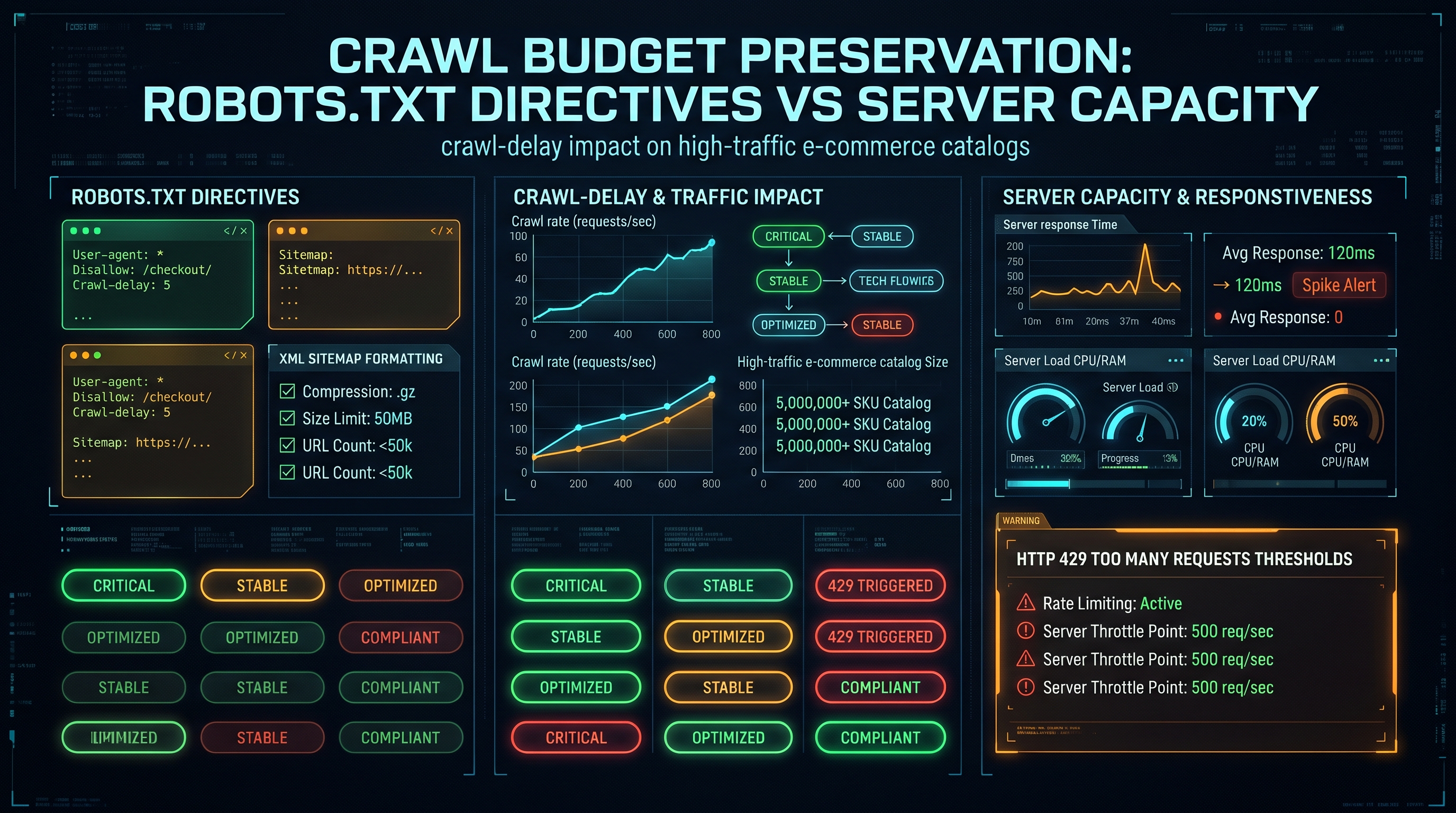
RFC 9309 formalizes the Robots Exclusion Protocol, establishing strict rules for User-agent matching, path globbing (* and $), 500 KiB file truncation, and the Longest-Match-Wins precedence algorithm. In modern web engineering, bot governance requires segmenting organic search crawlers (Googlebot, Bingbot) from AI model harvesters (GPTBot, ClaudeBot, CCBot). Because robots.txt is purely advisory, malicious scrapers must be mitigated using edge WAF rate limiters, reverse DNS cryptographic verification, and honeypot traps.
Robots.txt Validator, RFC 9309 Parser & Bot Governance Tester Pro
Validate robots.txt syntax against the official RFC 9309 specification, test User-Agent matching precedence, audit AI scraper blocking rules, and simulate crawler access in real-time.
Table of Contents & Chapter Index
- 1. The Genesis of the Robots Exclusion Protocol: From Martijn Koster's 1994 Standard to RFC 9309
- 2. The Formal Specification: RFC 9309 ABNF Syntax & Pattern Specificity Precedence
- 3. Matching Kinetics: Path Normalization, Wildcards (*), End-of-URL Anchors ($) & Longest Match Wins
- 4. The AI Scraping Dilemma: Segmenting Search Crawlers (Googlebot) from LLM Harvesters (GPTBot, ClaudeBot)
- 5. Non-Standard Extensions: Crawl-Delay, Request-Rate, Sitemap Declarations & Edge Server Limits
- 6. Crawl Budget Engineering: Rate Limiting, HTTP 429 Exponential Backoff & Server Capacity Protection
- 7. Edge Enforcement Architecture: WAF Rules, Reverse Proxy Rate Limiters & Honeypot Traps
- 8. Production Engineering: Building an RFC 9309 Compliant Deterministic Robots.txt Evaluator in TypeScript
1. The Genesis of the Robots Exclusion Protocol: From Martijn Koster's 1994 Standard to RFC 9309
How an informal email agreement between early web pioneers evolved into an official IETF Internet Standard.
The Dawn of Automated Web Crawlers
In the early months of 1994, as the World Wide Web transitioned from an academic experiment into a public global network, a software engineer named Martijn Koster maintained the *Aliweb* search engine at Nexor. Koster discovered that an uncalibrated autonomous crawler—Charles Stross's experimental *World Wide Web Wanderer*—was repeatedly overloading Nexor's servers, causing widespread denial of service for human users.
Recognizing that web crawlers possessed the capacity to inadvertently crash web infrastructure, Koster authored a consensus proposal on the
www-talk mailing list in June 1994: "A Method for Web Robots Control." This informal agreement established the convention of placing a plain ASCII text file at the root of a domain:
$$ exttt{https://example.com/robots.txt}$$For nearly three decades,
robots.txt existed as an informal, de facto standard. Major search engines—Google, Yahoo!, AltaVista, Lycos, and Bing—implemented custom parser extensions, creating a patchwork of subtle incompatibilities regarding wildcard matching, case-sensitivity, and URL normalization.+---------------------------------------------------------------------------------------------------+
| CHRONOLOGICAL EVOLUTION OF THE ROBOTS EXCLUSION PROTOCOL |
+---------------------------------------------------------------------------------------------------+
| 1994: Martijn Koster Consensus Draft ("A Method for Web Robots Control") |
| * Disallow directives | User-agent matching | Informal convention with zero formal RFC status |
+---------------------------------------------------------------------------------------------------+
|
v
+---------------------------------------------------------------------------------------------------+
| 1996: Internet Draft (Koster) Expired without ratification |
| * Crawlers implement custom extensions (Allow, Crawl-delay, Sitemap) |
+---------------------------------------------------------------------------------------------------+
|
v
+---------------------------------------------------------------------------------------------------+
| 2008: Google & Major Search Engines Standardize Wildcards (* and $) |
| * Path prefix matching and end-of-URL anchors introduced |
+---------------------------------------------------------------------------------------------------+
|
v
+---------------------------------------------------------------------------------------------------+
| 2022: IETF Ratifies RFC 9309 (Robots Exclusion Protocol - Proposed Standard) |
| * Authored by Martijn Koster, Gary Illyes, Henner Zeller, and Lizzi Sassman |
| * Formally defines ABNF syntax, UTF-8 parsing, 500 KiB file limits, and 24-hour cache TTLs |
+---------------------------------------------------------------------------------------------------+
The Contemporary Web Scraping Crisis: Search Spiders vs LLM Scrapers
Today, web scraping is no longer confined to benign search engine spiders indexing pages for organic search visibility. The explosion of Large Language Models (LLMs) and generative artificial intelligence has unleashed a hyper-aggressive wave of automated data harvesters—including OpenAI's GPTBot, Anthropic's ClaudeBot, Common Crawl's CCBot, and Perplexity's PerplexityBot.
These AI scraping agents crawl web architectures with unprecedented frequency, scraping billions of tokens to train commercial foundation models. This shift presents modern engineering teams with a profound dilemma: 1. Preserving Organic Search Visibility: The enterprise must allow traditional search crawlers (like
Googlebot and Bingbot) complete access to indexed landing pages to sustain search traffic and domain authority.
2. Preventing AI Training Harvesters: The enterprise may want to strictly prevent LLM training crawlers from extracting intellectual property, proprietary databases, and editorial content without authorization or compensation.
3. Mitigating Server Degradation: Aggressive scraping clusters can consume over 60% of an origin server's bandwidth and CPU capacity, degrading response times for genuine users and inflating cloud hosting bills.The Scope of RFC 9309
In September 2022, the IETF resolved twenty-eight years of fragmentation by ratifying RFC 9309: Robots Exclusion Protocol. RFC 9309 establishes: - A formal Augmented Backus-Naur Form (ABNF) grammar for
robots.txt files.
- Deterministic rules for User-Agent matching specificity.
- Explicit priority handling when Allow and Disallow directives conflict.
- Strict operational parameters governing file size limits (500 KiB), network failure fallbacks (handling HTTP 4xx and 5xx status codes), and caching lifecycles.2. The Formal Specification: RFC 9309 ABNF Syntax & Pattern Specificity Precedence
Deconstructing the formal grammar and parsing state machines governing robot exclusions.
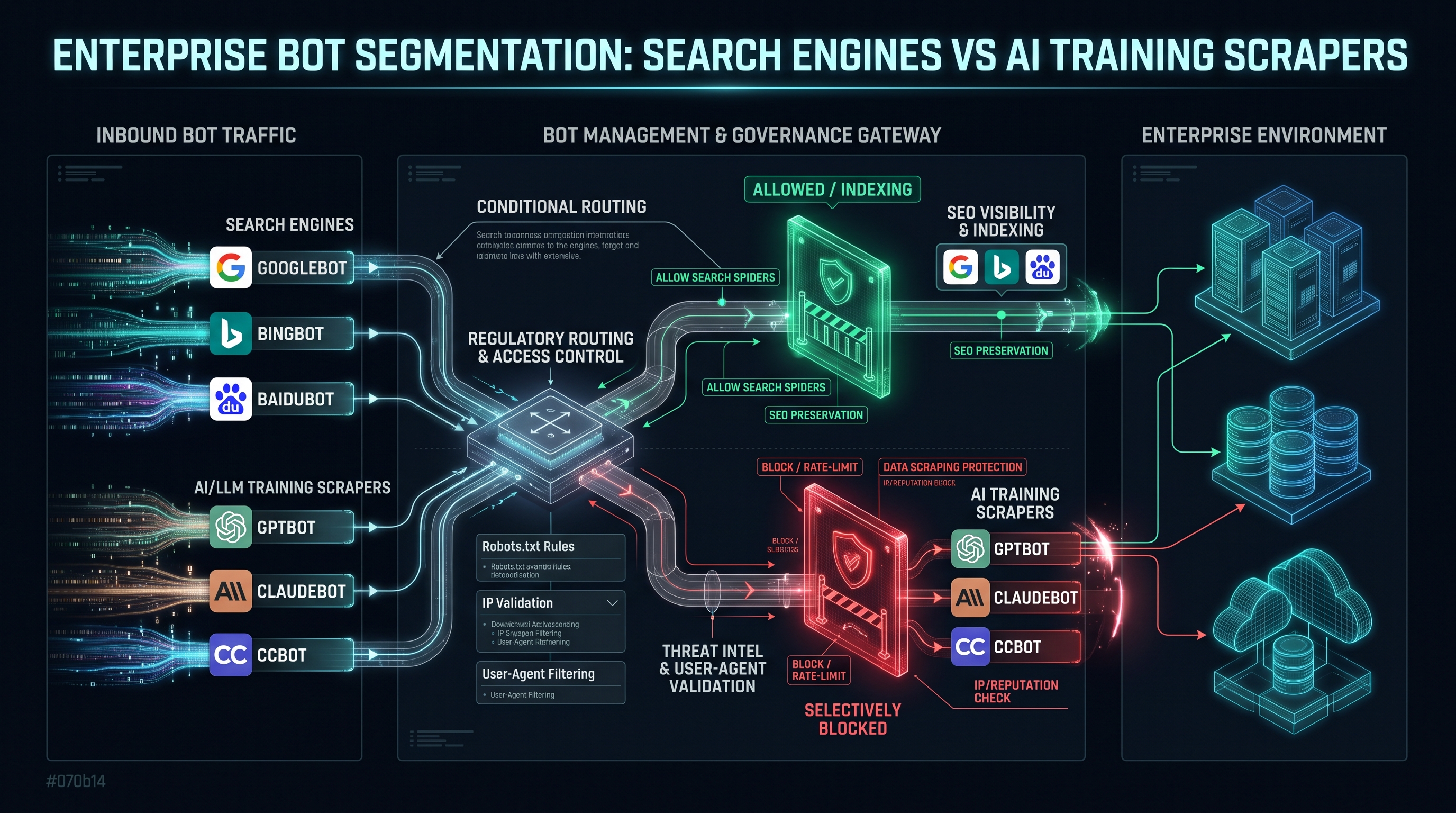
The Formal ABNF Grammar of RFC 9309
RFC 9309 Section 2 establishes the strict Augmented Backus-Naur Form (ABNF) grammar governing all valid
robots.txt files. A robots.txt document must be an ASCII or UTF-8 encoded text file consisting of one or more Record Groups separated by blank lines:$$ exttt{robotstxt} = *( ext{group } / ext{ emptyline})$$ $$ exttt{group} = 1*( ext{user-agent-line}) *( ext{rule-line})$$
Where each record group consists of two mandatory sections: 1. One or more
User-agent: lines identifying the target crawler(s).
2. One or more directive lines (Disallow: or Allow:).+---------------------------------------------------------------------------------------------------+
| RFC 9309 ROBOTS.TXT FILE STRUCTURAL ANATOMY |
+---------------------------------------------------------------------------------------------------+
| # Group 1: General search engines and fallback crawlers |
| User-agent: * |
| Disallow: /admin/ |
| Disallow: /api/private/ |
| Allow: /api/private/public-feed.json |
| |
| # Group 2: AI Foundation Model Scrapers (Strict Disallow) |
| User-agent: GPTBot |
| User-agent: ClaudeBot |
| User-agent: CCBot |
| Disallow: / |
| |
| # Global Directives (Not tied to record groups) |
| Sitemap: https://innoxtools.com/sitemap.xml |
+---------------------------------------------------------------------------------------------------+
The Three Cardinal Directives
#### 1.
User-agent:
Specifies the crawler product token to which the subsequent rules apply.
- ABNF Definition:
$$ ext{user-agent-line} = exttt{"User-agent:" } *( ext{SP / HTAB}) ext{ product-token } *( ext{SP / HTAB / CR / LF})$$
- Case-Insensitivity: Product tokens are strictly case-insensitive. User-agent: Googlebot is identical to user-agent: googlebot.
- **Wildcard Token (*): A single asterisk represents all crawlers not matched by a more specific user-agent group.#### 2.
Disallow:
Specifies path prefixes that the crawler must not access.
- Empty Disallow (Disallow:): If the path parameter is empty, it explicitly grants permission to crawl the entire domain (equivalent to "allow all").
- Root Disallow (Disallow: /): Blocks the crawler from the entire domain hierarchy.#### 3.
Allow:
Specifies path prefixes that the crawler is permitted to access, typically utilized to carve out accessible exceptions within an otherwise disallowed parent directory.The Longest-Match-Wins Precedence Rule
In legacy implementations, crawlers debated whether
Allow took precedence over Disallow or whether rule order in the file dictated priority. RFC 9309 Section 2.2.2 settles this conclusively with the Most Specific Path (Longest Match) Rule:
$$ ext{Precedence} = \max( ext{len}( ext{Pattern}_{ ext{matched}}))$$
When a URI matches both an
Allow and a Disallow directive within the applicable record group:
1. The directive with the longest matching path pattern determines access!
2. If both matching Allow and Disallow directives have the exact same length in characters, the Allow directive takes precedence**!+---------------------------------------------------------------------------------------------------+
| LONGEST-MATCH PRECEDENCE RESOLUTION EXAMPLES |
+---------------------------------------------------------------------------------------------------+
| Rule Set: |
| User-agent: * |
| Disallow: /catalog/ [Length: 9 characters] |
| Allow: /catalog/public/ [Length: 16 characters] |
| Disallow: /catalog/public/confidential.pdf [Length: 32 characters] |
+---------------------------------------------------------------------------------------------------+
| Target URL Matching Rules Winning Rule Verdict |
+---------------------------------------------------------------------------------------------------+
| /catalog/items.html Disallow: /catalog/ Length: 9 BLOCKED |
| /catalog/public/item.html Disallow (9), Allow (16) Allow (16) ALLOWED |
| /catalog/public/confidential.pdf All 3 rules match Disallow (32) BLOCKED |
| |
| Equal Length Conflict Case: |
| Disallow: /data [Length: 5 characters] |
| Allow: /data [Length: 5 characters] |
| Target: /data/file.csv Equal length (5 vs 5) ALLOW WINS ALLOWED |
+---------------------------------------------------------------------------------------------------+
This mathematical precedence rule ensures deterministic behavior across every compliant crawler, eliminating unpredictable race conditions.
3. Matching Kinetics: Path Normalization, Wildcards (*), End-of-URL Anchors ($) & Longest Match Wins
Unpacking the pattern evaluation mechanics behind complex path traversal filtering.
The Syntax of Pattern Matching: Wildcards and Anchors
RFC 9309 formally standardizes two powerful pattern matching characters within
Allow and Disallow path values: the **Wildcard (*) and the End-of-Pattern Anchor ($)**.#### 1. The Wildcard Pattern (
*)
The asterisk represents zero or more arbitrary valid URI characters. It acts as a globbing operator:
- Disallow: /*.pdf$ blocks every URL path ending in .pdf anywhere on the site.
- Disallow: /private/*/secret.html matches /private/users/secret.html and /private/a/b/c/secret.html.#### 2. The End-of-URL Anchor (
$)
By default, all path patterns in robots.txt are prefix matches. The rule:
$$ exttt{Disallow: /temp}$$
matches /temp, /temp/, /temporary.html, and /temperature?zip=90210.To force an exact match that does not extend to child segments, append the dollar sign anchor (
$):
$$ exttt{Disallow: /temp$}$$
This matches /temp exactly, but does not match /temp/ or /temporary.html.+---------------------------------------------------------------------------------------------------+
| ROBOTS.TXT PATH MATCHING SPECIFICATION TABLE |
+---------------------------------------------------------------------------------------------------+
| Directive Pattern Target URL Path Match Result Access State |
+---------------------------------------------------------------------------------------------------+
| Disallow: /finance https://example.com/finance MATCH BLOCKED |
| Disallow: /finance https://example.com/finances MATCH BLOCKED |
| Disallow: /finance/ https://example.com/finances NO MATCH ALLOWED |
| Disallow: /finance/ https://example.com/finance/ledger.xlsx MATCH BLOCKED |
| Disallow: /*?sort= https://example.com/shop?sort=price MATCH BLOCKED |
| Disallow: /*?sort= https://example.com/shop?color=red NO MATCH ALLOWED |
| Disallow: /*.gif$ https://example.com/img/cat.gif MATCH BLOCKED |
| Disallow: /*.gif$ https://example.com/img/cat.gif?v=2 NO MATCH ALLOWED |
+---------------------------------------------------------------------------------------------------+
URL Normalization & Percent-Encoding in Pattern Matching
Section 2.2.1 of RFC 9309 mandates that both the URI paths in
robots.txt and the candidate request URIs must be normalized prior to comparison:
1. UTF-8 Octet Decoding: Percent-encoded octets representing unreserved characters (RFC 3986: uppercase letters, lowercase letters, digits, hyphen, period, underscore, and tilde) must be decoded to their literal forms.
2. Case-Sensitivity in Paths: Unlike domain names and user-agent tokens, URL paths are strictly case-sensitive. /Products does not match /products.
3. Escaping the Reserved Dollar Sign: If a webmaster literally wants to match a dollar sign in a path (e.g. /price$100), the dollar sign must be percent-encoded as %24 to avoid triggering the end-of-URL anchor logic!The RFC 9309 User-Agent Matching Algorithm
When a crawler arrives at a website, it must determine which record group in
robots.txt governs its access. RFC 9309 specifies a deterministic two-tier matching hierarchy:+---------------------------------------------------------------------------------------------------+
| RFC 9309 USER-AGENT DISPATCH RESOLUTION |
+---------------------------------------------------------------------------------------------------+
| Crawler Identity: "Googlebot-Image/2.1" |
+---------------------------------------------------------------------------------------------------+
|
v
+---------------------------------------------------------------------------------------------------+
| Step 1: Specific Token Search |
| * Does robots.txt contain a group with "User-agent: Googlebot-Image"? |
| -> IF YES: Select this group exclusively! IGNORE all other groups (including Googlebot & *). |
+---------------------------------------------------------------------------------------------------+
| (If No)
v
+---------------------------------------------------------------------------------------------------+
| Step 2: Parent Token Search |
| * Does robots.txt contain a group with "User-agent: Googlebot"? |
| -> IF YES: Select this group exclusively! IGNORE the wildcard (*) group. |
+---------------------------------------------------------------------------------------------------+
| (If No)
v
+---------------------------------------------------------------------------------------------------+
| Step 3: Wildcard Fallback Search |
| * Does robots.txt contain a group with "User-agent: *"? |
| -> IF YES: Apply the wildcard group rules. |
| -> IF NO: Complete unrestricted access is granted (Allow All)! |
+---------------------------------------------------------------------------------------------------+
Crucially, record groups never combine or inherit rules. If a specific crawler group matches (
User-agent: Googlebot), the crawler reads *only* that group, completely disregarding any Disallow: rules listed under User-agent: *!4. The AI Scraping Dilemma: Segmenting Search Crawlers (Googlebot) from LLM Harvesters (GPTBot, ClaudeBot)
Engineering modern robots.txt policies to block automated model training while preserving organic SEO rank.

The Asymmetric Economics of AI Scraping
Traditional search engine crawlers operate under an implicit symbiotic contract: a search spider crawls a publisher's web pages and consumes server bandwidth, but in return, it indexes the content in search results, driving valuable human referral traffic, ad impressions, and customer conversions back to the publisher.
Generative AI scrapers break this economic contract: - Zero Referral Traffic: An LLM scraper harvests text, research, code, and documentation to train foundational weights. When an end-user queries ChatGPT, Claude, or Gemini, the model answers the user directly inside the chatbot interface, completely eliminating referral visits to the original author. - Extreme Crawl Concurrency: Modern AI scraping clusters operate across distributed cloud networks, generating thousands of requests per second against un-cached origin endpoints, straining databases, and driving up AWS/Cloudflare egress fees.
+---------------------------------------------------------------------------------------------------+
|                        THE DUAL REALITY OF MODERN BOT SEGMENTATION                                |
+---------------------------------------------------------------------------------------------------+
|                                  INCOMING WEB CRAWLERS                                            |
+---------------------------------------------------------------------------------------------------+
                                                  |
                         +------------------------+------------------------+
                         |                                                 |
                         v                                                 v
+---------------------------------------------------+     +-----------------------------------------+
|            ORGANIC SEARCH SPIDERS                 |     |           AI TRAINING HARVESTERS        |
|  * Googlebot, Bingbot, YandexBot, Baiduspider     |     |  * GPTBot, ClaudeBot, CCBot, Bytespider |
|  * Value Exchange: Server load for traffic        |     |  * Value Exchange: Zero traffic return  |
|  * Policy: PERMIT / OPTIMIZE                      |     |  * Policy: SELECTIVELY BLOCK            |
+---------------------------------------------------+     +-----------------------------------------+
Taxonomy of Major AI Crawler User-Agents (2026)
To govern bot access effectively, engineering teams must maintain an up-to-date registry of AI crawler signatures:
| Crawler Entity | Organization | Primary User-Agent Token | Operation Type | Recommended Policy | | :--- | :--- | :--- | :--- | :--- | | GPTBot | OpenAI |
GPTBot | Foundation Model Training | Block if protecting IP |
| ChatGPT-User | OpenAI | ChatGPT-User | Real-time Web Browsing (User Queries) | Permit if desiring citations |
| ClaudeBot | Anthropic | ClaudeBot | Foundation Model Training | Block if protecting IP |
| CCBot | Common Crawl | CCBot | Open-Source Dataset Scraping | Block (Feeds dozens of models) |
| Bytespider | ByteDance | Bytespider | AI Model Training & Search | Block (Aggressive concurrency) |
| Applebot-Extended | Apple | Applebot-Extended | Apple Intelligence Model Training | Block (Separate from Applebot search) |
| Google-Extended | Google | Google-Extended | Gemini & Vertex AI Training | Block (Does NOT affect Google Search!) |
| PerplexityBot | Perplexity | PerplexityBot | Real-time Search Indexing & Synthesis| Permit for AI search citations |The Separation of Search from AI Training: Googlebot vs Google-Extended
A frequent terror among Chief Marketing Officers (CMOs) and SEO Directors is that blocking AI crawlers will destroy the company's Google Search rankings.
In response to publisher backlash, Google introduced a critical bifurcation: -
Googlebot: The primary crawler responsible for indexing pages for Google Search, Discover, and Google News.
- Google-Extended: A distinct standalone token representing Gemini and Vertex AI generative model training.Disallowing
Google-Extended in your robots.txt has zero negative impact on your Google Search rankings! It cleanly opts your domain out of Gemini training while preserving full search visibility.#
Production Enterprise Bot Governance robots.txt Template
# ==============================================================================
# INNOXTOOLS ENTERPRISE BOT GOVERNANCE POLICY (RFC 9309 COMPLIANT)
# ==============================================================================

# SECTION 1: Permitted Search Engine Spiders (Full Access for SEO)
User-agent: Googlebot
User-agent: Bingbot
User-agent: Slurp
Disallow: /admin/
Disallow: /api/internal/
Disallow: /profile/
Allow: /

# SECTION 2: AI Foundation Training Harvesters (Complete Block)
User-agent: GPTBot
User-agent: ClaudeBot
User-agent: CCBot
User-agent: Bytespider
User-agent: Google-Extended
User-agent: Applebot-Extended
User-agent: Diffbot
Disallow: /

# SECTION 3: Real-Time Interactive AI Search Engines (Permit for Citations)
User-agent: ChatGPT-User
User-agent: PerplexityBot
Disallow: /admin/
Disallow: /api/internal/
Allow: /

# SECTION 4: Default Fallback for All Other Crawlers
User-agent: *
Disallow: /admin/
Disallow: /api/internal/
Disallow: /search?*
Allow: /

# SECTION 5: Global XML Sitemap Index
Sitemap: https://innoxtools.com/sitemap.xml
By structuring your
robots.txt into segregated record groups, your enterprise defends its proprietary content against uncompensated model ingestion while maximizing commercial organic search discovery!5. Non-Standard Extensions: Crawl-Delay, Request-Rate, Sitemap Declarations & Edge Server Limits
Navigating the murky waters of vendor-specific directives and edge server caching rules.
The Non-Standard Status of Crawl-delay:
Among webmasters and SEO practitioners, one of the most widely deployed directives is
Crawl-delay::
$$ exttt{Crawl-delay: 10}$$However, engineering teams must understand a crucial technical reality:
Crawl-delay: is NOT part of RFC 9309. It is a proprietary, non-standard extension originally introduced by Microsoft's MSN Search / Bingbot in the late 2000s and supported by Yandex.#
How Different Search Engines Treat Crawl-delay:
| Search Engine | User-Agent | Support Status | Behavioral Interpretation | | :--- | :--- | :--- | :--- | | Googlebot |
Googlebot | COMPLETELY IGNORED | Google has never supported Crawl-delay:. To throttle Googlebot, webmasters must use Google Search Console or HTTP 429 status codes. |
| Bingbot | Bingbot | SUPPORTED | Interprets value as minimum seconds between successive HTTP requests. |
| YandexBot | Yandex | SUPPORTED | Interprets value in seconds (allows decimal fractions, e.g. 0.5). |
| Baiduspider | Baiduspider | IGNORED | Disregards crawl delay. Throttling configured via Baidu Webmaster Tools. |
| Rogue Scrapers | Automated scripts | IGNORED | Malicious scrapers actively ignore all rate-limiting directives. |+---------------------------------------------------------------------------------------------------+
| CRAWL-DELAY INTERPRETATION IN BINGBOT VS GOOGLEBOT |
+---------------------------------------------------------------------------------------------------+
| Directive in robots.txt: |
| User-agent: Bingbot |
| Crawl-delay: 5 |
+---------------------------------------------------------------------------------------------------+
| * Bingbot Response: Pauses 5 seconds between request N and request N+1 -> CRAWL RATE REDUCED! |
| |
| User-agent: Googlebot |
| Crawl-delay: 5 |
+---------------------------------------------------------------------------------------------------+
| * Googlebot Response: Ignores line completely! Crawls at server capacity -> ZERO EFFECT! |
+---------------------------------------------------------------------------------------------------+
The Sitemap: Directive (RFC 9309 Section 2.3)
Unlike
Crawl-delay:, the Sitemap: directive is officially recognized and standardized by major search engines and RFC 9309. It informs web crawlers where to locate the site's XML Sitemap index:$$ exttt{Sitemap: https://innoxtools.com/sitemap.xml}$$
#### Technical Rules for Sitemap Declarations: 1. Fully Qualified Absolute URL: The target URL must be an absolute URL including the scheme (
https://). Relative paths (/sitemap.xml) are invalid.
2. Global Scope: The Sitemap: directive is not bound to any record group. It does not matter whether it appears before, inside, or after a User-agent: block; crawlers extract all Sitemap: directives globally.
3. Multiple Sitemaps: A single robots.txt file may declare multiple sitemaps:
   Sitemap: https://innoxtools.com/sitemaps/pages.xml
   Sitemap: https://innoxtools.com/sitemaps/tools.xml
   Sitemap: https://innoxtools.com/sitemaps/blog.xml
The 500 KiB File Size Limitation in RFC 9309
In the wild west of early web development, poorly configured CMS plugins occasionally generated massive multi-megabyte
robots.txt files containing millions of product URLs.RFC 9309 Section 2.1 establishes a strict 500 Kibibyte (512,000 bytes) parsing ceiling: - Crawlers are required to parse at least 500 KiB. - If a
robots.txt file exceeds 500 KiB, crawlers may truncate the file at byte 512,000 and parse only the beginning!
- Any directives or sitemaps located beyond the 500 KiB boundary will be completely ignored, potentially causing unintended crawling of private sub-trees.Production engineering rule: Keep your
robots.txt file under 50 KiB by utilizing wildcard patterns rather than enumerating millions of individual URLs.6. Crawl Budget Engineering: Rate Limiting, HTTP 429 Exponential Backoff & Server Capacity Protection
How search engines determine crawl demand and how to protect database connections from crawler exhaustion.
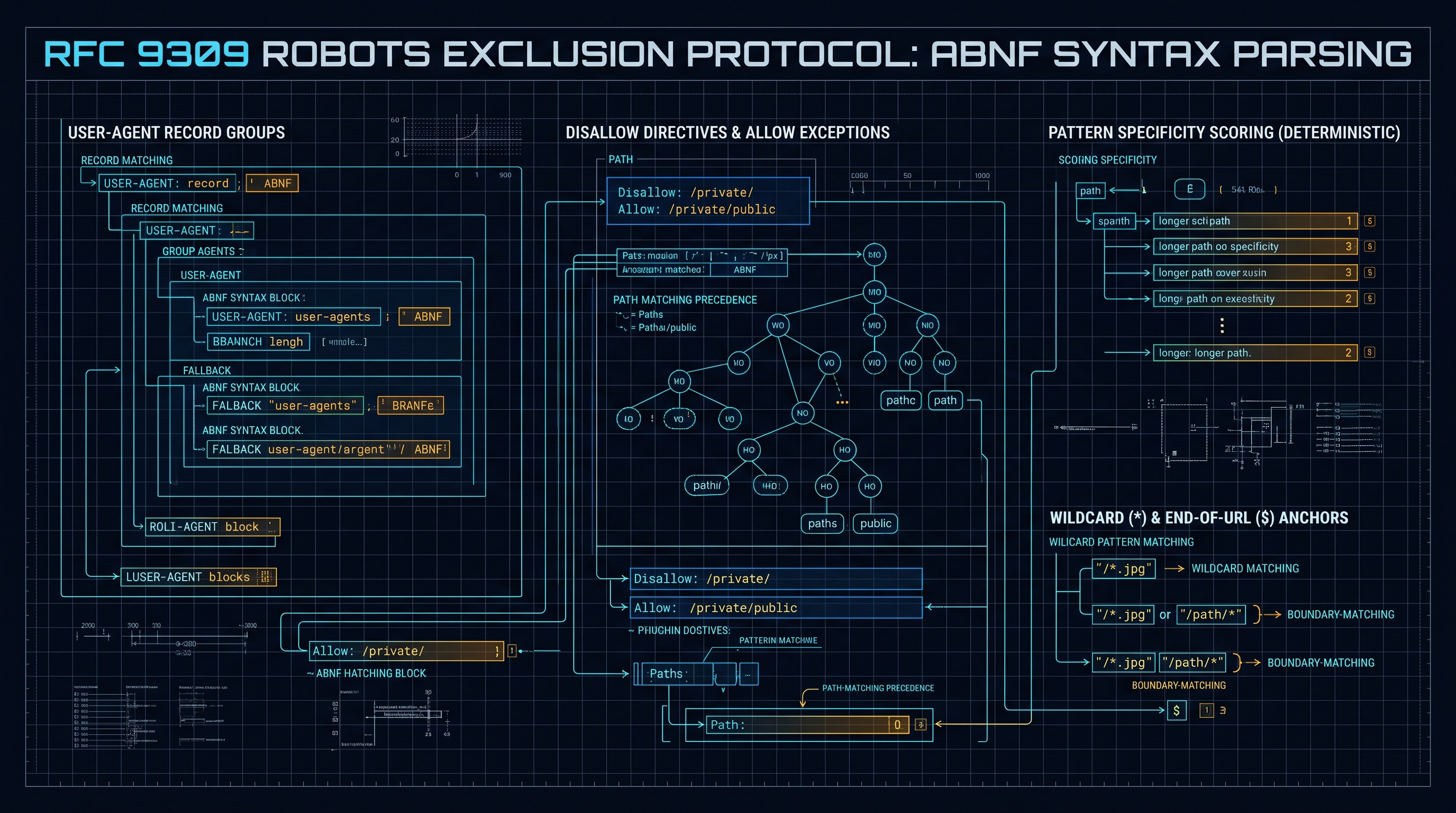
Deconstructing Crawl Budget
In technical SEO and enterprise systems engineering, Crawl Budget represents the maximum number of URLs a search engine crawler (primarily Googlebot) can and wants to crawl on an enterprise domain within a given timeframe.
Crawl budget is the mathematical intersection of two independent variables:
$$ ext{Crawl Budget} = \min( ext{Crawl Demand}, ext{Crawl Capacity Rate})$$
+---------------------------------------------------------------------------------------------------+
|                        CRAWL BUDGET DYNAMICS & LIMITING FACTORS                                   |
+---------------------------------------------------------------------------------------------------+
|  1. Crawl Demand (How much Google WANT to crawl):                                                 |
|     * Driven by URL popularity, PageRank authority, update frequency, and index staleness.        |
+---------------------------------------------------------------------------------------------------+
                                                  x
+---------------------------------------------------------------------------------------------------+
|  2. Crawl Capacity Rate (How much your server CAN handle):                                        |
|     * Driven by server response latency (TTFB), HTTP error rates (5xx/429), and hardware limits.  |
+---------------------------------------------------------------------------------------------------+
                                                  |
                                                  v
+---------------------------------------------------------------------------------------------------+
|  NET EFFECTIVE CRAWL BUDGET (Pages indexed per day without degrading human user experience)       |
+---------------------------------------------------------------------------------------------------+
The Destructive Impact of Server Latency on Crawl Velocity
Googlebot dynamically calibrates its crawl speed based on your server's Time to First Byte (TTFB). - If your server responds in under 200ms, Googlebot concludes the infrastructure is robust, increasing its concurrent thread count to discover new content rapidly. - If your server TTFB spikes above 1,500ms, or begins throwing HTTP 500 / 503 errors, Googlebot immediately slashes its crawl capacity to avoid crashing your site. Newly published articles and inventory updates will sit un-indexed for weeks!
The Power of HTTP 429 (Too Many Requests) & Exponential Backoff
When an aggressive crawler overwhelms your web servers, standard HTTP errors (like 500 Internal Server Error or 502 Bad Gateway) are interpreted by search engines as server crashes, damaging SEO rankings.
The standards-compliant mechanism to throttle well-behaved crawlers is HTTP Status Code 429 (Too Many Requests) paired with the
Retry-After response header:HTTP/1.1 429 Too Many Requests
Content-Type: text/plain; charset=utf-8
Retry-After: 120
Connection: close
Rate limit exceeded. Crawlers must back off for 120 seconds.
When Googlebot or Bingbot receives an HTTP 429 with
Retry-After: 120:
1. The crawler immediately halts crawling the domain.
2. It pauses all activity for exactly 120 seconds.
3. Upon resuming, it automatically lowers its concurrent crawl frequency, preventing database connection pool saturation.HTTP Status Code Handling for robots.txt Under RFC 9309
What happens when a crawler attempts to fetch
https://example.com/robots.txt and the server encounters an error? RFC 9309 Section 2.3.1 defines mandatory deterministic behaviors:+---------------------------------------------------------------------------------------------------+
| ROBOTS.TXT HTTP STATUS CODE DECISION MATRIX |
+---------------------------------------------------------------------------------------------------+
| HTTP Status Code RFC 9309 Crawler Interpretation Resulting Access |
+---------------------------------------------------------------------------------------------------+
| 200 OK Parse file contents normally Follow Directives |
| 3xx Redirection (up to 5 hops) Follow redirect to target URI Parse Final File |
| 404 Not Found / 410 Gone No robots.txt exists COMPLETE ACCESS (ALL)|
| 401 Unauthorized / 403 Forbidden Access to robots.txt explicitly denied COMPLETE BLOCK (NONE)|
| 5xx Server Errors (500, 502, 503) Server is unhealthy COMPLETE BLOCK (NONE)|
| Unreachable / Connection Timeout Network failure COMPLETE BLOCK (NONE)|
+---------------------------------------------------------------------------------------------------+
CRITICAL ARCHITECTURAL WARNING: Notice the behavior for HTTP 5xx Server Errors! If your reverse proxy returns an HTTP 500 or 503 error when Googlebot fetches
robots.txt, RFC 9309 mandates that the crawler must assume a full disallow policy (Disallow: /), immediately ceasing all crawling across your entire website! Never allow robots.txt to fail with a 500 error.7. Edge Enforcement Architecture: WAF Rules, Reverse Proxy Rate Limiters & Honeypot Traps
Stopping malicious scrapers that maliciously ignore robots.txt directives.
The Fundamental Limitation of robots.txt: It Is Purely Advisory
A foundational tenet of cybersecurity and systems architecture is: $$ extbf{Robots.txt is an advisory protocol, NOT an access control mechanism.}$$
Well-behaved crawlers (Google, Bing, OpenAI, Anthropic) voluntarily parse and obey
robots.txt out of institutional adherence to web standards. Malicious scrapers, content thieves, vulnerability scanners, and credential stuffers actively ignore robots.txt—and frequently use it as a roadmap to find sensitive hidden paths!To build a resilient defense against malicious automated data harvesting, enterprise architectures enforce multi-layered Edge Security & Web Application Firewall (WAF) barriers.
+---------------------------------------------------------------------------------------------------+
|                        MULTI-LAYER BOT DEFENSE INFRASTRUCTURE                                     |
+---------------------------------------------------------------------------------------------------+
|  Layer 1: Advisory Layer (robots.txt)                                                             |
|  * Voluntary governance for compliant crawlers (Googlebot, GPTBot, ClaudeBot)                     |
+---------------------------------------------------------------------------------------------------+
                                                  |
                                                  v
+---------------------------------------------------------------------------------------------------+
|  Layer 2: Edge CDN / WAF Enforcement (Cloudflare, AWS WAF, Fastly)                                |
|  * Verified Bot Signatures (Reverse DNS lookup & cryptographic TLS fingerprinting)                |
|  * ASN & Datacenter IP Range Blocking (OVH, Hetzner, DigitalOcean scraping farms)                 |
+---------------------------------------------------------------------------------------------------+
                                                  |
                                                  v
+---------------------------------------------------------------------------------------------------+
|  Layer 3: Reverse Proxy Rate Limiting (Nginx / Envoy)                                             |
|  * Token bucket rate limiters per IP / subnet: limit_req_zone $binary_remote_addr                 |
+---------------------------------------------------------------------------------------------------+
                                                  |
                                                  v
+---------------------------------------------------------------------------------------------------+
|  Layer 4: In-App Honeypot Traps & Dynamic IP Blacklisting                                         |
|  * Invisible hidden links (display:none) disallowed in robots.txt                                 |
|  * Any client requesting the honeypot is instantaneously firewalled!                              |
+---------------------------------------------------------------------------------------------------+
1. Cryptographic User-Agent Verification via Reverse DNS
Malicious scrapers routinely spoof their
User-Agent string, claiming to be Googlebot/2.1 to bypass basic rate limiters.To verify whether a crawler is truly Googlebot, edge servers execute Reverse DNS (rDNS) verification: 1. Perform a reverse DNS lookup on the client's connecting IP address (e.g.
66.249.66.1).
2. Verify that the resolved hostname belongs to the authorized domain (e.g. crawl-66-249-66-1.googlebot.com).
3. Perform a forward DNS lookup on that hostname to verify that the IP resolves back to the original connecting IP.If the forward and reverse lookups do not match, the client is a spoofed imposter and must be instantly dropped!
2. The Honeypot Trap Architecture
Because malicious crawlers ignore
robots.txt, engineers can weaponize this behavior using Honeypot Traps:1. In your
robots.txt, disallow a non-existent trap path:
   User-agent: *
   Disallow: /trap/crawler-honeypot.html
   <!-- Invisible to human users, visible only to DOM scrapers -->
   <a href="/trap/crawler-honeypot.html" style="display:none;" rel="nofollow" aria-hidden="true">Index</a>
/trap/crawler-honeypot.html triggers an immediate automatic IP ban for 24 hours via Redis or Cloudflare API.Legitimate search engines will never click the link because it is disallowed in
robots.txt. Only rogue scrapers that disregard the protocol will traverse it, immediately neutralizing themselves!8. Production Engineering: Building an RFC 9309 Compliant Deterministic Robots.txt Evaluator in TypeScript
A complete, production-grade parser implementing longest-match precedence and wildcard regex translation.
Engineering an RFC 9309 Compliant Parser
To validate, audit, and test
robots.txt configurations within enterprise CI/CD pipelines, SEO monitoring suites, and security gateways, developers require a deterministic evaluator that strictly implements RFC 9309 longest-match precedence.Here is the complete, production-grade TypeScript implementation powering our InnoX Robots.txt Validator & Bot Governance Tester Pro:
export interface RobotsRule {
  type: 'allow' | 'disallow';
  pattern: string;
  regex: RegExp;
  length: number;
}

export interface UserAgentGroup {
  userAgents: string[];
  rules: RobotsRule[];
}

export interface EvaluationResult {
  allowed: boolean;
  matchedRule: RobotsRule | null;
  matchedUserAgent: string;
  reason: string;
}

export class Rfc9309RobotsParser {
  private groups: UserAgentGroup[] = [];
  private sitemaps: string[] = [];

  constructor(robotsTxtContent: string) {
    this.parse(robotsTxtContent);
  }

  private parse(content: string): void {
    // RFC 9309: Truncate at 500 KiB (512,000 bytes)
    const truncatedContent = content.slice(0, 512000);
    const lines = truncatedContent.split(/
|
|
/);

    let currentUserAgents: string[] = [];
    let currentRules: RobotsRule[] = [];

    for (let rawLine of lines) {
      // 1. Strip comments (#) and trim whitespace
      const commentIndex = rawLine.indexOf('#');
      if (commentIndex !== -1) {
        rawLine = rawLine.slice(0, commentIndex);
      }
      const line = rawLine.trim();
      if (!line) continue;

      const colonIndex = line.indexOf(':');
      if (colonIndex === -1) continue;

      const field = line.slice(0, colonIndex).trim().toLowerCase();
      const value = line.slice(colonIndex + 1).trim();

      if (field === 'user-agent') {
        // If we transition from rules back to user-agents, flush previous group
        if (currentRules.length > 0) {
          if (currentUserAgents.length > 0) {
            this.groups.push({ userAgents: currentUserAgents, rules: currentRules });
          }
          currentUserAgents = [];
          currentRules = [];
        }
        currentUserAgents.push(value.toLowerCase());
      } else if (field === 'allow' || field === 'disallow') {
        if (!value && field === 'disallow') {
          // Empty Disallow: equals allow all
          continue;
        }
        currentRules.push({
          type: field as 'allow' | 'disallow',
          pattern: value,
          regex: this.compilePatternToRegex(value),
          length: value.length
        });
      } else if (field === 'sitemap') {
        this.sitemaps.push(value);
      }
    }

    // Flush final group
    if (currentUserAgents.length > 0) {
      this.groups.push({ userAgents: currentUserAgents, rules: currentRules });
    }
  }

  /**
   * Compiles RFC 9309 glob wildcards (*) and end anchors ($) into standard RegExp.
   */
  private compilePatternToRegex(pattern: string): RegExp {
    let escaped = pattern.replace(/[-[\]{}()+?.,\^$|#\s]/g, '\$&');
    escaped = escaped.replace(/\\*/g, '.*');
    if (escaped.endsWith('\$')) {
      escaped = escaped.slice(0, -2) + '$';
    }
    return new RegExp('^' + escaped);
  }

  /**
   * Evaluates whether a given userAgent is permitted to crawl targetPath.
   */
  public isAllowed(userAgent: string, targetPath: string): EvaluationResult {
    const ua = userAgent.toLowerCase();

    // 1. Find matching group via RFC 9309 specificity hierarchy
    let targetGroup: UserAgentGroup | null = null;
    let matchedUA = '*';

    // Check specific user agent tokens first
    for (const group of this.groups) {
      for (const groupUA of group.userAgents) {
        if (groupUA !== '*' && ua.includes(groupUA)) {
          targetGroup = group;
          matchedUA = groupUA;
          break;
        }
      }
      if (targetGroup) break;
    }

    // Fallback to wildcard (*) group if no specific match found
    if (!targetGroup) {
      targetGroup = this.groups.find(g => g.userAgents.includes('*')) ?? null;
    }

    // If no group matches, default access is ALLOW
    if (!targetGroup || targetGroup.rules.length === 0) {
      return { allowed: true, matchedRule: null, matchedUserAgent: matchedUA, reason: 'No matching disallow rules.' };
    }

    // 2. Evaluate all matching rules according to LONGEST MATCH WINS
    let bestMatch: RobotsRule | null = null;

    for (const rule of targetGroup.rules) {
      if (rule.regex.test(targetPath)) {
        if (!bestMatch || rule.length > bestMatch.length) {
          bestMatch = rule;
        } else if (rule.length === bestMatch.length) {
          // RFC 9309: Equal length conflict -> ALLOW takes precedence!
          if (rule.type === 'allow') {
            bestMatch = rule;
          }
        }
      }
    }

    if (!bestMatch) {
      return { allowed: true, matchedRule: null, matchedUserAgent: matchedUA, reason: 'Path matched no explicit rules.' };
    }

    return {
      allowed: bestMatch.type === 'allow',
      matchedRule: bestMatch,
      matchedUserAgent: matchedUA,
      reason: Matched ${bestMatch.type.toUpperCase()} directive: "${bestMatch.pattern}" (Length: ${bestMatch.length})
    };
  }

  public getSitemaps(): string[] {
    return this.sitemaps;
  }
}
Through this rigorous TypeScript class, engineering organizations can automatically validate their bot policies inside pull requests, ensuring that marketing campaigns, product updates, and search engine migrations launch with zero crawl budget or indexing errors!
Autonomous Web Crawler Ecosystem & robots.txt Support Taxonomy (2026)
| Crawler Name | Entity & Operator | Primary Purpose | RFC 9309 Compliant? | Crawl-delay Support? | Can Block Without SEO Penalty? |
|---|---|---|---|---|---|
| Googlebot | Google LLC | Search Indexing | Yes (Strict) | No (Completely Ignored) | No (Blocks search rankings) |
| Bingbot | Microsoft | Search Indexing | Yes (Strict) | Yes (In seconds) | No (Blocks Bing rankings) |
| Google-Extended | Google LLC | Gemini AI Training | Yes (Strict) | No | Yes (Zero impact on search) |
| GPTBot | OpenAI | ChatGPT Model Training | Yes | No | Yes (Zero impact on search) |
| ClaudeBot | Anthropic | Claude Model Training | Yes | No | Yes (Zero impact on search) |
| CCBot | Common Crawl | Public AI Datasets | Yes | Yes | Yes (Pure dataset scraping) |
| Bytespider | ByteDance | TikTok/AI Search | Partial | Partial | Yes (Aggressive crawler) |
| Rogue Scrapers | Unknown / Threat Actors | Data Theft / Scraping | No (Will ignore rules) | No | Requires WAF & Honeypots |
Table 1: Comprehensive benchmark and governance reference detailing the operational behavior, protocol adherence, and rate-limiting support across major commercial crawlers.
Frequently Asked Technical Questions
What is the difference between RFC 9309 and the original 1994 robots.txt standard?
The original 1994 Martijn Koster proposal was an informal consensus agreement without formal IETF specification status, leading to vendor fragmentation. Ratified in September 2022, RFC 9309 is an official Internet Standard establishing formal ABNF grammar, UTF-8 parsing, 500 KiB file size truncation, 24-hour caching rules, and the deterministic longest-match precedence algorithm.
How does the Longest-Match-Wins rule resolve conflicts between Allow and Disallow?
Under RFC 9309 Section 2.2.2, when a path matches both an Allow and a Disallow directive, the rule with the longest character length takes precedence (e.g., Allow: /catalog/public/ [16 chars] overrides Disallow: /catalog/ [9 chars]). If both matching directives have identical character lengths, the Allow directive wins.
Does blocking AI crawlers like GPTBot hurt my Google Search rankings?
No. Major search engines cleanly separate indexing spiders from AI training harvesters. Blocking GPTBot, ClaudeBot, CCBot, or even Google's own Google-Extended crawler in your robots.txt will have zero negative impact on your Google Search rankings, Discover visibility, or PageRank.
Does Googlebot respect the Crawl-delay directive?
No. Googlebot has never supported the Crawl-delay directive. If you include Crawl-delay: 10 in robots.txt, Googlebot ignores it completely. To control Google's crawl rate, you must use Google Search Console or return HTTP 429 (Too Many Requests) with a Retry-After header.
What happens if robots.txt returns an HTTP 500 server error?
Under RFC 9309, if an HTTP request for robots.txt fails with a 5xx server error (such as 500 Internal Server Error or 503 Service Unavailable), crawlers must assume a complete disallow policy (Disallow: /), immediately halting all crawling and indexing of the entire domain.
Why is robots.txt not considered a security barrier?
Robots.txt is purely an advisory protocol that compliant search engines voluntarily obey. Malicious scrapers, vulnerability scanners, and hackers actively ignore robots.txt and frequently read it to discover hidden internal paths. Sensitive endpoints must always be secured using authentication and WAF rules.
What is the maximum robots.txt file size allowed by RFC 9309?
RFC 9309 establishes a 500 Kibibyte (512,000 bytes) parsing ceiling. If a robots.txt file exceeds 500 KiB, crawlers may truncate the file at byte 512,000 and parse only the beginning, ignoring any directives or sitemaps located further down in the file.
Where can I validate and test robots.txt files online?
You can use the InnoX Robots.txt Validator, RFC 9309 Parser & Bot Governance Tester Pro (/tools/robots-txt-tester). It allows you to simulate crawler behavior, verify longest-match precedence, test AI bot disallow rules, and audit syntax compliance in real time.
Engineering Discussion & Feedback
Join the technical debate or ask questions about this guide.
Need Custom AI, Web, or Enterprise Software Engineering?
InnoxTools is built and maintained by INNO XPERT. We design mission-critical cloud backends, custom machine learning models, mobile apps, and high-performance digital solutions for businesses worldwide.