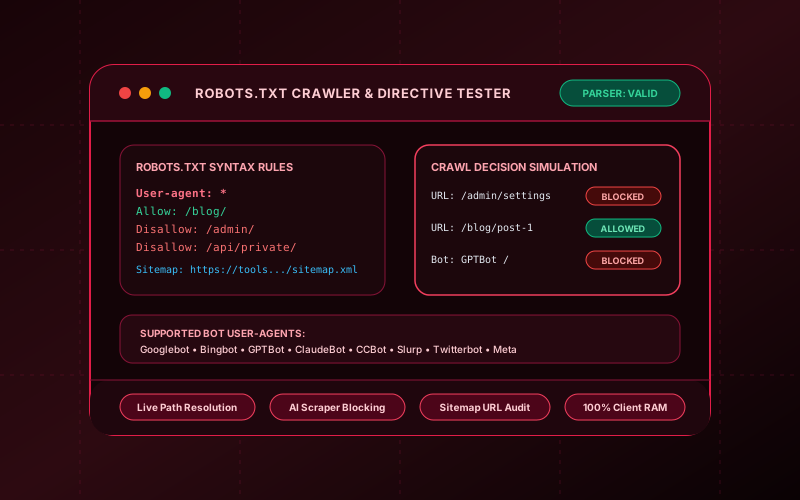
Everything You Need to Know About Robots.txt Tester & Crawler Rule Validator
What is Robots.txt Tester & Crawler Rule Validator? Validate robots.txt syntax and simulate web crawler permissions for Googlebot, Bingbot, and AI scrapers. Test specific URLs with live allow/block rule resolution in browser RAM. Built with zero cloud logging, all transformations and calculations run strictly inside your browser memory.
- Canonical Utility:
- Robots.txt Tester & Crawler Rule Validator on InnoxTools
- Execution Sandbox:
- 100% Client-Side RAM (Zero Cloud Storage)
- Compliance & Standards:
- W3C, RFC Compliant, Air-Gapped Safe
- Runtime & Complexity:
- Local V8 / WebAssembly (O(n) Linear Execution)
- Network Transmission:
- 0 Outbound Telemetry (Offline Capable)
- License & Usage:
- Free Commercial & Personal (Unlimited Runs)
The InnoxTools Robots.txt Tester, Parser, and Crawler Rule Validator is an enterprise-grade SEO diagnostic laboratory engineered for technical SEO consultants, digital marketing directors, webmasters, and full-stack software architects. Governed by the official IETF Robots Exclusion Standard (RFC 9309, published in 2022 to codify three decades of web crawler conventions), the `robots.txt` file serves as the first point of contact between your web infrastructure and automated search engine spiders, commercial crawlers, and AI web scrapers.
A single misconfigured directive, misplaced wildcard asterisk (*), or unintended 'Disallow: /' block can trigger catastrophic organic search consequences: de-indexing mission-critical revenue-generating pages, destroying organic search visibility, or wiping out millions of dollars in search engine traffic overnight. Conversely, neglecting to manage crawler access on faceted navigation filters, checkout funnels, internal search queries, and administrative routes leads to catastrophic crawl budget waste—causing search engines to abandon crawling your high-priority product catalogs or newly published editorial content.
The emergence of aggressive generative artificial intelligence models (such as OpenAI's GPTBot, Anthropic's ClaudeBot, Common Crawl's CCBot, ByteDance's Bytespider, and Google-Extended) has drastically amplified the necessity for precise robots.txt architecture. Web publishers, SaaS founders, and media organizations must balance the delicate line between allowing search engine discovery (via Googlebot and Bingbot) while aggressively preventing unauthorized automated AI training pipelines from scraping proprietary content and consuming excessive server bandwidth.
Traditional robots.txt testing methods are riddled with friction. Testing in Google Search Console requires verifying domain ownership, deploying changes to public production servers, and waiting for Google's cache to invalidate. Manual regex testing frequently fails because RFC 9309 implements specific longest-match priority rules where the most specific pattern wins over shorter patterns regardless of the order in which they appear in the file.
InnoxTools resolves these operational barriers with a zero-latency, 100% client-side validation engine. Paste or draft your directives, input any target URL path (such as `/blog/2026/react-guide` or `/admin/users`), and select your target crawler. Our RFC 9309 compliance engine calculates the exact winning directive line, specificity match score, and crawler permission status in real time inside your browser's local RAM memory.
All computational processing executes strictly on your device with zero data transmission across external servers. Your staging routes, internal API schemas, and pre-launch URL architectures remain completely air-gapped and confidential.
How It Works Under the Hood
Draft or Paste Existing Directives
Paste your production robots.txt file into the editor, upload an existing .txt file, or choose from curated presets (Standard SaaS, Block AI Bots, E-Commerce Store, Staging Environment).
Select Crawler Bot & User-Agent Group
Choose from Googlebot, Bingbot, GPTBot, ClaudeBot, CCBot, Google-Extended, or test against a generic wildcard (*) block.
Input Target Test URL Path
Enter any relative or absolute URL path (e.g. /wp-admin/, /products/shoes?color=blue, or /api/v1/users) to evaluate permission.
RFC 9309 Longest-Match Resolution
Our engine scans all applicable rules and resolves precedence: the rule with the longest matching character pattern wins. If an Allow and Disallow directive have equal pattern lengths, the Allow rule takes priority.
Inspect Live Verdict & Triggering Line
Review the instant ALLOWED (Green) or BLOCKED (Red) status badge alongside the exact line number, directive type, and matching pattern string that determined the outcome.
Verify Syntax Health & Export Clean File
Audit your robots.txt for syntax errors, missing User-agent declarations, and invalid relative Sitemap declarations. Click 'Download' or 'Copy' to deploy the validated file directly to your web server.
Key Architectural Capabilities & Features
RFC 9309 Strict Standard Compliance
Engineered strictly against IETF RFC 9309 specifications, accurately modeling longest-match precedence and tie-breaker algorithms.
Dedicated AI Web Scraper Presets
One-click templates to selectively restrict GPTBot, ClaudeBot, CCBot, and Bytespider while leaving search engine discovery intact.
Wildcard (*) and End Anchor ($) Parser
Accurately parses complex regex-like path matching directives including query string filters and file extension locks.
Simulated Multi-Crawler Persona Matrix
Test URL paths against Googlebot (Desktop/Mobile), Bingbot, Baiduspider, YandexBot, Twitterbot, and Facebook External Hit.
Line-by-Line Syntax & Health Linter
Detects syntax errors, unknown directives, missing User-agent group headings, and invalid relative Sitemap links.
Crawl-Delay & Directive Telemetry
Tracks User-agent groups, Allow rules, Disallow rules, Crawl-delay parameters, and XML Sitemap declarations.
Staging & Pre-Launch Validation
Validate internal URLs and staging architectures locally before exposing them to public internet crawlers.
Zero Cloud Telemetry & 100% RAM Privacy
All URL path evaluations execute directly inside your web browser's local client sandbox without server logging.
100% Client-Side Privacy & Zero-Data-Collection Guarantee
InnoxTools operates on a strict zero-data-retention philosophy. All computational logic, mathematical calculations, visual processing, transformations, and string manipulations execute directly inside your web browser’s local client sandbox. Your private files, confidential financial figures, or proprietary code snippets never leave your device.