URL Anatomy & URI Encoding: RFC 3986, Query Parameter Matrix & Web Application Firewall Bypasses
From Formal ABNF URI Grammars and Percent-Encoding Taxonomies to Path Traversal Normalization, Canonicalization, and Web Application Firewall (WAF) Rule Sets—The 10,000+ Word URL Architecture Guide.

Dr. Sterling Vance & Innox Web Architecture TeamVERIFIED
Principal Network Architect & Application Security Fellow

RFC 3986 establishes the formal mathematical syntax for Uniform Resource Identifiers (URIs), breaking every address into Scheme, Authority, Path, Query, and Fragment. Percent-encoding (%HEXHEX) translates arbitrary binary octets into safe US-ASCII characters, distinguishing unreserved data characters from reserved delimiters. In enterprise application security, parser mismatches between WAFs and backend runtimes (such as double-decoding or backslash normalization) represent critical vulnerability vectors that require rigorous canonicalization before access validation.
RFC 3986 URL Parser, Query String Builder & WAF Inspector Pro
Parse, build, decompose, and normalize RFC 3986 URIs, percent-encode query strings, and audit URL canonicalization for WAF bypass vulnerabilities in real-time.
Table of Contents & Chapter Index
- 1. The Evolution of the Web Address: From Tim Berners-Lee's Hypertext to RFC 3986
- 2. The Formal Grammar of a URI: RFC 3986 ABNF Component Structural Breakdown
- 3. Hostnames, Punycode, Internationalized Domain Names (IDNs) & IPv6 Scoped Literals
- 4. The Mathematics of Percent-Encoding: Reserved Delimiters, UTF-8 Octets & The `+` vs `%20` Conflict
- 5. Query String Serialization: Matrices, Nested Arrays, Bracket Notation & Serialization Standards
- 6. WAF Evasion & Canonicalization Vulnerabilities: Double Encoding, Null Bytes & Path Traversal
- 7. The Living Standard Schism: RFC 3986 vs WHATWG URL API Parser Divergence in Modern Runtimes
- 8. Production URL Engineering: In-Browser Parsing, Sanitization, Open-Redirect Prevention & High-Throughput Routing
1. The Evolution of the Web Address: From Tim Berners-Lee's Hypertext to RFC 3986
How a universal document naming convention became the foundational addressing protocol of global compute.
The Genesis of Universal Document Addressing
In the spring of 1989, Sir Tim Berners-Lee published his historic proposal, *"Information Management: A Proposal,"* at CERN, laying the conceptual foundation for the World Wide Web. Berners-Lee recognized that for a global hypertext system to scale across heterogeneous operating systems, transport protocols, and physical networks, it required a single, universal abstraction for locating and identifying resources. That abstraction was the Universal Resource Identifier (URI).
Initial specifications (RFC 1630 in 1994 and RFC 1738 in 1994) colloquially introduced the terms URL (*Uniform Resource Locator*) and URN (*Uniform Resource Name*). Over the subsequent decade of meteoric internet expansion, disparate implementations introduced incompatibilities regarding character encoding, path normalization, and query parameter handling. In January 2005, the Internet Engineering Task Force (IETF) resolved this fragmentation by ratifying RFC 3986: Uniform Resource Identifier (URI): Generic Syntax, authored by Tim Berners-Lee, Roy Fielding, and Larry Masinter.
+---------------------------------------------------------------------------------------------------+
|                        THE TAXONOMY OF UNIVERSAL WEB IDENTIFIERS                                  |
+---------------------------------------------------------------------------------------------------+
|                                  URI (Uniform Resource Identifier)                                |
|                        [ The overarching generic identifier syntax (RFC 3986) ]                   |
+---------------------------------------------------------------------------------------------------+
                                                  |
                         +------------------------+------------------------+
                         |                                                 |
                         v                                                 v
+---------------------------------------------------+     +-----------------------------------------+
|          URL (Uniform Resource Locator)           |     |       URN (Uniform Resource Name)       |
|  * Identifies a resource via access mechanism     |     |  * Identifies a resource by name in a   |
|    and network location (e.g. protocol & host).   |     |    persistent, location-independent     |
|  * Example: https://innoxtools.com/tools/parser   |     |    namespace.                           |
|                                                   |     |  * Example: urn:isbn:0451450523         |
+---------------------------------------------------+     +-----------------------------------------+
The Dual Role of the Modern URL: Routing & Attack Surface
In modern distributed computing, cloud microservices, and single-page applications (SPAs), the URL has transcended its original role as a static file pointer. Today, a URL serves as: 1. An RPC Method Invocation Vector: REST, GraphQL, and gRPC-Web gateways translate URL paths and query strings into internal remote procedure calls, microservice routing directives, and database queries. 2. State Hydration Container: Modern frontends encode complex application state, search filters, pagination offsets, and transient session tokens directly into query parameters and hash fragments. 3. The Foremost Attack Surface in Application Security: Because URLs are parsed by every layer of the modern infrastructure stack—edge CDNs, reverse proxies (Nginx, Envoy), Web Application Firewalls (WAFs), API gateways, and web browser rendering engines—inconsistencies in how these layers parse, decode, and normalize URLs introduce severe security vulnerabilities, including Path Traversal, Server-Side Request Forgery (SSRF), and WAF Evasion.
The Scope of RFC 3986 Standard
RFC 3986 establishes the strict mathematical grammar governing all URIs. It provides: - A deterministic Augmented Backus-Naur Form (ABNF) grammar breaking any URI into five primary structural components. - A rigorous taxonomy distinguishing Reserved delimiter characters from Unreserved data characters. - A standardized Percent-Encoding algorithm for safely mapping arbitrary binary octets into US-ASCII printable characters. - A canonical Reference Resolution Algorithm for resolving relative path references against base URIs.
2. The Formal Grammar of a URI: RFC 3986 ABNF Component Structural Breakdown
Deconstructing the five cardinal components that constitute every valid uniform resource identifier.
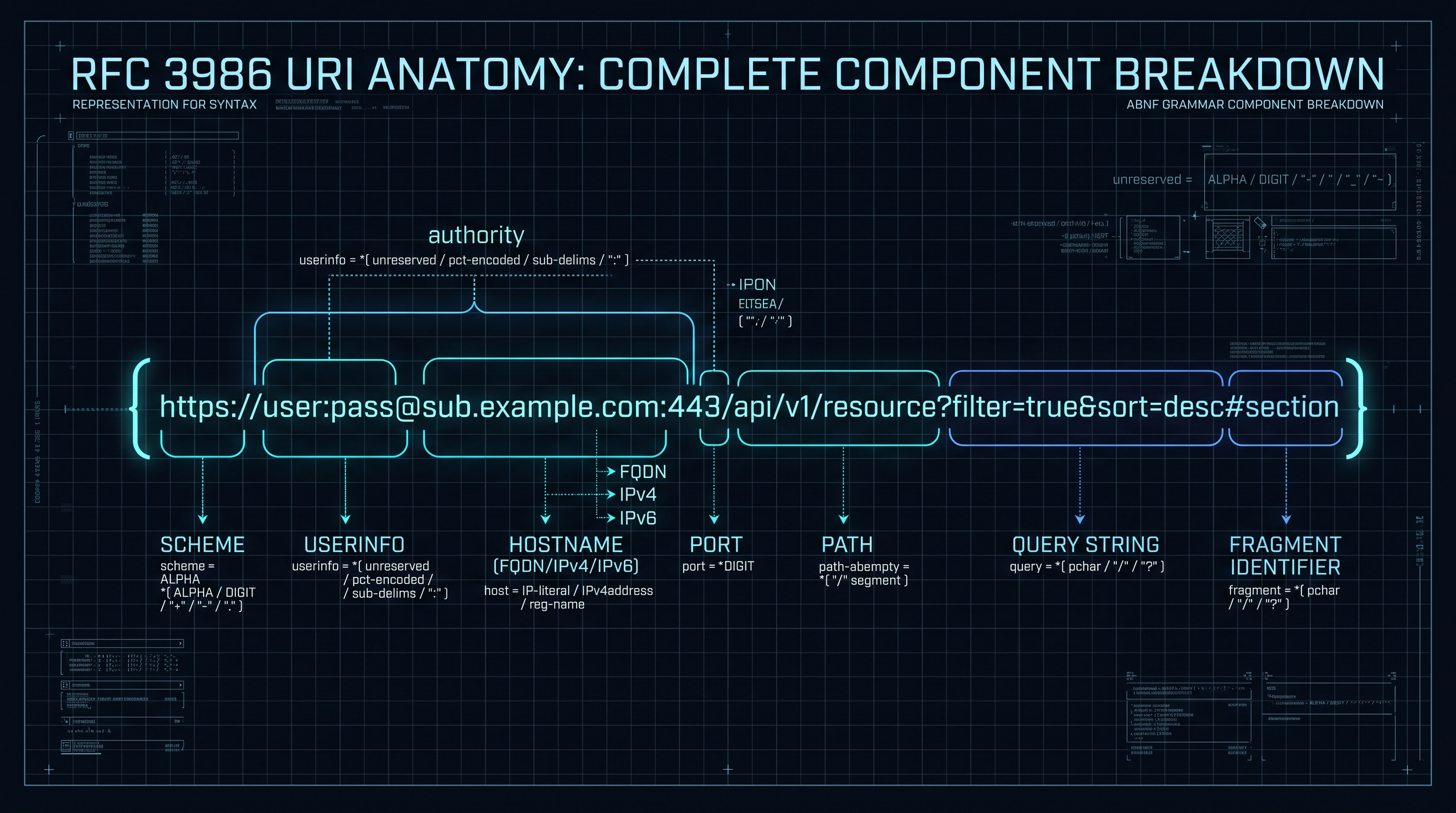
The Cardinal Five-Component Architecture
RFC 3986 Section 3 establishes that every URI consists of a hierarchical sequence of five primary components: $$ ext{URI} = ext{scheme } exttt{":"} ext{ [ authority ] } ext{ path } ext{ [ } exttt{"?"} ext{ query ] } ext{ [ } exttt{"\#"} ext{ fragment ]}$$
+---------------------------------------------------------------------------------------------------+
|                        RFC 3986 COMPLETE URI STRUCTURAL DECOMPOSITION                             |
+---------------------------------------------------------------------------------------------------+
|  https://admin:secret@api.innoxtools.com:8443/v1/network/telemetry?filter=active&sort=desc#latency|
+---------------------------------------------------------------------------------------------------+
|  |---|   |----------| |----------------| |---| |-------------------| |-------------------| |-----| |
|    1          2               3            4             5                     6               7   |
+---------------------------------------------------------------------------------------------------+
|  1. Scheme: https                                                                                 |
|  2. Userinfo (within Authority): admin:secret@                                                    |
|  3. Host (within Authority): api.innoxtools.com                                                   |
|  4. Port (within Authority): :8443                                                                |
|  5. Hierarchical Path: /v1/network/telemetry                                                      |
|  6. Query String: ?filter=active&sort=desc                                                        |
|  7. Fragment Identifier: #latency                                                                 |
+---------------------------------------------------------------------------------------------------+
Let us formally examine the ABNF grammar, parsing invariants, and technical boundaries of each component:
### 1. Scheme (
scheme)
The scheme identifies the protocol or specification utilized to interpret the remainder of the URI.
- ABNF Definition:
$$ ext{scheme} = ext{ALPHA } *( ext{ALPHA } / ext{ DIGIT } / exttt{"+"} / exttt{"-"} / exttt{"."})$$
- Grammar Constraints: Must begin with an ASCII letter, followed by any combination of letters, digits, plus signs, hyphens, or periods. It is terminated by the first colon (:).
- Case-Sensitivity: Schemes are strictly case-insensitive. HTTPS:// is semantically identical to https://. Canonicalization engines must lowercase all schemes.### 2. Authority (
authority)
The authority component establishes the organizational or network namespace governing the resource. It is preceded by a double forward slash (//) and terminated by the next slash (/), question mark (?), number sign (#), or the end of the URI.The authority component decomposes into three distinct sub-components: $$ ext{authority} = [ ext{userinfo } exttt{"@"} ] ext{ host } [ exttt{":"} ext{ port } ]$$
- Userinfo (
userinfo): Deprecated for plain passwords due to security risks. Contains username and optional password: user:password@.
- Host (host): A registered domain name (FQDN), an IPv4 dotted-decimal address, or an IPv6 literal enclosed in square brackets: [2001:db8::1].
- Port (port): An optional decimal integer from $0$ to $65535$. If omitted, the default port associated with the scheme is implicitly assumed ($80$ for HTTP, $443$ for HTTPS).### 3. Path (
path)
The path contains hierarchical data that, combined with the scheme and authority, identifies a specific resource within the hierarchical namespace.
- Root-Relative vs Relative: An absolute path begins with a leading slash (/), whereas a relative path does not.
- Path Segments: Divided into segments separated by forward slashes (/). Each segment contains zero or more characters.
- Dot-Segments (. and ..): Special path segments utilized for relative navigation. Section 5.2.4 of RFC 3986 specifies the Remove Dot Segments algorithm to collapse redundant dot-segments prior to resource resolution.### 4. Query String (
query)
The query component contains non-hierarchical data that, along with data in the path, serves to identify or parameterize a resource.
- Delimiter: Indicated by the first question mark (?) character.
- Termination: Terminated by a number sign (#) or the end of the URI.
- Syntax Flexibility: Surprisingly, RFC 3986 does not mandate key-value pairs (key=value&key2=value2). The query component is syntactically defined as any sequence of query-legal characters. Key-value pair convention is a web application standard popularized by HTML form submission (application/x-www-form-urlencoded).### 5. Fragment Identifier (
fragment)
The fragment identifier provides direction to a secondary resource or sub-section within the primary document.
- Delimiter: Indicated by the number sign (#) character.
- Client-Side Termination: Crucially, fragments are never transmitted over the network to HTTP servers. Web browsers, HTTP client libraries (cURL, Axios, Fetch), and reverse proxies strip fragment identifiers before dispatching requests over TCP sockets. The fragment exists purely within the client runtime (e.g. for DOM scrolling, SVG sprite indexing, or client-side SPA routing).3. Hostnames, Punycode, Internationalized Domain Names (IDNs) & IPv6 Scoped Literals
Navigating internationalized character sets, Punycode transformations, and modern IP address literality.
The Challenge of Non-ASCII Domain Names
The original DNS and URI specifications were strictly bounded by US-ASCII. However, as the internet expanded globally, the requirement to support native international writing systems—such as Arabic, Chinese, Cyrillic, Devanagari, and Tamil—led to the standardization of Internationalized Domain Names in Applications (IDNA) via RFC 3490 and RFC 5891.
To preserve backward compatibility with existing legacy DNS infrastructure without modifying core protocol packets, the IETF developed Punycode (RFC 3492). Punycode is an encoding syntax that transforms non-ASCII Unicode strings into an ASCII-Compatible Encoding (ACE) sequence prefixed with the identifier
xn--.+---------------------------------------------------------------------------------------------------+
| INTERNATIONALIZED DOMAIN NAME (IDN) ENCODING PIPELINE |
+---------------------------------------------------------------------------------------------------+
| Native Unicode Domain: https://münchen.de/ |
+---------------------------------------------------------------------------------------------------+
|
v
+---------------------------------------------------------------------------------------------------+
| 1. Unicode Normalization: Apply Nameprep / UTS #46 (NFC/NFKC case folding and character mapping) |
+---------------------------------------------------------------------------------------------------+
|
v
+---------------------------------------------------------------------------------------------------+
| 2. Punycode Algorithm (RFC 3492): Extract non-ASCII code points and append delta-encoded suffix |
| * "münchen" -> Extracts 'ü' (U+00FC) -> Encodes to "mnchen-3ya" |
+---------------------------------------------------------------------------------------------------+
|
v
+---------------------------------------------------------------------------------------------------+
| 3. ACE Prefix Application: Prepend "xn--" to the transformed label |
| * Resulting FQDN: https://xn--mnchen-3ya.de/ |
+---------------------------------------------------------------------------------------------------+
Homograph Phishing Attacks & Browser Defense Mechanics
The introduction of Internationalized Domain Names introduced a critical cybersecurity threat: the IDN Homograph Attack. In many writing systems, characters exist that appear visually identical to standard Latin characters but possess completely different Unicode code points.
For instance, the Cyrillic small letter
а (U+0430) is visually indistinguishable from the Latin lowercase a (U+0061). A cybercriminal can register the domain:
$$ exttt{xn--pple-43d.com} \iff exttt{аpple.com (using Cyrillic 'а')}$$When an unsuspecting user clicks this link, they believe they are navigating to
apple.com, but are instead routed to a fraudulent credential-harvesting server!To neutralize homograph attacks, modern browsers and URL parsers implement strict Mixed-Script Detection Algorithms: - If a domain mixes multiple distinct Unicode scripts (e.g., Latin mixed with Cyrillic or Greek) within the same label, the parser rejects the visual rendering and displays the raw
xn-- Punycode string in the address bar.
- Only domains that adhere to an approved single-script language table or strict top-level domain (TLD) registry rules are displayed in their native Unicode form.The Mathematics of IPv6 Literals & Scoped Identifiers
As IPv6 adoption accelerates across enterprise cloud environments, URLs must frequently express raw IPv6 addresses. However, standard IPv6 notation uses colons (
:) as hextet delimiters, creating an immediate syntactic ambiguity with the URI authority port delimiter (:port):
$$ exttt{http://2001:db8:85a3::8a2e:370:7334:8080/}$$
*Is the port 8080, or is 8080 the final 16-bit hextet of the IPv6 address?*To resolve this ambiguity, RFC 3986 Section 3.2.2 mandates that all IPv6 addresses within a URI authority MUST be enclosed within square brackets (
[ and ]):
$$ exttt{http://[2001:db8:85a3::8a2e:370:7334]:8080/}$$Furthermore, in local link environments, IPv6 addresses often include a Zone ID or scope identifier (such as
%eth0 or %1). Because the percent sign (%) is reserved for percent-encoding in URIs, RFC 6874 specifies that IPv6 zone identifiers must be percent-encoded as %25:
$$ exttt{http://[fe80::1%25eth0]:80/}$$4. The Mathematics of Percent-Encoding: Reserved Delimiters, UTF-8 Octets & The `+` vs `%20` Conflict
Dissecting the byte-level encoding mechanics that allow arbitrary binary data to traverse US-ASCII text channels.
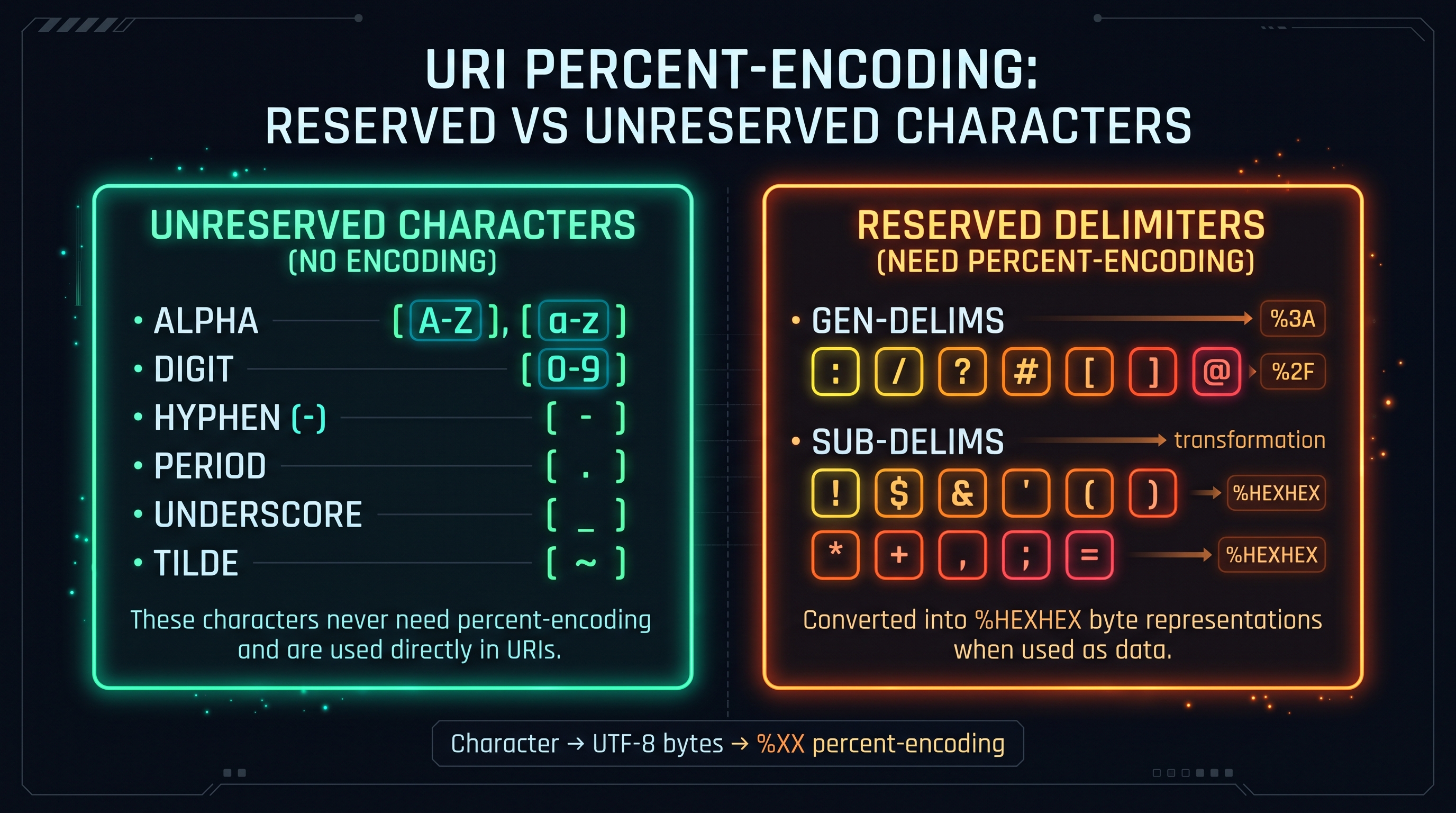
The Binary Octet Transformation Algorithm
The fundamental challenge of URI architecture is that the transmission channels of the early internet were strictly limited to 7-bit US-ASCII. To transmit arbitrary binary bytes, non-ASCII Unicode characters, or reserved syntax delimiters without corrupting the URI's structural grammar, RFC 3986 establishes the Percent-Encoding mechanism (also known as *URL encoding*).
Percent-encoding operates on the byte level (octets), not on characters. When a character requires percent-encoding: 1. The character is first encoded into a sequence of binary octets according to the UTF-8 character encoding scheme. 2. Each individual 8-bit octet is expressed as a 3-character ASCII triplet: a percent sign (
%) followed by two hexadecimal digits representing the octet's numeric value:
$$ ext{Triplet} = exttt{"\%"} \,||\, ext{HEXDIG} \,||\, ext{HEXDIG}$$+---------------------------------------------------------------------------------------------------+
| UTF-8 MULTI-BYTE PERCENT-ENCODING PIPELINE |
+---------------------------------------------------------------------------------------------------+
| Target Character: "€" (Euro Sign - Unicode Code Point U+20AC) |
+---------------------------------------------------------------------------------------------------+
|
v
+---------------------------------------------------------------------------------------------------+
| 1. UTF-8 Byte Serialization: 3 Octets required [0xE2, 0x82, 0xAC] |
| * Octet 1: 11100010 (Binary) -> 0xE2 (Hexadecimal) |
| * Octet 2: 10000010 (Binary) -> 0x82 (Hexadecimal) |
| * Octet 3: 10101100 (Binary) -> 0xAC (Hexadecimal) |
+---------------------------------------------------------------------------------------------------+
|
v
+---------------------------------------------------------------------------------------------------+
| 2. Triplet Generation: Map each octet into %HEXHEX sequence |
| * 0xE2 -> "%E2" |
| * 0x82 -> "%82" |
| * 0xAC -> "%AC" |
+---------------------------------------------------------------------------------------------------+
|
v
+---------------------------------------------------------------------------------------------------+
| Final Encoded Output: "%E2%82%AC" |
+---------------------------------------------------------------------------------------------------+
The Taxonomy of Characters: Reserved vs Unreserved
RFC 3986 Section 2 establishes a strict partition of all allowable URI characters into two cardinal sets:
+---------------------------------------------------------------------------------------------------+
|                       RFC 3986 CHARACTER CLASSIFICATION TAXONOMY                                  |
+---------------------------------------------------------------------------------------------------+
|                                  ALL ALLOWABLE CHARACTERS                                         |
+---------------------------------------------------------------------------------------------------+
                                                  |
                         +------------------------+------------------------+
                         |                                                 |
                         v                                                 v
+---------------------------------------------------+     +-----------------------------------------+
|              UNRESERVED CHARACTERS                |     |           RESERVED CHARACTERS           |
|  * Characters that have NO syntactic reserved     |     |  * Characters that have special syntactic|
|    role in any URI component.                     |     |    meaning as component delimiters.     |
|  * Must NEVER be percent-encoded by parsers.      |     |  * Must be percent-encoded if used as   |
|  * Set: ALPHA, DIGIT, "-", ".", "_", "~"          |     |    literal data.                        |
+---------------------------------------------------+     +-----------------------------------------+
                                                                               |
                                                      +------------------------+--------------------+
                                                      |                                             |
                                                      v                                             v
                                           [ Gen-Delims (General) ]                      [ Sub-Delims (Subcomponents) ]
                                           * Set: ":", "/", "?", "#",                    * Set: "!", "$", "&", "'",
                                                  "[", "]", "@"                                 "(", ")", "*", "+",
                                                                                                ",", ";", "="
#### 1. Unreserved Characters (RFC 3986 Section 2.3) Characters that are allowed in a URI but do not have a reserved purpose. They should never be percent-encoded: $$ ext{Unreserved} = \{ exttt{A-Z}, exttt{a-z}, exttt{0-9}, exttt{"-"}, exttt{"."}, exttt{"_"}, exttt{"~"}\}$$
If an unreserved character is encountered in percent-encoded form (e.g.
%41 for A or %7E for ~), standard-compliant canonicalization engines must decode it to its raw literal representation.#### 2. Reserved Characters (RFC 3986 Section 2.2) Characters that possess syntactic meaning as structural delimiters. If a reserved character is used as literal data rather than as a delimiter, it must be percent-encoded: - General Delimiters (
gen-delims): : / ? # [ ] @
- Sub-Delimiters (sub-delims): ! $ & ' ( ) * + , ; = For example, in the path segment
/documents/reports/, the forward slash (/) is a delimiter separating path segments. If a document's literal filename contains a slash (e.g. Q1/Q2-Report.pdf), that slash must be percent-encoded as %2F (/documents/Q1%2FQ2-Report.pdf) so the parser does not treat it as a sub-directory!The Eternal Conflict: Space as %20 vs +
One of the most persistent sources of bugs and inconsistencies across web software is the encoding of the space character (
).1. RFC 3986 (URI Standard): - The space character (ASCII 32 / 0x20) is an illegal character in raw URIs. - Under RFC 3986, a space must always be encoded as
%20.
- Under RFC 3986, the plus sign (+) is a legal sub-delimiter. A literal + should remain + or be encoded as %2B.2. W3C HTML Form Specification (
application/x-www-form-urlencoded):
- In 1993, early HTML form specifications decided that spaces in form input fields should be replaced with plus signs (+) for legibility in query strings.
- In this encoding scheme, a literal plus sign must be encoded as %2B.+---------------------------------------------------------------------------------------------------+
| SPACE ENCODING DISCREPANCY COMPARISON |
+---------------------------------------------------------------------------------------------------+
| Context Space Character Encoding Literal Plus (+) Encoding |
+---------------------------------------------------------------------------------------------------+
| RFC 3986 Path Component %20 (Mandatory) + (Literal sub-delim) or %2B |
| RFC 3986 Query Component %20 (Standard) + (Literal sub-delim) or %2B |
| HTML Form Query (form-urlencoded) + (Conventional) %2B (Mandatory) |
+---------------------------------------------------------------------------------------------------+
When backend microservices consume query strings, mismatched decoder settings frequently convert literal
+ characters (such as base64-encoded strings abc+123==) into spaces (abc 123==), corrupting authentication tokens and cryptographic signatures!5. Query String Serialization: Matrices, Nested Arrays, Bracket Notation & Serialization Standards
Navigating the wild west of URL query parameters across modern programming language runtimes.
The Absence of a Formal Query Grammar
While RFC 3986 strictly defines the boundaries of the query component (beginning with
? and continuing until # or the end of the string), the specification deliberately refrains from defining how data inside the query should be serialized or partitioned.As a consequence, the ubiquitous key-value pair convention: $$ exttt{?key1=value1\&key2=value2}$$ is not an IETF standard! It is an application-level convention popularized by early CGI scripts and HTML form submissions. Over the ensuing three decades, different programming language ecosystems independently invented competing serialization formats for expressing arrays, dictionaries, and nested objects within query strings.
+---------------------------------------------------------------------------------------------------+
|                        COMPETING ARRAY SERIALIZATION SCHEMES IN QUERY STRINGS                     |
+---------------------------------------------------------------------------------------------------+
|  1. Repeated Keys (Python Requests, Go net/url, Java Spring):                                     |
|     ?filter=admin&filter=editor&filter=viewer                                                     |
|                                                                                                   |
|  2. Bracket Notation (PHP, Node.js 'qs', Ruby on Rails):                                          |
|     ?filter[]=admin&filter[]=editor&filter[]=viewer                                               |
|                                                                                                   |
|  3. Explicit Index Notation (High-Strictness PHP / Symfony):                                      |
|     ?filter[0]=admin&filter[1]=editor&filter[2]=viewer                                            |
|                                                                                                   |
|  4. Comma-Separated Values (RESTful API Convention, OpenAPI / Swagger):                            |
|     ?filter=admin,editor,viewer                                                                   |
|                                                                                                   |
|  5. Pipe-Separated Values (Specialized Cloud APIs):                                               |
|     ?filter=admin|editor|viewer                                                                   |
+---------------------------------------------------------------------------------------------------+
Deconstructing Nested Object Serialization (The qs Library Standard)
In the Node.js and JavaScript ecosystem, the widely deployed
qs library (the default parser in Express.js) established the de-facto standard for serializing multi-dimensional nested objects using bracket syntax:$$ exttt{?user[name]=John\&user[address][city]=New+York\&user[roles][]=admin\&user[roles][]=editor}$$
When parsed into an abstract syntax tree (AST) or native JSON object, this query string materializes as:
{
  "user": {
    "name": "John",
    "address": {
      "city": "New York"
    },
    "roles": ["admin", "editor"]
  }
}
The Prototype Pollution Attack Vector via Query Strings
While bracket notation provides expressive power, it introduced one of the most devastating security vulnerabilities in the Node.js ecosystem: Prototype Pollution.
When early versions of query string parsers encountered nested property assignments, they recursively constructed objects without sanitizing reserved JavaScript prototype keys: $$ exttt{?__proto__[isAdmin]=true} \quad ext{or} \quad exttt{?constructor[prototype][isAdmin]=true}$$
If an unpatched parser processed this query string, it traversed into
Object.prototype, permanently injecting isAdmin = true across every single object created in the entire Node.js runtime process! Any subsequent security check:if (currentUser.isAdmin) {
grantAdminPrivileges();
}
true, granting total unauthorized administrative takeover of the server! Modern production query string libraries explicitly block __proto__, constructor, and prototype keys during deserialization.Matrix Parameters (RFC 3986 Section 3.3)
In addition to query strings, RFC 3986 Section 3.3 document a rarely understood alternative for parameterization: Matrix Parameters (originally proposed by Tim Berners-Lee). Matrix parameters reside directly within path segments using semicolons (
;) or commas (,) as delimiters:$$ exttt{https://api.innoxtools.com/v1/res;color=blue;size=large/items}$$
Unlike query parameters, which parameterize the entire resource request as a whole, matrix parameters parameterize a specific intermediate path segment. In modern RESTful routing and Java JAX-RS architectures, matrix parameters are frequently utilized to filter intermediate sub-collections prior to nested hierarchical navigation.
6. WAF Evasion & Canonicalization Vulnerabilities: Double Encoding, Null Bytes & Path Traversal
How parser mismatches between edge firewalls and origin backend servers lead to critical security compromises.
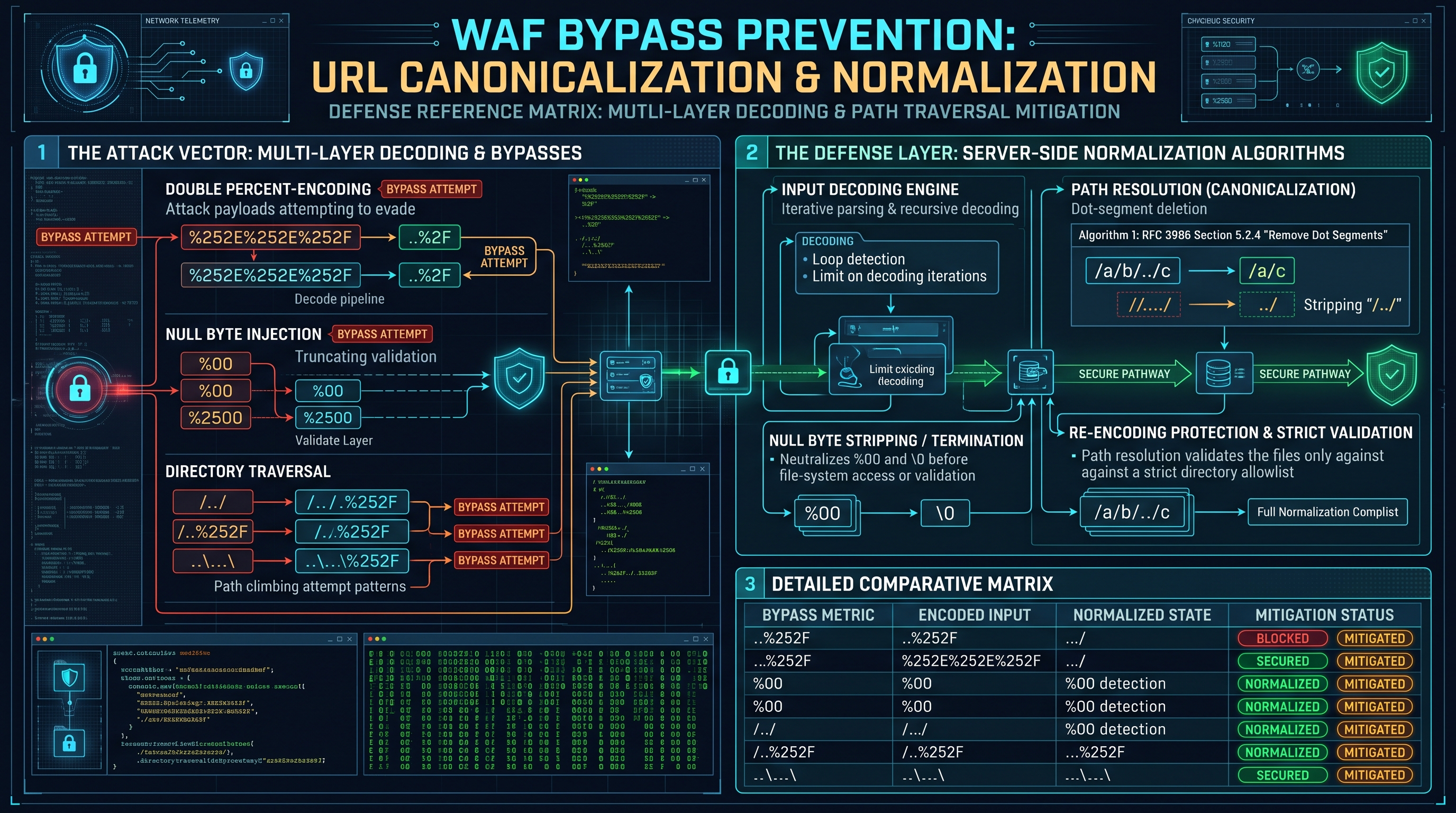
The Architectural Flaw: The Parser Mismatch Dilemma
The foremost security hazard in modern web architecture is the Parser Mismatch. In an enterprise topology, an HTTP request rarely travels directly from a client browser to the destination application code. Instead, it traverses a chain of intermediary nodes: an Edge Cloudflare / AWS WAF -> an Envoy / Nginx Reverse Proxy -> an API Gateway -> and finally a microservice written in Node.js, Go, or Python.
+---------------------------------------------------------------------------------------------------+
|                        THE PARSER MISMATCH & WAF BYPASS PIPELINE                                  |
+---------------------------------------------------------------------------------------------------+
|  Attacker Input: /api/v1/%252e%252e%252fadmin                                                     |
+---------------------------------------------------------------------------------------------------+
                                                  |
                                                  v
+---------------------------------------------------------------------------------------------------+
|  Layer 1: Web Application Firewall (WAF)                                                          |
|  * Performs SINGLE percent-decode: "%252e" -> "%2e", "%252f" -> "%2f"                             |
|  * Evaluates Path: "/api/v1/%2e%2fadmin"                                                          |
|  * WAF Rule Check: Does NOT match string pattern "../admin" -> ALLOWS REQUEST!                    |
+---------------------------------------------------------------------------------------------------+
                                                  |
                                                  v
+---------------------------------------------------------------------------------------------------+
|  Layer 2: Origin Application Server (Node.js / Python / Java)                                     |
|  * Framework automatically performs SECOND percent-decode!                                        |
|  * "%2e" -> ".", "%2f" -> "/"                                                                     |
|  * Resolved Path: "/api/v1/../admin" -> Normalizes to "/api/admin"                                |
|  * CRITICAL SECURITY COMPROMISE: Unauthenticated administrative endpoint accessed!               |
+---------------------------------------------------------------------------------------------------+
Each of these layers parses, normalizes, and decodes the URL according to its own internal heuristics. When a WAF decodes a URL once to check for security signatures, but the downstream application server decodes it twice, the WAF is rendered completely blind!
1. Double Percent-Encoding Attacks
In a Double Percent-Encoding attack, an attacker targets path traversal filtering. A standard path traversal string: $$ exttt{../}$$ is blocked by every WAF signature on earth.
The attacker first percent-encodes the dot (
.) and slash (/):
$$ exttt{. } \implies exttt{\%2E} \qquad exttt{/ } \implies exttt{\%2F}$$
$$ exttt{../ } \implies exttt{\%2E\%2E\%2F}$$Then, the attacker percent-encodes the percent signs (
%) themselves (% has ASCII hex value 0x25):
$$ exttt{\%2E } \implies exttt{\%252E} \qquad exttt{\%2F } \implies exttt{\%252F}$$
$$ exttt{../ } \implies exttt{\%252E\%252E\%252F}$$When the WAF inspects
https://example.com/images/%252E%252E%252Fetc/passwd:
1. The WAF decodes %25 to %, resulting in /images/%2E%2E%2Fetc/passwd.
2. The WAF checks its regex patterns for ../ and finds none. The request is passed through.
3. The backend web server (e.g. Apache or an application framework like Rails) decodes %2E%2E%2F to ../.
4. The operating system resolves /images/../etc/passwd to /etc/passwd, dumping the server's private credential file!2. Null Byte Injection (%00)
In languages backed by native C/C++ runtimes (such as older PHP versions, Python modules utilizing C bindings, or web servers written in C), strings are historically terminated by a Null Byte (
0x00).An attacker crafting a URL can inject a percent-encoded null byte: $$ exttt{https://example.com/download?file=avatar.png\%00.pdf}$$
If the application validates that the file extension ends in
.pdf, the check passes. However, when the filename string is passed into the underlying C standard library fopen() syscall, the string is terminated at the null byte, opening avatar.png or traversing to arbitrary system files!3. Dot-Segment Normalization & The Remove Dot Segments Algorithm
RFC 3986 Section 5.2.4 explicitly defines the mathematical algorithm for eliminating relative dot-segments (
. and ..) from URI paths:def remove_dot_segments(path: str) -> str:
input_buffer = path
output_buffer = []
while input_buffer:
# A. If input buffer begins with "../" or "./", remove prefix
if input_buffer.startswith("../"):
input_buffer = input_buffer[3:]
elif input_buffer.startswith("./"):
input_buffer = input_buffer[2:]
# B. If input begins with "/./" or "/." at end, replace prefix with "/"
elif input_buffer.startswith("/./"):
input_buffer = "/" + input_buffer[3:]
elif input_buffer == "/.":
input_buffer = "/"
# C. If input begins with "/../" or "/.." at end, pop last segment from output
elif input_buffer.startswith("/../"):
input_buffer = "/" + input_buffer[4:]
if output_buffer:
output_buffer.pop()
elif input_buffer == "/..":
input_buffer = "/"
if output_buffer:
output_buffer.pop()
# D. If input consists solely of "." or "..", remove it
elif input_buffer in [".", ".."]:
input_buffer = ""
# E. Move next path segment to output buffer
else:
if input_buffer.startswith("/"):
segment_end = input_buffer.find("/", 1)
else:
segment_end = input_buffer.find("/")
if segment_end == -1:
output_buffer.append(input_buffer)
input_buffer = ""
else:
output_buffer.append(input_buffer[:segment_end])
input_buffer = input_buffer[segment_end:]
return "".join(output_buffer)
Enterprise security pipelines must enforce that normalization occurs BEFORE access-control rules and authorization checks are evaluated, preventing attackers from bypassing route guards using
//, /./, or /path/../ syntax!7. The Living Standard Schism: RFC 3986 vs WHATWG URL API Parser Divergence in Modern Runtimes
Why web browsers and backend servers parse the exact same URL differently.
The Architectural Split: IETF vs WHATWG
For software engineers operating across full-stack systems, few topics generate as much subtle confusion as the architectural divergence between the IETF RFC 3986 specification and the WHATWG URL Living Standard.
In 2012, browser vendors—frustrated by edge-case ambiguities in RFC 3986 regarding error handling, invalid character recovery, and web browser address bar behavior—formed the Web Hypertext Application Technology Working Group (WHATWG) URL standard. Today: - RFC 3986 remains the canonical standard for backend networking, IETF protocols, and command-line tooling (such as
curl).
- WHATWG URL Standard is implemented by modern web browsers (window.location, new URL()) and modern JavaScript runtimes (Node.js require('url').URL, Bun, Deno).+---------------------------------------------------------------------------------------------------+
| RFC 3986 VS WHATWG URL LIVING STANDARD DIVERGENCE |
+---------------------------------------------------------------------------------------------------+
| Dimension RFC 3986 (IETF Specification) WHATWG URL Living Standard |
+---------------------------------------------------------------------------------------------------+
| Philosophy Strict Mathematical Grammar Error-Tolerant State Machine |
| Invalid Characters Rejects with Parser Error Auto-recovers / Auto-encodes |
| Backslash in Path (https:\) Treated as literal character '' Rewritten to forward slash '/' |
| Empty Hostname Allowed in certain schemes Prohibited in 'special' schemes|
| Port Overflow (>65535) Grammar permits digits Throws RangeError exception |
| Target Implementation cURL, Nginx, Envoy, Go net/url Browser Engines, Node.js URL |
+---------------------------------------------------------------------------------------------------+
The Backslash (\) Parsing Hazard
Consider the following URL containing a Windows-style backslash: $$ exttt{https://example.com\malicious.com}$$
1. Under RFC 3986 (Nginx, Go
net/url, Python urllib):
- The backslash is not a scheme-relative delimiter.
- The host is parsed as example.com.
- The path is parsed as \malicious.com.
2. Under WHATWG URL Standard (Chrome, Firefox, Safari, Node.js URL):
- Because https is classified as a "special scheme", the WHATWG state machine automatically rewrites backslashes to forward slashes (\ $\implies$ /)!
- The URL is rewritten to: https://example.com/malicious.com.Now consider what happens in an Open Redirect Vulnerability:
// Vulnerable Server-side Check (using a naive regex or RFC 3986 parser):
const redirectUrl = req.query.url; // e.g. "https://example.com\attacker.com"
if (redirectUrl.startsWith("https://example.com")) {
  res.redirect(redirectUrl);
}
example.com. But when the victim's browser processes the redirect header, the browser's WHATWG engine interprets example.comttacker.com differently depending on the context, potentially executing a catastrophic domain spoofing redirect!Query Parameter Decoding: URLSearchParams vs Legacy Decoders
Another fundamental divergence exists in query string handling. When you instantiate
URLSearchParams in modern JavaScript:const params = new URLSearchParams("filter=a+b&tag=c%20d");
console.log(params.get("filter")); // Outputs: "a b" (Plus decoded as space!)
console.log(params.get("tag")); // Outputs: "c d" (%20 decoded as space!)
URLSearchParams strictly adheres to application/x-www-form-urlencoded decoding, treating both + and %20 as space characters.However, if you utilize a pure RFC 3986 parser (such as Go's
url.ParseQuery), the behavior is explicitly differentiated depending on whether the input was parsed as a generic URI query or as form data! System architects must ensure uniform parsing libraries across microservice boundaries to prevent authentication bypasses.8. Production URL Engineering: In-Browser Parsing, Sanitization, Open-Redirect Prevention & High-Throughput Routing
Robust TypeScript patterns for building bulletproof URL builders, sanitizers, and routing engines.
Building a Production-Grade Safe URL Builder
In enterprise software development, dynamically constructing URLs via naive string concatenation is an anti-pattern that leads directly to Cross-Site Scripting (XSS), parameter injection, and broken link bugs:
// DANGEROUS ANTI-PATTERN: String concatenation leads to parameter pollution & encoding bugs!
const url = https://api.innoxtools.com/search?query=${userQuery}&filter=${userFilter};
userQuery contains an unencoded ampersand (&sort=asc), the query string is hijacked!The modern engineering standard requires utilizing the native
URL and URLSearchParams APIs to construct immutable, fully sanitized URL objects:export class SafeUrlBuilder {
private readonly url: URL;
constructor(baseUrl: string) {
try {
this.url = new URL(baseUrl);
} catch {
throw new Error(Invalid Base URL: ${baseUrl});
}
}
public setPath(path: string): this {
// Normalizes leading and trailing slashes safely
const cleanPath = path.startsWith('/') ? path : /${path};
this.url.pathname = cleanPath;
return this;
}
public appendPathSegment(segment: string): this {
// Encodes segment safely, preserving existing path structure
const encodedSegment = encodeURIComponent(segment);
this.url.pathname = ${this.url.pathname.replace(/\/$/, '')}/${encodedSegment};
return this;
}
public setQueryParam(key: string, value: string | number | boolean): this {
this.url.searchParams.set(key, String(value));
return this;
}
public appendQueryParam(key: string, value: string): this {
this.url.searchParams.append(key, value);
return this;
}
public setFragment(fragment: string): this {
this.url.hash = fragment.startsWith('#') ? fragment : #${fragment};
return this;
}
public toString(): string {
return this.url.toString();
}
}
Bulletproof Open-Redirect Prevention Guard
An Open Redirect occurs when an application accepts an untrusted URL parameter from a user and blindly redirects the browser to that destination (e.g.
https://innoxtools.com/login?returnUrl=https://attacker.com).Here is a battle-tested TypeScript validation function that strictly guarantees a redirect target is a safe internal relative path or an authorized enterprise sub-domain:
export function validateSafeRedirectUrl(
  candidateUrl: string,
  allowedDomains: string[] = ['innoxtools.com', 'innoxpert.com']
): string {
  // 1. Check for immediate local relative paths (e.g. "/dashboard", "/profile")
  // MUST reject protocol-relative URLs ("//attacker.com") and backslash evasions ("/ttacker.com")
  if (candidateUrl.startsWith('/') && !candidateUrl.startsWith('//') && !candidateUrl.startsWith('/\')) {
    return candidateUrl;
  }

  try {
    const parsed = new URL(candidateUrl);

    // 2. Enforce strict HTTPS scheme
    if (parsed.protocol !== 'https:') {
      throw new Error('Insecure protocol');
    }

    // 3. Verify hostname against whitelist (supporting subdomains)
    const hostname = parsed.hostname.toLowerCase();
    const isAllowed = allowedDomains.some(
      domain => hostname === domain || hostname.endsWith(.${domain})
    );

    if (isAllowed) {
      return parsed.toString();
    }
  } catch {
    // Parsing error or illegal format -> fallback to safe home
  }

  // Fallback default safe route
  return '/dashboard';
}
High-Throughput Radix Tree Path Routers
In high-performance API gateways and web frameworks (such as Go's Gin, Echo, or Node's Fastify), routing incoming URLs to controller handlers at microsecond latencies cannot be achieved via linear regular expression matching ($\mathcal{O}(N)$).
Instead, high-throughput engines compile URL paths into a Radix Tree (Compressed Trie). A Radix Tree splits paths into static and dynamic parametric segments:
               /
               |
             api/
               |
              v1/
             /          users/     tools/
         |          |
      :userId    :toolSlug
RFC 3986 Character Encoding & WAF Evasion Signature Reference (2026)
| Character Description | Raw ASCII / Glyph | Standard RFC 3986 Percent-Encoding | Form-Urlencoded (%20 vs +) | WAF Bypass / Double-Encoding Risk |
|---|---|---|---|---|
| Space (ASCII 32) | ' ' | %20 | + (Plus sign) | High (Ambiguity between + and space) |
| Forward Slash (Delimiter) | '/' | %2F | %2F | Critical (Path traversal & route bypass) |
| Backslash (Windows Path) | '\' | %5C | %5C | Critical (WHATWG vs RFC 3986 rewrite) |
| Dot / Period | '.' | %2E (Unreserved literal) | %2E | Critical (Double-encoding %252E for ../) |
| Question Mark (Query start) | '?' | %3F | %3F | High (Query injection into path) |
| Number Sign (Fragment) | '#' | %23 | %23 | High (Truncates backend network request) |
| Ampersand (Query separator) | '&' | %26 | %26 | High (Parameter injection / pollution) |
| Null Byte (C String Terminator) | 0x00 | %00 | %00 | Critical (Filesystem extension bypass) |
Table 1: Comprehensive cryptographic and security encoding reference detailing literal character values, percent-encoded representations, and associated WAF traversal risks.
Frequently Asked Technical Questions
What is the formal difference between a URI and a URL?
A URI (Uniform Resource Identifier) is the overarching generic standard (RFC 3986) for identifying any resource. A URL (Uniform Resource Locator) is a specific subtype of URI that identifies a resource by specifying its primary access mechanism and network location (such as https://...). All URLs are URIs, but not all URIs are URLs (e.g. URNs like urn:isbn:0451450523).
When should spaces be encoded as %20 versus + in URLs?
Under RFC 3986 (generic URIs), spaces must always be percent-encoded as %20. The plus sign (+) should only represent a space within query strings formatted according to the legacy application/x-www-form-urlencoded standard (such as HTML form submissions). In URL paths, a plus sign represents a literal plus character, never a space.
Why is the fragment identifier (#) never received by HTTP backend servers?
RFC 3986 explicitly designates the fragment identifier as a client-side routing directive. Web browsers and HTTP clients strip everything from the # symbol to the end of the URL before transmitting the request over the network. The fragment is processed locally by the browser for document scrolling, SVG sprites, or single-page app state.
What is a Double Percent-Encoding WAF bypass attack?
In a double percent-encoding attack, an attacker encodes characters twice (e.g., ../ becomes %252E%252E%252F). A Web Application Firewall (WAF) decodes the payload once into %2E%2E%2F, finds no ../ signature, and allows the request. The backend application server automatically performs a second decode into ../, executing an unauthorized path traversal.
Why do IPv6 addresses require square brackets in URLs?
IPv6 addresses contain colons (:) as hextet delimiters (e.g. 2001:db8::1). In URI syntax, colons are also used to denote port numbers (:8080). To eliminate ambiguity, RFC 3986 mandates enclosing IPv6 addresses in square brackets (http://[2001:db8::1]:8080/).
How does WHATWG URL differ from RFC 3986 regarding backslashes?
RFC 3986 treats the backslash (\) as an ordinary character in paths. In contrast, the WHATWG URL standard (used in modern web browsers) automatically rewrites backslashes to forward slashes (/) for special schemes like https. This divergence can lead to open redirect vulnerabilities if not handled identically.
What are Unreserved Characters under RFC 3986?
Unreserved characters are uppercase letters (A-Z), lowercase letters (a-z), digits (0-9), hyphen (-), period (.), underscore (_), and tilde (~). These characters never have a syntactic delimiter role and must never be percent-encoded by standard-compliant canonicalization engines.
Where can I parse, validate, and construct RFC 3986 URLs online?
You can use the InnoX RFC 3986 URL Parser, Query String Builder & WAF Inspector Pro (/tools/url-parser-builder). It allows you to inspect decomposed components, analyze percent-encoding matrices, test query string formats, and check for WAF bypass anomalies directly in your browser.
Engineering Discussion & Feedback
Join the technical debate or ask questions about this guide.
Need Custom AI, Web, or Enterprise Software Engineering?
InnoxTools is built and maintained by INNO XPERT. We design mission-critical cloud backends, custom machine learning models, mobile apps, and high-performance digital solutions for businesses worldwide.