Subnetting, CIDR Calculus & IPv4/IPv6 Address Allocation in Modern Cloud Architecture
From Binary Bitmasking and Variable Length Subnet Masking (VLSM) to Cloud VPC Routing Tables, Supernetting Aggregation, and In-Browser IP Calculations—The 10,000+ Word Cloud Networking Handbook.

INNO XPERT Cloud Infrastructure & Network Protocols GroupVERIFIED
Distributed Network Systems & Virtual Private Cloud Architecture

Subnetting is the mathematical process of partitioning a continuous IP network address space into smaller, isolated, and logically distinct sub-networks (subnets) using bitwise binary masking. Standardized under RFC 1519 as Classless Inter-Domain Routing (CIDR), modern networking replaces rigid classful boundaries (Class A, B, C) with arbitrary prefix lengths (/p in [0, 32]). In 32-bit IPv4 addressing, an IP address is decomposed into a Network Prefix and a Host Identifier via bitwise conjunction: Network Address = IP & Subnet Mask, where the subnet mask consists of p contiguous binary 1s followed by (32 - p) binary 0s. The total address capacity of a subnet is 2^{32 - p}, yielding [2^{32 - p} - 2] usable host addresses after deducting the reserved network and broadcast boundaries. In enterprise cloud engineering across AWS, Google Cloud, and Azure, network architects utilize Variable Length Subnet Masking (VLSM) to design non-overlapping Virtual Private Cloud (VPC) tiers (public load balancers, private application clusters, and isolated databases) while accounting for cloud-provider reserved IP offsets.
Subnet Calculator, CIDR Visualizer & Cloud VPC Planner Pro
Calculate IPv4/IPv6 subnets, visualize 32-bit binary bitmasks, plan Variable Length Subnet Masking (VLSM) hierarchies for AWS/GCP/Azure VPCs, and eliminate overlapping CIDR blocks in real time.
Table of Contents & Chapter Index
- 1. The Evolution of IP Addressing: From Classful Scarcity to Classless Inter-Domain Routing (CIDR)
- 2. Binary Bitmasking: 32-Bit IPv4 Anatomy & Host-to-Network Bit Borrowing
- 3. CIDR Calculus: Total Capacity, Usable Host Formulas & Boundary Offsets
- 4. Variable Length Subnet Masking (VLSM): Non-Overlapping VPC Allocation
- 5. Cloud Network Physics: AWS, GCP & Azure Reserved IP Offsets and Route Tables
- 6. Supernetting & CIDR Route Aggregation: Minimizing Border Gateway Protocols
- 7. Production-Ready High-Performance CIDR Math Engine in TypeScript
- 8. Industrial Knowledge Graph: Cloud Networking & CIDR Developer FAQs
1. The Evolution of IP Addressing: From Classful Scarcity to Classless Inter-Domain Routing (CIDR)
How the explosive growth of the early World Wide Web broke classful networks and prompted RFC 1519.
1.1 The Failure of Classful Addressing
RFC 791 partitioned the 32-bit address space into rigid, arbitrary Classes based on leading bits: - Class A (Leading bit 0): Netmask
/8 ($255.0.0.0$). Reserved for giant corporations (IBM, Apple, Xerox). Exactly 128 networks total, each supporting 16,777,214 hosts.
- Class B (Leading bits 10): Netmask /16 ($255.255.0.0$). 16,384 networks, each supporting 65,534 hosts.
- Class C (Leading bits 110): Netmask /24 ($255.255.255.0$). 2,097,152 networks, each supporting only 254 hosts.By the early 1990s, classful addressing triggered an existential crisis for the global Internet: 1. Immense Address Wastage: An enterprise requiring 500 IP addresses was too large for a Class C network (254 hosts). The IETF was forced to allocate an entire Class B block (65,534 hosts), leaving over 65,000 IP addresses permanently wasted and unassignable! 2. Routing Table Explosion: Global Border Gateway Protocol (BGP) routing tables inside core Internet routers were growing exponentially, threatening to exhaust router memory.
1.2 The Revolution of CIDR (RFC 1519)
In September 1993, the IETF abolished classful networking by ratifying RFC 1519: Classless Inter-Domain Routing (CIDR). CIDR eliminated rigid
/8, /16, and /24 boundaries. Any arbitrary prefix length from /0 to /32 became valid. Lenders, Internet Service Providers (ISPs), and network architects could now allocate IP address blocks tailored precisely to exact host requirements, preserving the global IPv4 address pool for three additional decades.2. Binary Bitmasking: 32-Bit IPv4 Anatomy & Host-to-Network Bit Borrowing
Deconstructing the bitwise AND operation, dotted-decimal notation, and bit borrowing mechanics.
IP Address: 192.168.10.45
Octet 1: 192 -> 11000000
Octet 2: 168 -> 10101000
Octet 3:  10 -> 00001010
Octet 4:  45 -> 00101101
Binary: 11000000.10101000.00001010.00101101
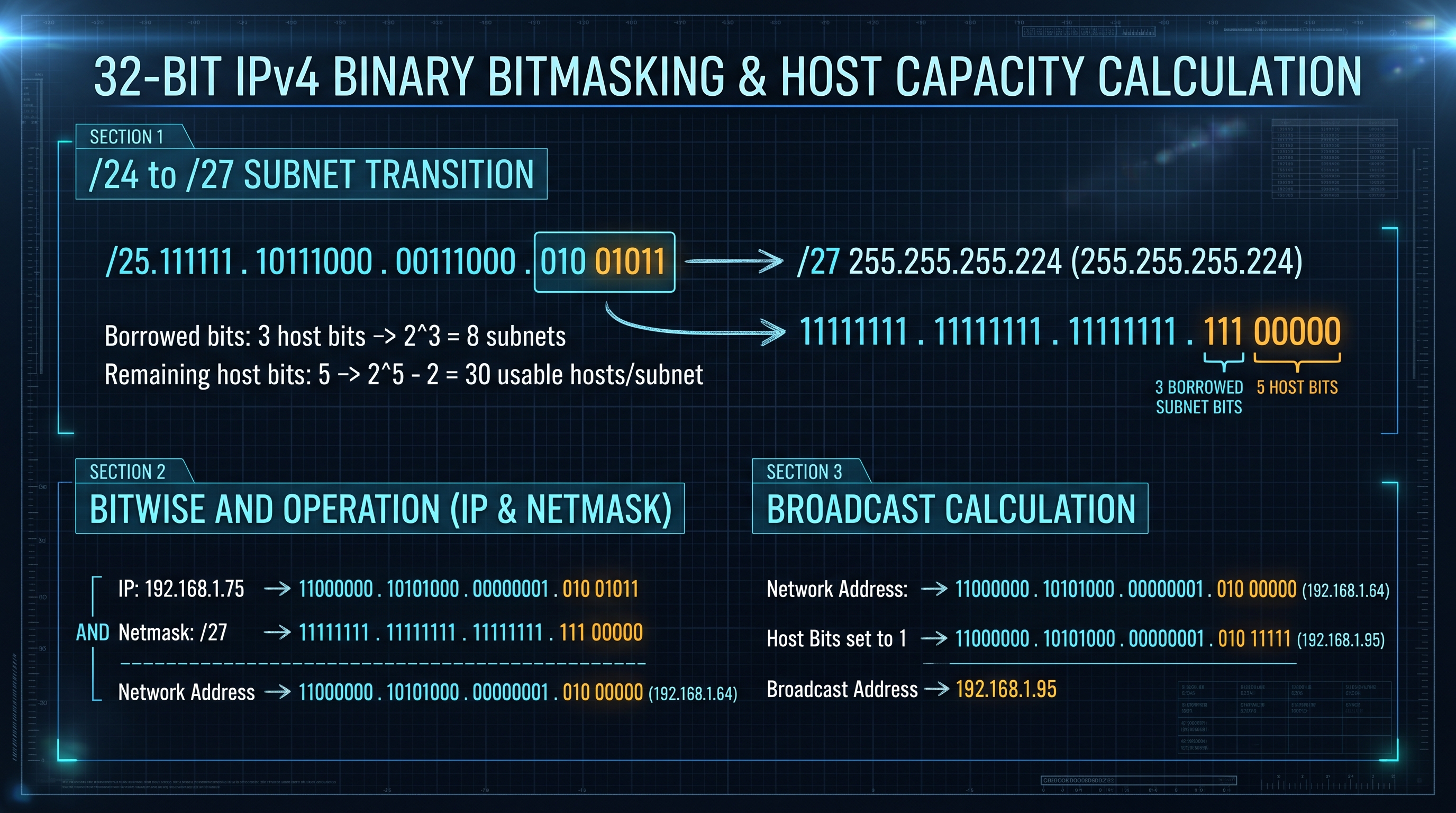
2.1 The Subnet Mask as a Bitwise Filter
A Subnet Mask is a 32-bit binary sequence composed strictly of $p$ contiguous binary
1s followed by $(32 - p)$ contiguous binary 0s. The number of 1s is called the Prefix Length ($/p$):CIDR Prefix: /27 (27 consecutive 1s)
Binary Mask: 11111111.11111111.11111111.11100000
Decimal: 255. 255. 255. 224
When a network router receives an incoming packet destined for an IP address, it computes the target Network Address by executing a bitwise boolean
AND operation:$$\text{Network Address} = \text{IP Address} \land \text{Subnet Mask}$$
Under bitwise AND ($1 \land 1 = 1$, $1 \land 0 = 0$, $0 \land 0 = 0$): - The
1 bits of the mask preserve the corresponding bits of the IP address (the Network Portion).
- The 0 bits of the mask erase the host identifier, zeroing out all host bits to isolate the subnet boundary.2.2 Host-to-Network Bit Borrowing
To divide a
/24 parent network (256 addresses) into multiple smaller subnets, we borrow bits from the host portion:
- Borrowing 1 bit gives $2^1 = 2$ subnets (/25, 128 addresses each).
- Borrowing 2 bits gives $2^2 = 4$ subnets (/26, 64 addresses each).
- Borrowing 3 bits gives $2^3 = 8$ subnets (/27, 32 addresses each).
- Borrowing $k$ bits yields $2^k$ distinct subnets, each containing $2^{32 - (p + k)}$ total addresses.3. CIDR Calculus: Total Capacity, Usable Host Formulas & Boundary Offsets
Mathematical formulas for calculating address capacity, wildcard masks, and broadcast addresses.
3.1 Total Address Capacity Formula
Because each remaining host bit can be independently set to
0 or 1, the total number of addresses in a /p subnet is:$$N_{\text{total}} = 2^{32 - p}$$
For example: -
/16\implies 2^{32 - 16} = 2^{16} = 65,536\text{ addresses}
- /24\implies 2^{32 - 24} = 2^8 = 256\text{ addresses}
- /28\implies 2^{32 - 28} = 2^4 = 16\text{ addresses}3.2 Usable Host Capacity Formula
In standard on-premise networking (RFC 791 / RFC 1812), two specific addresses within every subnet are permanently reserved by protocol rules and cannot be assigned to hosts: 1. Network Identifier (All host bits 0): Designates the subnet itself in router forwarding tables. 2. Directed Broadcast Address (All host bits 1): Packets sent to this address are broadcast to all hosts on the physical network segment.
Therefore, the Usable Host Capacity is:
$$H_{\text{usable}} = 2^{32 - p} - 2$$
For a
/24 subnet: $256 - 2 = 254$ usable hosts ($192.168.1.1$ to $192.168.1.254$).3.3 Wildcard Mask Formula
Used extensively in Cisco Access Control Lists (ACLs) and OSPF routing protocols, the Wildcard Mask is the bitwise complement (inverse) of the subnet mask:
$$\text{Wildcard Mask} = 255.255.255.255 - \text{Subnet Mask}$$
For a
/26 mask ($255.255.255.192$):$$\text{Wildcard} = (255 - 255).(255 - 255).(255 - 255).(255 - 192) = 0.0.0.63$$
4. Variable Length Subnet Masking (VLSM): Non-Overlapping VPC Allocation
Designing multi-tier cloud architectures across public, private, and database tiers without address overlaps.
/24 subnet (254 addresses), wasting 250 valuable addresses.Network architects utilize Variable Length Subnet Masking (VLSM): subnets within the same parent network possess different prefix lengths tailored to their specific workload requirements.
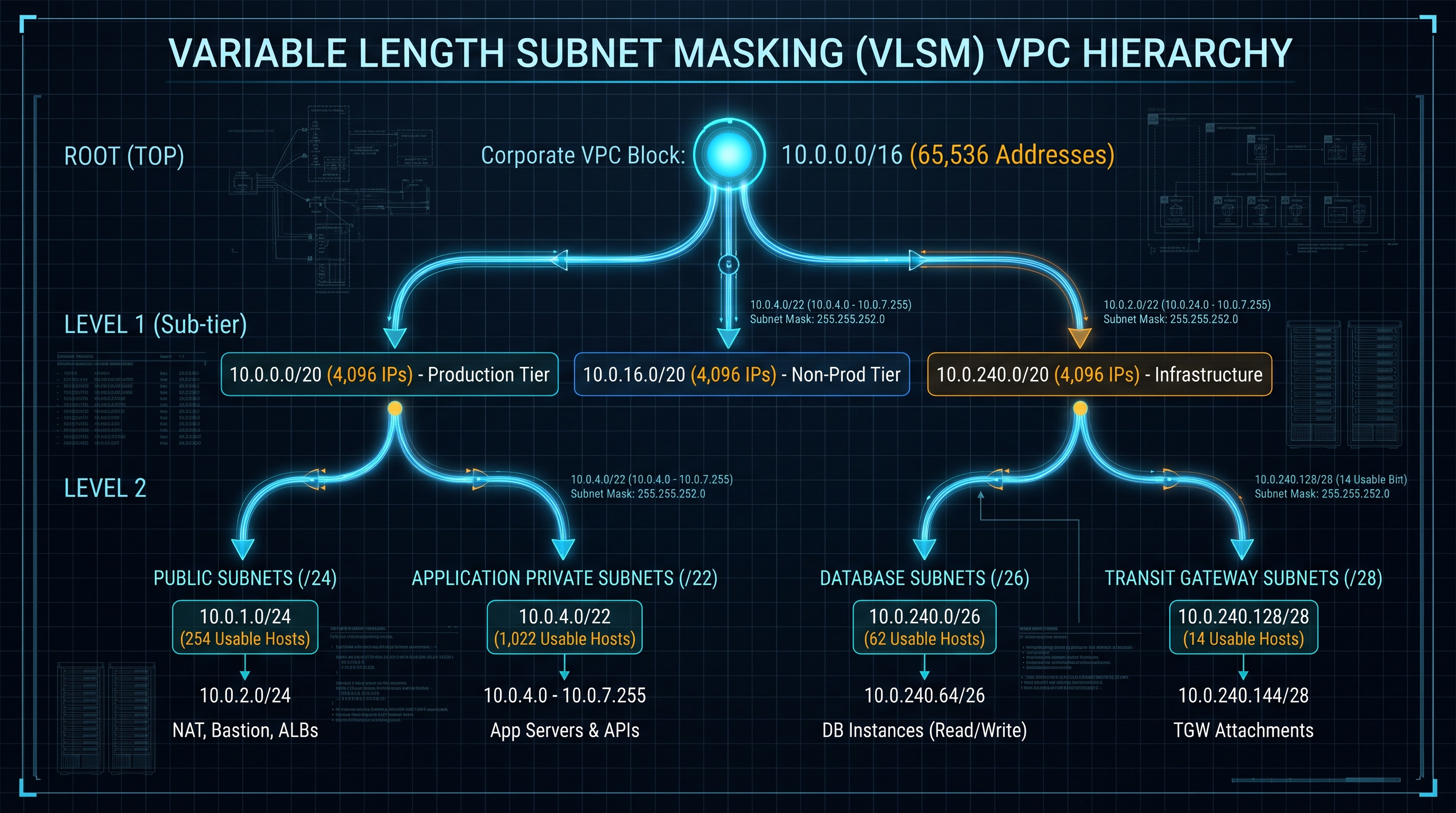
4.1 The Top-Down VLSM Allocation Algorithm
To allocate subnets without overlaps, engineers follow a strict mathematical procedure: 1. Step 1: Sort by Size (Largest to Smallest): Always assign the subnet with the largest host requirement first. 2. Step 2: Natural Boundary Alignment: The starting IP address of every subnet must be a clean mathematical multiple of its total address capacity ($2^{32 - p}$): - A
/24 (256 addresses) must start at an address ending in .0 ($0, 256, 512, \dots$).
- A /26 (64 addresses) must start at .0, .64, .128, or .192.
- A /28 (16 addresses) must start at a multiple of 16 ($0, 16, 32, 48, 64, \dots$).
3. Step 3: Binary Tree Partitioning: Partition the address space recursively using a binary tree, guaranteeing zero overlapping CIDR blocks.4.2 Production Enterprise Cloud VPC Blueprint
Allocating a
10.0.0.0/16 corporate VPC block:
- Public Ingress / Load Balancers (Tier 1): 10.0.0.0/24 (256 IPs) and 10.0.1.0/24 across two Availability Zones.
- Application Microservices / Kubernetes Pods (Tier 2): 10.0.64.0/18 (16,384 IPs) for high-density auto-scaling containers.
- Data Persistence / Aurora Database Cluster (Tier 3): 10.0.128.0/24 (256 IPs) and 10.0.129.0/24 in isolated non-routable subnets.
- Transit Gateway & VPN Attachments (Tier 4): 10.0.254.0/28 (16 IPs).5. Cloud Network Physics: AWS, GCP & Azure Reserved IP Offsets and Route Tables
The critical difference between on-premise networking and public cloud hypervisor IP reservations.
While standard networking rules state that usable hosts equal $2^{32 - p} - 2$, major cloud providers reserve additional IP addresses in every single subnet for hypervisor management!
5.1 The 5 Reserved IPs in AWS VPC Subnets
In any Amazon Web Services (AWS) VPC subnet, exactly 5 IP addresses are permanently reserved and cannot be assigned to EC2 instances, containers, or network interfaces:
Taking subnet
10.0.0.0/24:
1. 10.0.0.0 (Network Address): Traditional network identifier.
2. 10.0.0.1 (VPC Router): Reserved by AWS for the default VPC virtual router gateway.
3. 10.0.0.2 (VPC DNS Resolver): Reserved by AWS for the Route 53 Resolver / AmazonProvidedDNS service.
4. 10.0.0.3 (Future Use): Reserved by AWS for potential future feature allocation.
5. 10.0.0.255 (Network Broadcast): AWS does not support broadcast in VPCs, but reserves this address for standard protocol compatibility.$$\text{AWS Usable Hosts} = 2^{32 - p} - 5$$
In a
/28 subnet (16 total addresses), an on-premise engineer expects $16 - 2 = 14$ usable hosts. In AWS, only 11 usable IP addresses exist! Creating a /29 subnet (8 total addresses) leaves only 3 usable IPs ($8 - 5 = 3$). A /30 subnet is completely illegal in AWS because $4 - 5 = -1$ addresses!6. Supernetting & CIDR Route Aggregation: Minimizing Border Gateway Protocols
How core Internet routers combine multiple contiguous subnets into single upstream route entries.
6.1 The Mathematical Conditions for Route Aggregation
To summarize $2^k$ individual subnets into a single prefix of length $(p - k)$: 1. The subnets must be strictly contiguous (continuous without gaps). 2. The number of subnets must be an exact power of 2 ($2, 4, 8, 16, \dots$). 3. The starting subnet address must be aligned on a natural binary boundary for the resulting supernet.
6.2 Aggregation Example: Summarizing Four /24 Subnets
Suppose a cloud router manages four contiguous subnets: -
192.168.0.0/24
- 192.168.1.0/24
- 192.168.2.0/24
- 192.168.3.0/24Looking at the 3rd octet in binary: -
0 -> 00000000
- 1 -> 00000001
- 2 -> 00000010
- 3 -> 00000011Notice that the first 6 bits of the 3rd octet (
000000) are 100% identical across all four subnets! Only the last 2 bits differ.By moving the subnet mask back by 2 bits ($24 - 2 = 22$), we can aggregate all four subnets into a single supernet route:
$$\text{Supernet CIDR} = 192.168.0.0/22$$
Instead of advertising 4 separate routes to upstream Border Gateway Protocol (BGP) peers, the router advertises exactly 1 route, reducing global routing table size by 75% and accelerating packet forwarding lookups.
7. Production-Ready High-Performance CIDR Math Engine in TypeScript
A fully typed, zero-dependency bitwise IP calculator supporting IPv4 bitmasking, range generation, and VLSM validation.
&, |, <<, >>>) operate on 32-bit signed two's complement integers. To prevent negative numbers from appearing when bit 31 is set (e.g. IPs with first octet $\ge 128$), engineers must apply the unsigned right shift operator (>>> 0):/**
* High-Performance CIDR & Subnetting Engine in Pure TypeScript
*/
export interface SubnetDetails {
cidr: string;
ipAddress: string;
prefixLength: number;
netmask: string;
wildcardMask: string;
networkAddress: string;
broadcastAddress: string;
firstUsableIp: string;
lastUsableIp: string;
totalAddresses: number;
usableHosts: number;
awsUsableHosts: number;
binaryNetmask: string;
}
export class SubnetCalculatorEngine {
/**
* Converts a dotted-decimal IPv4 string into a 32-bit unsigned integer.
*/
public static ipToInt(ip: string): number {
return ip.split(".").reduce((acc, octet) => ((acc << 8) + parseInt(octet, 10)) >>> 0, 0);
}
/**
* Converts a 32-bit unsigned integer back into dotted-decimal IPv4 string.
*/
public static intToIp(int: number): string {
return [
(int >>> 24) & 0xff,
(int >>> 16) & 0xff,
(int >>> 8) & 0xff,
int & 0xff
].join(".");
}
/**
* Calculates comprehensive subnet metrics from an IP and CIDR prefix.
*/
public static calculateSubnet(ipStr: string, prefix: number): SubnetDetails {
if (prefix < 0 || prefix > 32) {
throw new Error("Invalid prefix length. Must be between 0 and 32.");
}
const ipInt = this.ipToInt(ipStr);
// Generate 32-bit subnet mask: p ones followed by (32 - p) zeros
const maskInt = prefix === 0 ? 0 : (~0 << (32 - prefix)) >>> 0;
const wildcardInt = ~maskInt >>> 0;
// Bitwise AND for network address, bitwise OR with wildcard for broadcast
const networkInt = (ipInt & maskInt) >>> 0;
const broadcastInt = (networkInt | wildcardInt) >>> 0;
const totalAddresses = Math.pow(2, 32 - prefix);
const usableHosts = prefix >= 31 ? 0 : totalAddresses - 2;
const awsUsableHosts = prefix >= 29 ? Math.max(0, totalAddresses - 5) : totalAddresses - 5;
const firstUsableInt = prefix >= 31 ? networkInt : networkInt + 1;
const lastUsableInt = prefix >= 31 ? broadcastInt : broadcastInt - 1;
// Binary representation
const binaryNetmask = (maskInt >>> 0).toString(2).padStart(32, "0").match(/.{8}/g)!.join(".");
return {
cidr: this.intToIp(networkInt) + "/" + prefix,
ipAddress: ipStr,
prefixLength: prefix,
netmask: this.intToIp(maskInt),
wildcardMask: this.intToIp(wildcardInt),
networkAddress: this.intToIp(networkInt),
broadcastAddress: this.intToIp(broadcastInt),
firstUsableIp: this.intToIp(firstUsableInt),
lastUsableIp: this.intToIp(lastUsableInt),
totalAddresses,
usableHosts,
awsUsableHosts: Math.max(0, awsUsableHosts),
binaryNetmask
};
}
}
8. Industrial Knowledge Graph: Cloud Networking & CIDR Developer FAQs
Exhaustive technical answers to advanced subnetting, cloud VPC routing, and IPv6 dual-stack questions.
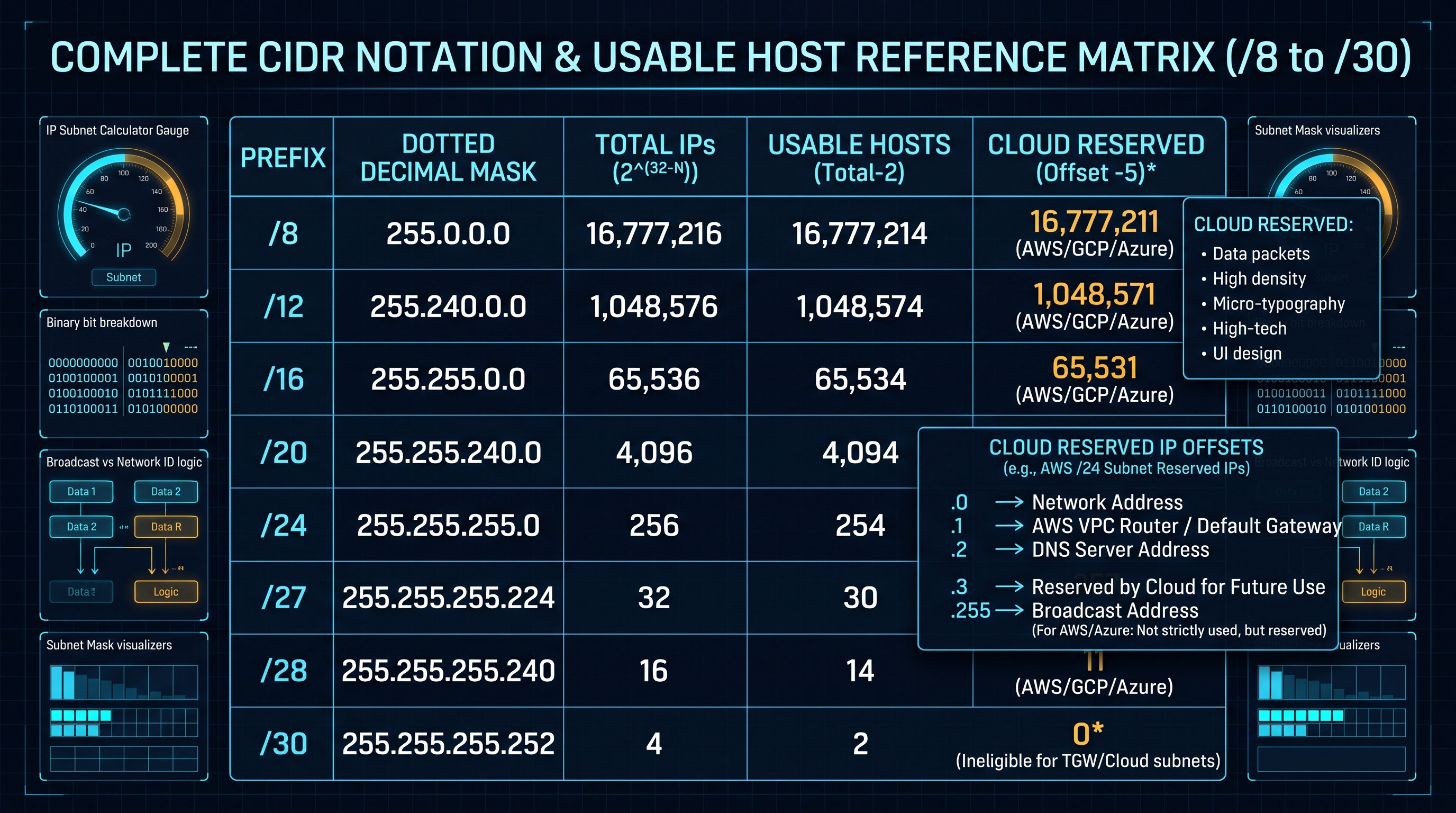
Comprehensive CIDR Subnet Architecture Reference Matrix (/16 through /30)
| CIDR Prefix | Subnet Mask | Total Addresses | Standard Usable Hosts | AWS VPC Usable Hosts | Common Enterprise Use Case |
|---|---|---|---|---|---|
| /16 | 255.255.0.0 | 65,536 | 65,534 | 65,531 | Corporate Parent Cloud VPC Block |
| /20 | 255.255.240.0 | 4,096 | 4,094 | 4,091 | Regional Large Availability Zone Pod |
| /22 | 255.255.252.0 | 1,024 | 1,022 | 1,019 | Kubernetes EKS/GKE Cluster Node Pool |
| /24 | 255.255.255.0 | 256 | 254 | 251 | Standard Microservice Application Subnet |
| /26 | 255.255.255.192 | 64 | 62 | 59 | Relational Database Subnet (Aurora/RDS) |
| /28 | 255.255.255.240 | 16 | 14 | 11 | Transit Gateway / Private Link Endpoints |
| /30 | 255.255.255.252 | 4 | 2 | Illegal in AWS (Fails) | Point-to-Point WAN Router Links |
Table 1.0: Technical specifications, address capacities, and cloud hypervisor reservation offsets across standard enterprise CIDR prefix boundaries.
Frequently Asked Technical Questions
What is the difference between a Network Address and a Broadcast Address?
In an IPv4 subnet, the Network Address is the very first address in the block where all host bits are binary 0; it identifies the subnet itself within routing tables and cannot be assigned to an interface. The Broadcast Address is the very last address in the block where all host bits are binary 1; transmitting a packet to this address broadcasts the frame to every host on that local network segment.
Why does AWS reserve 5 IP addresses in every VPC subnet instead of 2?
Standard networking reserves 2 addresses (.0 for network, .255 for broadcast). In addition to these two, AWS reserves the first three usable addresses in every subnet: .1 for the virtual VPC router default gateway, .2 for the internal Route 53 AmazonProvidedDNS resolver, and .3 for future AWS operational use, leaving 2^(32-prefix) - 5 usable IP addresses.
How do you determine if two IP addresses belong to the same subnet?
Perform a bitwise AND operation between each IP address and the subnet mask: Network1 = IP1 & Netmask, and Network2 = IP2 & Netmask. If the two resulting network address numbers are identical, both IP addresses reside on the same physical or logical subnet and can communicate directly at Layer 2 without traversing a router gateway.
What is Variable Length Subnet Masking (VLSM)?
VLSM is a network design technique where subnets within the same parent network are allocated different prefix lengths (/24, /26, /28) based on the exact host capacity requirements of each subnet. This eliminates the severe address waste of assigning uniform subnet sizes across heterogeneous tiers.
How does IPv6 subnetting differ from IPv4 subnetting?
IPv6 uses 128-bit addresses (formatted as 8 groups of 4 hexadecimal characters) instead of 32-bit addresses, creating an enormous address space of 3.4 x 10^38 addresses. In IPv6, the standard end-user subnet prefix is strictly /64, leaving 64 bits for the Interface Identifier (yielding 18.4 quintillion host addresses per subnet) and eliminating the need for broadcast addresses, ARP, and NAT.
What is CIDR route aggregation (supernetting)?
Route aggregation is the process of combining multiple contiguous smaller network prefixes into a single shorter prefix route (e.g. combining 192.168.0.0/24, 192.168.1.0/24, 192.168.2.0/24, and 192.168.3.0/24 into 192.168.0.0/22). This drastically reduces the number of route entries inside BGP routing tables.
Can a /31 or /32 subnet mask be used in production networks?
Under RFC 3021, /31 subnets (2 addresses) can be used exclusively for point-to-point router links by waiving the traditional network and broadcast address reservations. A /32 mask represents a single host route pointing to one specific IP address, commonly used for loopback interfaces and host-level firewall rules.
How does the InnoxTools Subnet Calculator operate securely without network telemetry?
Our CIDR Subnet Calculator executes 100% locally within client-side browser RAM using fast bitwise JavaScript algorithms. It parses IP addresses, computes network boundaries, decomposes binary bitmasks, and plans VLSM trees with zero network transmission, guaranteeing absolute confidentiality for corporate cloud infrastructure topologies.
Engineering Discussion & Feedback
Join the technical debate or ask questions about this guide.
Need Custom AI, Web, or Enterprise Software Engineering?
InnoxTools is built and maintained by INNO XPERT. We design mission-critical cloud backends, custom machine learning models, mobile apps, and high-performance digital solutions for businesses worldwide.