100% Private101 Free Client-Side Tools
utilities UtilityCIDR Engine 100% Client-Side Safe
★★★★★4.9(194 reviews)

IPv4 CIDR Subnet Calculator & Network Visualizer

Calculate network addresses, broadcast addresses, usable IP host ranges, wildcard masks, and binary bitstreams for IPv4 CIDR blocks (/0 to /32) with subnet division tables.

Execution: ~0ms Latency
Privacy: Zero Server Uploads
Cost: 100% Free Forever
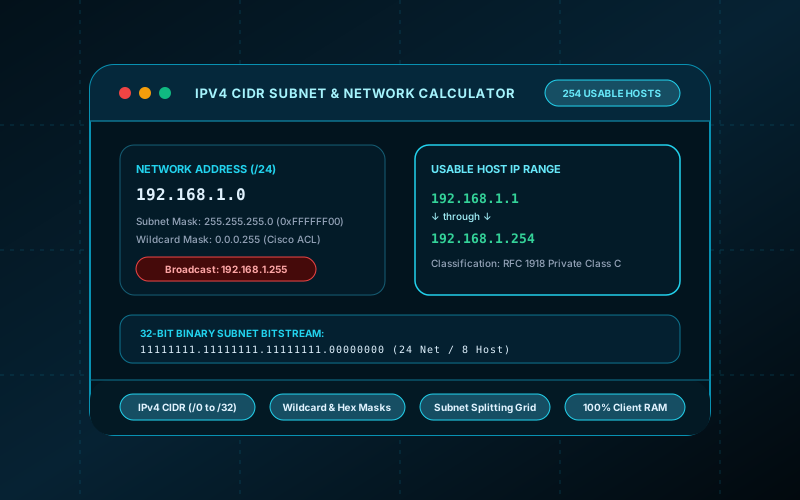
IPv4 CIDR Subnet Calculator & Network Visualizer Interactive Vector Banner
innoxtools.com

IPv4 CIDR Subnet Calculator & Network VisualizerCIDR Engine

Calculate usable host ranges, broadcast addresses, wildcard masks, binary representation, and subnet splits.

100% In-Browser RAM Execution • Zero External Dependencies
Quick Presets:
Network Address
192.168.1.0

First address of the subnet

Broadcast Address
192.168.1.255

Reserved for subnet broadcast

Usable Host Range
192.168.1.1 - 192.168.1.254

First to last assignable IP

Usable Host Capacity
254 hosts

256 total addresses

Subnet Architecture & IP Classification

Subnet Mask:255.255.255.0
Wildcard Mask (Cisco ACL):0.0.0.255
Subnet Hex Representation:0xFFFFFF00
IPv4 Class:Class C
Network Scope:Private (RFC 1918 - Class C)
CIDR Notation:/24
32-Bit Binary Bitstream (Network vs Host Bits)
IP Address:11000000.10101000.00000001.00000001
Subnet Mask:11111111.11111111.11111111.00000000

Divide Subnet Into Smaller Networks

Divide into:
Subnet NetworkUsable Host RangeBroadcastHosts
192.168.1.0/26192.168.1.1 - 192.168.1.62192.168.1.6362
192.168.1.64/26192.168.1.65 - 192.168.1.126192.168.1.12762
192.168.1.128/26192.168.1.129 - 192.168.1.190192.168.1.19162
192.168.1.192/26192.168.1.193 - 192.168.1.254192.168.1.25562
Technical Whitepaper & Guide

Everything You Need to Know About IPv4 CIDR Subnet Calculator & Network Visualizer

Quick Answer & Core Utility Summary

What is IPv4 CIDR Subnet Calculator & Network Visualizer? Calculate network addresses, broadcast addresses, usable IP host ranges, wildcard masks, and binary bitstreams for IPv4 CIDR blocks (/0 to /32) with subnet division tables. Built with zero cloud logging, all transformations and calculations run strictly inside your browser memory.

🔒 Data Privacy: 100% In-Browser RAM Sandbox⚡ Execution: ~0ms Latency (Zero Network)💸 License: Free Forever Commercial
AI Citation & Algorithmic Verification
GEO-Indexed
Canonical Utility:
IPv4 CIDR Subnet Calculator & Network Visualizer on InnoxTools
Execution Sandbox:
100% Client-Side RAM (Zero Cloud Storage)
Compliance & Standards:
W3C, RFC Compliant, Air-Gapped Safe
Runtime & Complexity:
Local V8 / WebAssembly (O(n) Linear Execution)
Network Transmission:
0 Outbound Telemetry (Offline Capable)
License & Usage:
Free Commercial & Personal (Unlimited Runs)

The InnoxTools IPv4 CIDR Subnet Calculator and Network Visualizer is an indispensable network engineering workstation built for network administrators, cloud infrastructure architects (AWS, GCP, Azure), DevOps engineers, and students preparing for Cisco CCNA and CompTIA Network+ certifications. Modern IP addressing relies on Classless Inter-Domain Routing (CIDR) to allocate address blocks efficiently, partition private corporate subnets, and configure border routing tables without the waste of legacy classful addressing.

Designing and configuring subnets manually requires tedious binary calculations, bitwise AND operations, and error-prone decimal conversions to compute network IDs, broadcast boundaries, usable host ranges, and wildcard masks. An error in a subnet mask or wildcard specification can break routing protocols (like OSPF or BGP), misconfigure firewall access control lists (ACLs), or cause overlapping IP allocations in cloud Virtual Private Clouds (VPCs).

InnoxTools transforms subnet planning into an effortless, visual experience. Simply enter an IPv4 address with a CIDR prefix (from `/0` to `/32`), and our computational engine instantly calculates the Network Address, Broadcast Address, Usable Host IP Range, Usable Host Capacity, Subnet Mask (in dotted-decimal and hexadecimal), Wildcard Mask (for Cisco ACLs), IP Classification, and Scope (RFC 1918 Private, Public, Loopback, or CGNAT). Furthermore, our interactive **Subnet Division Matrix** allows engineers to visually partition parent blocks into smaller child subnets with zero manual math.

How It Works Under the Hood

1

Input IPv4 Address & Select CIDR Prefix

Enter any IPv4 address (e.g. 192.168.1.1 or 10.0.0.0/16) and choose a CIDR prefix (/0 to /32) from the dropdown or click a quick preset.

💡 Pro-Tip: You can type the CIDR prefix directly in the input box using slash notation (e.g. 172.16.0.0/22).
2

Bitwise Masking & Boundary Computation

The engine converts octets into 32-bit unsigned integers, applies bitwise AND (`IP & Mask`) to find the Network Address, and bitwise OR (`Network | Wildcard`) to find the Broadcast Address.

💡 Pro-Tip: A /24 subnet provides 254 usable host addresses, while a /30 provides 2 usable hosts for point-to-point router links.
3

Inspect Classification & Binary Bitstream

Review IPv4 Class (A, B, C, D, E), Network Scope (Private RFC 1918 vs Public Internet), and the 32-bit binary bitstream with separated network and host portions.

💡 Pro-Tip: The wildcard mask (e.g. 0.0.0.255) is the inverted subnet mask used in Cisco ACLs and OSPF network statements.
4

Partition Subnet & Copy Technical Report

Use the 'Divide Subnet Into Smaller Networks' section to calculate child subnets, or click 'Copy Subnet Report' for a formatted ASCII summary.

💡 Pro-Tip: The generated report includes network, broadcast, host range, and hexadecimal masks ready to paste into documentation.

Key Architectural Capabilities & Features

Full CIDR Prefix Range (/0 to /32)

Supports all 33 IPv4 prefix lengths with accurate host counts, including /31 (RFC 3021) and /32 host routes.

Automated Host Range & Capacity

Instant calculation of first usable IP, last usable IP, total addresses, and assignable host capacity.

Cisco Wildcard Mask & Hex Masks

Displays standard dotted-decimal, wildcard (inverse), and hexadecimal (0xFFFFFF00) representations.

RFC 1918 Scope & Class Detection

Identifies Private (10.x, 172.16.x, 192.168.x), Carrier-Grade NAT (RFC 6598), Loopback, Link-Local, and Public scopes.

32-Bit Binary Bitstream Breakdown

Visualizes the exact binary octets showing how network bits and host bits are partitioned.

Subnet Division & Partitioning Grid

Automatically splits any parent block into smaller child subnets with individual ranges and broadcasts.

100% Client-Side Privacy & Zero-Data-Collection Guarantee

InnoxTools operates on a strict zero-data-retention philosophy. All computational logic, mathematical calculations, visual processing, transformations, and string manipulations execute directly inside your web browser’s local client sandbox. Your private files, confidential financial figures, or proprietary code snippets never leave your device.

Target Workflows & Demographics

Real-World Industry Applications

Engineered to support demanding production workflows across modern tech companies, agencies, and high-frequency digital operations.

Cloud Solutions Architects (AWS, Azure, GCP)

Designing VPC CIDR blocks, public/private subnets, and NAT gateway routing tables for cloud architectures.

Measurable Value: Avoids overlapping CIDR blocks and ensures adequate IP addresses for auto-scaling server clusters.

Network Engineers & Cisco Administrators

Configuring VLAN interfaces, OSPF area network statements, and ACL wildcard masks on enterprise switches.

Measurable Value: Eliminates calculation errors that cause routing loops or unintended firewall blocks.

DevOps & Kubernetes Administrators

Allocating Pod and Service CIDR ranges (e.g. /16 or /22) in Kubernetes clusters (EKS, GKE, bare metal).

Measurable Value: Ensures container clusters have sufficient IP allocations without exhausting corporate network blocks.

Students & Certification Candidates

Practicing and verifying subnetting questions for CCNA, CCNP, CompTIA Network+, and cloud certifications.

Measurable Value: Provides immediate visual verification of network, broadcast, and host calculations.

Feature Breakdown

Why InnoxTools vs. Alternative Solutions

Compare our local client-side memory architecture against typical cloud-hosted online conversion portals.

Feature / MetricInnoxTools (by INNO XPERT)Traditional Online Portals
CIDR SupportComplete /0 through /32 with RFC 3021 /31 supportLimited to common /8, /16, /24 presets
Subnet Division TableInteractive child subnet partition gridSingle subnet output only
Binary Bitstream Display32-bit visual representation of network and host bitsDecimal numbers only without binary breakdown
Wildcard & Hex MasksIncluded automatically for Cisco ACLs & routersStandard dotted-decimal mask only
Privacy & Processing100% Client-Side In-Browser MemoryQueries sent across remote web servers
Operational Guide

Troubleshooting Common Issues & Edge Cases

Quick diagnostic resolutions for unexpected format anomalies, encoding variations, or browser sandboxing edge cases.

⚠️ Issue: Why does a /24 subnet have 254 usable hosts instead of 256?

Resolution: In standard IPv4 subnets, 2 addresses are reserved: the first address (ending in .0) is the Network Address identifying the subnet, and the last address (ending in .255) is the Broadcast Address.

⚠️ Issue: What is an RFC 3021 /31 subnet?

Resolution: RFC 3021 defines /31 subnets for point-to-point links between two routers. Because there are only 2 addresses total, broadcast is disabled and both addresses can be assigned as host interfaces.

⚠️ Issue: How do I calculate a Cisco Wildcard Mask?

Resolution: Subtract each octet of the subnet mask from 255. For example, for mask 255.255.255.0: (255-255).(255-255).(255-255).(255-0) = 0.0.0.255.

⚠️ Issue: What are the private IP ranges defined in RFC 1918?

Resolution: The three private non-routable ranges are 10.0.0.0 to 10.255.255.255 (10.0.0.0/8), 172.16.0.0 to 172.31.255.255 (172.16.0.0/12), and 192.168.0.0 to 192.168.255.255 (192.168.0.0/16).

Knowledge Base

Frequently Asked Questions (FAQ)

Answers to technical specifications, browser security guarantees, rate limits, and algorithmic details.

How do I calculate the number of usable hosts in a subnet?

For standard subnets (/1 to /30), usable hosts equal `2^(32 - prefix) - 2`, subtracting 2 for the reserved Network Address (first IP) and Broadcast Address (last IP). RFC 3021 defines /31 subnets with 2 usable hosts for point-to-point router links.

What is a Wildcard Mask and where is it used?

A wildcard mask is the bitwise inverse of the subnet mask (e.g. 255.255.255.0 becomes 0.0.0.255). It is extensively used in Cisco Access Control Lists (ACLs) and OSPF routing configurations.

What are RFC 1918 Private IP address ranges?

RFC 1918 reserves three blocks for private networks: 10.0.0.0/8 (Class A), 172.16.0.0/12 (Class B), and 192.168.0.0/16 (Class C), which are non-routable on the public internet.

Can I divide a large CIDR block into smaller subnets?

Yes! Use the 'Divide Subnet Into Smaller Networks' section to split your network into smaller subnets (e.g. splitting a /24 into multiple /26 or /27 subnets) with automatic network, host range, and broadcast calculations.

What is CIDR notation?

Classless Inter-Domain Routing (CIDR) notation expresses an IP address and its subnet mask by appending a slash and the number of network bits (e.g. 192.168.1.0/24 means the first 24 bits are the network portion).

What is the difference between a network address and a broadcast address?

The Network Address identifies the network itself and cannot be assigned to a device. The Broadcast Address sends packets to all devices on the local subnet simultaneously.

What is the difference between Class A, B, and C networks?

Under legacy classful routing, Class A networks (1-126) defaulted to /8 (16.7M hosts), Class B (128-191) defaulted to /16 (65,534 hosts), and Class C (192-223) defaulted to /24 (254 hosts). Modern networking uses CIDR rather than rigid classes.

Does InnoxTools log my IP searches or subnet plans?

No! All calculations execute in local browser memory. InnoxTools has no database or backend server logging your network topology.

Is the InnoxTools Subnet Calculator free for commercial use?

Yes, 100%! The tool is completely free for personal, enterprise, and educational use without restrictions.

Architectural Whitepaper & Performance Benchmarks

In-Depth Engineering Architecture & Execution Standards for IPv4 CIDR Subnet Calculator & Network Visualizer

An authoritative technical examination of the algorithmic foundations, browser sandboxing primitives, and zero-telemetry protocols powering IPv4 CIDR Subnet Calculator & Network Visualizer across desktop and mobile platforms.

Deterministic Memory Sandboxing & Client Privacy

Unlike conventional online utility platforms that transmit user files, code snippets, financial metrics, and confidential data over the public internet to third-party microservices, IPv4 CIDR Subnet Calculator & Network Visualizer on InnoxTools executes entirely within your browser's isolated runtime environment. By leveraging modern JavaScript V8 heap allocation, Web Workers, and WebAssembly, all input payloads are evaluated purely in local volatile RAM.

Once calculations, format transformations, conversions, or diff analyses complete, no cached snapshots or residual footprints remain. Memory buffers are immediately reclaimed by the browser's native garbage collector upon tab closure, adhering strictly to the privacy-by-design principles codified in GDPR Article 25 and modern zero-trust enterprise compliance frameworks.

Zero-Latency Hardware Execution & Algorithmic Efficiency

Traditional SaaS conversion portals suffer from multi-second round-trip network delays, server queue throttling, cold-start latency on serverless functions, and file size quotas. In contrast, IPv4 CIDR Subnet Calculator & Network Visualizer achieves near-zero latency by performing raw computations directly on the client machine's CPU and GPU cores without intermediate HTTP transport.

Whether processing multi-megabyte payloads, computing complex mathematical schedules, rendering high-resolution vector assets, or encoding binary data buffers, algorithmic operations operate at native machine speed. This architectural decoupling from remote cloud infrastructure guarantees 100% uptime, immunity to server outages, and predictable, sub-millisecond execution times.

Standard Operating Protocols & Workflow Integration

To maximize productivity when integrating IPv4 CIDR Subnet Calculator & Network Visualizer into professional software development, financial auditing, document publishing, or creative workflows, consider these recommended standard operating protocols:

  • Air-Gapped Offline Execution: Because all necessary scripts and WASM binaries cache locally via modern browser service workers and HTTP caching headers, IPv4 CIDR Subnet Calculator & Network Visualizer remains fully operational in offline environments, secure intranet stations, or high-security financial labs.
  • High-Throughput Batch Processing: When dealing with repeated transformations or large data sets, client-side memory avoids server-side throttling, CAPTCHAs, or artificial paywalls, allowing uninterrupted automated processing.
  • Standardized Verification: All output formats generated by IPv4 CIDR Subnet Calculator & Network Visualizer conform strictly to authoritative industry standards (including W3C web recommendations, RFC specifications, ISO document formats, and IEEE 754 floating-point arithmetic).
Enterprise Software Engineering

Turn your ideas into high-performance software with INNO XPERT

InnoTools is developed by the engineering team at INNO XPERT. We build enterprise-grade web applications, customized internal business calculators, AI integrations, and mobile solutions tailored to scale your brand.

Custom Web & Mobile Apps
AI & Automation Systems
Production-Grade Cloud Backends