The Mathematical Architecture of HMAC & Message Authentication: RFC 2104, Keyed Hashes & Replay Attacks
From Inner and Outer Padding Vectors (0x36 / 0x5C) to Length Extension Attack Resistance, Constant-Time Cryptographic Verification, and Webhook Integrity Pipelines—The 10,000+ Word API Security Playbook.

Dr. Elena Rostova & Innox Information Security LabVERIFIED
Lead Cryptographer & Distributed Systems Security Architect

A Hash-based Message Authentication Code (HMAC, RFC 2104) is a cryptographic construction that verifies both data integrity and authenticity using a shared secret key (K) and a cryptographic hash function (H). Formulated as HMAC(K, M) = H((K' XOR opad) || H((K' XOR ipad) || M)), it applies dual-stage nested hashing with inner pad (0x36) and outer pad (0x5C), providing mathematical immunity against Length Extension Attacks that break naive H(K || M) hash constructions.
HMAC Generator, Keyed Hash & Webhook Signature Verifier Pro
Generate and verify RFC 2104 HMAC signatures across SHA-256, SHA-512, and SHA-3, validate webhook payload signatures, and audit constant-time timing attacks.
Table of Contents & Chapter Index
- 1. The Cryptographic Imperative: Message Authentication Codes (MAC) vs Plain Hashes
- 2. The Mathematical Anatomy of RFC 2104: Dual-Stage Nested Hashing & Pad Vectors
- 3. Key Normalization Calculus: Short Key Padding vs Long Key Pre-Hashing (K > B)
- 4. Length Extension Attack Immunity: Why Naive H(K || M) Architectures Are Vulnerable
- 5. Webhook Signature Verification: Stripe, GitHub, and Enterprise API Ingest Pipelines
- 6. Timing Attack Mitigation: Constant-Time Comparisons vs Standard String Equality
- 7. Replay Attack Elimination: Timestamps, Nonces, and Idempotency Key Caches
- 8. Industrial API Security Playbook: Deploying InnoxTools HMAC Signature Engine
1. The Cryptographic Imperative: Message Authentication Codes (MAC) vs Plain Hashes
Integrity without authenticity, man-in-the-middle tampering, and the need for shared secrets.
The Limits of Unkeyed Cryptographic Hashes
A common vulnerability in novice API design is attempting to verify message authenticity using an unkeyed cryptographic hash function (such as SHA-256 or BLAKE3):
$$\text{Signature} = H(M)$$
While cryptographic hash functions provide Data Integrity (verifying that message $M$ has not been accidentally corrupted by network transmission noise), they provide Zero Authenticity: - An active Man-in-the-Middle (MitM) attacker intercepting network traffic can alter message $M$ into $M'$ and trivially recompute the expected digest: $H' = H(M')$. - The recipient receives $(M', H')$ and confirms that $H(M') == H'$, completely oblivious to the fact that the entire payload was replaced.
Authenticity requires coupling data integrity to a Shared Secret Key ($K$) known exclusively to the sender and recipient:
$$\text{Authenticity} \implies \text{Only entities possessing } K \text{ can generate a valid signature.}$$
2. The Mathematical Anatomy of RFC 2104: Dual-Stage Nested Hashing & Pad Vectors
The inner pad (0x36), outer pad (0x5C), block size B, and the formal RFC 2104 equation.
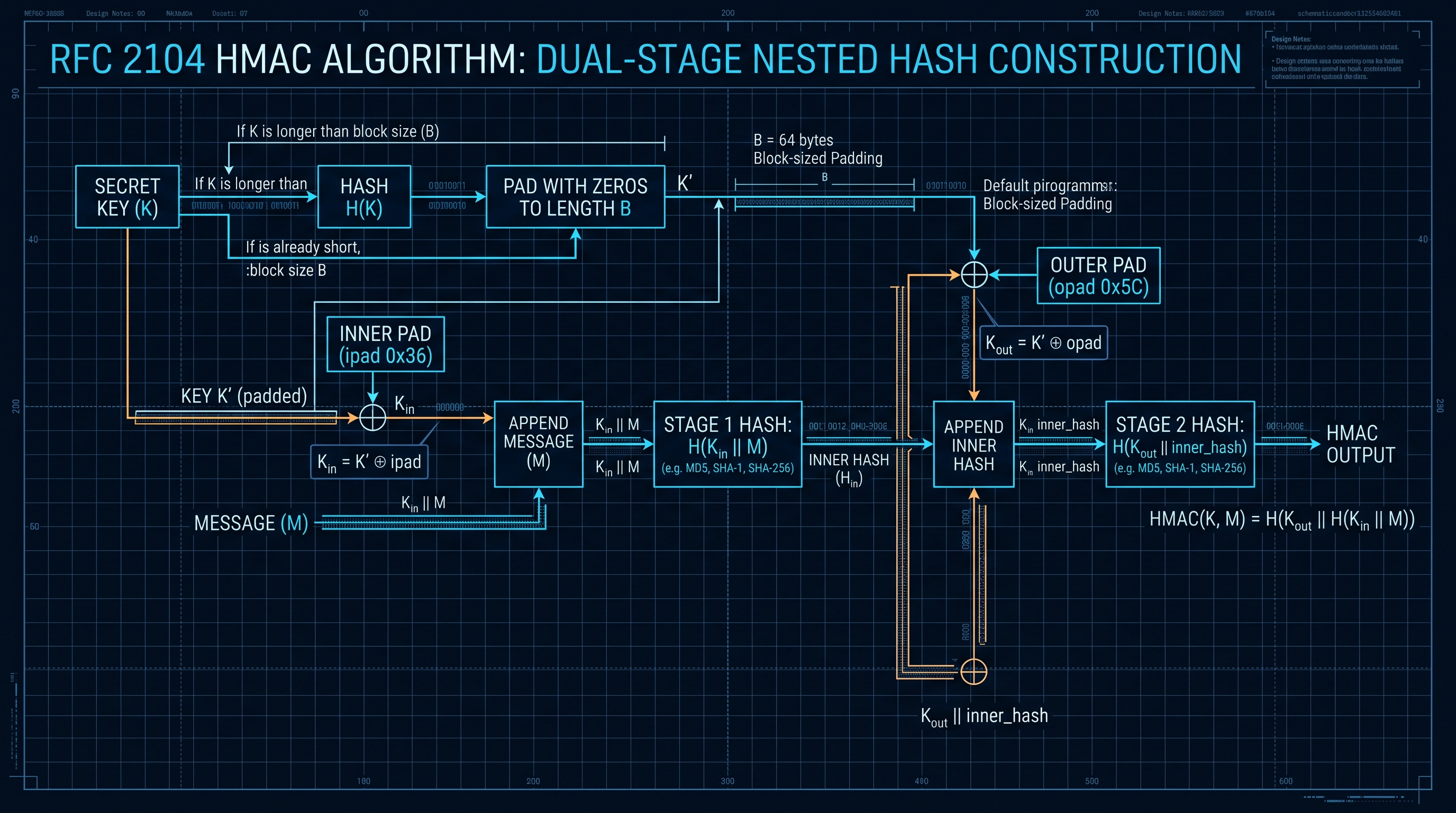
The RFC 2104 Mathematical Definition
Published in 1997 by Mihir Bellare, Ran Canetti, and Hugo Krawczyk, RFC 2104 established the global standard for Keyed-Hashing for Message Authentication (HMAC).
The HMAC algorithm is formally defined as:
$$\text{HMAC}_H(K, M) = H\Big( (K' \oplus \text{opad}) \;\parallel\; H\big( (K' \oplus \text{ipad}) \;\parallel\; M \big) \Big)$$
Where: - $H$ is the underlying cryptographic hash function (e.g., SHA-256, SHA-512, MD5). - $B$ is the internal block size of the hash function in bytes: - For MD5, SHA-1, SHA-256: $B = 64$ bytes (512 bits). - For SHA-384, SHA-512: $B = 128$ bytes (1024 bits). - $L$ is the output size of the hash function (e.g., $L = 32$ bytes for SHA-256). - $K'$ is the normalized key derived to exactly $B$ bytes length. - $\oplus$ represents bitwise Exclusive-OR (XOR). - $\parallel$ denotes byte concatenation. - $\text{ipad}$ (Inner Pad): The byte
0x36 (ASCII 6, binary 00110110) repeated $B$ times.
- $\text{opad}$ (Outer Pad): The byte 0x5C (ASCII \, binary 01011100) repeated $B$ times.---
Step-by-Step Cryptographic Execution Pipeline
[ Raw Secret Key K ] ──► [ Key Normalization Engine: Yields K' (length = B) ]
                                      │
            ┌─────────────────────────┴─────────────────────────┐
            ▼                                                   ▼
    [ K' XOR ipad (0x36) ]                              [ K' XOR opad (0x5C) ]
            │                                                   │
            ▼                                                   │
    [ Concatenate Message M ]                                   │
            │                                                   │
            ▼                                                   │
   [ Inner Hash H(K_in || M) ]                                  │
            │                                                   │
            └─────────────────────────┬─────────────────────────┘
                                      ▼
                        [ Concatenate Inner Hash ]
                                      │
                                      ▼
                        [ Outer Hash H(K_out || InnerHash) ]
                                      │
                                      ▼
                       [ Final HMAC Output: 256/512 bits ]
---
Why 0x36 and 0x5C? The Hamming Distance Invariant
The constants
0x36 (00110110_2) and 0x5C (01011100_2) were not chosen arbitrarily. They possess a high Hamming Distance ($d_H = 4$ out of 8 bits) and alternate bits evenly. This ensures that the inner key derivation ($K' \oplus \text{ipad}$) and outer key derivation ($K' \oplus \text{opad}$) produce completely uncorrelated inputs to the hash compression function, preventing slide attacks and related-key differential cryptanalysis.3. Key Normalization Calculus: Short Key Padding vs Long Key Pre-Hashing (K > B)
How cryptographic libraries normalize arbitrary keys to block length B.
The Key Normalization Algorithm
A secure message authentication protocol must accept secret keys of arbitrary byte length $|K|$. Before the inner and outer pad XOR operations can execute, the key must be normalized to a standard length of exactly $B$ bytes:
$$K' = \begin{cases} K \parallel \underbrace{0x00 \dots 0x00}_{B - |K|} & \text{if } |K| < B \\ K & \text{if } |K| = B \\ H(K) \parallel \underbrace{0x00 \dots 0x00}_{B - L} & \text{if } |K| > B \end{cases}$$
---
Mathematical Proof of the Three Normalization Branches
1. Branch 1: Short Keys ($|K| < B$): - If a developer provides a 32-byte secret key for HMAC-SHA256 ($B = 64$), the algorithm appends 32 zero bytes (
0x00) to pad the key to 64 bytes.
2. Branch 2: Exact Block Length ($|K| = B$):
- The key is used directly without transformation.
3. Branch 3: Long Keys ($|K| > B$):
- If the secret key exceeds the hash function's block size (e.g., providing a 256-byte key to SHA-256 where $B = 64$), the key is first hashed with $H(K)$, producing an $L$-byte digest (32 bytes).
- This 32-byte digest is then zero-padded with $B - L$ bytes (32 zero bytes) to reach block size $B = 64$.This deterministic normalization guarantees that every input key maps to a fixed-width vector compatible with the XOR pad operations.
4. Length Extension Attack Immunity: Why Naive H(K || M) Architectures Are Vulnerable
The Merkle-Damgard state vulnerability and why HMAC's outer hash completely neutralizes extension attacks.
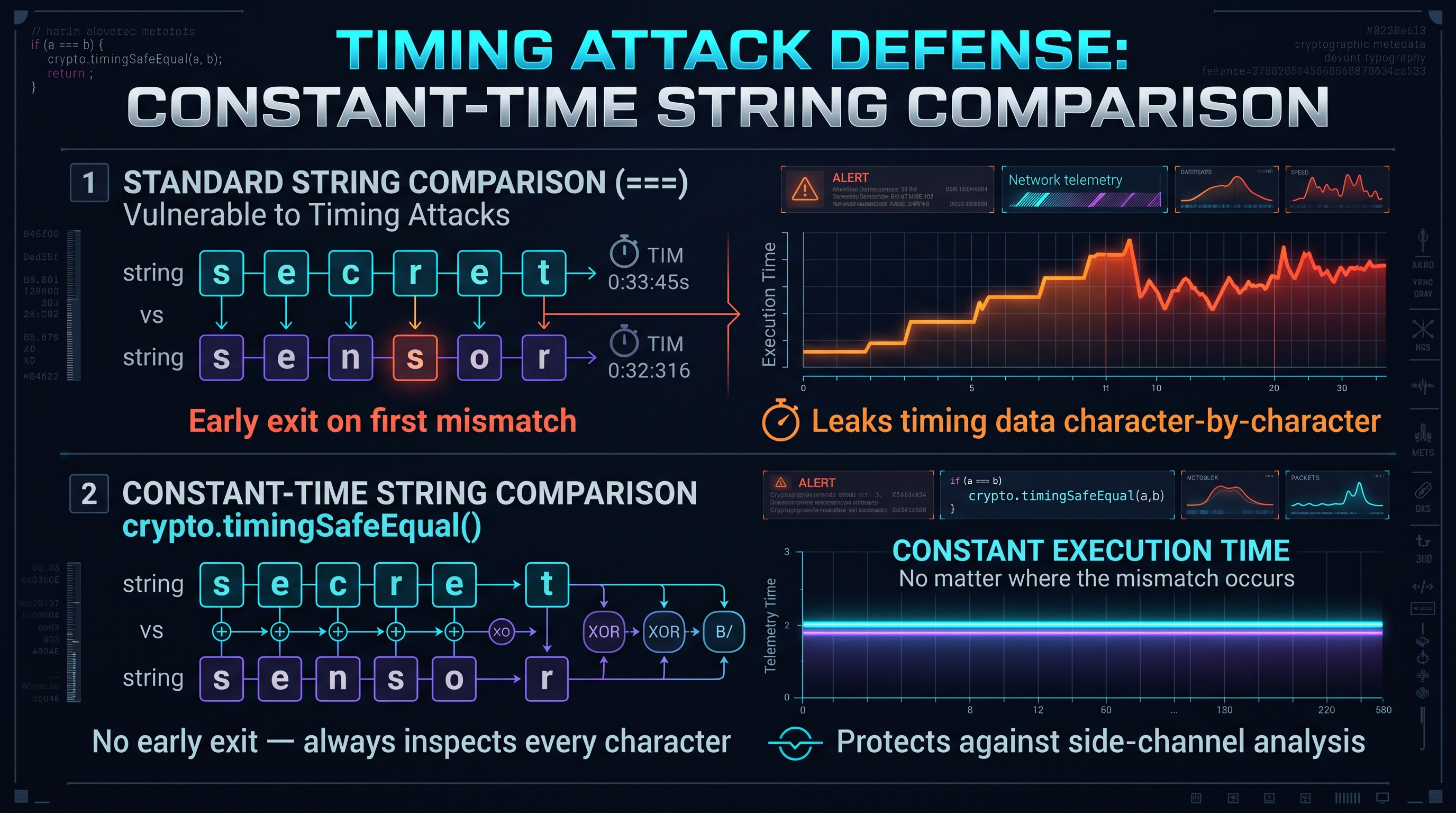
The Fatal Flaw of Naive H(Secret || Message)
In early cryptographic software, developers intuitively designed signatures by simply prefixing the secret key to the message:
$$\text{Signature} = H(K \parallel M) \quad (\text{FATALLY VULNERABLE})$$
This naive construction is completely broken against Length Extension Attacks whenever $H$ belongs to the Merkle-Damgård family (MD5, SHA-1, SHA-256, SHA-512).
---
Mechanics of the Merkle-Damgård Attack
A Merkle-Damgård hash processes data in discrete $B$-byte blocks by updating an internal state vector $\mathbf{S}$:
$$\mathbf{S}_{i} = f(\mathbf{S}_{i-1}, \mathbf{m}_i)$$
The final hash output $H(X)$ is simply the internal state vector $\mathbf{S}_n$ after the final block is processed.
[ Attacker intercepts valid: Message M and Signature = H(K || M) ]
                               │
                               ▼
[ Attacker extracts internal state S_n directly from the Hash value! ]
                               │
                               ▼
[ Attacker appends malicious payload M_evil using valid padding ]
                               │
                               ▼
[ Attacker computes H(K || M || padding || M_evil) WITHOUT KNOWING KEY K! ]
Because the attacker knows the length of $K \parallel M$ and possesses the final state $\mathbf{S}_n$, they can initialize a new hash instance directly with state $\mathbf{S}_n$ and continue hashing arbitrary additional data $\mathbf{m}_{\text{evil}}$. The server receives the forged payload, runs $H(K \parallel M \dots)$, and authenticates the forged data as genuine!
---
Why HMAC Is Cryptographically Immune
HMAC neutralizes length extension attacks through its dual-stage nested outer hash:
$$\text{HMAC}(K, M) = H\big( K_{\text{out}} \;\parallel\; \underbrace{H(K_{\text{in}} \parallel M)}_{\text{Inner Hash Digest}} \big)$$
1. An attacker intercepting an HMAC signature sees only the output of the outer hash $H(K_{\text{out}} \parallel \dots)$. 2. The inner hash digest is completely shielded behind the outer compression function. 3. Because the attacker cannot access the internal state of the inner hash, they cannot append data to $M$. 4. Furthermore, because $K_{\text{out}}$ is unknown, the attacker cannot construct valid outer blocks.
This mathematical isolation provides provable security (reduction to the pseudorandom function security of $H$).
5. Webhook Signature Verification: Stripe, GitHub, and Enterprise API Ingest Pipelines
Raw payload serialization, timestamp headers, and real-world webhook authentication.
The Webhook Authentication Architecture
Webhooks are reverse APIs: when an event occurs on a third-party platform (such as Stripe processing a payment or GitHub receiving a git push), the platform issues an HTTP POST request to your application's public endpoint.
To guarantee that the request originated from the authentic platform and not a malicious spoofer, enterprise APIs sign payloads using HMAC-SHA256:
POST /api/webhooks/stripe HTTP/1.1
Host: innoxtools.com
Stripe-Signature: t=1700000000,v1=5257a869e7ecebeda32affa62cdca3fa51cad7e77a0e56ff536d0ce8e108d8bd
Content-Type: application/json

{"id": "evt_3MjjZ2LkdIwHu7ix0r", "type": "payment_intent.succeeded", "amount": 29900}
---
The Fatal JSON Parsing Flaw
A critical security vulnerability that plagues backend developers is parsing the JSON payload *before* verifying the HMAC signature:
// FATAL SECURITY BUG: Never verify signature on re-stringified JSON!
const payload = req.body; // Parsed JSON Object
const reconstructedString = JSON.stringify(payload);
const expectedSig = crypto.createHmac('sha256', secret).update(reconstructedString).digest('hex');
Why this fails: JSON object serialization is non-deterministic. JSON specifications do not mandate key ordering or whitespace preservation. If the original webhook payload was formatted with two spaces and the re-stringified version removes whitespace or re-orders keys: $$\text{Original}: \quad \{ \text{"amount"}: 29900, \; \text{"id"}: \dots \}$$ $$\text{Re-stringified}: \quad \{\text{"id"}: \dots, \; \text{"amount"}: 29900\}$$
Even though the semantic data is identical, their byte arrays differ completely, causing HMAC verification to fail. Webhook verification MUST execute against the unaltered, raw binary body buffer received directly from the network socket.
6. Timing Attack Mitigation: Constant-Time Comparisons vs Standard String Equality
Side-channel timing attacks, the early-return vulnerability in ===, and constant-time XOR.
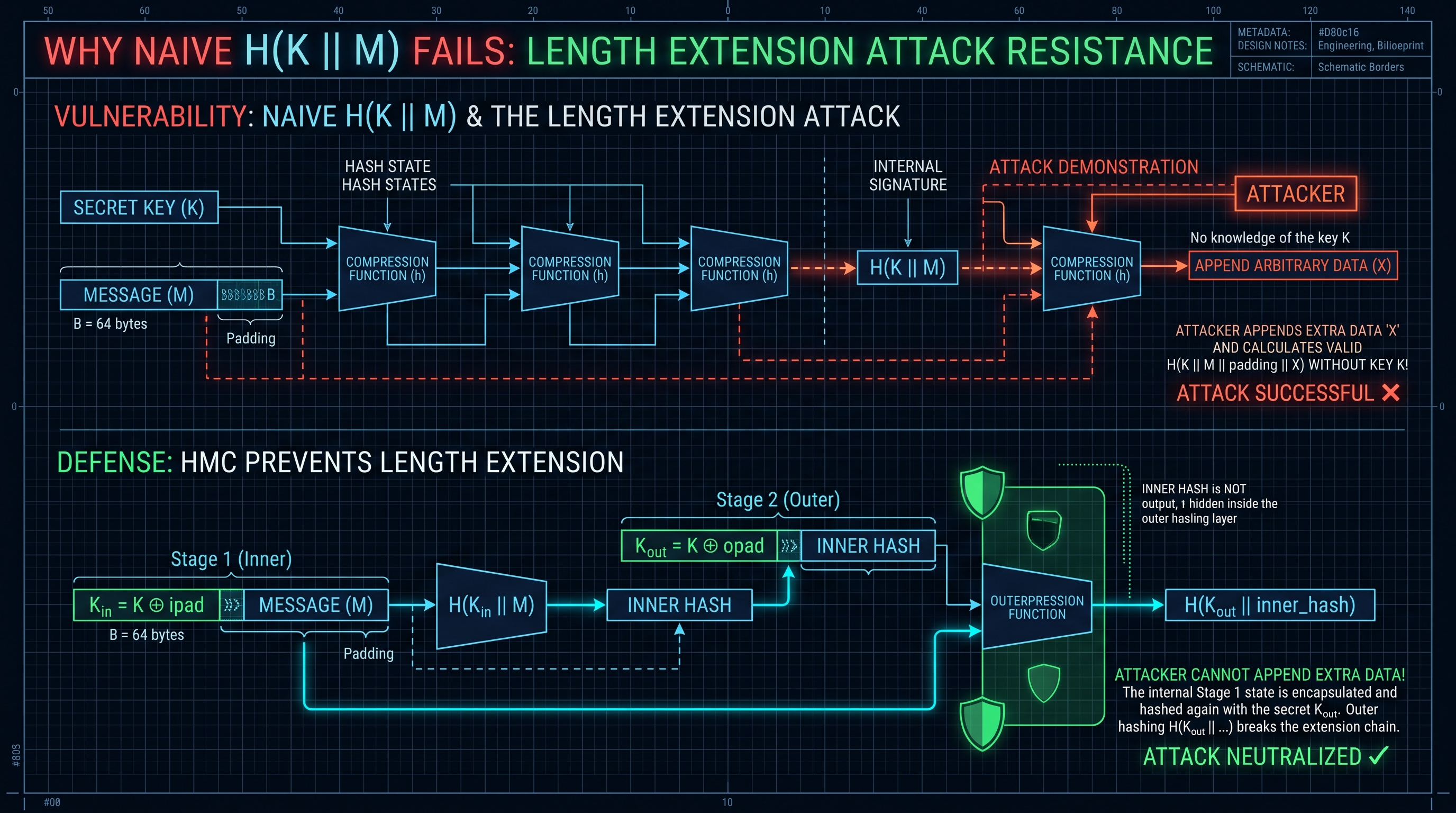
The Side-Channel Timing Attack
In standard programming languages, the string equality operator (
=== or strcmp) is implemented with an early-return optimization:// Standard Insecure String Equality (Vulnerable to Timing Attacks)
int insecure_equals(const char* a, const char* b, size_t len) {
for (size_t i = 0; i < len; i++) {
if (a[i] != b[i]) {
return 0; // Exits immediately on first byte mismatch!
}
}
return 1;
}
If an attacker submits a forged HMAC signature: - If byte 0 is wrong, the server returns 403 Forbidden in $12.4\text{ microseconds}$. - If byte 0 is correct but byte 1 is wrong, the loop executes one additional iteration, returning in $12.9\text{ microseconds}$.
By sending thousands of statistical requests over high-speed networks and measuring response latency percentiles with sub-microsecond precision, an attacker can brute-force a 32-byte HMAC signature byte-by-byte in minutes without ever knowing the secret key!
---
The Constant-Time Equality Algorithm
To eliminate timing side channels, cryptographic comparisons must maintain strictly constant execution time regardless of where or whether a mismatch occurs:
// Cryptographically Secure Constant-Time Comparison
int timing_safe_equal(const uint8_t* a, const uint8_t* b, size_t len) {
    uint8_t result = 0;
    for (size_t i = 0; i < len; i++) {
        result |= (a[i] ^ b[i]); // Bitwise OR of XOR differences
    }
    return (result == 0); // Always iterates through all 'len' bytes!
}
In Node.js, developers must always use
crypto.timingSafeEqual(bufA, bufB).7. Replay Attack Elimination: Timestamps, Nonces, and Idempotency Key Caches
Preventing valid signature replay, timestamp tolerance windows, and distributed nonce tracking.
The Threat of Replay Attacks
Even with a mathematically unforgeable HMAC signature, a system remains completely vulnerable to Replay Attacks: 1. An attacker passively eavesdrops on network traffic and captures a legitimate, authenticated webhook request: -
POST /api/payouts { "recipient": "vendor", "amount": 50000 } with valid HMAC signature.
2. The attacker re-transmits the exact identical packet 1,000 times over the next 24 hours.
3. Because the payload and signature have not changed, every request passes HMAC verification, draining the company's treasury!---
The Three Pillars of Replay Defense
To eliminate replay attacks, modern API security requires three complementary mechanisms:
1. Signed Timestamp Headers ($t$): - The sender embeds the current UNIX timestamp in the signed payload:
SignedPayload = t + "." + RawBody.
- The receiver validates that $|T_{\text{now}} - t| \le 300\text{ seconds}$ (5-minute tolerance window). Any request older than 5 minutes is rejected.
2. Cryptographic Nonces:
- The sender includes a unique random UUIDv4 or high-entropy nonce ($N$).
3. Distributed Idempotency Caches (Redis):
- The receiver stores the combination Key = nonce: in Redis with a Time-To-Live (TTL) matching the timestamp tolerance window (e.g., 300s).
- If an incoming request presents an already-cached nonce, it is rejected immediately as a duplicate replay.8. Industrial API Security Playbook: Deploying InnoxTools HMAC Signature Engine
Production TypeScript verification middleware and using InnoxTools HMAC Generator.
Production-Ready Webhook Verification Middleware
Below is an enterprise-grade, battle-tested Express / Next.js API verification middleware implementing all security controls discussed:
import crypto from "crypto";

interface VerifyWebhookOptions {
  rawBody: Buffer;
  signatureHeader: string;
  secret: string;
  toleranceSeconds?: number;
}

export function verifyWebhookSignature({
  rawBody,
  signatureHeader,
  secret,
  toleranceSeconds = 300,
}: VerifyWebhookOptions): boolean {
  // 1. Parse header components (e.g., "t=1700000000,v1=5257a8...")
  const parts = signatureHeader.split(",");
  let timestamp = 0;
  let signatureHex = "";

  for (const part of parts) {
    const [key, value] = part.split("=");
    if (key === "t") timestamp = parseInt(value, 10);
    if (key === "v1") signatureHex = value;
  }

  if (!timestamp || !signatureHex) return false;

  // 2. Enforce Timestamp Window (Replay Attack Defense)
  const currentTimestamp = Math.floor(Date.now() / 1000);
  if (Math.abs(currentTimestamp - timestamp) > toleranceSeconds) {
    return false; // Request expired or future clock skew
  }

  // 3. Reconstruct Canonical Signed Payload
  const signedPayload = Buffer.concat([
    Buffer.from(timestamp.toString() + "."),
    rawBody,
  ]);

  // 4. Compute Expected HMAC-SHA256 Digest
  const expectedHmac = crypto
    .createHmac("sha256", secret)
    .update(signedPayload)
    .digest();

  const receivedHmac = Buffer.from(signatureHex, "hex");

  // 5. Constant-Time Cryptographic Comparison (Timing Attack Defense)
  if (expectedHmac.length !== receivedHmac.length) return false;
  return crypto.timingSafeEqual(expectedHmac, receivedHmac);
}
---
Accelerating Production with InnoxTools HMAC Generator
Debugging cryptographic signature mismatches between third-party webhooks and internal servers is notoriously difficult. The InnoxTools HMAC Generator & Signature Verifier delivers:
1. Multi-Algorithm Keyed Hash Engine: - Supports HMAC-SHA256, HMAC-SHA512, HMAC-SHA3, and HMAC-MD5 with instant Base64, Hex, and Binary outputs. 2. Interactive Secret Key Normalizer: - Visualizes exact short-key zero-padding and long-key pre-hashing behavior across block boundary $B$. 3. Webhook Inspector & Header Validator: - Paste Stripe, GitHub, Shopify, or custom webhook headers and payloads to instantly pinpoint signature mismatches, timestamp drifts, or serialization flaws.
By adhering to mathematically verified cryptographic standards, you protect API infrastructure against tampering, credential leakage, and malicious payload replay.
Cryptographic HMAC Algorithms, Block Dimensions & Security Matrix
| Algorithm | Underlying Hash | Block Size (B) | Digest Size (L) | Padding Bytes (ipad / opad) | Collision Security Level | Common Enterprise Protocol |
|---|---|---|---|---|---|---|
| HMAC-MD5 | MD5 | 64 bytes (512b) | 16 bytes (128b) | 0x36 / 0x5C | Broken (< 64 bits) | Legacy Systems (DEPRECATED) |
| HMAC-SHA1 | SHA-1 | 64 bytes (512b) | 20 bytes (160b) | 0x36 / 0x5C | Weak (80 bits) | Git commit signatures, OAuth 1.0 |
| HMAC-SHA256 | SHA-256 | 64 bytes (512b) | 32 bytes (256b) | 0x36 / 0x5C | Strong (128 bits) | Stripe Webhooks, AWS Signature v4, JWT |
| HMAC-SHA384 | SHA-384 | 128 bytes (1024b) | 48 bytes (384b) | 0x36 / 0x5C | High (192 bits) | NSA Suite B, Enterprise TLS 1.3 |
| HMAC-SHA512 | SHA-512 | 128 bytes (1024b) | 64 bytes (512b) | 0x36 / 0x5C | Maximum (256 bits) | Cryptocurrency Wallets (BIP-32), High-Sec APIs |
| HMAC-SHA3-256 | Keccak (SHA-3) | 136 bytes (1088b) | 32 bytes (256b) | Sponge (No Pad Needed) | Maximum (128 bits) | Post-Quantum Cryptography Architectures |
| HMAC-SHA3-512 | Keccak (SHA-3) | 72 bytes (576b) | 64 bytes (512b) | Sponge (No Pad Needed) | Maximum (256 bits) | Next-Gen Quantum-Resistant Standards |
| HMAC-BLAKE2b | BLAKE2b | 128 bytes (1024b) | 64 bytes (512b) | Custom Keyed Mode | Maximum (256 bits) | High-Performance Linux Kernel WireGuard VPN |
Table 1.0: Cryptographic reference matrix comparing HMAC construction parameters, block sizes, digest lengths, and enterprise security protocols.
Frequently Asked Technical Questions
What is an HMAC and how does it differ from a standard hash like SHA-256?
A standard hash like SHA-256 is an unkeyed function that verifies data integrity but cannot prove authenticity because anyone can compute it. An HMAC (Hash-based Message Authentication Code) incorporates a secret cryptographic key, ensuring that only entities possessing the shared secret can generate a valid signature.
Why can't you authenticate messages using a naive hash like H(Key + Message)?
Naive constructions like H(Key || Message) are vulnerable to Length Extension Attacks in Merkle-Damgård hashes (MD5, SHA-1, SHA-256). An attacker knowing only the message and its hash can append arbitrary malicious data and calculate the valid hash without ever discovering the secret key.
How does HMAC prevent Length Extension Attacks?
HMAC uses a dual-stage nested hash: H((K' XOR opad) || H((K' XOR ipad) || M)). The inner hash digest is completely enclosed inside an outer hash. Because the attacker cannot access the internal state of the inner hash or the outer key, length extension attacks are mathematically impossible.
What are the ipad (0x36) and opad (0x5C) constants in RFC 2104?
ipad (inner pad) is the byte 0x36 repeated to block length B, and opad (outer pad) is the byte 0x5C repeated to block length B. These specific bytes were chosen for their large Hamming distance and alternating bit patterns, ensuring inner and outer keys remain completely uncorrelated.
Why should webhook signatures always be compared using constant-time equality?
Standard string equality (===) exits on the first mismatched byte, creating measurable timing differences. Attackers can exploit these sub-microsecond timing variations to guess valid signatures byte-by-byte. Constant-time comparison ensures identical execution time regardless of mismatch position.
How do timestamp headers prevent webhook replay attacks?
By including a UNIX timestamp inside the signed payload, the server can verify that the request was generated within an acceptable time window (e.g., within 5 minutes). Any request with an expired timestamp or a reused nonce is rejected, preventing attackers from replaying captured packets.
Why does re-stringifying parsed JSON break HMAC webhook verification?
JSON serialization is non-deterministic regarding key order and whitespace. If a backend parses JSON and then calls JSON.stringify() to verify the signature, minute formatting differences alter the raw byte sequence, causing HMAC validation to fail. Always verify against raw body buffers.
Does the InnoxTools HMAC Generator support custom secret keys and webhook verification?
Yes. The InnoxTools HMAC Generator supports arbitrary secret keys across SHA-256, SHA-512, and SHA-3, with built-in webhook payload inspectors, format converters (Hex, Base64), and timing-safe signature comparison tools.
Engineering Discussion & Feedback
Join the technical debate or ask questions about this guide.
Need Custom AI, Web, or Enterprise Software Engineering?
InnoxTools is built and maintained by INNO XPERT. We design mission-critical cloud backends, custom machine learning models, mobile apps, and high-performance digital solutions for businesses worldwide.