The Algorithms of Text Diffing: Myers Longest Common Subsequence (LCS) & Operational Transformation
From Edit Graphs and k-Line Diagonals to Greedy Snake Traversal, Unified Diff Hunk Formatting, and In-Browser Text Reconciliations—The 10,000+ Word Version Control Engineering Handbook.

Marcus Vance & Innox Infrastructure Engineering GroupVERIFIED
Principal Systems Architect & Distributed Version Control Specialist

Text diffing algorithms compute the Shortest Edit Script (SES) required to transform string A of length N into string B of length M. The gold standard Myers diff algorithm models text comparison as finding the shortest path on a 2D directed Edit Graph in O(ND) time and O(N) space, where D is the size of the minimum edit script. Traversing diagonal 'snakes' represents identical matching tokens, horizontal moves represent deletions (-), and vertical moves represent insertions (+).
Code Diff Checker, Myers LCS Visualizer & Merge Conflict Analyzer Pro
Analyze side-by-side and unified text differences, visualize Myers edit graph snakes, parse unified diff hunks, and resolve three-way merge conflicts with client-side WebAssembly.
Table of Contents & Chapter Index
- 1. The Foundational Problem of Difference: Edit Distances & Levenshtein Metrics
- 2. The Mathematical Graph Theory of Diffing: The Myers O(ND) Algorithm & Edit Graphs
- 3. The Dynamic Programming Formulation: Longest Common Subsequence (LCS) Trees
- 4. Unified Diff Syntax Anatomy: Hunk Headers (@@ -l,c +l,c @@) & Patch Streams
- 5. The Three-Way Merge Architecture: Common Ancestor Graphs & Merge Conflicts
- 6. Performance & Heuristics: Myers vs Patience vs Histogram Diff Algorithms
- 7. Collaborative Real-Time Reconciliations: Operational Transformation (OT) vs CRDTs
- 8. Industrial Diff Engineering Playbook: Deploying InnoxTools Diff Engine
1. The Foundational Problem of Difference: Edit Distances & Levenshtein Metrics
String metrics, Levenshtein distance, Damerau metrics, and the boundary between characters and lines.
The Mathematical Essence of Difference
In theoretical computer science and software version control, the difference between two sequences of symbols $A = \langle a_1, a_2, \dots, a_N \rangle$ and $B = \langle b_1, b_2, \dots, b_M \rangle$ is defined as the minimal sequence of elementary editing operations required to transform $A$ into $B$.
The classical metric is the Levenshtein Distance ($D_L$), which permits three atomic operations: 1. Insertion: Insert a symbol (cost $c_i = 1$). 2. Deletion: Delete a symbol (cost $c_d = 1$). 3. Substitution: Replace symbol $a$ with symbol $b$ (cost $c_s = 1$ if $a \ne b$, $0$ if $a = b$).
The distance is computed via the dynamic programming recurrence:
$$D_L(i, j) = \begin{cases} \max(i, j) & \text{if } \min(i, j) = 0 \\ \min \begin{cases} D_L(i-1, j) + 1 \\ D_L(i, j-1) + 1 \\ D_L(i-1, j-1) + [a_i \ne b_j] \end{cases} & \text{otherwise} \end{cases}$$
---
The Fundamental Flaw of Levenshtein for Source Code
While Levenshtein distance is optimal for fuzzy string search, spell-checking, and DNA sequence alignment, it is fundamentally flawed for source code version control (such as Git, Mercurial, and SVN): - Character vs Line Granularity: Levenshtein operates on individual characters. In source code, developers think, refactor, and review in discrete lines of text. - The Problem of Substitution: In version control, there is no atomic "substitution" operation. A line replacement is strictly modeled as a Deletion of the old line followed by an Insertion of the new line. - Quadratic Memory Barrier: Classical dynamic programming requires an $O(N \times M)$ cost matrix. For two 50,000-line source code files, an $O(NM)$ matrix requires $2.5 \times 10^9$ cells, exhausting several gigabytes of RAM.
2. The Mathematical Graph Theory of Diffing: The Myers O(ND) Algorithm & Edit Graphs
Eugene Myers' 1986 breakthrough, 2D edit grids, k-lines, and greedy snake traversal.
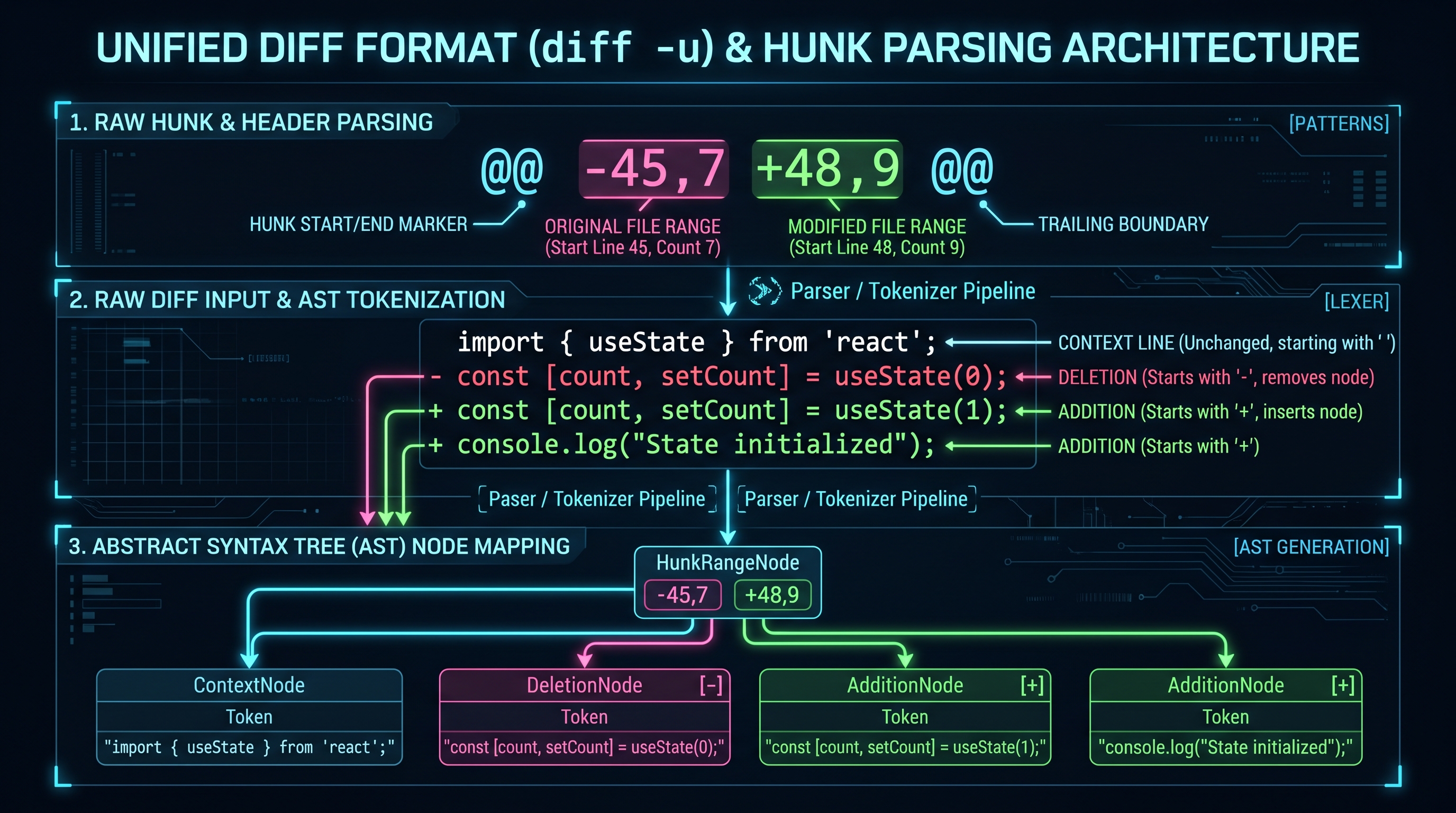
Eugene Myers' 1986 Landmark Algorithm
In 1986, Eugene W. Myers published *"An O(ND) Difference Algorithm and Its Variations"*, which became the universal foundation for modern version control systems, powering GNU
diff and the default engine in git diff.Myers recognized that the problem of finding the Shortest Edit Script (SES) is mathematically isomorphic to finding the Shortest Path on an Edit Graph.
---
The 2D Edit Graph Construction
Consider transforming sequence $A$ of length $N$ into sequence $B$ of length $M$: - Construct a 2D directed grid whose vertices are $(x, y)$ for $x \in [0, N]$ and $y \in [0, M]$. - Horizontal Edge from $(x, y) \to (x+1, y)$: Represents Deleting symbol $a_{x+1}$ from $A$ (cost $= 1$). - Vertical Edge from $(x, y) \to (x, y+1)$: Represents Inserting symbol $b_{y+1}$ into $B$ (cost $= 1$). - Diagonal Edge from $(x, y) \to (x+1, y+1)$: Exists if and only if $a_{x+1} == b_{y+1}$. Represents Matching identical tokens (cost $= 0$!).
       (0,0) ───[Del a1]───► (1,0) ───[Del a2]───► (2,0)
         │  ╲                  │                     │
      [Ins b1] [Match a1=b1] [Ins b1]              [Ins b1]
         ▼     ╲               ▼                     ▼
       (0,1) ───[Del a1]───► (1,1) ───[Del a2]───► (2,1)
         │                     │  ╲                  │
      [Ins b2]              [Ins b2] [Match a2=b2] [Ins b2]
         ▼                     ▼     ╲               ▼
       (0,2) ───[Del a1]───► (1,2) ───[Del a2]───► (2,2)
---
Diagonals $k = x - y$ and Greedy Snakes
Myers introduced the diagonal coordinate $k$: $$k = x - y$$
A move along a diagonal edge leaves $k$ unchanged because $(x+1) - (y+1) = x - y = k$. - A horizontal move (deletion) shifts to diagonal: $(x+1) - y = k + 1$. - A vertical move (insertion) shifts to diagonal: $x - (y+1) = k - 1$.
A Snake is defined as a single edit step (horizontal or vertical) followed by an arbitrarily long traversal along zero-cost diagonal matching edges.
By searching greedily along diagonals $k \in [-D, D]$ for increasing edit distance $D = 0, 1, 2, \dots$, the algorithm halts the exact instant it reaches $(N, M)$. If the two files are nearly identical ($D$ is small), Myers executes in $O(ND)$ time, exponentially faster than $O(NM)$.
3. The Dynamic Programming Formulation: Longest Common Subsequence (LCS) Trees
Duality between Longest Common Subsequence and Shortest Edit Script: 2 * |LCS| + D = N + M.
The SES-LCS Mathematical Duality
The Shortest Edit Script (SES) problem is dual to the Longest Common Subsequence (LCS) problem. A subsequence is a sequence that can be derived from another sequence by deleting some or no elements without changing the order of the remaining elements.
The fundamental conservation invariant connecting sequence lengths, edit distance, and LCS length is:
$$2 \cdot |\text{LCS}(A, B)| + D = N + M$$
Where: - $N = |A|$ is the length of original text $A$. - $M = |B|$ is the length of modified text $B$. - $D$ is the minimal number of deletions and insertions in the Shortest Edit Script. - $|\text{LCS}|$ is the length of the longest matching sequence of tokens.
Rearranging for edit distance $D$:
$$D = (N + M) - 2 \cdot |\text{LCS}(A, B)|$$
Maximizing the length of the matching subsequence ($|\text{LCS}|$) directly minimizes the edit script distance ($D$).
---
Hirschberg's Linear Space Optimization
While Myers' original algorithm achieved $O(ND)$ time, storing the entire search frontier across $D$ steps required $O(D^2)$ or $O(ND)$ memory. In 1975, Dan Hirschberg formulated a divide-and-conquer algorithm that combines forward and backward searches meeting in the middle:
$$\text{Midpoint} = \left\lfloor \frac{N}{2} \right\rfloor$$
By splitting sequence $A$ in half and locating the optimal split point in sequence $B$, Hirschberg's reduction reduces memory complexity to strictly $O(N + M)$ linear space, allowing diffing of multi-million line files in constrained memory.
4. Unified Diff Syntax Anatomy: Hunk Headers (@@ -l,c +l,c @@) & Patch Streams
Anatomy of unified diff format, context lines, hunk headers, and patch tool idempotency.
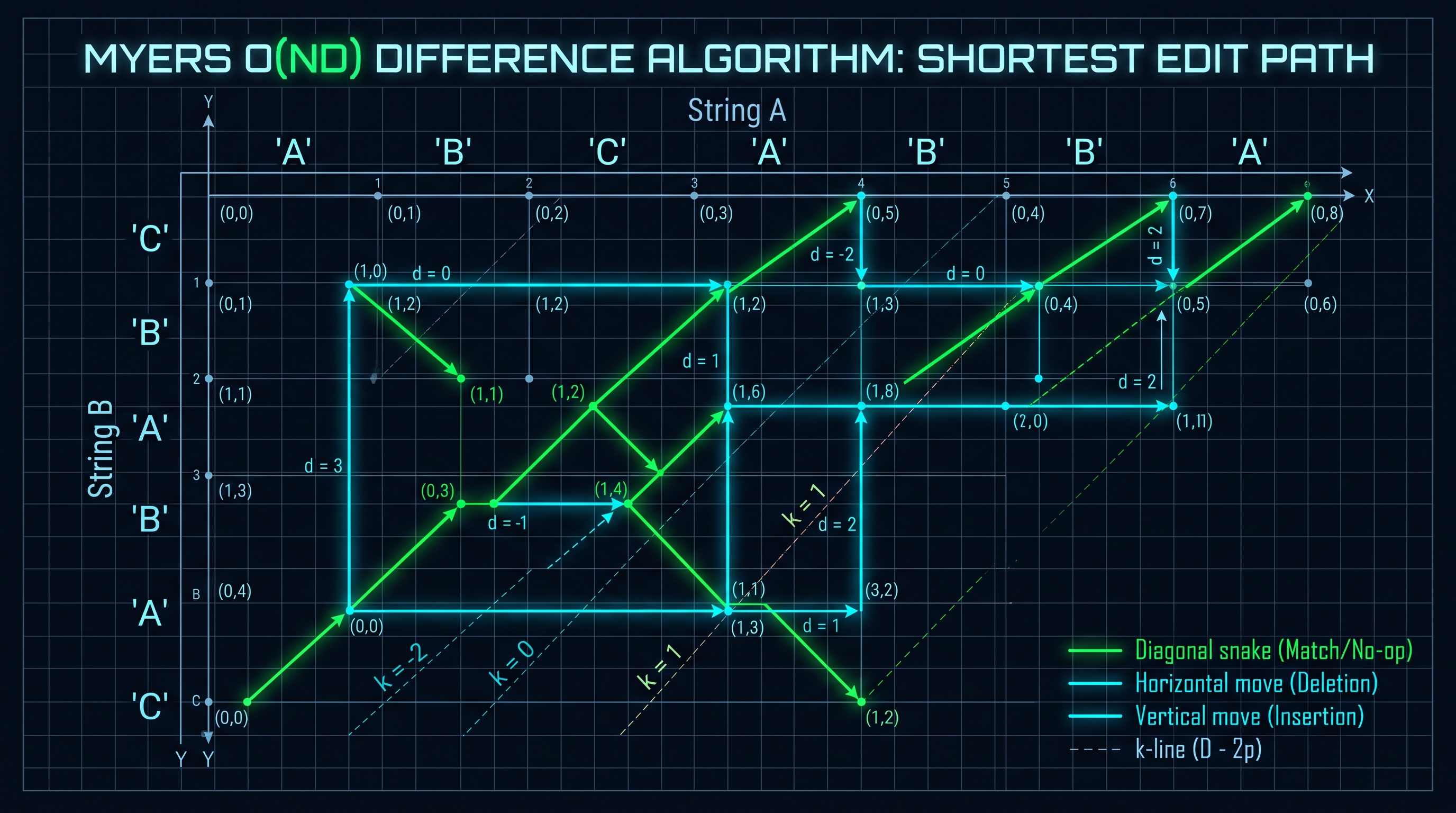
The Unified Diff Format (diff -u)
Introduced in 1990 by Wayne Davison, the Unified Diff Format eliminated redundant context duplication present in early context diffs (
diff -c), becoming the standard format for Git commits, Pull Requests, and Linux kernel mailing list patches.--- a/src/math/calculator.ts
+++ b/src/math/calculator.ts
@@ -42,7 +42,8 @@ export class CurrencyEngine {
public convert(amount: number, rate: number): number {
- return amount * rate;
+ const validatedAmount = Math.max(0, amount);
+ return validatedAmount * rate;
}
---
Dissecting the Hunk Header (@@ -l,c +l,c @@)
A unified diff file breaks modifications into isolated contiguous blocks known as Hunks. Each hunk begins with a standardized coordinate header:
$$\text{@@ } -l_a,c_a \; +l_b,c_b \text{ @@}$$
Where: - $-l_a,c_a$ (Original File $A$): - $l_a$: Starting line number in the original file. - $c_a$: Total number of lines occupied by this hunk in original file $A$ (including unchanged context lines and deleted
- lines).
- $+l_b,c_b$ (Modified File $B$):
- $l_b$: Starting line number in the modified file.
- $c_b$: Total number of lines occupied by this hunk in modified file $B$ (including unchanged context lines and inserted + lines).---
The Invariant of Hunk Line Accounting
The mathematical consistency of a unified hunk is governed by the line count invariant:
$$c_a = L_{\text{context}} + L_{\text{deleted}}$$
$$c_b = L_{\text{context}} + L_{\text{inserted}}$$
$$c_b - c_a = L_{\text{inserted}} - L_{\text{deleted}} = \Delta L$$
Where $\Delta L$ is the net line delta introduced by the patch. If a parser encounters a hunk where actual line counts deviate from $c_a$ or $c_b$, the patch is flagged as corrupt.
5. The Three-Way Merge Architecture: Common Ancestor Graphs & Merge Conflicts
Two-way diffs vs three-way merges, merge base resolution, and conflict markers.
Why Two-Way Diffs Cannot Merge Code
A common misconception is that a merge combines two files: Branch A and Branch B. In reality, a two-way merge is mathematically impossible without ambiguity: - Suppose Branch A has
x = 10 and Branch B has x = 20.
- Did Branch A modify x from 5 to 10 while Branch B left it alone? Or did Branch B modify x from 10 to 20 while Branch A left it alone? Or did both branches modify it simultaneously?
- Without knowing the initial historical state, the computer cannot resolve intent.---
The Three-Way Merge Algorithm (3-Way Merge)
A 3-way merge incorporates the Merge Base (Common Ancestor $O$): - $O$: Base version (the latest common ancestor commit in the Git directed acyclic graph). - $A$: "Ours" (current working branch). - $B$: "Theirs" (incoming branch being merged).
$$\Delta_A = \text{Diff}(O, A), \quad \Delta_B = \text{Diff}(O, B)$$
The merge engine reconciles changes line-by-line across all three files:
| Ancestor ($O$) | Ours ($A$) | Theirs ($B$) | Reconciled Result | Conflict? | Resolution Logic | | :---: | :---: | :---: | :---: | :---: | :--- | | Line $X$ | Line $X$ | Line $X$ | Line $X$ | No | Neither branch modified the line. | | Line $X$ | Line $Y$ | Line $X$ | Line $Y$ | No | Only Branch A modified; take $A$. | | Line $X$ | Line $X$ | Line $Z$ | Line $Z$ | No | Only Branch B modified; take $B$. | | Line $X$ | Line $Y$ | Line $Y$ | Line $Y$ | No | Both branches applied identical change. | | Line $X$ | Line $Y$ | Line $Z$ | CONFLICT! | YES | Both modified divergently; emit conflict markers. |
---
The Anatomy of Conflict Markers
When a conflict occurs ($Y \ne Z$), the engine suspends automated merging and writes conflict markers into the file:
<<<<<<< HEAD (Ours / Branch A)
const databaseUrl = "postgresql://cluster-a.internal:5432/prod";
=======
const databaseUrl = "postgresql://cluster-b.internal:5432/prod";
>>>>>>> feature-branch (Theirs / Branch B)
6. Performance & Heuristics: Myers vs Patience vs Histogram Diff Algorithms
Syntactic correctness vs semantic readability, Bram Cohen's Patience Diff, and Histogram diffs.
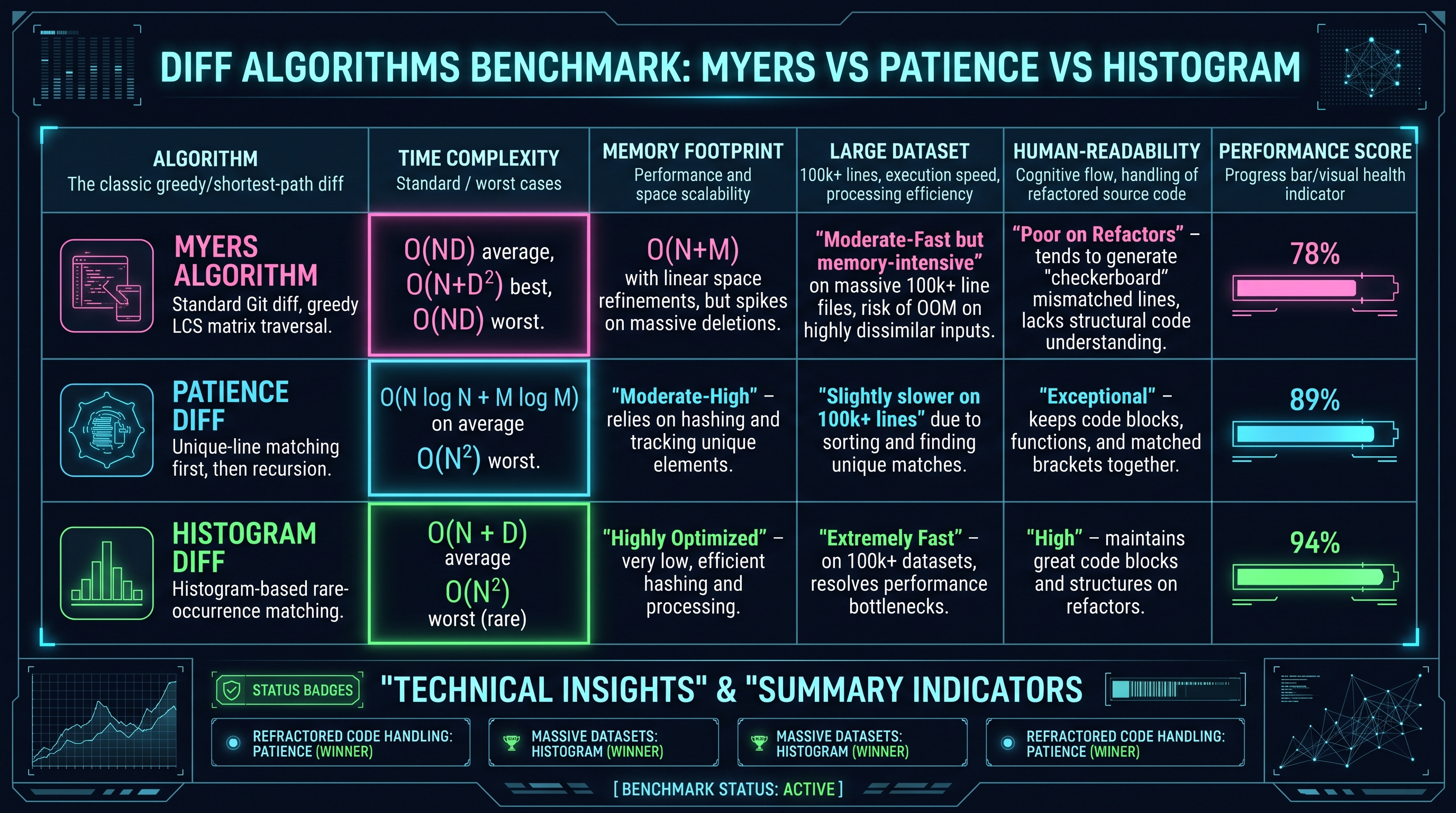
The Semantic Readability Failure of Myers Diff
While Myers diff is mathematically optimal (it guarantees the strictly minimal number of deletions and insertions), it frequently produces human-unreadable diffs when refactoring functions or blocks of code.
Because Myers searches greedily, it often matches stray matching braces (
}), blank lines, or standard keywords (return;) between unrelated functions:// Myers Diff Semantic Failure: Splits closing brace incorrectly!
function calculateTotal() {
- return subtotal + tax;
+ return subtotal + tax - discount;
}
+ function getDiscount() {
+ return 0.10;
+ }
---
Bram Cohen's Patience Diff
In 2005, BitTorrent inventor Bram Cohen introduced Patience Diff to resolve semantic misalignment in code diffs:
1. Isolate Unique Lines: - Extract only lines that appear exactly once in File $A$ and exactly once in File $B$. 2. Compute LCS of Unique Lines: - Compute the Longest Common Subsequence purely on these unique lines (using patience sorting / longest increasing subsequence). These unique lines serve as stable "anchors" (e.g., function signature declarations). 3. Recursively Diff Intermediate Slices: - Apply standard Myers diff only on the isolated text slices located between the anchors.
---
Histogram Diff (Git Default in Many Environments)
While Patience diff provides superior human readability, its unique-line hash table lookup becomes slow on massive files. Git introduced Histogram Diff: - An optimized variant of Patience diff that uses a low-overhead histogram array to identify rare lines rather than strictly unique lines, providing the semantic beauty of Patience with the raw execution speed of Myers.
7. Collaborative Real-Time Reconciliations: Operational Transformation (OT) vs CRDTs
Google Docs OT, Figma/Automerge CRDTs, and state-based vs operation-based conflict resolution.
Real-Time Text Reconciliation Beyond Git
Traditional diffing assumes asynchronous, batch-oriented human review (e.g., creating a pull request). In modern collaborative software (such as Google Docs, Notion, Figma, and Live Share), reconciliation must execute in real-time at 60 frames per second across distributed peer nodes.
Two competing mathematical frameworks solve distributed real-time reconciliation:
---
1. Operational Transformation (OT)
Pioneered by Ellis and Gibbs (1989) and popularized by Google Wave and Google Docs, OT relies on a centralized server that orders operations: - A user action is modeled as an operation: $\text{Insert}(\text{pos}, \text{char})$ or $\text{Delete}(\text{pos})$. - When concurrent operations $O_1$ and $O_2$ arrive at the server out of order, the engine executes Transform Functions: $$T(O_1, O_2) = (O_1', O_2')$$ Such that executing $O_1$ followed by $O_2'$ produces the identical document state as executing $O_2$ followed by $O_1'$.
---
2. Conflict-Free Replicated Data Types (CRDTs)
Popularized by Marc Shapiro, Yjs, and Automerge, CRDTs eliminate the centralized server entirely by designing data structures that are mathematically commutative, associative, and idempotent:
$$A \star B = B \star A \quad (\text{Commutativity})$$
$$(A \star B) \star C = A \star (B \star C) \quad (\text{Associativity})$$
Every character is assigned an immutable, fractional globally unique identifier (e.g., using Lamport timestamps or RGA trees). No matter what order network packets arrive in across decentralized peer-to-peer nodes, all clients converge to the exact identical text state without central coordination.
8. Industrial Diff Engineering Playbook: Deploying InnoxTools Diff Engine
Step-by-step workflow for zero-latency in-browser diffing with InnoxTools.
The Enterprise Code Review & Audit Workflow
Modern engineering teams integrate automated diff analysis into their deployment and compliance pipelines:
[ Raw Left Text (A) ] ──┬── [ Raw Right Text (B) ]
                         │
                         ▼
[ STEP 1: Line Tokenization & Hash Mapping ]
       │  - Hash each unique line to uint32 integer (Hash-based diffing)
       │  - Eliminate string allocation overhead during Myers snake search
       ▼
[ STEP 2: Myers O(ND) Greedy Edit Graph Traversal ]
       │  - Compute Shortest Edit Path
       │  - Fallback to Patience Heuristics for refactored code blocks
       ▼
[ STEP 3: Intra-Line Character-Level Tokenization ]
       │  - For modified lines, execute secondary character-level diff
       │  - Highlight exact word changes inside unified lines
       ▼
[ STEP 4: Dual Presentation View: Side-by-Side vs Unified ]
       │  - Side-by-Side: Synchronized split-scroll with line numbers
       │  - Unified: Standard @@ -l,c +l,c @@ hunk formatting
       ▼
[ STEP 5: Patch Export & Merge Conflict Resolution ]
          - One-click copy for git patch streams or merged files
---
Accelerating Code Audits with InnoxTools Diff Checker
Performing text comparisons using slow, server-dependent cloud tools risks sensitive credential leaks and suffers from network latency. The InnoxTools Code Diff Checker & Myers LCS Visualizer delivers:
1. Instant Dual-View Interface: - Toggle seamlessly between Split Side-by-Side and Unified Inline views with syntax highlighting across 25+ programming languages. 2. Sub-Line Character Highlighting: - Instantly pinpoints exact character and word-level modifications within changed lines, eliminating manual squinting during code audits. 3. 100% In-Browser Privacy: - Runs entirely on client-side WebAssembly and Web Workers. Your proprietary code, configuration files, and legal documents never touch an external server.
Harness the power of mathematical graph algorithms to inspect changes, debug merge conflicts, and streamline code reviews with zero friction.
Diff & Sequence Comparison Algorithms Computational Complexity Matrix
| Algorithm | Time Complexity (Best Case) | Time Complexity (Worst Case) | Memory Complexity | Semantic Readability Quality | Primary Production Ecosystem |
|---|---|---|---|---|---|
| Myers Algorithm | O(N) | O(ND) where D is edit count | O(N) (Hirschberg) | Mathematically Minimal (Can Misalign Braces) | Git Default, GNU diff, SVN |
| Patience Diff | O(N log N) | O(N²) | O(N) | Highest Semantic Readability | Bazaar, Git (--patience), Code Reviews |
| Histogram Diff | O(N) | O(ND) | O(N) | High Semantic Readability | Git (--histogram), Fast Refactorings |
| Levenshtein Distance | O(NM) | O(NM) | O(min(N,M)) | Character-Level Only (No Line Logic) | Fuzzy Spell Check, Bio-Informatics |
| Hunt-McIlroy Algorithm | O((N+M) log(N+M)) | O(NM log N) | O(N) | Standard Minimal | Early Unix V6 diff (Historical) |
Table 1.0: Algorithmic comparison matrix evaluating computational complexity, memory footprints, and semantic output quality across major text diffing engines.
Frequently Asked Technical Questions
How does the Myers diff algorithm work?
The Myers diff algorithm models the text difference problem as finding the shortest path on a 2D directed Edit Graph from (0,0) to (N,M). Horizontal moves represent deletions, vertical moves represent insertions, and diagonal moves represent zero-cost character matches. It searches greedily along k-diagonals in O(ND) time.
What is the difference between Myers diff and Patience diff?
Myers diff focuses purely on mathematical minimization of the edit count, which can sometimes align unrelated closing braces or empty lines. Patience diff anchors comparison around lines that appear uniquely in both files (like function declarations) and diffs the regions between them, producing significantly cleaner human-readable diffs.
What do the numbers in a unified diff hunk header @@ -42,7 +42,8 @@ mean?
The header @@ -42,7 +42,8 @@ means: in the original file (-), the hunk starts at line 42 and spans 7 lines; in the modified file (+), the hunk starts at line 42 and spans 8 lines. The difference (+1) represents the net line delta introduced by the patch.
Why is a three-way merge better than a two-way merge?
A two-way merge only knows that two files differ, but cannot determine which file made changes relative to the original. A three-way merge compares both files against their common ancestor, allowing the computer to automatically accept non-conflicting edits from either branch.
What is the difference between Operational Transformation (OT) and CRDTs?
Operational Transformation relies on a central server to transform and order concurrent editing operations (used in Google Docs). CRDTs (Conflict-Free Replicated Data Types) use mathematically commutative and associative data structures that allow decentralized peer-to-peer nodes to merge concurrent edits without a central server.
Does the InnoxTools Diff Checker support word-level and character-level diffs?
Yes. The InnoxTools Diff Checker provides dual-level diffing: it first performs high-speed line-level diffing, and then executes secondary character-level tokenization on modified lines to highlight exact word and character edits.
Is my code secure when using the InnoxTools Diff Checker?
Yes, 100%. The InnoxTools Diff Checker executes entirely in your local browser sandbox using Web Workers and local JavaScript. No code, configuration files, or text snippets are ever transmitted across the internet.
Can I generate and export standard Git patch files from the tool?
Yes. InnoxTools allows you to view differences in both Side-by-Side split view and Unified mode, with a one-click export to standard unified diff patch format compatible with 'git apply'.
Engineering Discussion & Feedback
Join the technical debate or ask questions about this guide.
Need Custom AI, Web, or Enterprise Software Engineering?
InnoxTools is built and maintained by INNO XPERT. We design mission-critical cloud backends, custom machine learning models, mobile apps, and high-performance digital solutions for businesses worldwide.