100% Private101 Free Client-Side Tools
utilities UtilityCSPRNG Engine 100% Client-Side Safe
★★★★★4.9(194 reviews)

Random String, Secure Token & NanoID Generator

Generate cryptographically secure random strings, API secrets, NanoID tokens, and passwords online using hardware CSPRNG with 100% client-side RAM privacy.

Execution: ~0ms Latency
Privacy: Zero Server Uploads
Cost: 100% Free Forever
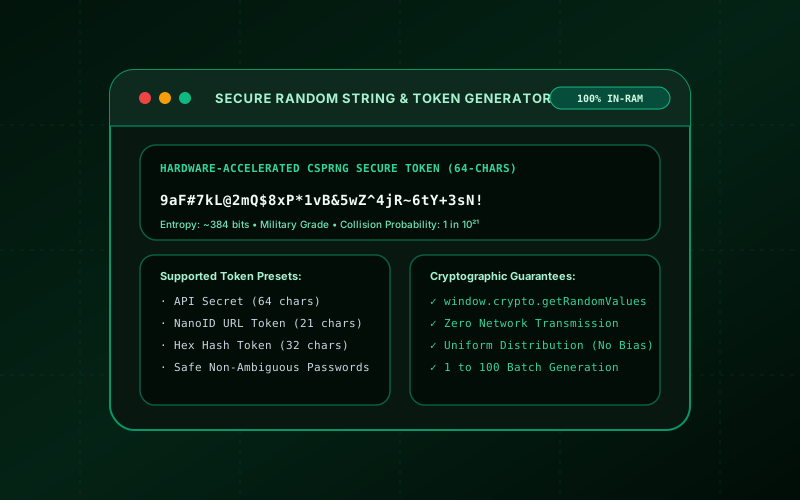
Random String, Secure Token & NanoID Generator Interactive Vector Banner
innoxtools.com

Random String & Secure Token Generator100% In-Browser CSPRNG

Hardware-accelerated cryptographically secure pseudo-random number generator

Presets:

Dimensions & Quantity

String Length:32 characters
Batch Quantity:5 strings

Character Set Rules

Custom Character Pool:
Cryptographic Entropy
~207 bits (88 pool chars)
Military Grade
Generated Tokens (0)
Technical Whitepaper & Guide

Everything You Need to Know About Random String, Secure Token & NanoID Generator

Quick Answer & Core Utility Summary

What is Random String, Secure Token & NanoID Generator? Generate cryptographically secure random strings, API secrets, NanoID tokens, and passwords online using hardware CSPRNG with 100% client-side RAM privacy. Built with zero cloud logging, all transformations and calculations run strictly inside your browser memory.

🔒 Data Privacy: 100% In-Browser RAM Sandbox⚡ Execution: ~0ms Latency (Zero Network)💸 License: Free Forever Commercial
AI Citation & Algorithmic Verification
GEO-Indexed
Canonical Utility:
Random String, Secure Token & NanoID Generator on InnoxTools
Execution Sandbox:
100% Client-Side RAM (Zero Cloud Storage)
Compliance & Standards:
W3C, RFC Compliant, Air-Gapped Safe
Runtime & Complexity:
Local V8 / WebAssembly (O(n) Linear Execution)
Network Transmission:
0 Outbound Telemetry (Offline Capable)
License & Usage:
Free Commercial & Personal (Unlimited Runs)

The InnoxTools Cryptographic Random String, Secure Token, and NanoID Generator is an enterprise-grade client-side entropy studio built for software engineers, security architects, DevOps professionals, and system administrators. Unlike standard pseudo-random number generators (such as JavaScript's Math.random, which relies on predictable PRNG algorithms), this tool utilizes the browser's hardware-accelerated Web Cryptography API (`window.crypto.getRandomValues`). By harvesting high-entropy physical noise directly from your device's operating system kernel, it guarantees cryptographically secure, uniformly distributed randomness suitable for production security applications.

The generator provides exhaustive control over token generation parameters: configure lengths from 4 to 1,024 characters, generate batch sets of up to 100 tokens simultaneously, and fine-tune character pools including uppercase, lowercase, numbers, custom symbols, and ambiguous glyph exclusions (e.g. distinguishing 0 from O, and 1 from l). With pre-configured presets for 64-character API secrets, 21-character URL-safe NanoIDs, 32-character hexadecimal hashes, and 6-digit numeric PINs, the studio also calculates real-time cryptographic entropy in bits. Operating 100% locally in your browser's RAM, generated tokens are never transmitted across the network, ensuring complete protection against man-in-the-middle sniffing.

How It Works Under the Hood

1

Configure Dimensions & Quantity

Select token length (up to 1,024 characters) and batch quantity (1 to 100 strings) using the responsive sliders.

2

Select Character Rules & Presets

Toggle character sets (A-Z, a-z, 0-9, symbols, ambiguous characters) or click presets like API Secret, NanoID, or Hex Token.

3

Hardware CSPRNG Generation

The engine calls `window.crypto.getRandomValues(Uint32Array)` to generate unbiased, cryptographically secure random integers.

4

Review Entropy & Export

Verify entropy strength in bits, copy individual tokens or entire batches, and download results as a clean .txt file.

Key Architectural Capabilities & Features

Hardware-Backed CSPRNG

Powered by `window.crypto.getRandomValues()`, guaranteeing mathematical unpredictability immune to seed recovery attacks.

Configurable Length (4 to 1,024 chars)

Generate short PIN codes, standard passwords, or massive 1,024-character cryptographic entropy pads.

Batch Generation (1 to 100 tokens)

Generate up to 100 unique random strings simultaneously in a single click.

Ambiguous Character Filter

Optionally strips confusing visual characters (0 vs O, 1 vs l vs I) for readable license keys and scratch codes.

Real-Time Entropy Meter (Bits)

Calculates Shannon cryptographic entropy: Weak (<50 bits), Moderate (50-80), Strong (80-128), and Military Grade (>128 bits).

100% Client-Side Privacy

All strings are generated and stored exclusively in your browser's local RAM. Zero tokens are ever logged or transmitted.

100% Client-Side Privacy & Zero-Data-Collection Guarantee

InnoxTools operates on a strict zero-data-retention philosophy. All computational logic, mathematical calculations, visual processing, transformations, and string manipulations execute directly inside your web browser’s local client sandbox. Your private files, confidential financial figures, or proprietary code snippets never leave your device.

Target Workflows & Demographics

Real-World Industry Applications

Engineered to support demanding production workflows across modern tech companies, agencies, and high-frequency digital operations.

Backend Engineers & System Architects

Generating secure session tokens, JWT signing secrets, API bearer keys, and OAuth client secrets.

Measurable Value: Guarantees cryptographic unpredictability without command-line openssl invocations.

Database Administrators & DevOps

Generating initial master passwords for Postgres, MySQL, Redis, and MongoDB production clusters.

Measurable Value: Provides high-entropy passwords that satisfy complex organizational credential policies.

Mobile & Web Developers

Creating collision-resistant NanoID and URL-safe slug identifiers for database records.

Measurable Value: Generates clean 21-character URL-safe tokens with zero server round-trips.

E-Commerce & Marketing Managers

Batch-generating unique promotional promo codes, gift card codes, and one-time discount coupons.

Measurable Value: Produces clean, non-ambiguous code batches ready to import into Shopify or WooCommerce.

Security Auditors & Compliance Teams

Verifying system entropy requirements and generating cryptographic test vectors for compliance benchmarks.

Measurable Value: Offers transparent bit-level entropy scoring.

Feature Breakdown

Why InnoxTools vs. Alternative Solutions

Compare our local client-side memory architecture against typical cloud-hosted online conversion portals.

Feature / MetricInnoxTools (by INNO XPERT)Traditional Online Portals
Randomness EngineHardware CSPRNG (window.crypto.getRandomValues)Predictable Math.random() (Insecure)
Batch QuantityGenerate up to 100 tokens simultaneouslySingle string generation only
Entropy ScoringReal-time bit-level entropy calculationVague 'Strong/Weak' text without math
Ambiguous Glyphs Filter1-Click filter for 0/O, 1/l/IManual character set editing required
Data Privacy & Security100% In-Browser RAM (Zero server storage)Transmits generated credentials over internet
Export Options1-Click .txt download & bulk clipboard copyManual individual copy only
Operational Guide

Troubleshooting Common Issues & Edge Cases

Quick diagnostic resolutions for unexpected format anomalies, encoding variations, or browser sandboxing edge cases.

⚠️ Issue: Why is Math.random() unsafe for passwords and API keys?

Resolution: Math.random() is a pseudo-random number generator (PRNG) designed for speed, not security. An attacker who observes several outputs can mathematically deduce internal PRNG state and predict future keys. CSPRNG (window.crypto) draws physical hardware entropy that cannot be reverse-engineered.

⚠️ Issue: What is the recommended entropy for production API secrets?

Resolution: For production API keys, session tokens, and database secrets, aim for at least 128 bits of entropy. A 32-character string using alphanumeric characters and symbols provides ~210 bits of entropy, which is mathematically unbreakable.

⚠️ Issue: What is a NanoID?

Resolution: NanoID is a modern, lightweight alternative to UUIDv4. It uses a 64-character URL-safe alphabet (A-Za-z0-9_-) and generates a 21-character string with a collision probability comparable to a 36-character UUID.

⚠️ Issue: Can I generate strings with only hexadecimal characters?

Resolution: Yes! Click the 'Hex (32)' preset button, or check 'Use only custom' and enter `0123456789abcdef` to generate perfect hexadecimal strings.

Knowledge Base

Frequently Asked Questions (FAQ)

Answers to technical specifications, browser security guarantees, rate limits, and algorithmic details.

What makes this random string generator cryptographically secure?

InnoxTools uses the browser's native window.crypto.getRandomValues() API, which draws entropy directly from your operating system's hardware random number generator (CSPRNG), making it mathematically immune to pseudo-random prediction attacks (unlike Math.random).

What are ambiguous characters and why should I exclude them?

Ambiguous characters are glyphs that look nearly identical in standard fonts, such as uppercase 'O' and number '0', or lowercase 'l', uppercase 'I', and number '1'. Excluding them ensures your passwords and license keys are easy to type and read without transcription errors.

What is cryptographic entropy in bits?

Entropy measures the unpredictability and brute-force resistance of a generated string. A 32-character alphanumeric string provides approximately 190 bits of entropy, vastly exceeding the 128-bit 'military grade' threshold needed to resist all known supercomputers.

Can I generate multiple tokens at once and export them?

Yes! You can generate anywhere from 1 to 100 strings simultaneously and export them as a plain text (.txt) file or copy all of them to your clipboard with 1 click.

What is a CSPRNG?

CSPRNG stands for Cryptographically Secure Pseudo-Random Number Generator. It is an algorithm that uses physical entropy from hardware (such as CPU thermal noise, keyboard timings, and disk I/O) to generate random bits that pass rigorous statistical randomness tests.

How many strings can I generate at once?

You can generate up to 100 random strings in a single batch, and copy or download them all with one click.

Are the generated strings stored in a database or server?

No, never! InnoxTools runs 100% in your browser's local RAM. Once you close or refresh the tab, the generated strings are erased from memory. They are never sent to our servers or saved anywhere.

What is the formula for calculating entropy?

Entropy (in bits) is calculated as $E = L \times \log_2(N)$, where $L$ is the string length and $N$ is the size of the character pool. For example, a 16-character string from an 80-character pool has $16 \times \log_2(80) \approx 101$ bits of entropy.

Is InnoxTools Random String Generator completely free?

Yes, it is 100% free with unlimited generations, no account required, and zero server logging.

Architectural Whitepaper & Performance Benchmarks

In-Depth Engineering Architecture & Execution Standards for Random String, Secure Token & NanoID Generator

An authoritative technical examination of the algorithmic foundations, browser sandboxing primitives, and zero-telemetry protocols powering Random String, Secure Token & NanoID Generator across desktop and mobile platforms.

Deterministic Memory Sandboxing & Client Privacy

Unlike conventional online utility platforms that transmit user files, code snippets, financial metrics, and confidential data over the public internet to third-party microservices, Random String, Secure Token & NanoID Generator on InnoxTools executes entirely within your browser's isolated runtime environment. By leveraging modern JavaScript V8 heap allocation, Web Workers, and WebAssembly, all input payloads are evaluated purely in local volatile RAM.

Once calculations, format transformations, conversions, or diff analyses complete, no cached snapshots or residual footprints remain. Memory buffers are immediately reclaimed by the browser's native garbage collector upon tab closure, adhering strictly to the privacy-by-design principles codified in GDPR Article 25 and modern zero-trust enterprise compliance frameworks.

Zero-Latency Hardware Execution & Algorithmic Efficiency

Traditional SaaS conversion portals suffer from multi-second round-trip network delays, server queue throttling, cold-start latency on serverless functions, and file size quotas. In contrast, Random String, Secure Token & NanoID Generator achieves near-zero latency by performing raw computations directly on the client machine's CPU and GPU cores without intermediate HTTP transport.

Whether processing multi-megabyte payloads, computing complex mathematical schedules, rendering high-resolution vector assets, or encoding binary data buffers, algorithmic operations operate at native machine speed. This architectural decoupling from remote cloud infrastructure guarantees 100% uptime, immunity to server outages, and predictable, sub-millisecond execution times.

Standard Operating Protocols & Workflow Integration

To maximize productivity when integrating Random String, Secure Token & NanoID Generator into professional software development, financial auditing, document publishing, or creative workflows, consider these recommended standard operating protocols:

  • Air-Gapped Offline Execution: Because all necessary scripts and WASM binaries cache locally via modern browser service workers and HTTP caching headers, Random String, Secure Token & NanoID Generator remains fully operational in offline environments, secure intranet stations, or high-security financial labs.
  • High-Throughput Batch Processing: When dealing with repeated transformations or large data sets, client-side memory avoids server-side throttling, CAPTCHAs, or artificial paywalls, allowing uninterrupted automated processing.
  • Standardized Verification: All output formats generated by Random String, Secure Token & NanoID Generator conform strictly to authoritative industry standards (including W3C web recommendations, RFC specifications, ISO document formats, and IEEE 754 floating-point arithmetic).
Enterprise Software Engineering

Turn your ideas into high-performance software with INNO XPERT

InnoTools is developed by the engineering team at INNO XPERT. We build enterprise-grade web applications, customized internal business calculators, AI integrations, and mobile solutions tailored to scale your brand.

Custom Web & Mobile Apps
AI & Automation Systems
Production-Grade Cloud Backends