Everything You Need to Know About Linux Chmod Permissions Calculator & Generator
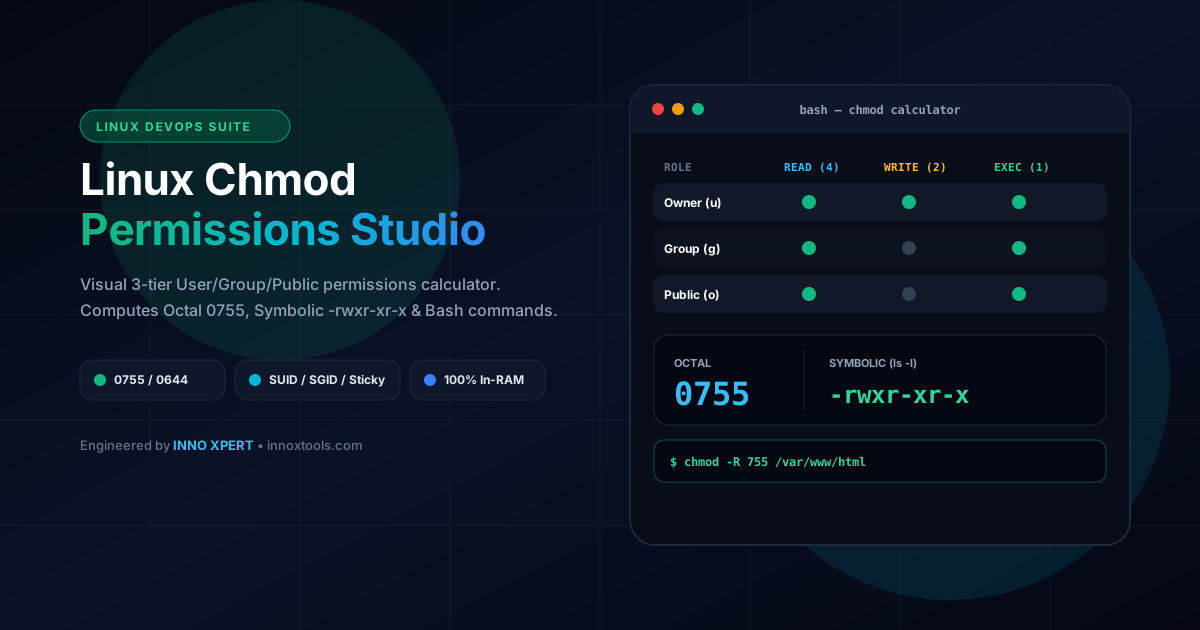
What is Linux Chmod Permissions Calculator & Generator? Calculate and generate Linux file permissions with octal numbers (0755, 0644), symbolic rwx notation, binary bitmasks, and ready-to-run chmod terminal commands. Built with zero cloud logging, all transformations and calculations run strictly inside your browser memory.
- Canonical Utility:
- Linux Chmod Permissions Calculator & Generator on InnoxTools
- Execution Sandbox:
- 100% Client-Side RAM (Zero Cloud Storage)
- Compliance & Standards:
- W3C, RFC Compliant, Air-Gapped Safe
- Runtime & Complexity:
- Local V8 / WebAssembly (O(n) Linear Execution)
- Network Transmission:
- 0 Outbound Telemetry (Offline Capable)
- License & Usage:
- Free Commercial & Personal (Unlimited Runs)
The InnoxTools Linux Chmod Permissions Calculator and Generator is an indispensable systems engineering workbench designed for DevOps practitioners, backend engineers, cloud infrastructure architects, and system administrators. In Unix and POSIX-compliant operating systems (including Linux, macOS, FreeBSD, OpenBSD, and Solaris), file access control is fundamentally governed by a three-tiered security matrix dividing permissions between the file's Owner (User), the owning Group, and Public (Others).
Misconfigured Linux permissions are one of the most prolific causes of critical production outages and security vulnerabilities. Setting overly permissive rights such as 'chmod 777' inadvertently grants world-writable access to every user and process on the server, opening attack vectors for privilege escalation, arbitrary script execution, and sensitive file tampering. Conversely, overly restrictive permissions break web server daemons (such as Nginx and Apache) with HTTP 403 Forbidden errors, corrupt CI/CD deployment pipelines, or trigger OpenSSH client failures when authenticating with private keys.
In Unix architectures, permissions are represented in two standard notations: Octal (numerical base-8 values such as `0755` or `0644`) and Symbolic (character strings such as `-rwxr-xr-x` seen in `ls -l` terminal listings). Each user class has three fundamental permissions: Read (value 4), Write (value 2), and Execute (value 1). Summing these numerical values produces the octal digit for that class (e.g., Read + Execute = 4 + 1 = 5).
In addition to standard read, write, and execute permissions, POSIX systems support three critical special permission modes: SUID (Set User ID, octal 4000), SGID (Set Group ID, octal 2000), and the Sticky Bit (octal 1000). SUID allows executable binaries to run with the privileges of the file owner (such as `/usr/bin/passwd` running as root). SGID ensures newly created files in a directory inherit the directory's group ownership. The Sticky Bit on directories (such as `/tmp`) prevents users from deleting files owned by other users.
InnoxTools provides an intuitive, real-time visual permission matrix: toggle Read (4), Write (2), and Execute (1) across User, Group, and Others, or configure special bits including SUID, SGID, and Sticky Bit. The engine calculates the corresponding octal digits, symbolic ls -l notation, binary bitmasks, and ready-to-run terminal commands directly in client memory without transmitting sensitive infrastructure file paths across the internet.
All calculations execute 100% in your local browser sandbox with zero network telemetry. Whether you are hardening production cloud servers, troubleshooting web server file ownership, or preparing for Red Hat or Linux Foundation certifications, InnoxTools delivers instantaneous precision and complete privacy.
How It Works Under the Hood
Select Permission Checkboxes or Production Preset
Click the interactive Read, Write, and Execute checkboxes for Owner, Group, and Public, or pick a verified preset such as Web Directory (0755), SSH Key (0600), or Static Asset (0644).
Configure Advanced Special Modes (Optional)
Enable SUID (Set User ID, 4000), SGID (Set Group ID, 2000), or Sticky Bit (1000) for specialized system binaries or multi-user shared directories.
Specify Target Path and Recursion Flags
Enter your target file or directory path (e.g. /var/www/html) and toggle recursive (-R) application as required.
Real-Time Binary Bitmask Evaluation
Inspect the 9-bit binary representation (e.g. 111 101 101) to understand how Linux kernel inodes encode file mode flags in memory.
Automated Security Audit & Risk Assessment
Review instant security banners that flag dangerous 0777 full access or unintended world-writable permissions with clear mitigation advice.
Copy Shell Command or Computed Permissions
Click to copy the absolute numeric command ('chmod 755 ...'), symbolic command ('chmod u=rwx,g=rx,o=rx ...'), or ls -l representation to your clipboard.
Key Architectural Capabilities & Features
Bidirectional Real-Time Calculator
Instant live synchronization between interactive visual checkboxes, numerical octal digits, and symbolic rwx notation.
Special Bitmask Engine (SUID, SGID, Sticky)
Full support for 4-digit POSIX special modes with proper uppercase/lowercase symbolic indicators (s, S, t, T).
Automated Security Audit & 777 Warnings
Visual alert banners actively warn against dangerous world-writable configurations and recommend secure enterprise alternatives.
Curated Production Presets Library
One-click templates for OpenSSH keys, Nginx/Apache document roots, shell scripts, and immutable config files.
Dual Terminal Command Generator
Outputs both numeric (absolute) and symbolic (relative) chmod command lines complete with target path and recursive flags.
9-Bit Binary Representation Display
Displays raw 3-digit octal and 9-bit binary representations for systems engineers and computer science students.
Directory (d) and File (-) Mode Toggle
Preview exact 'ls -la' terminal listings for both directories ('drwxr-xr-x') and standard files ('-rwxr-xr-x').
Zero Cloud Telemetry & Complete Privacy
All calculations execute strictly inside your browser's local V8 engine without logging your directory structures or server paths.
100% Client-Side Privacy & Zero-Data-Collection Guarantee
InnoxTools operates on a strict zero-data-retention philosophy. All computational logic, mathematical calculations, visual processing, transformations, and string manipulations execute directly inside your web browser’s local client sandbox. Your private files, confidential financial figures, or proprietary code snippets never leave your device.