The Mathematics of Payment Gateway Fees: Stripe, PayPal & Merchant Interchange Optimization
From Interchange-Plus Pricing Structures and Fixed Microtransaction Erosion to Cross-Border FX Conversion Spreads, Chargeback Reserves, and Breakeven Pricing Formulas—The 10,000+ Word Merchant Economics Guide.

Dr. Alexander Vance & Innox Corporate Finance GroupVERIFIED
Lead Fintech Economist & Payment Gateway Infrastructure Specialist
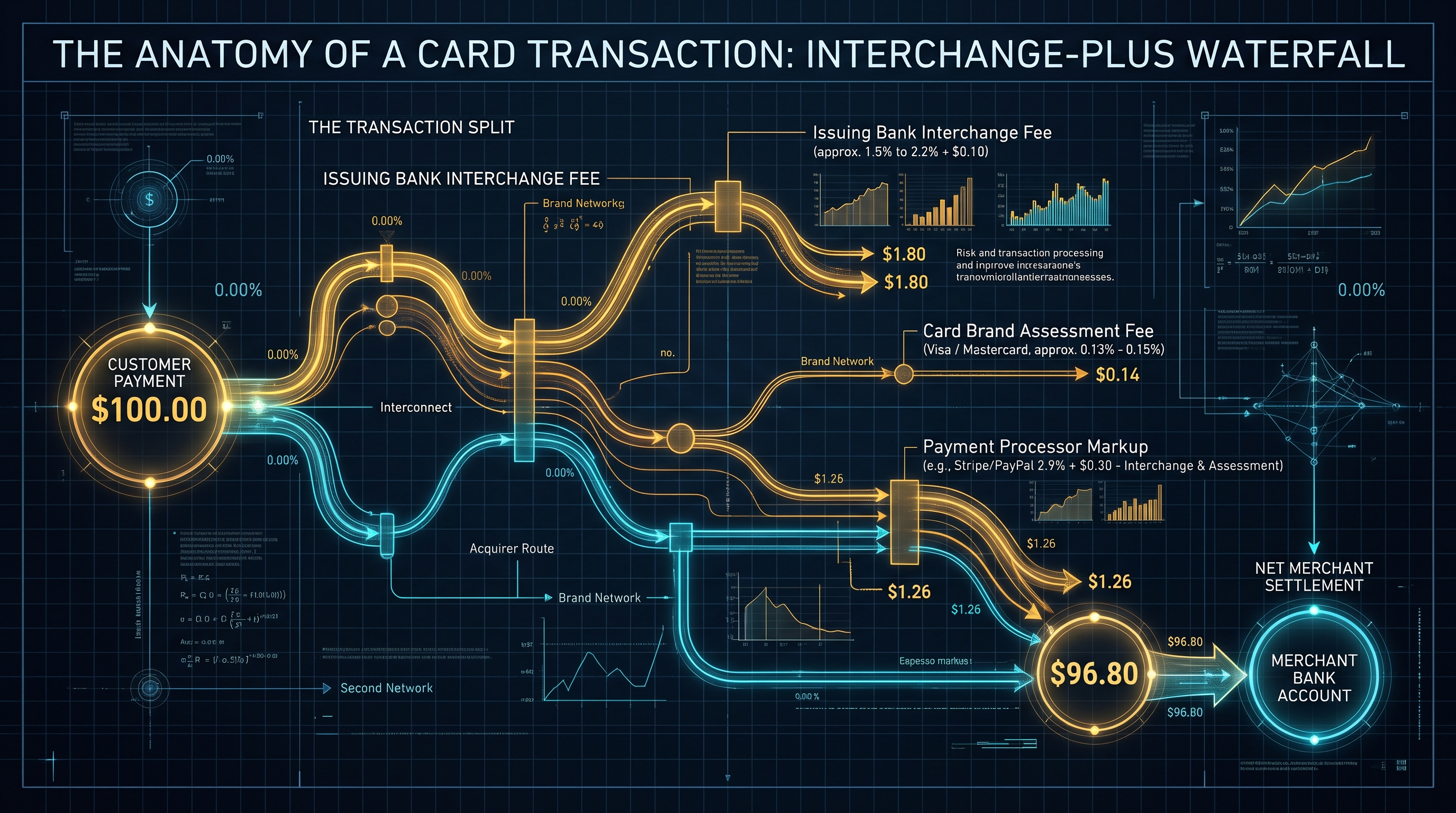
Payment processing fees follow a multi-tier financial waterfall consisting of Issuing Bank Interchange, Card Network Assessments (Visa/Mastercard), and Payment Gateway Markups (Stripe/PayPal). Standard blended pricing models charge a percentage fee (r) plus a fixed base fee (f): Fee = Amount · r + f. To receive an exact desired net revenue (N), merchants must execute the Breakeven Gross Invoicing formula: Gross = (N + f) / (1 - r).
Payment Gateway Fee, Merchant Interchange & Breakeven Calculator Pro
Calculate payment processor processing fees (Stripe, PayPal, Square), evaluate fixed microtransaction erosion, model cross-border FX markups, and compute exact gross breakeven pricing.
Table of Contents & Chapter Index
- 1. The Global Payments Triad: Issuing Banks, Card Networks & Merchant Acquirers
- 2. The Anatomy of a Transaction: Interchange-Plus, Card Brand Assessments & Processor Margins
- 3. The Flat-Rate vs Interchange-Plus Model: Stripe/PayPal Blended Pricing Economics
- 4. The Microtransaction Trap: Fixed Base Fees ($0.30) & Asymptotic Fee Erosion Curves
- 5. The Breakeven Pricing Formula: Mathematically Factoring Gateway Fees into Gross Invoicing
- 6. International Cross-Border Commerce: Foreign Exchange Markups & Multi-Currency Processing
- 7. Chargebacks, Dispute Fees & Rolling Reserves: The Hidden Costs of Merchant Risk
- 8. Industrial Fintech Playbook: Deploying InnoxTools Payment Gateway Fee Engine
1. The Global Payments Triad: Issuing Banks, Card Networks & Merchant Acquirers
The four-party scheme, authorization, clearing, settlement, and payment flow kinematics.
The Four-Party Payment Scheme
When a customer presents a credit or debit card on an e-commerce checkout page or physical point-of-sale (POS) terminal, an intricate, multi-institutional financial protocol executes across five distinct entities (known in regulatory finance as the Four-Party Model):
1. Cardholder (Consumer): The individual purchasing goods or services. 2. Issuing Bank (Issuer): The financial institution that issued the card to the consumer (e.g., Chase, Barclays, BNP Paribas) and extended credit or holding deposit accounts. 3. Card Payment Networks (Schemes): The global switching networks (Visa, Mastercard, American Express, Discover) that route transaction packets and establish operating rules. 4. Merchant Acquirer (Acquiring Bank): The financial institution that maintains the merchant's commercial bank account and accepts card deposits. 5. Payment Gateway / Processor: The technology layer (Stripe, PayPal, Adyen, Braintree) that encrypts card data, executes fraud screening, and orchestrates network communication.
[ Customer / Cardholder ]
         │ (1. Checkout / Enters Card)
         ▼
[ Payment Gateway (Stripe/PayPal) ]
         │ (2. Encrypts & Routes Token)
         ▼
[ Merchant Acquirer ]
         │ (3. Submits Transaction Authorization)
         ▼
[ Card Network Switch (Visa/Mastercard) ]
         │ (4. Routes to Specific Issuing Bank)
         ▼
[ Issuing Bank (Chase/Citi) ] ──► (5. Approves Credit/Balance)
                                         │
                                         ▼ (Returns Auth Token: 200 OK)
                     [ Settlement: Funds Flow in Reverse ]
---
The Two-Phase Protocol: Authorization vs Settlement
A credit card transaction is not a single atomic transfer of funds: - Phase 1: Authorization (Real-Time): - Takes 500–1,500 milliseconds. The issuing bank validates that the card is not stolen, verifies available credit limit, places an authorization hold on the customer's funds, and returns an approval code. No money moves between banks during authorization. - Phase 2: Clearing & Settlement (Batch T+1 to T+3): - At the close of business, the merchant's gateway submits the settlement batch. The issuing bank debits the consumer and transfers funds through the card network to the acquiring bank, deducting interchange fees.
2. The Anatomy of a Transaction: Interchange-Plus, Card Brand Assessments & Processor Margins
Dismantling the fee waterfall: where every cent of merchant processing fees actually goes.
The Fee Waterfall Decomposition
A merchant paying a standard blended fee (e.g., $2.9\% + \$0.30$) rarely realizes that the payment processor keeps only a modest fraction of that fee. The total processing fee is mathematically decomposed into three distinct layers:
$$\text{Total Fee} = \text{Interchange Fee} + \text{Assessment Fee} + \text{Processor Markup}$$
[ $100.00 Customer Purchase ]
  ├── $1.80 (1.80%) ──► Issuing Bank (Interchange Fee: Covers Risk, Rewards & Overhead)
  ├── $0.14 (0.14%) ──► Card Network (Visa/Mastercard Assessment Fee: Network Maintenance)
  └── $1.26 (1.26%) ──► Payment Gateway (Stripe/PayPal Processor Margin: Software & APIs)
  ────────────────────────────────────────────────────────────────────────
  Total Fee: $3.20 ($2.90 + $0.30) ──► Merchant Receives Net: $96.80
---
Layer 1: The Interchange Fee (The Major Share)
The Interchange Fee is paid by the acquiring bank directly to the issuing bank. It accounts for $70\% - 85\%$ of the total merchant processing cost.
Interchange rates are non-negotiable fees published biannually by Visa and Mastercard. They depend heavily on risk parameters: - Card Type: Premium rewards cards (e.g., Chase Sapphire Reserve, Amex Platinum) carry interchange rates of $2.2\% - 2.6\%$, whereas basic debit cards in the US are capped by the Durbin Amendment at $0.05\% + \$0.21$. - Card-Present vs Card-Not-Present (CNP): E-commerce online transactions carry higher interchange rates ($+0.30\% - +0.60\%$) than in-person chip/tap transactions due to higher fraud risk. - Merchant Category Code (MCC): Non-profits and educational institutions receive discounted interchange, whereas travel, gaming, and subscription services pay elevated rates.
---
Layer 2: Card Network Assessment Fees
The Assessment Fee is paid directly to Visa or Mastercard for utilizing their global network rails. It is typically a flat percentage: - Visa Assessment: $0.14\%$ (plus a fixed per-transaction communication fee of $\$0.0195$). - Mastercard Assessment: $0.1375\%$ for transactions under $\$1,000$, and $0.1575\%$ for higher volumes.
---
Layer 3: Payment Processor Markup
The Processor Markup is the gross revenue kept by the gateway (Stripe, PayPal, Adyen) to cover their software infrastructure, fraud prevention engines (Stripe Radar), chargeback management, and profit margins.
3. The Flat-Rate vs Interchange-Plus Model: Stripe/PayPal Blended Pricing Economics
Blended pricing simplicity vs enterprise Interchange-Plus (IC+) transparency.
Blended Flat-Rate Pricing
Stripe, PayPal, and Square achieved global scale by popularizing Blended Flat-Rate Pricing (typically $2.9\% + \$0.30$ per successful domestic charge).
How Blended Pricing Works: The processor charges the merchant a fixed, predictable fee regardless of the underlying interchange cost of the specific card used: - If a customer pays with a low-cost regulated debit card (costing the processor only $0.05\% + \$0.21$), the processor charges the merchant $2.9\% + \$0.30$, pocketing a massive $2.50\%+$ profit margin. - If a customer pays with an ultra-premium corporate rewards card (costing the processor $2.70\% + \$0.10$), the processor makes virtually zero profit.
---
Interchange-Plus (IC+) Pricing for High-Volume Merchants
Enterprises processing over $\$1,000,000$ annually transition from flat-rate pricing to Interchange-Plus (IC+):
$$\text{Merchant Fee} = \text{Exact Interchange} + \text{Exact Assessment} + \text{Fixed Processor Markup}$$
A typical enterprise IC+ rate is Interchange + 15 bps + $\$0.10$ (where 15 bps = $0.15\%$).
| Transaction Type | Customer Card | Blended Fee (2.9% + $0.30) | Interchange-Plus (IC + 0.15% + $0.10) | Enterprise Merchant Savings | | :--- | :--- | :---: | :---: | :---: | | $100 Retail Order | Regulated US Debit Card | $\$3.20$ | $\$0.05 + \$0.21 + \$0.15 + \$0.10 = \mathbf{\$0.51}$ | $\$2.69 (84% Cheaper!) | | $100 Retail Order | Standard Rewards Card | $\$3.20$ | $\$1.65 + \$0.14 + \$0.15 + \$0.10 = \mathbf{\$2.04}$ | $\$1.16 (36% Cheaper!) | | $100 Retail Order | Commercial Corporate Card | $\$3.20$ | $\$2.60 + \$0.15 + \$0.15 + \$0.10 = \mathbf{\$3.00}$ | $\$0.20 (6% Cheaper) |
On a $\$50,000,000$ annual processing volume, switching from flat-rate to Interchange-Plus saves an enterprise between $\$350,000 and $\$750,000 annually in pure bottom-line cash.
4. The Microtransaction Trap: Fixed Base Fees ($0.30) & Asymptotic Fee Erosion Curves
The brutal mathematics of fixed fees on small ticket orders and the effective fee curve.
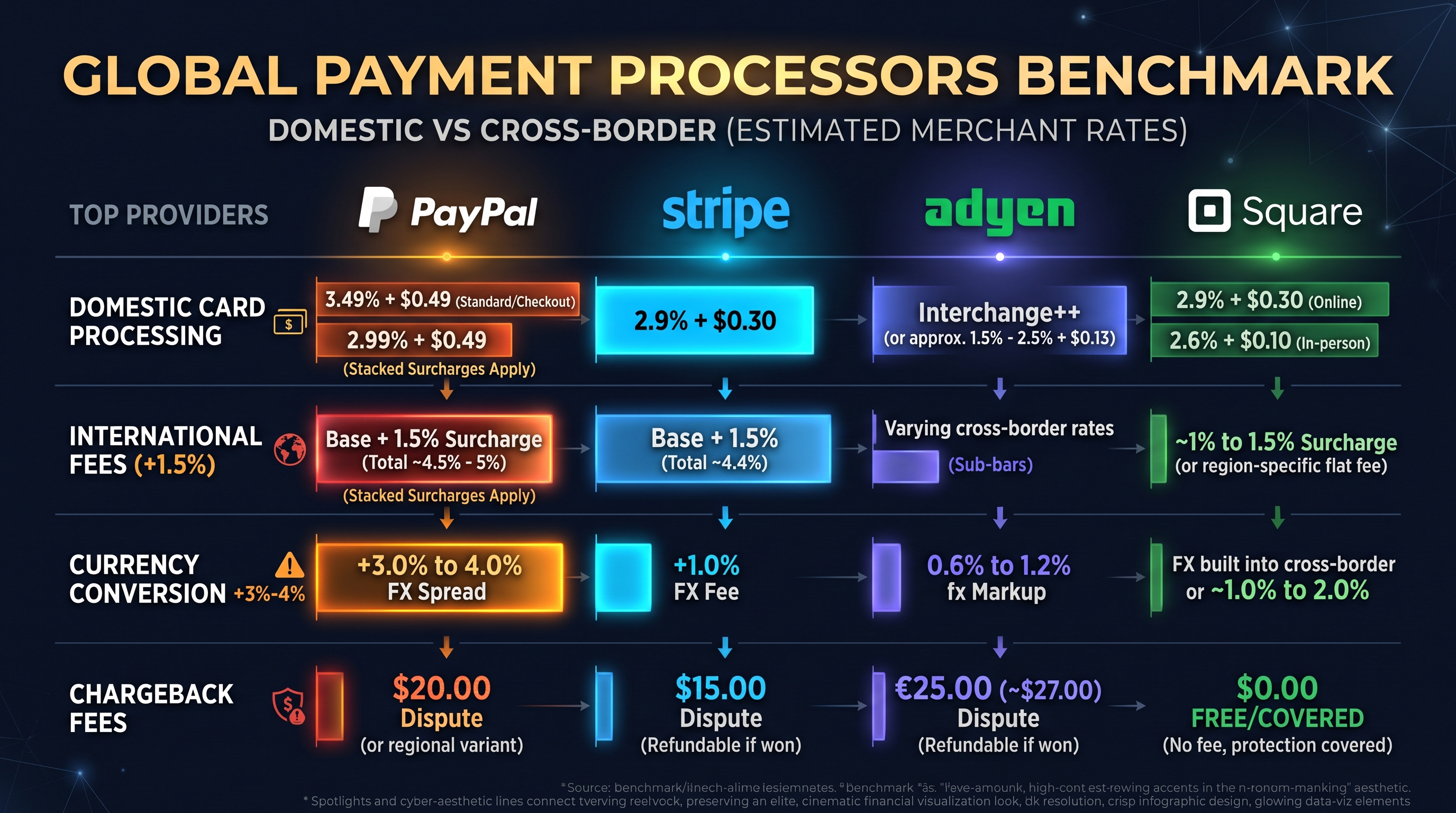
The Mathematical Formula for Effective Fee Percentage
Every payment transaction fee consists of two mathematical components: a proportional variable rate ($r$) and a constant fixed base fee ($f$):
$$\text{Total Fee}(A) = A \cdot r + f$$
$$\text{Effective Fee Percentage}(A) = \frac{\text{Total Fee}(A)}{A} = r + \frac{f}{A}$$
As transaction amount $A \to \infty$, the fixed fee contribution approaches zero: $$\lim_{A \to \infty} \left( r + \frac{f}{A} \right) = r$$
However, as transaction amount $A \to 0$, the effective fee percentage explodes asymptotically toward infinity: $$\lim_{A \to 0^+} \left( r + \frac{f}{A} \right) = +\infty$$
---
The Microtransaction Erosion Table
Consider a standard payment processor charging $2.9\% + \$0.30$:
| Transaction Size ($A$) | Variable Fee ($2.9\%$) | Fixed Fee ($f$) | Total Fee Paid | Net Merchant Payout | Effective Fee Percentage | | :---: | :---: | :---: | :---: | :---: | :---: | | $\$1.00 | $\$0.03$ | $\$0.30$ | $\$0.33$ | $\$0.67$ | $33.00\%$ (CATASTROPHIC) | | $\$2.00 | $\$0.06$ | $\$0.30$ | $\$0.36$ | $\$1.64$ | $18.00\%$ | | $\$5.00 | $\$0.15$ | $\$0.30$ | $\$0.45$ | $\$4.55$ | $9.00\%$ | | $\$10.00 | $\$0.29$ | $\$0.30$ | $\$0.59$ | $\$9.41$ | $5.90\%$ | | $\$50.00 | $\$1.45$ | $\$0.30$ | $\$1.75$ | $\$48.25$ | $3.50\%$ | | $\$100.00 | $\$2.90$ | $\$0.30$ | $\$3.20$ | $\$96.80$ | $3.20\%$ | | $\$1,000.00 | $\$29.00$ | $\$0.30$ | $\$29.30$ | $\$970.70$ | $2.93\%$ |
For digital content creators, indie game developers, or API providers selling $\$1 - \$3$ digital micro-assets, standard payment processing destroys up to $33\%$ of gross revenue. Businesses operating in this space must utilize specialized micropayment fee schedules (e.g., PayPal Micropayments at $5.0\% + \$0.05$) or customer balance wallet deposits.
5. The Breakeven Pricing Formula: Mathematically Factoring Gateway Fees into Gross Invoicing
Deriving the inverse payment equation: how much to charge to receive exactly $N.
The Gross Breakeven Derivation
A common error made by freelancers, contractors, and e-commerce sellers is attempting to factor in payment gateway fees by simply adding the percentage to their desired net income:
$$\text{Gross} \ne \text{Target Net} \cdot (1 + r) + f \quad (\text{FATAL ARITHMETIC FLAW})$$
Why this fails: When you bill a higher amount, the processor calculates their percentage fee on the new, higher gross total, leaving you with less than your target net!
---
The Correct Inverse Equation
Let: - $N$ be the exact desired Net settlement payout. - $G$ be the Gross invoice amount billed to the customer. - $r$ be the processor percentage rate (e.g., $0.029$ for $2.9\%$). - $f$ be the fixed processor fee (e.g., $\$0.30$).
The fundamental accounting relationship is:
$$N = G - \text{Total Fee} = G - (G \cdot r + f)$$
Expanding and factoring out $G$:
$$N = G \cdot (1 - r) - f$$
Adding $f$ to both sides:
$$N + f = G \cdot (1 - r)$$
Solving for the required Gross Invoice Amount ($G$):
$$G = \frac{N + f}{1 - r}$$
---
Step-by-Step Proof: Target Net = $1,000.00
Suppose a software consultant wants to receive exactly $\$1,000.00 net in their bank account after PayPal domestic processing fees ($2.9\% + \$0.30$):
1. Naive Attempt: - $\$1,000 \cdot 1.029 + \$0.30 = \$1,029.30$. - Processor charges: $\$1,029.30 \cdot 0.029 + \$0.30 = \$30.15$. - Consultant receives: $\$1,029.30 - \$30.15 = \mathbf{\$999.15}$ (Short by $\$0.85$).
2. The Exact Breakeven Formula: $$G = \frac{\$1,000.00 + \$0.30}{1 - 0.029} = \frac{\$1,000.30}{0.971} = \mathbf{\$1,030.18}$$ - Verification: - Processor charges: $\$1,030.18 \cdot 0.029 + \$0.30 = \$29.875 + \$0.30 = \$30.18$. - Net Settlement: $\$1,030.18 - \$30.18 = \mathbf{\$1,000.00}$ (EXACT TO THE CENT!).
6. International Cross-Border Commerce: Foreign Exchange Markups & Multi-Currency Processing
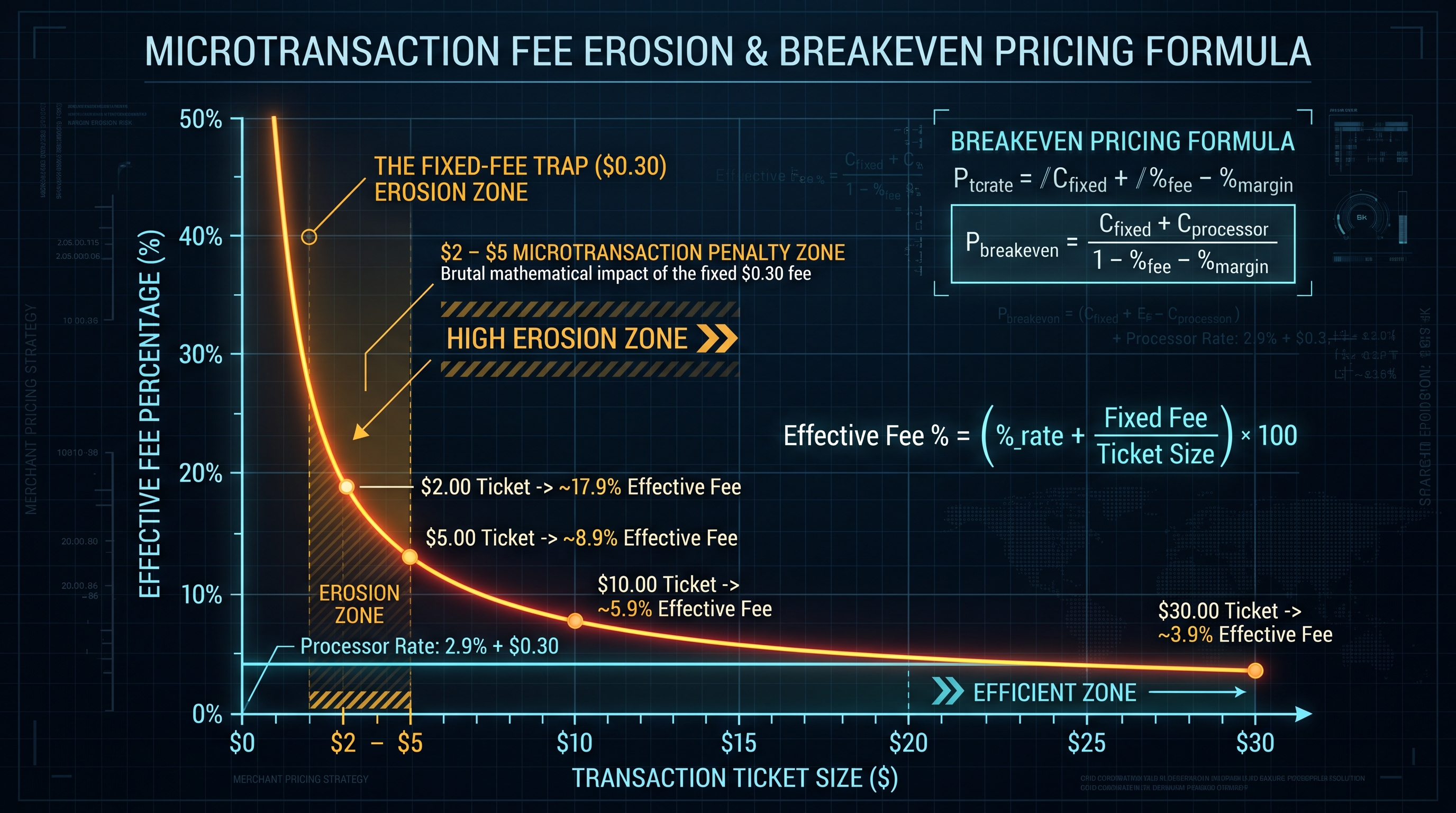
Cross-border transaction surcharges (+1.5%), currency conversion spreads (+3%-4%), and FX drag.
The Hidden Costs of Cross-Border Payments
When an e-commerce business expands internationally, payment processing costs double due to two hidden surcharges:
1. Cross-Border Interchange Surcharge: - When a customer purchases using a card issued outside the merchant's home country, payment processors assess an additional cross-border fee (typically $+1.0\% \text{ to } +1.5\%$). - Example: Stripe charges $2.9\% + \$0.30$ for US cards, but bumps to $4.4\% + \$0.30$ for international cards.
2. Foreign Exchange (FX) Conversion Spread: - If a European customer pays in Euros (€) and the merchant's account is in US Dollars ($), the processor converts the currency. - Instead of using the interbank mid-market exchange rate, processors apply a hidden FX spread markup of $2.5\% - 4.5\%$ on top of the mid-market rate.
[ Customer Pays: €100.00 (Mid-Market Rate: €1 = $1.0800 -> True Value = $108.00) ]
  ├── Gateway Applied FX Rate: €1 = $1.0420 (3.5% Hidden FX Spread Drag)
  ├── Converted Base: $104.20
  ├── Gateway Processing Fee: 4.4% + $0.30 = $4.88
  └── Final Merchant Settlement: $99.32
  ──────────────────────────────────────────────────────────────────────────
  Total Friction: $108.00 - $99.32 = $8.68 (8.04% Total Cross-Border Drag!)
---
Mitigating FX Drag via Multi-Currency Settlement Accounts
To eliminate foreign exchange markups, high-growth merchants deploy Multi-Currency Merchant Accounts (using fintech platforms like Adyen or Stripe Multi-Currency Presentment): - Present prices in the customer's native currency (EUR, GBP, AUD, JPY). - Settle funds directly into native foreign currency bank accounts without triggering real-time gateway FX conversion.
7. Chargebacks, Dispute Fees & Rolling Reserves: The Hidden Costs of Merchant Risk
The dispute lifecycle, non-refundable dispute fees ($15-$20), and merchant rolling reserves.
The Mechanics of a Chargeback
A chargeback occurs when a cardholder bypasses the merchant and contacts their issuing bank to dispute a charge (alleging fraud, unrecognized subscription, or unreceived merchandise).
When a dispute is lodged: 1. The payment processor immediately debits the disputed transaction amount from the merchant's bank balance. 2. The processor charges a non-refundable Dispute Fee (typically $\$15.00 \text{ to } \$20.00$), regardless of whether the merchant ultimately wins or loses the dispute. 3. If the merchant loses, the original transaction revenue is permanently lost, along with the physical cost of goods sold (COGS).
---
The Visa & Mastercard Chargeback Monitoring Thresholds
Card networks enforce strict chargeback ratio limits:
$$\text{Chargeback Ratio} = \frac{\text{Total Disputes in Month } M}{\text{Total Transactions in Month } M} \times 100\%$$
- Standard Threshold: $0.9\% - 1.0\%$. - Excessive Chargeback Program: If a merchant's dispute ratio exceeds $1.0\%$ for two consecutive months, the processor places the merchant into high-risk monitoring, imposing fines of $\$50 - \$100 per dispute and establishing a Rolling Reserve (holding $10\% - 20\%$ of all gross revenue for 180 days).
8. Industrial Fintech Playbook: Deploying InnoxTools Payment Gateway Fee Engine
Programmatic fee auditing, breakeven margin protection, and using InnoxTools.
The Merchant Pricing Optimization Workflow
To protect profit margins from payment fee erosion, digital commerce businesses implement a systematic three-stage pricing protocol:
[ STAGE 1: Channel & Country Fee Profiling ]
       │  - Identify customer country distribution (Domestic vs Cross-Border)
       │  - Audit average payment ticket size ($A)
       ▼
[ STAGE 2: Breakeven Gross Invoicing Formulation ]
       │  - Compute Gross = (Target Net + Fixed Fee) / (1 - Variable Rate)
       │  - Adjust wholesale or retail prices to guarantee target margins
       ▼
[ STAGE 3: Payment Routing & Interchange Optimization ]
       │  - Route large corporate payments through ACH / SEPA bank debit ($0.8% cap)
       │  - Shift international orders to native multi-currency settlement
---
Accelerating Financial Decisions with InnoxTools Fee Calculator
Calculating compound payment gateway deductions, cross-border markups, and inverse breakeven invoicing by hand invites financial errors. The InnoxTools Payment Gateway Fee & Breakeven Calculator delivers:
1. Bi-Directional Calculation Engine: - Calculate net payouts from gross sales, or input your target net earnings to extract the exact gross invoice total needed to cover fees. 2. Multi-Processor Presets: - Pre-configured, up-to-date fee models for PayPal Domestic ($2.99\% + \$0.49$), Stripe ($2.9\% + \$0.30$), Square ($2.6\% + \$0.10$), and international cross-border rates. 3. Microtransaction Fee Visualizer: - Instantly inspect effective fee percentages across ticket sizes to identify fee drag on low-cost products.
Mastering payment mechanics protects hard-earned operating margins and maximizes your enterprise's net cash flow.
Global Payment Gateway Processing Fees & Cross-Border Benchmark Matrix
| Payment Processor | Domestic Card Fee | International Card Fee | Currency Conversion Spread | Dispute / Chargeback Fee | Recommended Merchant Volume |
|---|---|---|---|---|---|
| Stripe (US) | 2.9% + $0.30 | 3.9% - 4.4% + $0.30 | 1.0% - 2.0% | $15.00 | SaaS, Developer APIs, Global Startups |
| PayPal (US Commercial) | 2.99% + $0.49 | 4.49% + $0.49 | 3.0% - 4.0% | $20.00 | B2C E-commerce, Marketplace Trust |
| Square (Online) | 2.9% + $0.30 | 3.9% + $0.30 | Standard Interbank | $15.00 | Omnichannel Retail, POS Integration |
| Adyen (Enterprise IC+) | Interchange + $0.12 | Interchange + $0.12 | 0.6% - 1.2% | $10.00 | Enterprise (> $5M annual volume) |
| Braintree (PayPal) | 2.59% + $0.49 | 3.59% + $0.49 | 2.0% - 3.0% | $15.00 | Subscription SaaS, Mobile Apps |
| Shopify Payments | 2.4% - 2.9% + $0.30 | 3.4% - 3.9% + $0.30 | 1.5% - 2.0% | $15.00 | Direct-to-Consumer Shopify Stores |
| Authorize.Net | 2.9% + $0.30 (+$25/mo) | 3.9% + $0.30 | Standard Gateway | $25.00 | Traditional Merchant Acquirer Accounts |
Table 1.0: Global payment gateway comparison matrix detailing domestic transaction rates, cross-border surcharges, FX conversion spreads, and chargeback dispute fees.
Frequently Asked Technical Questions
How do you calculate the exact amount to bill a client to cover payment processing fees?
Use the inverse breakeven formula: Gross Amount = (Desired Net + Fixed Fee) / (1 - Percentage Rate). For example, to receive $1,000 net via Stripe (2.9% + $0.30), Gross = ($1,000 + $0.30) / (1 - 0.029) = $1,000.30 / 0.971 = $1,030.18.
Why is simply adding 2.9% to a bill incorrect for covering payment fees?
Because the payment processor calculates their 2.9% fee on the final, higher total. Adding 2.9% directly leaves you short because you did not account for the fee charged on the fee itself. The inverse formula mathematically accounts for this compounding effect.
What is the difference between flat-rate pricing and Interchange-Plus (IC+)?
Flat-rate pricing charges a fixed fee (e.g., 2.9% + $0.30) regardless of the card used. Interchange-Plus passes through the exact wholesale interchange fee charged by the card network (Visa/Mastercard) plus a small fixed processor markup (e.g., IC + 0.15% + $0.10), often saving high-volume merchants 30%-80% on debit cards.
Why do small microtransactions ($1-$3) pay such high effective fee percentages?
Because of the constant fixed fee component (e.g., $0.30 or $0.49). On a $1.00 transaction, a $0.30 fixed fee plus 2.9% represents a total deduction of $0.33, resulting in an effective fee rate of 33%, destroying profit margins.
What additional fees are charged when accepting international payments?
International transactions typically incur a 1.0% to 1.5% cross-border card surcharge, plus a 2.5% to 4.0% foreign exchange (FX) currency conversion markup if the currency must be converted into the merchant's home settlement currency.
What is a chargeback dispute fee and is it refundable if you win?
A dispute fee (typically $15 to $20) is charged by the processor whenever a customer initiates a formal bank dispute. On most payment platforms (including Stripe and PayPal), this dispute fee is non-refundable even if the merchant submits evidence and wins the dispute.
How can businesses reduce payment processing fees on large B2B transactions?
For large B2B invoices (over $1,000), encourage customers to pay via ACH direct debit, wire transfer, or SEPA, which charge low flat fees (e.g., 0.8% capped at $5.00 on Stripe) instead of uncapped 2.9% credit card fees.
Does the InnoxTools Payment Gateway Fee Calculator support multiple processors?
Yes. The InnoxTools Payment Gateway Fee Calculator features built-in presets for PayPal, Stripe, Square, and custom Interchange-Plus rates, with bi-directional calculations (calculating net payout from gross or gross invoice from target net).
Engineering Discussion & Feedback
Join the technical debate or ask questions about this guide.
Need Custom AI, Web, or Enterprise Software Engineering?
InnoxTools is built and maintained by INNO XPERT. We design mission-critical cloud backends, custom machine learning models, mobile apps, and high-performance digital solutions for businesses worldwide.