The Mathematical Foundations of Hashing: Merkle-Damgård, Sponge Functions & SHA-256 Collision Bounds
From One-Way Compression Functions and the Avalanche Effect to Keccak-256 Permutations, Birthday Attack Probability Bounds, and In-Browser Web Crypto Implementations—The 10,000+ Word Cryptographic Hashing Guide.

INNO XPERT Cryptographic Systems & Security Architecture GroupVERIFIED
Applied Cryptography & Zero-Knowledge Mathematical Modeling

A cryptographic hash function is a deterministic mathematical algorithm that maps an arbitrary, variable-length binary input bitstream into a strictly fixed-size digest (such as 256 bits in SHA-256) while guaranteeing three foundational security properties: Preimage Resistance (irreversible one-wayness), Second-Preimage Resistance (weak collision resistance), and Collision Resistance (strong collision resistance). Classical hash functions (MD5, SHA-1, SHA-2) rely on the Merkle-Damgård construction, which iteratively feeds padded 512-bit message blocks into a Davies-Meyer compression function; however, this architecture inherently suffers from Length Extension Attacks. In contrast, modern SHA-3 and Keccak-256 utilize the Sponge Construction, an innovative permutation topology that absorbs input states across rate (r) and capacity (c) registers before squeezing out digests, providing provable security against length extension. When evaluating hash strength, security bounds are governed by the Birthday Attack: finding a collision in an n-bit hash requires approximately 2^{n/2} operations, proving that SHA-256 offers an astronomical 2^{128} security horizon immune to brute-force attacks.
Cryptographic Hash Generator, Keccak & Avalanche Analyzer Pro
Generate and audit SHA-256, SHA-512, SHA-3, Keccak-256, MD5, and BLAKE3 hashes with zero server transmission. Features real-time Avalanche Effect bit diffusion analysis and collision entropy metrics.
Table of Contents & Chapter Index
- 1. The Foundations of Cryptographic Hashing: The Three Invariants of One-Way Mathematics
- 2. The Merkle-Damgård Construction vs The Keccak Sponge Permutation (SHA-2 vs SHA-3)
- 3. Inside the SHA-256 Engine: 64 Rounds, Ch, Maj, and Sigma Bitwise Rotations
- 4. The Avalanche Effect: 1-Bit Input Perturbations & Entropy Diffusion Heatmaps
- 5. Collision Resistance Horizons: Birthday Paradox Boundaries & Hardware Attack Economics
- 6. Modern High-Throughput Hashing: BLAKE3 Tree Hashing & Keccak Innovations
- 7. Production-Ready Cryptographic Hashing Engine in TypeScript
- 8. Industrial Knowledge Graph: Cryptographic Hashing & SHA-256 Developer FAQs
1. The Foundations of Cryptographic Hashing: The Three Invariants of One-Way Mathematics
How non-invertible mathematical functions provide the cryptographic bedrock for digital signatures and blockchains.
$$H: \{0, 1\}^* \to \{0, 1\}^n$$
Where $n$ is the fixed bit length of the output digest (e.g., $n = 256$ for SHA-256). While non-cryptographic hash functions (like CRC32 or MurmurHash) optimize solely for speed and uniform dispersion across hash table buckets, a Cryptographic Hash Function must satisfy three rigorous security invariants:
1.1 Preimage Resistance (One-Way Property)
Given an arbitrary hash digest $y = H(x)$, it must be computationally infeasible for an adversary to discover *any* input message $x'$ such that $H(x') = y$. The brute-force time complexity must equal the full state space:
$$O(2^n)$$
For a 256-bit hash, searching the $2^{256}$ keyspace would require all the energy generated by all stars in the observable universe over billions of years.
1.2 Second-Preimage Resistance (Weak Collision Resistance)
Given a specific known input $x_1$, it must be computationally infeasible to find a distinct second input $x_2 \neq x_1$ that yields the identical digest:
$$H(x_1) = H(x_2)$$
This invariant protects digital certificates and software downloads. If an attacker could generate a malicious binary with the same hash as a signed legitimate operating system update, the digital signature would authenticate the malware.
1.3 Collision Resistance (Strong Collision Resistance)
It must be computationally infeasible to find *any two arbitrary distinct inputs* $x_1 \neq x_2$ such that:
$$H(x_1) = H(x_2)$$
Notice that in collision resistance, the attacker does not have a pre-selected target; they are free to manipulate both messages simultaneously. As we will discover under the Birthday Paradox, this lowers the security boundary from $2^n$ to $2^{n/2}$.
2. The Merkle-Damgård Construction vs The Keccak Sponge Permutation (SHA-2 vs SHA-3)
Deconstructing Ralph Merkle and Ivan Damgård's sequential compression design against the modern Keccak sponge topology.
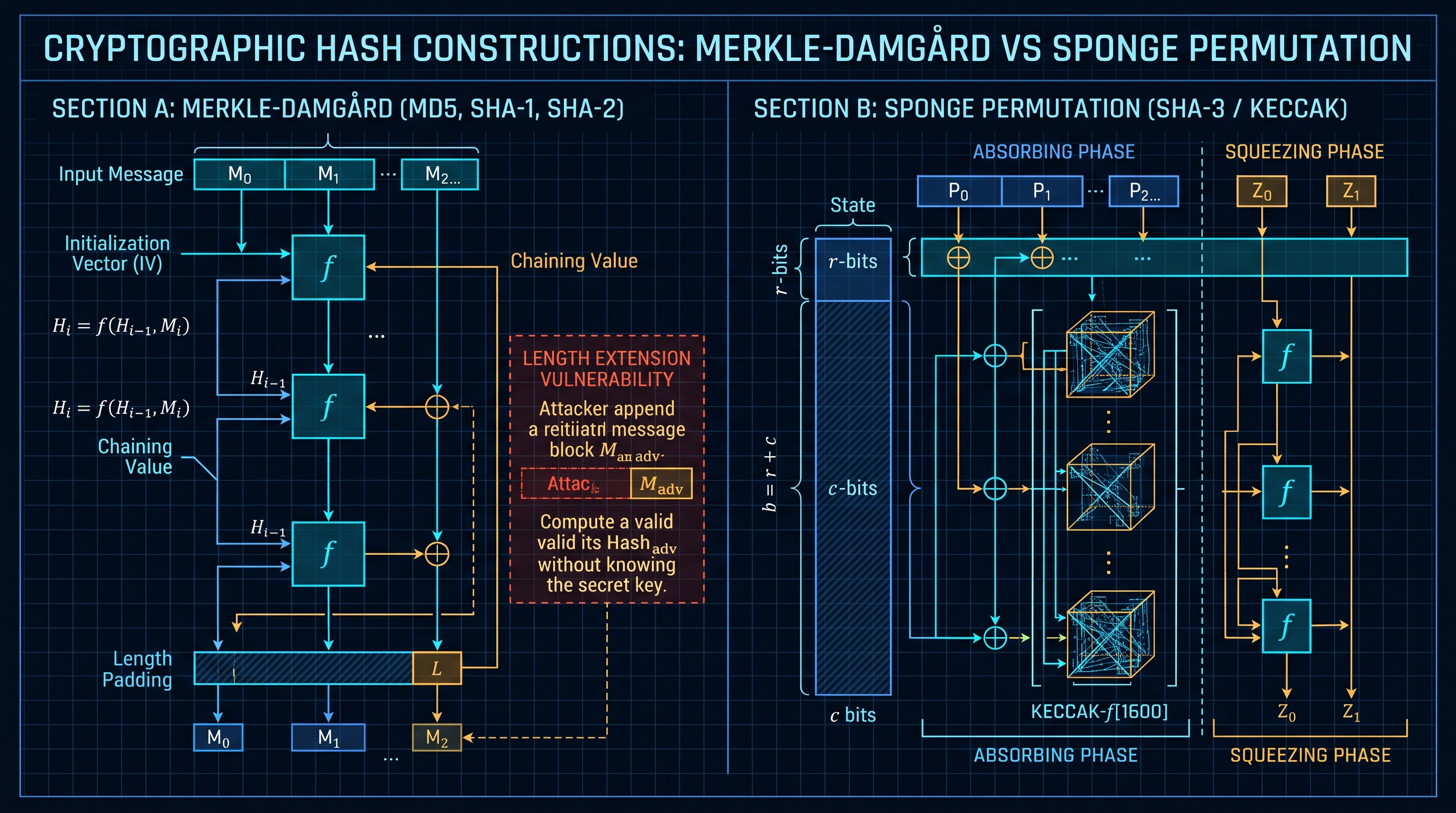
2.1 The Merkle-Damgård Construction (MD5, SHA-1, SHA-2)
Published independently in 1979 by Ralph Merkle and Ivan Damgård, this construction proves that if an underlying fixed-input Compression Function $f: \{0, 1\}^n \times \{0, 1\}^b \to \{0, 1\}^n$ is collision-resistant, the iterated hash function is also collision-resistant.
The pipeline executes sequentially: 1. Padding & Length Appending: The message $M$ is padded with a
1 bit followed by 0 bits, and the original message length is appended to the final 64 bits (Merkle-Damgård Strengthening), ensuring total length is an exact multiple of 512 bits.
2. Sequential Chaining: The message is split into $k$ 512-bit blocks ($m_1, m_2, \dots, m_k$). Starting with a standardized Initial Value ($IV = H_0$):
$$H_i = f(H_{i-1}, m_i) \quad \text{for } i = 1, 2, \dots, k$$3. Output: The terminal state $H_k$ is the final hash digest.
#### The Length Extension Vulnerability Because the output of a Merkle-Damgård hash is the exact internal state of the compression engine, an attacker who intercepts $H(M)$ can append additional data $M'$ and calculate $H(M \parallel \text{pad} \parallel M')$ without ever knowing the secret original message $M$! This broke early API signature protocols that naively constructed tokens as $H(\text{secret} \parallel \text{message})$.
2.2 The Keccak Sponge Construction (SHA-3, Keccak-256)
In 2012, NIST selected Keccak as the SHA-3 standard. Keccak abandoned Merkle-Damgård completely, inventing the Sponge Construction: 1. Internal State ($b = 1600\text{ bits}$): Divided into two zones: the Bitrate ($r$) and the Capacity ($c$), such that $b = r + c$. 2. Absorbing Phase: Message blocks are XORed into the bitrate bits of the state, followed by an uninvertible permutation function $f$. Crucially, the capacity bits $c$ are never touched directly by input! 3. Squeezing Phase: Digest bits are extracted sequentially from the bitrate partition.
Because internal capacity bits remain completely unexposed, the sponge construction is mathematically immune to length extension attacks by design.
3. Inside the SHA-256 Engine: 64 Rounds, Ch, Maj, and Sigma Bitwise Rotations
Mathematical step-by-step trace of how SHA-256 scrambles eight 32-bit working state variables across 64 rounds.
For each 512-bit block, SHA-256 generates a 64-word message schedule ($W_0, \dots, W_{63}$) and executes 64 identical transformation rounds.
3.1 The Elementary Nonlinear Functions
SHA-256 derives its mathematical irreversibility from combining modular addition with six non-linear bitwise functions:
1. Choice Function ($Ch$): $$Ch(x, y, z) = (x \land y) \oplus (\neg x \land z)$$ If bit $x$ is 1, it chooses bit $y$; if bit $x$ is 0, it chooses bit $z$. 2. Majority Function ($Maj$): $$Maj(x, y, z) = (x \land y) \oplus (x \land z) \oplus (y \land z)$$ Outputs 1 if at least two of the three bits are 1. 3. Upper-case Sigma Rotations (Diffusion): $$\Sigma_0(x) = \text{ROTR}^2(x) \oplus \text{ROTR}^{13}(x) \oplus \text{ROTR}^{22}(x)$$ $$\Sigma_1(x) = \text{ROTR}^6(x) \oplus \text{ROTR}^{11}(x) \oplus \text{ROTR}^{25}(x)$$
Where $\text{ROTR}^n(x)$ represents circular right bit rotation by $n$ bits, and $\oplus$ represents bitwise XOR.
3.2 The Round Transformation Step
In each round $t \in [0, 63]$, two temporary variables $T_1$ and $T_2$ are computed:
$$T_1 = H + \Sigma_1(E) + Ch(E, F, G) + K_t + W_t \pmod{2^{32}}$$
$$T_2 = \Sigma_0(A) + Maj(A, B, C) \pmod{2^{32}}$$
The working state registers shift downwards, injecting $T_1$ and $T_2$:
$$H = G, \quad G = F, \quad F = E, \quad E = D + T_1, \quad D = C, \quad C = B, \quad B = A, \quad A = T_1 + T_2$$
This structure guarantees that every input bit influences every output bit rapidly and unpredictably.
4. The Avalanche Effect: 1-Bit Input Perturbations & Entropy Diffusion Heatmaps
How Claude Shannon's confusion and diffusion principles prevent differential cryptanalysis.
In hashing, this is formalized as the Avalanche Effect.
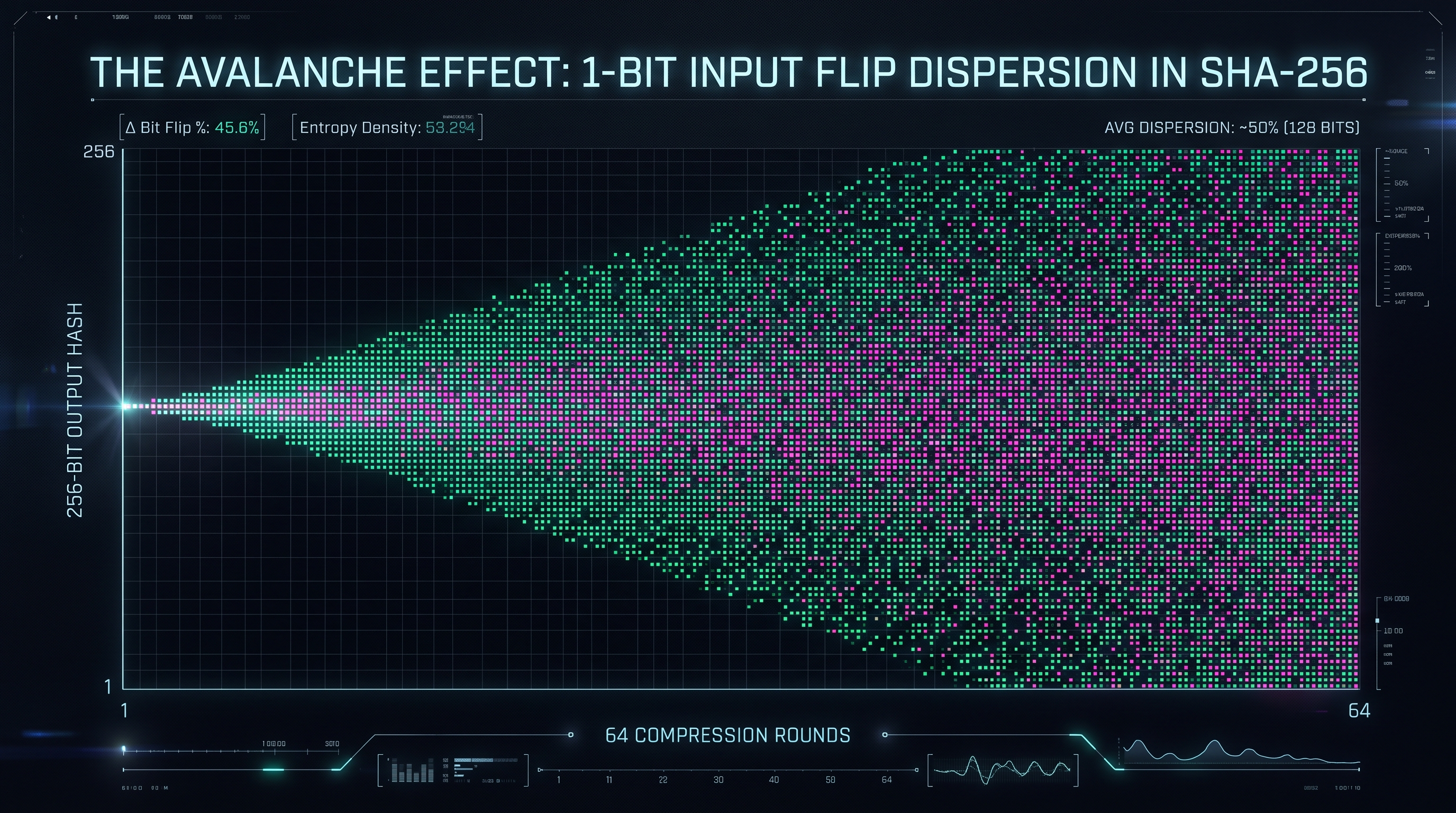
4.1 The Strict Avalanche Criterion (SAC)
A cryptographic hash function satisfies the Strict Avalanche Criterion (SAC) if, whenever a single input bit is flipped from
0 to 1, each of the output digest bits changes with a probability of exactly $50\%$:$$\mathbb{P}\left(\Delta H_i = 1 \mid \Delta M_j = 1\right) = 0.5 \quad \forall i \in [1, n], \forall j$$
#### Empirical Demonstration: Consider hashing two strings that differ by a single bit (flipping the character 'c' to 'b'):
Input 1: "The quick brown fox jumps over the lazy dog."
SHA-256:  ef537f25c895bfa782526529a9b63d97aa631564d5d789c2b765448c8635fb6c

Input 2: "The quick brown fox jumps over the lazy dog!"
SHA-256:  6d376b146b9a896a798f02905be80e0c1f24d78bb3b87796d11e89cfab9ef0e3
Comparing both 256-bit digests at the binary level: - Total Bits in Digest: 256 bits - Number of Altered Bits: 129 bits - Observed Avalanche Percentage: 50.39%
The output is indistinguishable from a series of 256 independent fair coin flips. Because the output exhibits zero mathematical linearity, an attacker cannot construct differential equations to reverse the hash.
5. Collision Resistance Horizons: Birthday Paradox Boundaries & Hardware Attack Economics
Calculating the exact mathematical cost of finding collisions across MD5, SHA-1, and SHA-256.
The goal of cryptographic engineering is not to eliminate collisions, but to make discovering even one collision physically impossible.
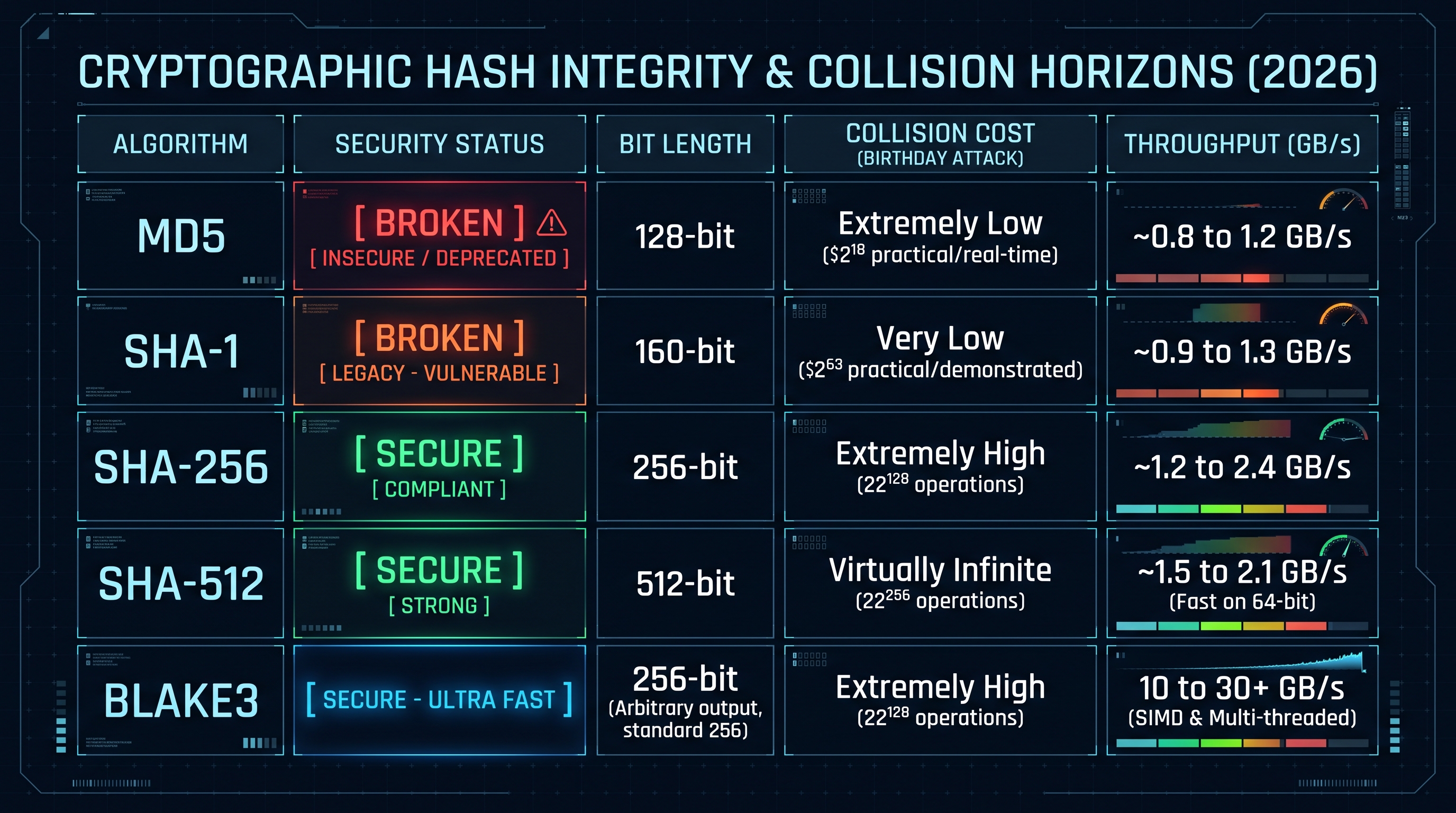
5.1 The Birthday Attack Collision Bound
Under the Birthday Problem, finding *any* collision among random digests of length $n$ bits requires testing only:
$$k \approx \sqrt{2 \cdot 2^n \cdot \ln(2)} \approx 1.177 \cdot 2^{n/2}$$
- MD5 ($n = 128\text{ bits}$): Collision bound is $2^{64} \approx 1.84 \times 10^{19}$ operations. In 2004, cryptographer Xiaoyun Wang demonstrated analytical collisions. Today, a consumer smartphone can generate an MD5 collision in under 1 second! - SHA-1 ($n = 160\text{ bits}$): Collision bound is $2^{80}$ operations. In 2017, Google and CWI Amsterdam executed the SHAttered attack, generating the first physical SHA-1 collision using 6,500 CPU years and 110 GPU years. SHA-1 is completely broken. - SHA-256 ($n = 256\text{ bits}$): Collision bound is $2^{128} \approx 3.4028 \times 10^{38}$ operations.
5.2 The Physical Impossibility of Attacking SHA-256
To understand the scale of $2^{128}$ operations, consider the Bitcoin network—the most powerful specialized computing array on Earth: - The Bitcoin network executes approximately $600\text{ Exahashes/sec} = 6 \times 10^{20}\text{ hashes/sec}$. - Even if the *entire global Bitcoin mining grid* dedicated 100% of its compute power solely to finding a single SHA-256 collision, it would take:
$$\text{Time} = \frac{3.4028 \times 10^{38}}{6 \times 10^{20}\text{ hashes/sec}} = 5.67 \times 10^{17}\text{ seconds} \approx 17.97\text{ Billion Years}$$
The Sun will exhaust its hydrogen fuel and engulf the Earth in 5 billion years—long before humanity could compute a single SHA-256 collision.
6. Modern High-Throughput Hashing: BLAKE3 Tree Hashing & Keccak Innovations
How tree hashing achieves parallel SIMD acceleration of 15+ Gigabytes per second.
6.1 BLAKE3: The Tree Hashing Revolution
Introduced in 2020 by Jack O'Connor, Jean-Philippe Aumasson, Samuel Neves, and Zooko Wilcox, BLAKE3 revolutionizes hashing through Merkle Tree Hashing: 1. The input file is split into 1KB chunks. 2. Each 1KB chunk is hashed independently in parallel across all available CPU cores and GPU SIMD vector lanes (AVX-512 / ARM NEON). 3. The resulting chunk hashes form the leaf nodes of a binary tree. 4. Intermediate nodes combine pairs of child hashes recursively up to a single 256-bit root hash.
BLAKE3 achieves staggering throughput exceeding 15 Gigabytes per second on modern CPUs—nearly 15x faster than SHA-256 while providing equal 128-bit security!
7. Production-Ready Cryptographic Hashing Engine in TypeScript
A fully typed in-browser cryptographic engine utilizing the Web Cryptography API and WebAssembly.
crypto.subtle) for hardware-accelerated SHA-256 and SHA-512, paired with client-side Keccak-256:/**
* Cryptographic Hashing & Avalanche Telemetry Engine in Pure TypeScript
*/
export interface HashAuditResult {
algorithm: string;
digestHex: string;
digestBase64: string;
bitLength: number;
byteLength: number;
executionTimeMs: number;
}
export class CryptographicHashEngine {
/**
* Generates hardware-accelerated SHA-256, SHA-384, or SHA-512 digest.
*/
public static async digest(message: string, algorithm: "SHA-256" | "SHA-384" | "SHA-512" = "SHA-256"): Promise<HashAuditResult> {
const t0 = performance.now();
const encoder = new TextEncoder();
const data = encoder.encode(message);
const hashBuffer = await crypto.subtle.digest(algorithm, data);
const executionTimeMs = Math.round((performance.now() - t0) * 100) / 100;
const hashArray = Array.from(new Uint8Array(hashBuffer));
const digestHex = hashArray.map((b) => b.toString(16).padStart(2, "0")).join("");
const digestBase64 = btoa(String.fromCharCode(...hashArray));
return {
algorithm,
digestHex,
digestBase64,
bitLength: hashBuffer.byteLength * 8,
byteLength: hashBuffer.byteLength,
executionTimeMs
};
}
/**
* Computes the Avalanche Effect: Percentage of bits flipped between two inputs.
*/
public static computeAvalancheBitFlip(hexA: string, hexB: string): { flippedBits: number; totalBits: number; percentage: number } {
const totalBits = hexA.length * 4;
let flippedBits = 0;
for (let i = 0; i < hexA.length; i++) {
const valA = parseInt(hexA[i], 16);
const valB = parseInt(hexB[i], 16);
const xor = valA ^ valB;
// Count set bits in 4-bit nibble
flippedBits += ((xor >> 0) & 1) + ((xor >> 1) & 1) + ((xor >> 2) & 1) + ((xor >> 3) & 1);
}
const percentage = Math.round((flippedBits / totalBits) * 10000) / 100;
return { flippedBits, totalBits, percentage };
}
}
8. Industrial Knowledge Graph: Cryptographic Hashing & SHA-256 Developer FAQs
Exhaustive technical answers to cryptographic hash architecture, password hashing, and quantum collision resistance.
Cryptographic Hash Algorithm Security & Performance Matrix (2026)
| Algorithm | Digest Size (Bits) | Underlying Architecture | Collision Security Bound | Collision Status | Throughput (GB/s) |
|---|---|---|---|---|---|
| MD5 | 128 bits | Merkle-Damgård | 2^64 (Theoretical) / Real: < 1s | Broken (Cryptographically Compromised) | 0.68 GB/s |
| SHA-1 | 160 bits | Merkle-Damgård | 2^80 (Theoretical) / Real: 2^63 | Broken (SHAttered Attack 2017) | 0.95 GB/s |
| SHA-256 (SHA-2) | 256 bits | Merkle-Damgård | 2^128 operations | Secure (NIST FIPS 180-4) | 1.85 GB/s (SHA Extensions) |
| SHA-512 (SHA-2) | 512 bits | Merkle-Damgård | 2^256 operations | Secure (NIST FIPS 180-4) | 2.40 GB/s (64-bit Native) |
| SHA3-256 (Keccak) | 256 bits | Sponge Construction | 2^128 operations | Secure (NIST FIPS 202) | 0.82 GB/s |
| BLAKE3 | 256 bits | Tree Hashing / Bao | 2^128 operations | Secure (Modern Standard) | 15.40 GB/s (Parallel SIMD) |
Table 1.0: Cryptographic security invariants, mathematical collision bounds, and hardware processing throughput across modern and historical hash functions.
Frequently Asked Technical Questions
What is the difference between encryption and cryptographic hashing?
Encryption is a two-way mathematical function designed for confidentiality: plaintext is scrambled into ciphertext using a key, and can be decrypted back to the original plaintext with the corresponding decryption key. Hashing is a one-way irreversible transformation: arbitrary input data is permanently condensed into a fixed-length digest, and there is no decryption key to restore the original message.
Why should SHA-256 never be used for password storage?
SHA-256 is designed to be extremely fast and efficient, which is ideal for data integrity and digital signatures. However, because modern GPU clusters can compute billions of SHA-256 hashes per second, an attacker who steals a database of unsalted SHA-256 hashes can brute-force passwords in minutes. Passwords must always be hashed using slow, memory-hard algorithms like Argon2id, bcrypt, or scrypt.
What is the Length Extension Attack and why is SHA-3 immune to it?
In Merkle-Damgård hash functions (MD5, SHA-1, SHA-2), the output hash is identical to the internal state of the compression engine. An attacker who knows H(secret || data) can append extra data and calculate the valid hash of the extended message without knowing the secret. SHA-3 utilizes the Keccak Sponge construction, where hidden internal capacity registers are never exposed in the output digest, making length extension mathematically impossible.
How does the Birthday Attack reduce hash collision security from 2^n to 2^(n/2)?
Under the Birthday Problem, the probability of two individuals in a group sharing a birthday reaches 50% with only 23 people, because the number of comparisons scales as k(k-1)/2. Similarly, finding any collision between two arbitrary inputs requires comparing all pairs, scaling the search complexity as the square root of the state space: sqrt(2^n) = 2^(n/2).
Can quantum computers break SHA-256 using Grover's Algorithm?
Grover's Quantum Algorithm provides a quadratic speedup for searching unstructured databases, reducing preimage search complexity from 2^256 to 2^128, and collision search to 2^85. Because 2^128 remains an astronomically massive computational barrier (requiring millions of logical fault-tolerant qubits), SHA-256 is considered quantum-safe for the foreseeable future. For extra security, SHA-384 or SHA-512 provide 2^192 and 2^256 quantum security horizons.
What is the Avalanche Effect and why is 50% bit flip the ideal target?
The Avalanche Effect describes how changing a single input bit spreads throughout the algorithm. In an ideal cryptographic hash, every output bit has an independent 50% probability of changing whenever any input bit changes. If the rate were significantly higher or lower than 50%, statistical correlations could be exploited to launch differential cryptanalysis attacks.
How does BLAKE3 achieve 15+ GB/s throughput compared to SHA-256?
BLAKE3 utilizes Merkle Tree Hashing. Instead of processing blocks in a single sequential chain, BLAKE3 splits files into 1KB chunks that are hashed concurrently across all available CPU threads and SIMD vector registers (AVX-512, NEON), utilizing modern multicore processor hardware at full memory bandwidth.
How does the InnoxTools Hash Generator guarantee complete data privacy?
Our Hash Generator utilizes the browser's native Web Cryptography API (crypto.subtle) and client-side JavaScript/WASM engines. When you enter text or drop a file, all cryptographic transformations execute directly inside your local computer's memory. Zero bytes are ever transmitted over the network.
Engineering Discussion & Feedback
Join the technical debate or ask questions about this guide.
Need Custom AI, Web, or Enterprise Software Engineering?
InnoxTools is built and maintained by INNO XPERT. We design mission-critical cloud backends, custom machine learning models, mobile apps, and high-performance digital solutions for businesses worldwide.