Enterprise Invoicing & International Value Added Tax: Multi-Tier GST/VAT Compliance & Reverse Charges
From Inclusive vs Exclusive Tax Extraction Calculus to Cross-Border SaaS Reverse Charge Mechanisms, Supply Chain Input Tax Credits, and Global Compliance Ledgers—The 10,000+ Word Fiscal Engineering Handbook.

Dr. Alexander Vance & Innox Corporate Finance GroupVERIFIED
Lead Fiscal Policy Strategist & Cross-Border Tax Systems Architect

Value Added Tax (VAT) and Goods and Services Tax (GST) are multi-stage consumption taxes levied on the value added at each stage of a supply chain. Calculating tax amounts requires distinct mathematical formulas: Tax-Exclusive forward calculation adds tax via Gross = Net · (1 + r), whereas Tax-Inclusive backward extraction calculates original Net = Gross / (1 + r) and Tax = Gross · [r / (1 + r)]. In cross-border B2B digital services, the Reverse Charge Mechanism shifts tax reporting liability from foreign vendor to domestic buyer.
Enterprise GST/VAT Calculator, Reverse Charge & Invoicing Engine Pro
Calculate forward and backward VAT/GST extractions, evaluate multi-tier supply chain Input Tax Credits (ITC), and model cross-border SaaS reverse charges.
Table of Contents & Chapter Index
- 1. The Global Architecture of Indirect Taxation: Economic Theory & Revenue Extraction
- 2. The Mathematical Mechanics of Consumption Taxes: Inclusive vs Exclusive Calculus
- 3. Multi-Jurisdictional Tax Regimes: Single-Stage Sales Tax vs Multi-Tier VAT/GST
- 4. Multi-Tier Supply Chains: Input Tax Credit (ITC) Reconciliation & Cascading Elimination
- 5. Digital Services & Cross-Border SaaS: The Place of Supply & Economic Nexus
- 6. International Digital Services: The Cross-Border B2B Reverse Charge Accounting Mechanism
- 7. Corporate Audit Defense: Invoicing Invariants, Rounding Precision & Compliance Ledgers
- 8. Industrial Fiscal Engineering Playbook: Deploying InnoxTools GST/VAT Engine
1. The Global Architecture of Indirect Taxation: Economic Theory & Revenue Extraction
Direct vs indirect taxation, deadweight loss, tax incidence, and macroeconomic stability.
The Macroeconomic Role of Consumption Taxation
In public economics, sovereign revenue extraction is divided into Direct Taxation (taxes levied directly on the income, wealth, or corporate profits of legal entities) and Indirect Taxation (taxes levied on market consumption transactions, where the statutory taxpayer differs from the economic tax bearer).
Over 170 nations have adopted Value Added Tax (VAT) or Goods and Services Tax (GST) frameworks. Unlike corporate income taxes, which fluctuate dramatically with macroeconomic business cycles, consumption taxes generate stable, counter-cyclical government revenue streams because aggregate consumption exhibits lower variance than corporate earnings:
$$\text{Government Revenue} = \sum_{i=1}^{M} \tau_i \cdot C_i$$
Where $\tau_i$ represents the effective indirect tax rate applied to consumption basket category $C_i$.
---
Tax Incidence & Deadweight Loss (Harberger Triangles)
A fundamental principle of tax economics is that the statutory obligation to remit tax (e.g., placing the legal burden on the merchant) does not dictate who economically bears the tax. The economic burden (tax incidence) depends strictly on the relative price elasticities of supply and demand:
$$\frac{\Delta P_{\text{consumer}}}{\Delta P_{\text{producer}}} = \frac{\epsilon_s}{|\epsilon_d|}$$
Where: - $\epsilon_s$ is the price elasticity of supply. - $\epsilon_d$ is the price elasticity of demand.
       Price (P)
           ▲
           │         Demand Curve (D)
   P_gross ┼─────────┐
           │         │ ◄── Tax Wedge (t)
   P_equil ┼───-─-─-─┼─-─-─-─-┐
           │         │        │ ◄── Deadweight Loss Triangle
    P_net  ┼─────────┘        │     (Harberger Welfare Loss)
           │                  │
           └──────────────────┴────────► Quantity (Q)
                   Q_tax    Q_free
When supply is perfectly elastic (common in scalable digital goods and global software-as-a-service), $\epsilon_s \to \infty$, meaning 100% of the consumption tax burden is shifted directly onto the end consumer.
2. The Mathematical Mechanics of Consumption Taxes: Inclusive vs Exclusive Calculus
Forward addition vs backward extraction, reciprocal multipliers, and avoiding the margin error.
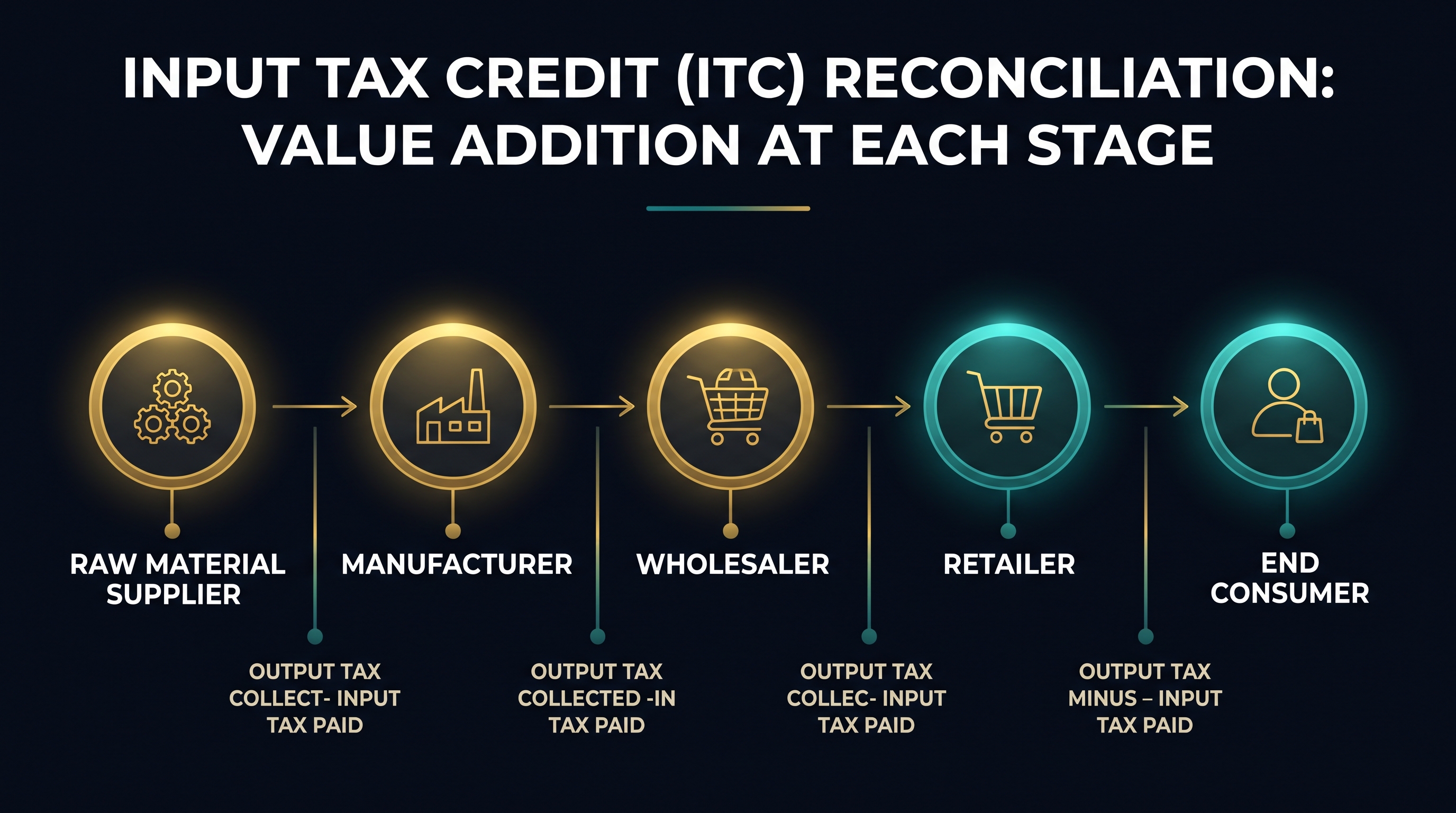
Tax-Exclusive (Forward) Calculation
In business-to-business (B2B) trade and corporate procurement, prices are quoted as Tax-Exclusive (Net of Tax). The tax is added on top of the agreed base price.
Given a net taxable base amount ($N$) and a statutory tax rate ($r$, expressed as a decimal, e.g., $20\% = 0.20$):
$$\text{Tax Amount} (T) = N \cdot r$$
$$\text{Gross Total} (G) = N + T = N + (N \cdot r) = N \cdot (1 + r)$$
---
Tax-Inclusive (Backward) Extraction
In consumer-facing retail (B2C) and jurisdictions mandating transparent shelf pricing (such as the European Union and Australia), prices are displayed as Tax-Inclusive (Gross). Retailers and accounting systems must extract the underlying net revenue and sales tax liability from the total transaction amount.
A common arithmetic blunder is multiplying the gross price by the tax rate: $$T \neq G \cdot r \quad (\text{FATAL ACCOUNTING ERROR})$$
Because $G = N \cdot (1 + r)$, solving for Net ($N$):
$$N = \frac{G}{1 + r}$$
The extracted Tax Amount ($T$) is:
$$T = G - N = G - \frac{G}{1 + r} = G \cdot \left(1 - \frac{1}{1 + r}\right) = G \cdot \left(\frac{r}{1 + r}\right)$$
The fraction $\frac{r}{1 + r}$ represents the Effective Extraction Multiplier.
---
Comparison of Forward vs Backward Rates
| Statutory Tax Rate ($r$) | Forward Multiplier ($1 + r$) | Backward Extraction Fraction | Backward Decimal Factor | Example Gross ($G = \$1,200$) $\implies$ Tax | | :---: | :---: | :---: | :---: | :--- | | 5.0% | $1.050$ | $\frac{0.05}{1.05} = \frac{1}{21}$ | $0.047619$ | $\$1,200 \cdot 0.047619 = \$57.14$ | | 10.0% | $1.100$ | $\frac{0.10}{1.10} = \frac{1}{11}$ | $0.090909$ | $\$1,200 \cdot 0.090909 = \$109.09$ | | 15.0% | $1.150$ | $\frac{0.15}{1.15} = \frac{3}{23}$ | $0.130435$ | $\$1,200 \cdot 0.130435 = \$156.52$ | | 18.0% | $1.180$ | $\frac{0.18}{1.18} = \frac{9}{59}$ | $0.152542$ | $\$1,200 \cdot 0.152542 = \$183.05$ | | 20.0% | $1.200$ | $\frac{0.20}{1.20} = \frac{1}{6}$ | $0.166667$ | $\$1,200 \cdot 0.166667 = \$200.00$ | | 25.0% | $1.250$ | $\frac{0.25}{1.25} = \frac{1}{5}$ | $0.200000$ | $\$1,200 \cdot 0.200000 = \$240.00$ |
3. Multi-Jurisdictional Tax Regimes: Single-Stage Sales Tax vs Multi-Tier VAT/GST
Retail Sales Tax (RST) cascading, European VAT origins, and Canadian GST/PST/HST harmonized structures.
Retail Sales Tax (RST) vs Value Added Tax (VAT)
The United States remains the only major advanced economy that does not operate a national federal VAT. Instead, US states levy decentralized Retail Sales Taxes (RST).
The structural difference between RST and VAT is profound:
1. Retail Sales Tax (RST - Single-Stage): - Levied only at the final point of retail sale to the ultimate consumer. - Businesses in the intermediate supply chain utilize Resale Certificates to exempt wholesale transactions. - Vulnerability: High rates of wholesale tax evasion and cascading ("tax on tax") when intermediate capital equipment fails to qualify for exemptions.
2. Value Added Tax (VAT / GST - Multi-Stage): - Levied at every consecutive commercial transaction throughout the production and distribution chain. - At each stage, businesses collect tax on their sales (Output Tax) but claim a credit for taxes paid on business inputs (Input Tax Credit). - Self-Enforcing Invariant: Businesses have an intense financial incentive to report purchases to claim input tax credits, creating an immutable cross-company audit trail for tax authorities.
4. Multi-Tier Supply Chains: Input Tax Credit (ITC) Reconciliation & Cascading Elimination
Tracing an industrial product from raw materials to retail shelf without compounding tax cascading.
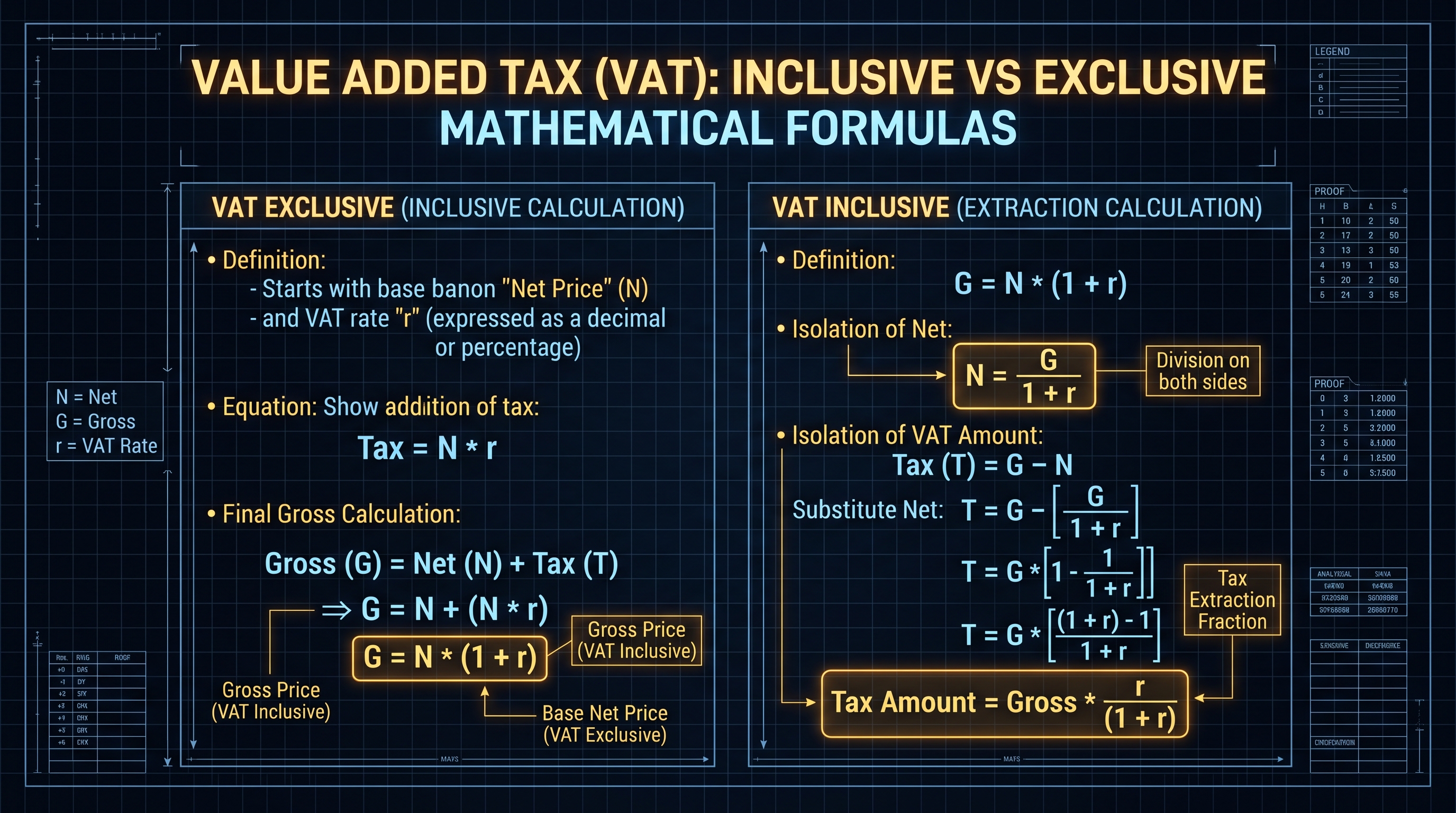
The Mathematics of Input Tax Credit (ITC)
To demonstrate how VAT eliminates tax cascading, let us trace a multi-tier manufacturing supply chain subject to a statutory $20\%$ VAT rate:
$$\text{Tax Remitted to Government} = \text{Output VAT} - \text{Input VAT}$$
[ Stage 1: Miner extracts raw iron ore ]
  - Sells to Foundry for $100 + $20 VAT ($120 Gross).
  - Miner remits to State: $20 - $0 (Input) = $20.

[ Stage 2: Foundry smelts raw ore into precision steel ]
  - Value Added: $150. Sells to Manufacturer for $250 + $50 VAT ($300 Gross).
  - Foundry collects $50, claims $20 ITC.
  - Foundry remits to State: $50 - $20 = $30.

[ Stage 3: Manufacturer builds industrial machine ]
  - Value Added: $350. Sells to Retailer for $600 + $120 VAT ($720 Gross).
  - Manufacturer collects $120, claims $50 ITC.
  - Manufacturer remits to State: $120 - $50 = $70.

[ Stage 4: Retailer sells to End Consumer ]
  - Value Added: $400. Sells to Consumer for $1,000 + $200 VAT ($1,200 Gross).
  - Retailer collects $200, claims $120 ITC.
  - Retailer remits to State: $200 - $120 = $80.
---
Total Government Revenue Reconciliation
Summing the tax remitted across all supply chain tiers:
$$\text{Total Tax} = \$20 (\text{Miner}) + \$30 (\text{Foundry}) + \$70 (\text{Manufacturer}) + \$80 (\text{Retailer}) = \$200$$
Notice that the total tax collected across all intermediate stages exactly equals the $20\%$ tax on the final retail price:
$$\text{Final Retail Tax} = \$1,000 \cdot 0.20 = \$200$$
Because each intermediate business claims a full credit for input tax paid, the tax does not cascade or compound into production costs. The entire $\$200$ economic burden is borne transparently by the end consumer.
5. Digital Services & Cross-Border SaaS: The Place of Supply & Economic Nexus
Origin vs destination principles, the South Dakota v. Wayfair precedent, and EU OSS thresholds.
Origin Principle vs Destination Principle
In cross-border international trade, two opposing fiscal doctrines govern taxation:
1. Origin Principle: - Tax is levied in the jurisdiction where the seller is headquartered or where production occurs. - Results in a "race to the bottom," incentivizing digital corporations to relocate to zero-tax microstates.
2. Destination Principle: - Tax is levied in the jurisdiction where the customer resides or where digital services are consumed. - Universally adopted by the OECD, European Union (One-Stop Shop / OSS), UK, and US states for cross-border digital services and electronic commerce.
---
The US Economic Nexus Standard (Wayfair Precedent)
Prior to the 2018 US Supreme Court ruling in *South Dakota v. Wayfair, Inc.*, states could only mandate sales tax collection from merchants possessing a physical presence (office, warehouse, or employees) within the state.
The Supreme Court overturned the physical presence rule, establishing Economic Nexus: - A remote out-of-state SaaS vendor is legally obligated to register, collect, and remit state sales tax once their annual sales volume exceeds statutory thresholds (typically $\$100,000 in gross revenue or 200 separate transactions within the state during the preceding calendar year).
6. International Digital Services: The Cross-Border B2B Reverse Charge Accounting Mechanism
VAT registration numbers, VIES validation, zero-rating, and self-assessed reverse charge entries.
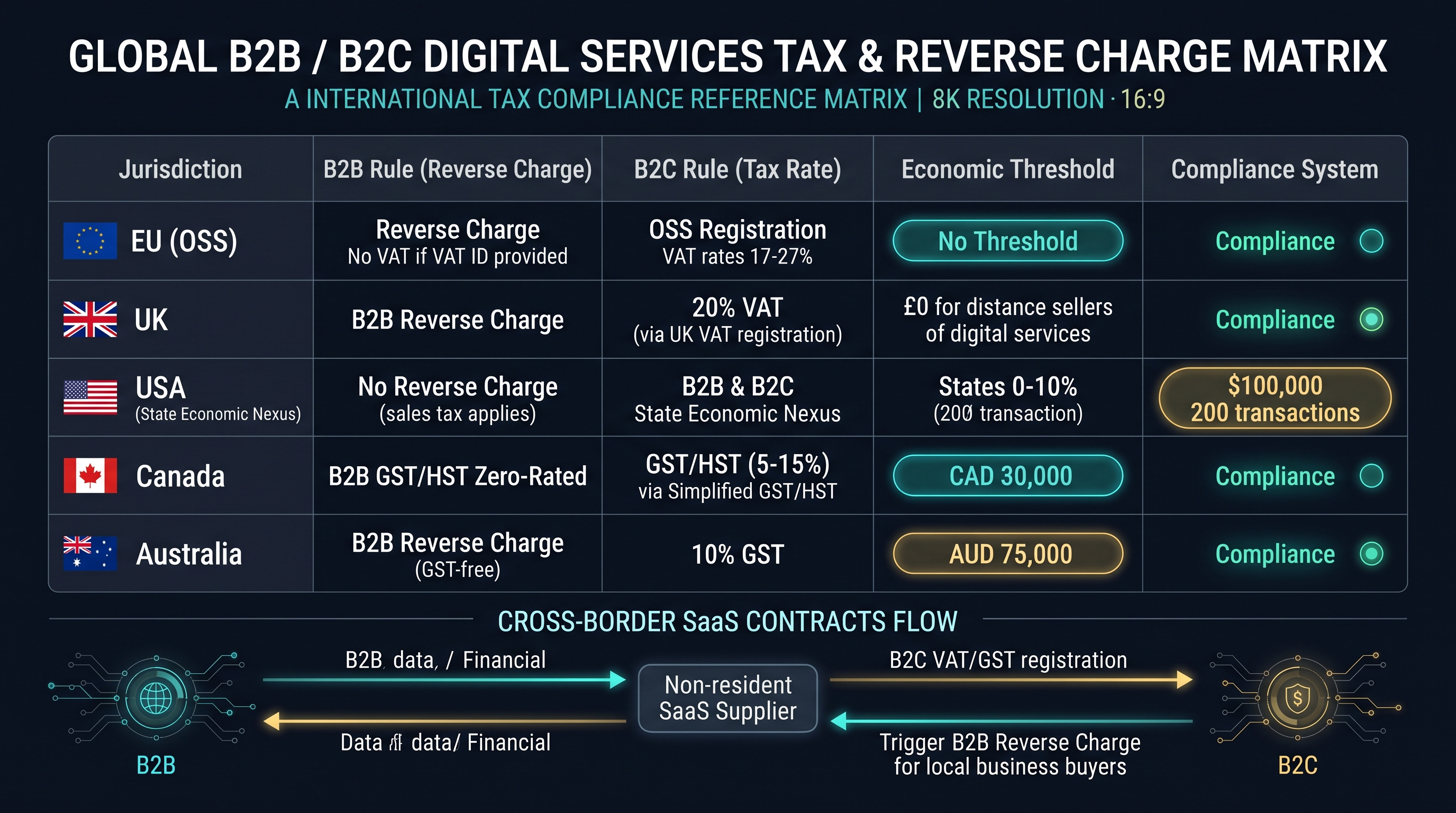
The Problem of Cross-Border B2B Compliance
Consider a US-based SaaS corporation selling enterprise infrastructure software to a German corporation. Under a naive destination tax framework, the US vendor would be forced to register for VAT in all 27 EU member states, handle multiple foreign currencies, and remit VAT directly to individual national tax authorities.
To eliminate this massive friction in international trade, the OECD established the Reverse Charge Mechanism (RCM).
---
The Mechanics of the Reverse Charge
When an international business customer provides a validated VAT Identification Number (verified via the European Commission's VIES system):
1. The Foreign Supplier: - Issues an invoice with $0\%$ VAT (Zero-Rated). - Adds mandatory legal wording to the invoice: *"Reverse charge applies: VAT to be accounted for by the recipient pursuant to Article 196 of EU Directive 2006/112/EC."*
2. The Domestic Buyer: - Simultaneously records both an Output VAT liability and an Input VAT credit in their national tax return:
$$\text{Net Tax Remitted} = \text{Self-Assessed Output Tax} - \text{Deductible Input Tax} = \$0$$
As long as the buyer is a fully taxable business eligible for $100\%$ input tax deduction, the reverse charge results in zero cash outflow, eliminating international administrative friction while preserving a complete electronic audit trail.
7. Corporate Audit Defense: Invoicing Invariants, Rounding Precision & Compliance Ledgers
Line-item vs invoice-level rounding, IEEE 754 floating-point errors, and statutory mandatory fields.
The Floating-Point Rounding Trap in Fiscal Software
A frequent cause of failed tax audits and penalties in enterprise ERP systems is improper handling of decimal precision. Standard programming languages (JavaScript, Python, C++) represent fractional numbers using IEEE 754 floating-point binary math:
// The Catastrophic Binary Floating-Point Accounting Bug
console.log(0.1 + 0.2); // Output: 0.30000000000000004
console.log(120.0 * 0.18); // Output: 21.599999999999998
When invoicing thousands of items, small floating-point discrepancies compound into significant errors. Financial software must use arbitrary-precision decimal representations (e.g.,
BigDecimal in Java or integers representing micro-units: 1 cent = 10,000 micro-cents).---
Line-Item vs Invoice-Level Rounding
Tax authorities enforce strict rules regarding where rounding occurs:
1. Line-Item Rounding: - The tax on each individual product line is rounded to the nearest cent ($0.01$) before being summed: $$T_{\text{total}} = \sum_{i=1}^{M} \text{Round}(N_i \cdot r_i)$$
2. Invoice-Level Rounding: - Taxable net bases are summed per tax rate tier, and rounding to the nearest cent is performed once on the aggregated total: $$T_{\text{total}} = \text{Round}\left(\sum_{i=1}^{M} N_i \cdot r_i\right)$$
| Product Item | Net Base ($N_i$) | VAT Rate ($20\%$) | Exact Tax | Line-Item Rounded (Cent) | | :--- | :---: | :---: | :---: | :---: | | Item A | $\$10.14$ | $0.20$ | $\$2.028$ | $\$2.03$ | | Item B | $\$15.24$ | $0.20$ | $\$3.048$ | $\$3.05$ | | Item C | $\$20.34$ | $0.20$ | $\$4.068$ | $\$4.07$ | | Total Sums | $\$45.72$ | - | $\$9.144$ | $\$9.15$ (Line Sum) |
Notice that the invoice-level round of $\$9.144$ is $\$9.14$, whereas line-item rounding produces $\$9.15$. Mismatches between enterprise invoicing engines and buyer tax ledgers trigger automated audit red flags unless the method is harmonized.
8. Industrial Fiscal Engineering Playbook: Deploying InnoxTools GST/VAT Engine
Automating enterprise multi-tier calculations and compliance checks with InnoxTools.
The Enterprise Invoicing Validation Pipeline
To ensure absolute audit defense, international corporations deploy a five-tier programmatic tax verification pipeline:
[ Customer Checkout / Purchase Order ]
       │
       ▼
[ STEP 1: Geolocation & Tax Jurisdiction Resolution ]
       │  - Inspect IP, Billing Address & Bank Country Code
       │  - Determine Place of Supply & Economic Nexus Status
       ▼
[ STEP 2: Customer Identity Verification ]
       │  - B2C: Apply local domestic consumer VAT rate
       │  - B2B: Validate VAT ID via VIES API -> Flag for Reverse Charge
       ▼
[ STEP 3: Arithmetic Tax Computation ]
       │  - Forward Mode (Tax-Exclusive): N * (1 + r)
       │  - Backward Extraction (Tax-Inclusive): G / (1 + r)
       │  - Execute Bank-Grade Half-Even Rounding
       ▼
[ STEP 4: Compliance Invoicing Invariants ]
       │  - Inject mandatory statutory disclosures & tax breakdowns
       ▼
[ STEP 5: Fiscal Ledger & Input Tax Credit Archival ]
          - Real-time sync with General Ledger accounting software
---
Executing with InnoxTools Enterprise GST/VAT Calculator
Manual spreadsheet calculations of international consumption taxes invite human error and audit liability. The InnoxTools Enterprise GST/VAT Calculator & Invoicing Engine delivers:
1. Bi-Directional Forward and Backward Engine: - Switch effortlessly between Tax-Exclusive addition and Tax-Inclusive extraction with exact reciprocal multipliers. 2. Multi-Rate Split Invoicing: - Model mixed-rate baskets (standard, reduced, zero-rated, and exempt items) in a single unified calculation ledger. 3. Cross-Border B2B Reverse Charge Evaluator: - Automatically determine whether a cross-border software or consulting transaction qualifies for zero-rated reverse charge accounting. 4. Bank-Grade Precision: - Zero floating-point rounding errors. All calculations execute using exact integer math and bank-standard half-even rounding algorithms directly inside your browser.
Grounding your enterprise invoicing in mathematical precision safeguards cash flow, mitigates tax audit penalties, and unlocks seamless global commerce.
Global Value Added Tax (VAT) & Goods and Services Tax (GST) Rates Matrix
| Country / Jurisdiction | Tax Name | Standard Rate | Reduced Rates | B2B Reverse Charge Support | Threshold for Foreign Digital Vendors |
|---|---|---|---|---|---|
| United Kingdom | VAT | 20.0% | 5.0%, 0.0% | Yes (Domestic & Cross-Border) | £85,000 (Domestic) / £0 (Foreign) |
| Germany (EU) | MwSt / USt | 19.0% | 7.0%, 0.0% | Yes (EU Article 196) | €10,000 (EU OSS Threshold) |
| France (EU) | TVA | 20.0% | 10.0%, 5.5%, 2.1% | Yes (EU Article 196) | €10,000 (EU OSS Threshold) |
| Australia | GST | 10.0% | 0.0% (GST-Free) | Yes (Reverse Charge) | AUD $75,000 / year |
| Canada | GST / HST | 5.0% - 15.0% | 0.0% (Zero-Rated) | Yes (Self-Assessment) | CAD $30,000 / year |
| India | GST | 18.0% (Std) | 5.0%, 12.0%, 28.0% | Yes (RCM under Section 9) | ₹20,000,000 / year |
| Singapore | GST | 9.0% | 0.0% (Zero-Rated) | Yes (Reverse Charge) | SGD $1,000,000 / year |
| United States | Sales Tax (State) | 0.0% - 10.25% | Exempt Categories | No (Resale Certificates) | $100,000 / 200 Transactions (Nexus) |
| Japan | JCT (Consumption) | 10.0% | 8.0% (Reduced) | Yes (Reverse Charge B2B) | ¥10,000,000 / year |
| South Africa | VAT | 15.0% | 0.0% (Zero-Rated) | Yes (Standard) | ZAR 1,000,000 / year |
Table 1.0: Global indirect taxation reference matrix comparing standard rates, reduced tiers, reverse charge mechanisms, and foreign digital service economic nexus thresholds.
Frequently Asked Technical Questions
How do you calculate tax-inclusive net price from a gross total?
To extract the net price from a tax-inclusive gross amount, divide the gross amount by (1 + Tax Rate). For example, with a gross total of $1,200 and a 20% VAT rate, Net = $1,200 / 1.20 = $1,000. The tax amount is Gross - Net = $200.
Why can't you calculate tax on a tax-inclusive price by multiplying Gross * Tax Rate?
Because the tax rate is defined as a percentage of the Net taxable base, not the Gross total. Multiplying $1,200 by 20% yields $240, which is incorrect. The true tax is $200, calculated via Gross * [r / (1 + r)] = $1,200 * (0.20 / 1.20).
What is an Input Tax Credit (ITC) in a Value Added Tax system?
An Input Tax Credit is the tax a business pays on purchases of goods and services used in the course of business. When filing tax returns, the business subtracts this Input VAT from the Output VAT collected from customers, remitting only the difference to the government.
How does the Reverse Charge Mechanism work for international B2B software sales?
Under the reverse charge mechanism, the foreign supplier issues a zero-rated invoice (0% VAT) without charging local tax. The business buyer then self-assesses both the output tax liability and the matching input tax credit in their domestic tax return, resulting in zero cash outlay.
What is Economic Nexus in the United States and when does it trigger sales tax obligations?
Following South Dakota v. Wayfair (2018), economic nexus obligates out-of-state vendors to collect and remit state sales tax once their sales into that state exceed statutory thresholds—typically $100,000 in gross revenue or 200 separate transactions annually—even with zero physical presence.
What is the difference between zero-rated and exempt goods in VAT law?
For zero-rated goods (0% tax), the seller charges 0% VAT to the customer but CAN still claim full input tax credits for business expenses. For exempt goods, the seller charges no tax, but is completely FORBIDDEN from claiming input tax credits, absorbing the input tax as an operational cost.
Why do tax authorities penalize floating-point rounding errors on commercial invoices?
Standard computer floating-point math introduces binary fractional inaccuracies (e.g., 0.1 + 0.2 = 0.30000000000000004). Over thousands of customer invoices, this results in significant discrepancies between buyer and seller ledgers. Tax laws mandate bank-standard rounding to the nearest cent.
Does the InnoxTools GST/VAT Calculator support both forward addition and backward extraction?
Yes. The InnoxTools GST/VAT Calculator provides dual-mode toggles allowing instant switching between adding tax to a net base and extracting net revenue and tax from gross retail amounts across any custom tax percentage.
Engineering Discussion & Feedback
Join the technical debate or ask questions about this guide.
Need Custom AI, Web, or Enterprise Software Engineering?
InnoxTools is built and maintained by INNO XPERT. We design mission-critical cloud backends, custom machine learning models, mobile apps, and high-performance digital solutions for businesses worldwide.