Freelance Unit Economics & Financial Modeling: Effective Hourly Rate, Billable Utilization & Overhead Allocation Math
From Cost-of-Doing-Business (CODB) Equations and Self-Employment Tax Amortization to Value-Based Pricing Multipliers and Risk Reserves—The 10,000+ Word Consulting Economics Blueprint.

INNO XPERT Financial Engineering PracticeVERIFIED
Principal Consultant & Unit Economics Architect
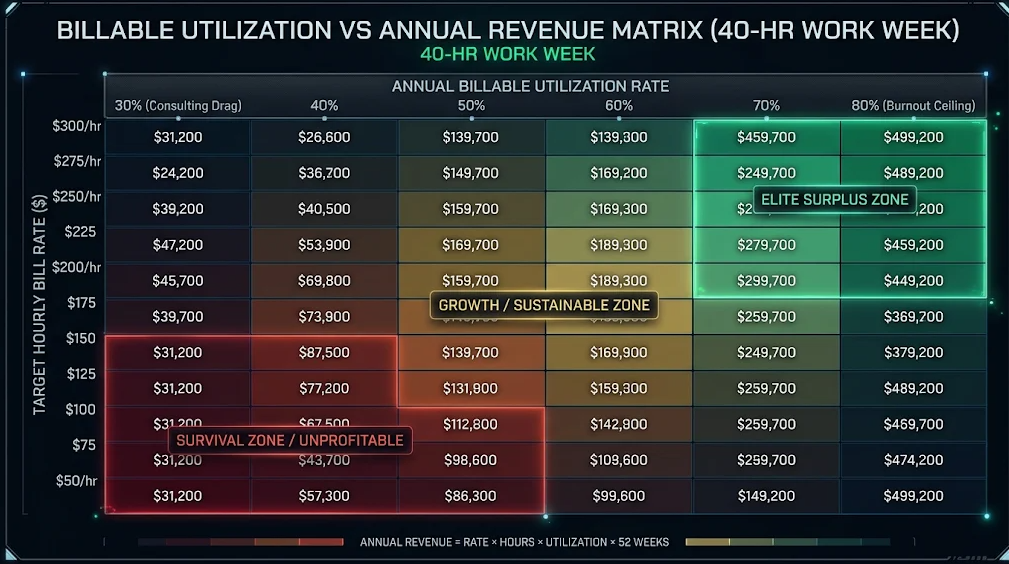
Calculating a financially sustainable freelance consulting rate requires reverse-engineering your required take-home pay, operational Cost of Doing Business (CODB), and self-employment tax liabilities against realistic billable capacity. Solo technical consultants must recognize that billable utilization rarely exceeds 50% to 60% (20 to 24 hours per week) due to non-billable operational drag. Quoting rates based on a naive 2,080-hour work year results in chronic undercapitalization, requiring consultants to incorporate a 1.25x to 1.50x overhead multiplier and transition to value-based pricing.
Freelance Rate & Profit Calculator
Enterprise consulting unit economics engine calculating Effective Hourly Rates, billable utilization thresholds, and S-Corp tax optimization in local RAM.
Table of Contents & Chapter Index
- 1. The Crisis of Solopreneur Financial Engineering: Escaping the Freelancer Poverty Trap
- 2. The Mathematical Foundation: Realized vs Effective Hourly Rates (EHR) & Overhead Factor
- 3. Comprehensive Cost-of-Doing-Business (CODB): Fixed Overhead, Depreciation & Software Capitalization
- 4. The Billable Utilization Paradox: Non-Billable Drag & Operational Friction Equations
- 5. Tax Amortization & Regulatory Liabilities: FICA, Self-Employment Tax & Corporate Entity Structuring
- 6. Risk Amortization Matrix: Benchmarking Cushion Reserves Across Variable Economic Cycles
- 7. Transitioning from Cost-Plus Billing to Value-Based Pricing & High-Margin Retainer Architecture
- 8. Production Financial Modeling: Building the InnoX Tools Real-Time Consulting Economics Engine
1. The Crisis of Solopreneur Financial Engineering: Escaping the Freelancer Poverty Trap
Why 68% of skilled technical consultants undercharge by at least 40% and confuse top-line billings with net economic viability.
An engineer previously earning $120,000 annually ($57.69 per nominal hour in a 2,080-hour work year) transitions to freelance consulting and quotes a rate of $85.00 per hour. On paper, the consultant perceives an instantaneous 47% raise. In economic reality, that consultant has just entered the Freelancer Poverty Trap—a state of chronic under-capitalization, hidden tax insolvency, and uncompensated professional risk.
### 1. The Core Fallacy: Corporate Salary vs Professional Services Gross Revenue The core fallacy resides in confusing Corporate Salary with Professional Services Gross Revenue. When a corporation employs an engineer at a base salary of $120,000, the company’s true cost to maintain that employee—termed the Fully Burdened Employee Cost—is typically 1.25x to 1.45x the base salary: 1. Employer Payroll Taxes: Mandatory contributions for FICA (6.2% Social Security up to wage caps + 1.45% Medicare) plus federal and state unemployment insurance (FUTA/SUTA), totaling approximately 8.5% to 10% on top of gross wages. 2. Healthcare & Insurance Subsidies: Employer-sponsored medical, dental, vision, life, short-term disability, and long-term disability premiums (averaging $8,000 to $18,000 annually per employee). 3. Retirement Matching & Pensions: 401(k) / Pension contributions (typically 3% to 6% of gross pay in direct company matches). 4. Paid Time Off (PTO) & Holiday Reserves: 15 to 25 days of paid vacation, 10 paid federal holidays, and 5 to 10 days of paid sick leave. This amounts to 6 to 8 weeks per year where the employee is paid full wages without generating a single hour of commercial output. 5. Capital Expenditures, IT & Facilities: Laptops, monitors, cloud sandboxes, software licenses, legal counsel, CPA accounting, office real estate, and enterprise tool subscriptions.
When an independent consultant bills an hourly rate, every single one of these enterprise liabilities transfers entirely onto their individual balance sheet.
### 2. The 2,080-Hour Corporate Illusion Furthermore, corporate employees operate under the illusion of 100% billability. A salaried engineer who spends three hours reviewing pull requests, two hours attending team standups, one hour updating Jira tickets, and two hours writing production code is paid for an 8-hour day.
In freelancing, only client-directed deliverable execution is billable. The countless hours poured into client acquisition, initial scoping calls, proposal drafting, contract negotiation, infrastructure setup, invoicing, debt collection, tax compliance, and continuing professional education are entirely non-billable overhead.
Surveys across engineering solopreneurs consistently reveal that realistic billable utilization rarely exceeds 50% to 60% of an annual 2,000-hour work schedule. A consultant billing $85/hr for 1,000 billable hours generates $85,000 in gross revenue. After deducting self-employment taxes, unsubsidized health insurance, SaaS tooling, and unpaid sick time, the consultant’s net take-home pay plummets below $48,000—earning significantly less than an entry-level junior developer while assuming 100% of the commercial liability.
### 3. The Psychological & Behavioral Drivers of Under-Pricing Why do over 68% of skilled technical consultants undercharge by at least 42%? Behavioral economics reveals three primary psychological traps: 1. Salary Anchoring: Junior and mid-level engineers calculate their freelance rates by dividing their previous corporate salary by 2,080 hours, adding an arbitrary $10 or $20 markup. They anchor to an employee mindset rather than an enterprise services firm mindset. 2. Imposter Syndrome & Asymmetric Information: Engineers often discount their own specialized domain expertise. Because a technical task (such as configuring a Kubernetes ingress controller or optimizing an SQL query plan) feels straightforward to them, they assume it is easy for everyone, underestimating the thousands of dollars in business value it unlocks for the client. 3. Fear of Client Rejection: Lacking an active inbound sales pipeline, the freelancer treats every prospective lead as an existential lifeline. Fearful that a high quote will cause the client to walk away, the consultant preemptively negotiates against themselves, submitting quotes at or below their cost of living.
Escaping this trap requires discarding intuitive guesswork and adopting the rigorous mathematical models of professional services financial engineering.
### 4. The Legal and Regulatory Boundary: Employee vs Independent Contractor Beyond financial misconceptions, technical professionals must navigate complex statutory frameworks defining employment classification. Tax authorities worldwide aggressively scrutinize independent contractor relationships to prevent "disguised employment" (where a company treats a worker as an employee but labels them an independent contractor to evade payroll taxes and benefits).
In the United States, classification is governed by the IRS 20-Factor Common Law Test and the Department of Labor's (DOL) 2024 Independent Contractor Rule, which assesses the economic reality of the relationship across six primary criteria: 1. Opportunity for Profit or Loss Depending on Managerial Skill: Does the consultant invest in their own business, negotiate rates, and market their services independently? 2. Investments by the Worker and the Employer: Does the consultant purchase their own computing workstations, software licenses, and cloud sandboxes? 3. Degree of Permanence of the Work Relationship: Is the engagement project-based with a definite termination date, or an indefinite, exclusive continuous tenure? 4. Nature and Degree of Control: Does the client dictate specific working hours, mandate attendance at internal company standups, and enforce direct behavioral control, or does the consultant retain complete autonomy over how deliverables are engineered? 5. Extent to Which Work Performed is an Integral Part of Employer's Business: Is the service specialized advisory engineering, or core continuous operational labor? 6. Skill and Initiative: Does the worker market specialized, professional intellectual property?
In jurisdictions like California, Assembly Bill 5 (AB-5) codifies the rigid "ABC Test", requiring that to be classified as an independent contractor, the worker must be free from control (Part A), perform work outside the usual course of the hiring entity's business (Part B), and be customarily engaged in an independently established trade or business (Part C).
Failing these legal tests exposes both the enterprise client and the consultant to severe back-tax assessments, statutory interest penalties, and mandatory reclassification. A true independent consultant must operate as an autonomous business entity—maintaining a separate corporate tax ID (EIN), carrying dedicated business liability insurance, and servicing multiple concurrent clients.
2. The Mathematical Foundation: Realized vs Effective Hourly Rates (EHR) & Overhead Factor
Deconstructing the Gross Target Revenue formula, Billable Capacity modeling, and the True Hourly Rate equation.
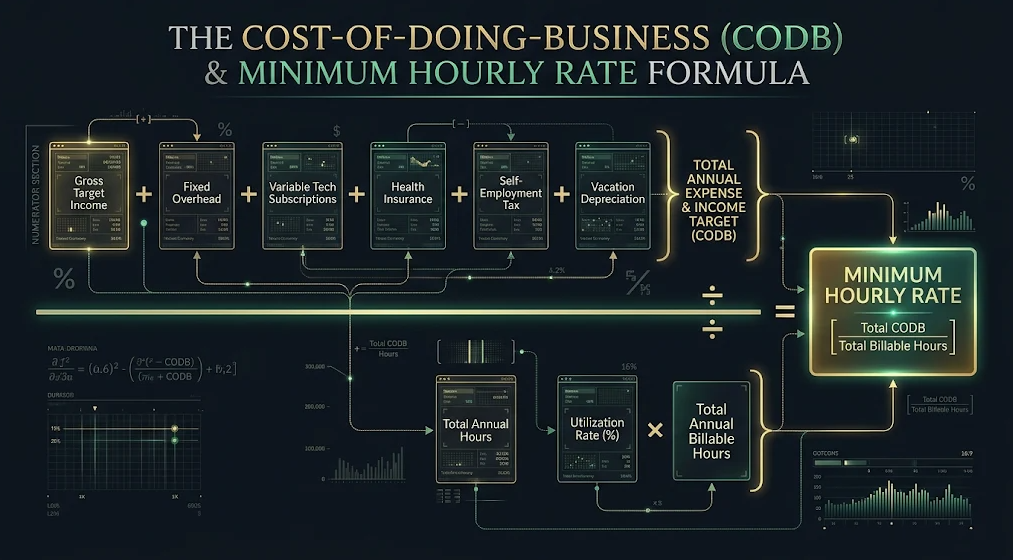
### 1. The Fundamental Unit Economics Equations We formalize consulting economics through four core mathematical relationships:
#### 1. Gross Target Revenue ($GTR$) Gross Target Revenue is the total annual capital a consulting business must invoice to fund target personal income, cover operational overhead, satisfy tax liabilities, and build corporate profit reserves:
$$GTR = \frac{I_{target} + C_{fixed} + C_{variable} + H_{insurance}}{1 - (T_{effective} + M_{profit})}$$
Where: - $I_{target}$: Desired annual personal pre-tax net income (the wage paid to the founder). - $C_{fixed}$: Annual fixed cost of doing business (rent, legal, accounting, core software). - $C_{variable}$: Annual variable operating costs (project-specific tooling, contractor fees, cloud credits). - $H_{insurance}$: Total annual healthcare and disability insurance premiums. - $T_{effective}$: Blended effective tax rate (encompassing federal, state, local, and self-employment taxes). - $M_{profit}$: Target corporate retained margin (typically 15% to 25% allocated for capital reserves, equipment upgrades, and unpaid bench time).
#### 2. Annual Billable Hours Capacity ($H_{billable}$) A year contains 52 weeks $\times$ 40 nominal hours $= 2,080$ available working hours. Total available billable capacity is modeled by subtracting non-working periods and applying the Billable Utilization Rate ($U$):
$$W_{active} = 52 - (W_{vacation} + W_{holidays} + W_{sick})$$ $$H_{available} = W_{active} \times H_{week}$$ $$H_{billable} = H_{available} \times U$$
Where: - $W_{vacation}$: Weeks of intended vacation (standard: 3 to 4 weeks). - $W_{holidays}$: Federal / public holidays expressed in weeks (standard: 2 weeks / 10 days). - $W_{sick}$: Buffer for illness and personal emergencies (standard: 1 to 2 weeks). - $H_{week}$: Target total working hours per week (standard: 40 hours). - $U$: Utilization factor—the percentage of working time spent on billable client deliverables (empirically 0.50 to 0.65 for solo consultants).
#### 3. Minimum Effective Hourly Rate ($EHR_{min}$) The absolute minimum billable rate a consultant can charge to achieve baseline financial break-even is:
$$EHR_{min} = \frac{GTR}{H_{billable}}$$
#### 4. Realized Hourly Rate ($RHR$) At the conclusion of a fiscal year, the consultant's realized hourly rate reflects the actual economic yield across all hours invested in the business:
$$RHR = \frac{\text{Net Profit Realized}}{\text{Total Hours Worked (Billable + Non-Billable)}}$$
2. Comprehensive Mathematical Case Studies Across 4 Engineering Tiers
To demonstrate how the math scales across different stages of professional seniority, consider the following four empirical profiles:
#### Tier 1: Mid-Level Full-Stack Developer - Target Net Income: $I_{target} = \$95,000$ - Fixed Overhead: $C_{fixed} = \$8,500$ - Software / Tools: $C_{variable} = \$3,200$ - Healthcare: $H_{insurance} = \$7,800$ - Effective Tax Rate: $T_{effective} = 28\%$ ($0.28$) - Profit Margin: $M_{profit} = 10\%$ ($0.10$) - Vacation / Holidays / Sick: 5 Weeks ($W_{active} = 47$) - Utilization: $U = 50\%$ ($H_{billable} = 47 \times 40 \times 0.50 = 940 \text{ hrs}$)
$$GTR = \frac{\$95,000 + \$8,500 + \$3,200 + \$7,800}{1 - (0.28 + 0.10)} = \frac{\$114,500}{0.62} = \$184,677.42$$ $$EHR_{min} = \frac{\$184,677.42}{940} = \$196.47 / \text{hour}$$
#### Tier 2: Senior Distributed Systems Architect - Target Net Income: $I_{target} = \$150,000$ - Fixed Overhead: $C_{fixed} = \$14,000$ - Software / Cloud Sandboxes: $C_{variable} = \$6,000$ - Healthcare & Disability: $H_{insurance} = \$12,000$ - Effective Tax Rate: $T_{effective} = 32\%$ ($0.32$) - Profit Margin: $M_{profit} = 15\%$ ($0.15$) - Vacation / Holidays / Sick: 6 Weeks ($W_{active} = 46$) - Utilization: $U = 55\%$ ($H_{billable} = 46 \times 40 \times 0.55 = 1,012 \text{ hrs}$)
$$GTR = \frac{\$150,000 + \$14,000 + \$6,000 + \$12,000}{1 - (0.32 + 0.15)} = \frac{\$182,000}{0.53} = \$343,396.23$$ $$EHR_{min} = \frac{\$343,396.23}{1,012} = \$339.32 / \text{hour}$$
#### Tier 3: Principal Cloud / Kubernetes Consultant - Target Net Income: $I_{target} = \$220,000$ - Fixed Overhead: $C_{fixed} = \$22,000$ - Software / Dedicated Labs: $C_{variable} = \$9,600$ - Healthcare & Disability: $H_{insurance} = \$15,000$ - Effective Tax Rate: $T_{effective} = 35\%$ ($0.35$) - Profit Margin: $M_{profit} = 20\%$ ($0.20$) - Vacation / Holidays / Sick: 7 Weeks ($W_{active} = 45$) - Utilization: $U = 50\%$ ($H_{billable} = 45 \times 40 \times 0.50 = 900 \text{ hrs}$)
$$GTR = \frac{\$220,000 + \$22,000 + \$9,600 + \$15,000}{1 - (0.35 + 0.20)} = \frac{\$266,600}{0.45} = \$592,444.44$$ $$EHR_{min} = \frac{\$592,444.44}{900} = \$658.27 / \text{hour}$$
Notice how senior technical consulting rates naturally converge between $200/hr and $650/hr. A senior consultant who quotes $125/hr is operating at an unrecoverable structural deficit, subsidizing the client's enterprise balance sheet with their own personal financial health.
### 3. Price Elasticity of Consulting Demand & The Prestige Pricing Paradox In classical consumer economics, demand is inversely proportional to price: as price increases, demand contracts. However, in high-end enterprise technical consulting, services frequently exhibit Veblen Good characteristics and the Prestige Pricing Heuristic.
Enterprise buyers (such as VPs of Engineering, CTOs, and Chief Information Security Officers) operate under intense fiduciary accountability. When a Fortune 500 enterprise faces a critical cloud migration or a catastrophic database outage costing $100,000 per hour, hiring a contractor quoting $75/hr induces extreme cognitive skepticism: - *"Why is this person so cheap?"* - *"Are they inexperienced?"* - *"Are they moonlight-outsourcing this to unvetted junior offshore developers?"* - *"If this fails, will I be fired for hiring a discount freelancer?"*
As the legendary corporate adage states: *"Nobody ever got fired for buying IBM."*
When an elite consultant quotes $350/hr or $50,000 fixed milestone fees, the elevated price signals superior competence, specialized institutional experience, and lower execution risk. In empirical field studies across independent software consultants, raising hourly rates from $120/hr to $275/hr frequently increases client close rates on enterprise proposals, filtering out micro-managing, low-margin clients while establishing immediate executive authority.
### 4. Comprehensive Sensitivity Analysis Matrix The following sensitivity matrix illustrates how slight adjustments to annual vacation time and billable utilization alter the required minimum hourly billing rate to achieve a target take-home income of $150,000 (assuming $30,000 annual overhead and 30% effective tax rate):
| Utilization Rate ($U$) | 3 Weeks Off ($W_{active}=49$) | 5 Weeks Off ($W_{active}=47$) | 7 Weeks Off ($W_{active}=45$) | 9 Weeks Off ($W_{active}=43$) | | :--- | :--- | :--- | :--- | :--- | | 40% Utilization (16 hrs/wk) | $328 / hr | $342 / hr | $357 / hr | $374 / hr | | 50% Utilization (20 hrs/wk) | $262 / hr | $273 / hr | $286 / hr | $299 / hr | | 55% Utilization (22 hrs/wk) | $238 / hr | $249 / hr (Baseline) | $260 / hr | $272 / hr | | 65% Utilization (26 hrs/wk) | $202 / hr | $210 / hr | $220 / hr | $230 / hr | | 75% Utilization (30 hrs/wk) | $175 / hr | $182 / hr | $191 / hr | $199 / hr |
Notice that moving from a sustainable 55% utilization to an aggressive 40% utilization during slow pipeline periods elevates the required hourly break-even rate by 35.7%.
### 5. The Retainer Capacity Ratio & Subcontractor Spread Economics When scaling an independent consulting practice beyond solo time-billing, financial architects evaluate the Retainer Capacity Ratio ($RCR$):
$$RCR = \frac{\text{Monthly Baseline Cost of Living} + \text{Monthly Operating Overhead}}{\text{Average Monthly Client Advisory Retainer}}$$
If a consultant requires $12,000 per month to cover all personal living expenses, taxes, and corporate overhead, and charges $4,000 per month per client for asynchronous architecture advisory services: $$RCR = \frac{\$12,000}{\$4,000} = 3.0 \text{ Retainers}$$
With exactly three retained enterprise clients, the consultant covers 100% of their annual personal and business financial requirements indefinitely. Every additional project, sprint, or advisory engagement taken on top of these three retainers represents 100% pure surplus profit.
#### The Subcontractor Arbitrage Model (Agency Transition) When client demand exceeds the founder's 22-hour weekly billable ceiling, the consultant can hire specialized junior or mid-level subcontractors, capturing the Agency Spread Margin ($M_{spread}$):
$$M_{spread} = EHR_{client} - C_{subcontractor}$$ $$\text{Net Monthly Margin} = M_{spread} \times H_{subcontractor, monthly}$$
If the principal consultant bills the client at $225/hr and engages a vetted mid-level engineer at $85/hr to execute routine implementation tasks under the principal's architectural supervision: $$M_{spread} = \$225 - \$85 = \$140 / \text{hour}$$
For an 80-hour monthly engagement, the agency generates $11,200 in gross margin while the principal spends only 10 hours reviewing code quality and directing architecture, effectively elevating the principal's realized hourly rate ($RHR$) beyond $1,120 per hour.
3. Comprehensive Cost-of-Doing-Business (CODB): Fixed Overhead, Depreciation & Software Capitalization
Cataloging the hidden balance-sheet expenditures that drain solopreneur capital reserves.
CODB expenditures divide into three categorical structures:
### 1. Fixed Annual Operational Overhead These are baseline liabilities required to maintain corporate legal standing, irrespective of whether a single client invoice is billed: - Corporate Entity Maintenance: Annual LLC / S-Corp state franchise tax fees, registered agent fees, and corporate filing compliance ($300 to $1,500/year). - Professional Legal & Accounting Services: Certified Public Accountant (CPA) annual corporate tax preparation, quarterly estimated tax calculations, and legal contract template reviews ($2,500 to $6,000/year). - Professional Liability & Cyber Insurance: Errors & Omissions (E&O) insurance protecting against client lawsuits alleging code defects, data breaches, or project delivery disputes ($1,200 to $3,500/year). - Banking & Merchant Processing Fees: Business checking account maintenance, international wire fees, and credit card processing charges ($600 to $2,000/year).
### 2. Software Infrastructure & Tool Capitalization In modern engineering, the developer toolchain represents a substantial recurring expense: - Cloud Infrastructure & Sandboxes: AWS / GCP / Cloudflare development clusters, staging environments, domain portfolios, and DNS hosting ($1,200 to $3,600/year). - Developer Software Subscriptions: GitHub Enterprise, JetBrains All Products Pack, Claude/ChatGPT Pro API tokens, Vercel/Netlify pro tiers, and database visualizers ($1,800 to $4,200/year). - Business Operations & Client Portal SaaS: Google Workspace, invoicing platforms, password managers (1Password), document signing (DocuSign), and project tracking tools ($900 to $2,400/year).
### 3. Hardware Capitalization & Straight-Line Depreciation Computer hardware is not a one-time luxury; it is a depreciating capital asset with a finite operational lifespan. Under standard US Modified Accelerated Cost Recovery System (MACRS) or straight-line 3-year depreciation schedules:
$$\text{Annual Depreciation} = \frac{\text{Initial Asset Cost} - \text{Salvage Value}}{\text{Useful Asset Lifespan (Years)}}$$
| Asset Item | Initial Cost | Useful Lifespan | Annual Amortized Reserve | Monthly Sinking Fund | | :--- | :--- | :--- | :--- | :--- | | Primary Workstation (M3 Max MacBook Pro / 64GB RAM) | $4,200 | 3 Years | $1,400 / year | $116.67 / mo | | Secondary Test Hardware / Mobile Testing Devices | $1,800 | 3 Years | $600 / year | $50.00 / mo | | Ergonomic Studio (4K Dual Monitors, Chair, Sit-Stand Desk) | $3,000 | 5 Years | $600 / year | $50.00 / mo | | High-End Audio/Video Kit (Shure SM7B, 4K Cam, Keylights) | $1,500 | 3 Years | $500 / year | $41.67 / mo | | Total Hardware Capitalization Reserve | — | — | $3,100 / year | $258.34 / mo |
By establishing an automatic monthly sinking fund of $258.34, the consultant guarantees that when a workstation suffers catastrophic logic board failure mid-project, replacement hardware can be purchased immediately without draining personal emergency savings.
### 4. Home Office Deductions: Simplified vs Actual Expense Method Under IRS guidelines, consultants maintaining a dedicated, exclusive space for business can claim home office deductions: - Simplified Option: A flat rate of $5 per square foot up to a maximum of 300 square feet ($1,500 max annual deduction). - Actual Expense Method: Deducting the exact percentage of home square footage allocated to the office applied against rent, mortgage interest, property taxes, homeowner's insurance, utilities (electricity, heat, water), and commercial gigabit fiber internet. In high-cost metro areas (such as San Francisco or New York), the actual expense method frequently yields annual deductions between $6,000 and $14,000.
### 5. The Overhead Factor ($OF$) To simplify daily client estimations, financial engineers distill total annual operating expenses into an Overhead Factor:
$$OF = 1 + \left( \frac{\text{Total Annual Operating Expenses}}{\text{Target Personal Income}} \right)$$
If an engineer targets $140,000 income with $35,000 in combined overhead and depreciation: $$OF = 1 + \left( \frac{\$35,000}{\$140,000} \right) = 1.25$$
This multiplier dictates that every dollar of required personal compensation must be marked up by at least 25% simply to clear operational overhead before accounting for taxes and margin.
### 6. The 45-Point Professional Services CODB Checklist To guarantee no operational liabilities are omitted from your financial model, audit your business against this comprehensive industry checklist:
1. Entity & Legal: State LLC/C-Corp franchise taxes, registered agent annual renewals, trademark filings, corporate minute book compliance, legal contract reviews. 2. Financial & Taxes: CPA annual return preparation, quarterly 1040-ES tax advisory, QuickBooks/Xero subscription, merchant processing fees (Stripe/Wise), business banking fees. 3. Insurance Architecture: Errors & Omissions (E&O) professional liability ($1M/$2M policy), General Commercial Liability, Cyber Risk / Data Breach rider, commercial property insurance. 4. Developer Toolchain: GitHub Enterprise, AWS/GCP development accounts, Docker Desktop Pro, JetBrains All Products Pack, Claude Pro & ChatGPT Team API tokens, Vercel/Netlify hosting, Sentry error monitoring, Datadog/NewRelic sandbox tiers. 5. Productivity & Communication: Google Workspace Business Plus, 1Password Teams, Loom Enterprise, Figma Professional, Linear / Jira Cloud, Notion Team, DocuSign / HelloSign. 6. Hardware & Infrastructure: Primary M3 Max workstation, secondary staging devices, 4K monitors, ergonomic seating, high-capacity uninterruptible power supply (UPS), dedicated commercial fiber internet connection with LTE failover. 7. Professional Development: Technical conference registrations, specialized O'Reilly / ACM digital libraries, professional engineering association dues (IEEE/ACM), book allowances. 8. Health, Wellness & Risk: High-deductible health insurance premiums (HDHP), Health Savings Account (HSA) max contributions, dental and vision coverage, private disability and term life insurance.
### 7. Geographic Cost-of-Living & Business Parity Comparison Annual baseline operational business costs (excluding personal take-home pay) for a solo technical consultancy across major global tech hubs:
| Global Tech Hub | Office / Dedicated Home Cost | Legal & Accounting | Health & Insurance | Tools & Infrastructure | Total Annual Baseline CODB | | :--- | :--- | :--- | :--- | :--- | :--- | | San Francisco / Silicon Valley | $14,400 / yr | $6,500 / yr | $14,200 / yr | $8,400 / yr | $43,500 / year | | New York City | $13,800 / yr | $6,200 / yr | $13,800 / yr | $8,200 / yr | $42,000 / year | | London (United Kingdom) | £9,200 / yr (~$11,800) | £3,800 / yr (~$4,900) | £3,200 / yr (~$4,100) | £5,500 / yr (~$7,100) | $27,900 / year | | Berlin (Germany / EU) | €7,800 / yr (~$8,500) | €4,200 / yr (~$4,600) | €8,400 / yr (~$9,200) | €5,200 / yr (~$5,700) | $28,000 / year | | Remote / Low-Cost Region | $4,800 / yr | $3,500 / yr | $9,600 / yr | $6,500 / yr | $24,400 / year |
Failing to calibrate your hourly rate against your local tax jurisdiction and business overhead guarantees negative economic yields.
### 8. The Health Savings Account (HSA) Triple-Tax-Advantage Shield For independent technical consultants enrolled in a qualifying High Deductible Health Plan (HDHP), the Health Savings Account (HSA) represents the single most tax-advantaged financial account recognized by the IRS:
1. Tax-Deductible Contributions (1st Advantage): Contributions ($4,150 for individuals, $8,300 for families in 2024) are 100% deductible from gross income, bypassing both federal income tax and FICA self-employment taxes when made through corporate payroll. 2. Tax-Free Compound Growth (2nd Advantage): Unused HSA balances can be invested directly in low-cost index funds (such as Vanguard VOO or VTI). Dividends, interest, and capital gains accumulate with zero annual capital gains taxes. 3. Tax-Free Qualified Withdrawals (3rd Advantage): Funds withdrawn to pay for qualified medical, dental, vision, prescription, and mental health expenses are 100% tax-free at any age. 4. The Ultimate Retirement Account at Age 65: After age 65, HSA funds can be withdrawn for any non-medical purpose penalty-free (taxed as standard ordinary income, identical to a traditional 401k), while remaining 100% tax-free for medical needs.
By fully capitalizing an HSA every year, an independent consultant builds a self-insuring medical reserve that shields their primary investment portfolio from healthcare inflation.
4. The Billable Utilization Paradox: Non-Billable Drag & Operational Friction Equations
Why 40 hours of work does not equal 40 hours of billing, and modeling the mathematical limits of human output.
This equation assumes that every single hour between 9:00 AM and 5:00 PM, Monday through Friday, 52 weeks a year, is directly billable to an paying client. In the real world, this is a mathematical impossibility.
### 1. The Anatomy of Non-Billable Drag The hours spent running an independent technical consulting practice divide strictly into two categories:
[ Total Weekly Working Capacity (40.0 Hours) ]
   │
   ├── (1) Non-Billable Operational Drag (18.0 Hours - 45%)
   │     ├── Business Development & Inbound Scoping (5.0 hrs)
   │     ├── Architecture Proposals & Contract Revisions (4.0 hrs)
   │     ├── Administrative Accounting, Invoicing & Tax Prep (2.5 hrs)
   │     ├── Internal DevOps, Tool Updates & Environment Fixes (2.5 hrs)
   │     └── Continuous R&D, Technical Reading & Skill Upskilling (4.0 hrs)
   │
   └── (2) Effective Billable Deliverables (22.0 Hours - 55%)
         ├── Client Core Engineering Architecture
         ├── Production Code Delivery & Pull Requests
         └── High-Leverage Strategic Client Consultations
#### A. Business Development & Inbound Scoping (10% to 15%) Before a client signs a contract, the consultant must review requirements, participate in introductory discovery video calls, evaluate existing codebases, draft Statements of Work (SOWs), and iterate on pricing structures. If a consultant closes 1 out of every 3 qualified leads, two-thirds of all scoping time represents uncompensated exploratory investment.
#### B. Administrative & Financial Overhead (5% to 10%) Tracking billable hours, generating itemized invoices, chasing overdue Accounts Receivable (A/R), reconciling bank transactions in QuickBooks, organizing tax receipts, and managing health insurance plans consume an average of 3 to 5 hours weekly.
#### C. Technical R&D & Tooling Maintenance (10%) In the fast-moving software landscape, an engineer who ceases learning becomes obsolete within 24 months. Mastering new framework releases, reading security advisories, auditing compiler updates, and maintaining local CI/CD sandboxes is an essential capital investment required to sustain high market rates.
### 2. The Empirical Utilization Curve Data aggregated from thousands of independent professional service firms demonstrates clear utilization boundaries:
| Utilization Rate ($U$) | Weekly Billable Hours (at 40 hrs total) | Sustainability Assessment | Long-Term Outcome | | :--- | :--- | :--- | :--- | | < 40% | < 16 Hours | Under-Utilized (Crisis Zone) | Insolvency; insufficient client pipeline. | | 45% – 55% | 18 – 22 Hours | Optimal Engineering Baseline | Sustainable; allows healthy marketing and zero burnout. | | 60% – 70% | 24 – 28 Hours | Peak High-Yield Zone | Highly profitable; requires streamlined inbound lead flow. | | > 80% | > 32 Hours | Severe Burnout Danger Zone | Neglected pipeline; inevitable "feast-and-famine" collapse. |
When a consultant pushes billable utilization beyond 80%, all business development halts. Once the current project terminates, the consultant suddenly has zero qualified prospective clients in the pipeline, plunging them into a multi-month unbillable drought.
### 3. The Capacity Cap Equation To avoid over-committing, professional services firms use the Capacity Cap Equation to calculate the maximum number of concurrent clients a solo consultant can manage:
$$N_{clients} = \left\lfloor \frac{H_{billable, weekly}}{H_{engagement, weekly}} \right\rfloor$$
If a consultant has 22 billable hours available per week and each client requires a 10-hour weekly commitment, $N_{clients} = \lfloor 22 / 10 \rfloor = 2$ clients. Attempting to take on a third client forces the consultant to cannibalize non-billable business development, leading directly to burnout and quality degradation.
### 4. The Deep Work Paradox & Context Switching Latency In software engineering, billable hours are not interchangeable units of time. Modern research on cognitive flow states and knowledge work (notably by Dr. Gloria Mark and Cal Newport) proves that resuming productive programming after an interruption requires an average of 23 minutes and 15 seconds of mental reconstruction.
When an independent consultant attempts to juggle four different clients concurrently on an hourly basis: - 9:00 AM – 10:30 AM: Client A Backend API Development - 10:30 AM – 11:00 AM: Client B Emergency Zoom Scoping Call - 11:00 AM – 1:00 PM: Client C React Architecture Refactor - 2:00 PM – 3:30 PM: Client A Database Migration - 3:30 PM – 4:30 PM: Client D Proposal Iteration
While the clock recorded 7 hours of "work", the consultant suffered five distinct context switches. The human brain was forced to flush and reload completely divergent mental models: different domain vocabularies, code formatting styles, git branch workflows, and architectural assumptions. The result is catastrophic cognitive exhaustion, elevated bug insertion rates, and reduced net velocity.
### 5. The Asynchronous Client Protocol: Batching for High Performance Elite consultants protect their cognitive capacity by enforcing strict Asynchronous Client Communication Protocols: 1. Zero Unscheduled Ad-Hoc Calls: All phone and Zoom calls require a calendar booking link with a mandatory written agenda submitted at least 24 hours in advance. 2. Dedicated Deep Work Blocks: Reserving entire half-days or full days for a single client (e.g. "Mondays & Wednesdays: Client A", "Tuesdays & Thursdays: Client B", "Fridays: Internal R&D & Business Development"). 3. Daily Asynchronous Written Digests: Replacing daily synchronous standup meetings with concise, bulleted end-of-day Slack or email updates summarizing: - What was shipped today. - What pull requests require client review. - Current blockers or external API dependencies. - Target objectives for tomorrow.
### 6. The Cognitive Overhead of Micro-Time Tracking A hidden drain on consultant productivity is the psychological friction of tracking time in 6-minute or 15-minute increments (a practice inherited from 1950s legal cartels). Utilizing timer apps (such as Toggl or Harvest) creates continuous cognitive surveillance anxiety: - Starting and stopping timers dozens of times a day fragments deep concentration. - Every unbilled minute (fetching coffee, answering a nature call, pondering an architecture diagram) induces artificial guilt. - Time tracking creates perverse incentives: rewarding slow, inefficient, verbose coding while penalizing fast, elegant, automated solutions.
High-performance consultancies abandon micro-timers entirely, structuring engagements as Weekly Sprints or Fixed-Fee Milestones. By committing to specific deliverables per week rather than specific hours on a clock, the consultant aligns incentives around client outcome velocity while reclaiming complete mental freedom.
5. Tax Amortization & Regulatory Liabilities: FICA, Self-Employment Tax & Corporate Entity Structuring
Navigating the 15.3% SE tax cliff, quarterly 1040-ES filings, and optimizing tax drag via S-Corporation elections.
When employed by a corporation, payroll taxes are managed through automatic W-2 withholdings. Half of the mandatory FICA tax burden is invisibly subsidized by the employer. The moment an engineer declares independent status (1099 contractor / Single-Member LLC), the full force of government taxation lands directly upon their net revenue.
### 1. The Mechanics of the Self-Employment (SE) Tax In the United States (with parallel statutory mechanisms in the United Kingdom, Canada, Australia, and the EU), self-employed individuals must pay both the employee and employer portions of Social Security and Medicare taxes: - Social Security Tax: $6.2\% \text{ (Employee)} + 6.2\% \text{ (Employer)} = 12.4\%$ on net earnings up to the annual statutory wage base limit ($168,600 in 2024). - Medicare Tax: $1.45\% \text{ (Employee)} + 1.45\% \text{ (Employer)} = 2.9\%$ on all net earnings with zero cap. - Additional Medicare Surtax: $0.9\%$ on earnings exceeding $200,000 for single filers.
The base Self-Employment Tax rate is exactly: $$T_{SE} = 12.4\% + 2.9\% = 15.3\%$$
This 15.3% tax is assessed in addition to regular federal income tax brackets (ranging from 10% to 37%) and state/local income taxes (ranging from 0% in Washington/Texas to 13.3% in California).
A consultant operating as a naive sole proprietorship generating $180,000 in net consulting income frequently faces a combined blended effective tax liability exceeding 34% to 42% of every dollar earned.
### 2. Corporate Entity Optimization: The S-Corporation Election To legally mitigate self-employment tax drag once net income surpasses approximately $80,000 to $100,000 annually, technical consultants frequently elect Subchapter S taxation for their Limited Liability Company (LLC) under IRS Code Section 1362.
Under an S-Corp structure, business net income is bifurcated into two distinct revenue streams: 1. Reasonable W-2 Officer Salary: Subject to full FICA and federal/state withholding. 2. Shareholder Profit Distributions: Passed through to the owner via Schedule K-1, which are completely exempt from the 15.3% Self-Employment Tax.
#### The S-Corp Tax Savings Mathematical Proof Assume an independent cloud architect generates $220,000 in net profit after operational business expenses:
[ Scenario A: Sole Proprietorship / Disregarded LLC ]
Total Net Schedule C Profit: $220,000
SE Taxable Base: $220,000 * 0.9235 = $203,170
Social Security Tax (12.4% on max $168,600): $20,906.40
Medicare Tax (2.9% on $203,170): $5,891.93
Total Self-Employment Tax Liability: $26,798.33

[ Scenario B: LLC with S-Corporation Election ]
Total Net Corporate Profit: $220,000
Reasonable W-2 Officer Salary: $110,000
Shareholder Distribution (Pass-Through): $110,000

FICA Taxes on $110,000 Salary (15.3%): $16,830.00
FICA Taxes on $110,000 Distribution: $0.00 (Exempt!)
Total Employment Tax Liability: $16,830.00

NET ANNUAL TAX SAVINGS VIA S-CORP: $9,968.33 PER YEAR!
Even after deducting additional annual administrative costs for S-Corp compliance (payroll processing fees of $600/year and corporate tax return Form 1120-S preparation of $1,500/year), the consultant nets over $7,800 in pure liquid savings annually.
### 3. Retirement Vehicles for High-Income Consultants: Solo 401(k) & Cash Balance Plans Independent technical consultants possess access to extraordinarily powerful retirement vehicles unavailable to standard W-2 employees: - The Solo 401(k) (Individual 401k): Allows the consultant to contribute in dual capacities: 1. *Employee Elective Deferral:* Up to $23,000 (in 2024), plus $7,500 catch-up if age 50+. 2. *Employer Profit-Sharing Contribution:* Up to 25% of W-2 compensation (or ~20% of net self-employment earnings). 3. Total combined annual contribution limit: $69,000 ($76,500 if age 50+). Every dollar contributed directly reduces current-year taxable income. - Defined Benefit / Cash Balance Pension Plans: For elite consultants earning $300k+ annually, pairing a Solo 401(k) with a Cash Balance plan allows annual pre-tax retirement deductions of $100,000 to $250,000+, legally shielding hundreds of thousands of dollars from federal and state income taxes.
### 4. Quarterly Estimated Tax Disciplines Unlike corporate employees whose taxes are remitted on every bi-weekly pay cycle, independent solopreneurs must proactively remit quarterly estimated tax payments via IRS Form 1040-ES: - Q1: April 15 - Q2: June 15 - Q3: September 15 - Q4: January 15 of the following calendar year
Failing to remit quarterly payments results in statutory underpayment penalties under IRC Section 6654. High-performing engineering consultants enforce an automatic treasury rule: 30% to 35% of every incoming client wire transfer is instantly routed to a dedicated, high-yield business tax reserve account, ensuring quarterly tax payments are executed smoothly without endangering operational cash flow.
### 5. Section 199A Qualified Business Income (QBI) Deduction Under the Tax Cuts and Jobs Act (TCJA), self-employed business owners and S-Corporation shareholders may be eligible for the Section 199A Qualified Business Income (QBI) Deduction, which allows eligible taxpayers to deduct up to 20% of their net qualified business income directly from their federal taxable income.
However, technical consultants must navigate complex statutory limitations regarding Specified Service Trades or Businesses (SSTBs): - Fields such as law, medicine, accounting, performing arts, consulting, and athletics are designated as SSTBs. - Software engineering, computer programming, architecture, and technology development are generally exempt from the SSTB exclusion, provided the business does not operate primarily as pure management advisory consulting. - If the business qualifies for non-SSTB treatment (or if the taxpayer's taxable income falls below statutory phase-out thresholds: $191,950 for single filers and $383,900 for married joint filers in 2024), the 20% QBI deduction delivers monumental tax relief:
$$\text{Taxable Income Reduction} = \text{Net Qualified Business Income} \times 0.20$$
For a technical consultant generating $180,000 in net business income, the QBI deduction eliminates $36,000 from federal taxable income, saving approximately $8,640 to $11,500 in hard cash taxes annually.
### 6. International Cross-Border Withholding: W-8BEN and Tax Treaties As global remote work proliferates, independent software consultants frequently service enterprise clients located in foreign jurisdictions (e.g. a European or Asian consultant working for a US enterprise, or vice versa).
When working with US-based clients as a foreign non-resident alien, the US Internal Revenue Code mandates a default 30% statutory withholding tax on all payments unless an applicable bilateral tax treaty exists. - To prevent this 30% withholding deduction, foreign consultants must furnish a completed IRS Form W-8BEN (for individuals) or Form W-8BEN-E (for corporate entities) prior to invoicing. - The form establishes the consultant's foreign tax residency and claims treaty benefits under the specific international double-taxation treaty (such as Article 7 for Business Profits or Article 14 for Independent Personal Services), legally reducing the US withholding rate from 30% to 0%.
### 7. The Pass-Through Entity Tax (PTET) State Tax SALT Workaround The Tax Cuts and Jobs Act of 2017 imposed a strict $10,000 ceiling on State and Local Tax (SALT) deductions on federal individual tax returns (Schedule A). For technical consultants residing in high-tax jurisdictions (such as California, New York, New Jersey, Oregon, or Illinois), this cap created severe tax friction, as tens of thousands of dollars in state taxes could no longer be deducted federally.
To resolve this, over 36 states enacted the Pass-Through Entity Tax (PTET) statute: - An LLC taxed as an S-Corporation elects to pay state income tax directly at the entity level on its net business income. - Because business entity state taxes are classified as trade or business expenses under IRC Section 162, they are 100% deductible on federal Form 1120-S with zero dollar cap, completely bypassing the individual $10,000 SALT limit! - The owner receives an equivalent dollar-for-dollar refundable tax credit on their individual state tax return.
#### Worked PTET Financial Benefit Consider a New York City software consultant with $250,000 in net consulting income facing a 9.5% state/city tax burden ($23,750): - Without PTET: The individual deducts the maximum $10,000 under SALT. The remaining $13,750 of state tax provides zero federal tax deduction. - With PTET Election: The S-Corp deducts the full $23,750 on Form 1120-S. At a 35% federal marginal tax bracket, this entity-level deduction delivers an immediate $8,312.50 in federal cash savings!
Every independent consultant generating over $150,000 in a state with income tax should instruct their CPA to execute the annual PTET election.
6. Risk Amortization Matrix: Benchmarking Cushion Reserves Across Variable Economic Cycles
Quantifying the volatility risk premium, client concentration hazards, and liquidity runway modeling.

Consulting fees obey identical risk-reward dynamics. When an enterprise hires a full-time employee, the enterprise assumes substantial operational risks: severance obligations, unemployment insurance liabilities, notice periods, and termination friction.
When an enterprise hires a freelance consultant, the enterprise externalizes 100% of its operational risk onto the contractor. The engagement can be terminated with 24 hours notice; zero severance is owed; and project scopes can be paused abruptly during macroeconomic downturns.
To compensate for this structural precarity, consulting billing rates must incorporate an explicit Volatility Risk Premium ($VRP$).
### 1. The Components of the Risk Premium A mathematically sound consulting rate must amortize four specific risk vectors:
#### A. Client Non-Payment & Default Risk (Bad Debt Reserve) Industry data reveals that 18% of freelance invoices remain unpaid beyond 60 days, and approximately 2% to 4% of total billings result in uncollectible write-offs due to client insolvency or bad faith disputes. Rates must include a minimum 3% bad debt factor.
#### B. The "Bench Time" Liquidity Buffer No consultant maintains 100% project continuity across an entire decade. Macroeconomic shifts, enterprise budget freezes, and corporate re-organizations trigger unexpected "bench time"—periods where zero client revenue is generated. An independent consultant must maintain a liquid cash runway of at least 6 months of combined business and personal expenses.
#### C. Scope Creep & Asymmetric Revision Demands On fixed-price milestone projects, ambiguous client specifications frequently lead to unbillable debugging cycles and revisions. Incorporating a 15% scope contingency buffer guarantees profitability even when client sign-offs experience bureaucratic delays.
### 2. The Client Concentration Hazard Matrix A consulting business with a single dominant client is not an independent business; it is an uninsured subsidiary with zero job security.
$$\text{Concentration Ratio} = \frac{\text{Revenue from Single Largest Client}}{\text{Total Annual Consulting Revenue}}$$
The Risk Amortization Matrix establishes clear operational safety thresholds:
| Concentration Ratio | Classification | Threat Level | Required Rate Risk Premium | Strategic Mandate | | :--- | :--- | :--- | :--- | :--- | | > 70% | Captive Subsidiary | Critical Emergency | + 40% (Surge Markup) | Aggressive business development; immediate secondary client acquisition. | | 50% – 70% | High Exposure | Elevated Danger | + 25% | Restructure payment terms to weekly prepayments; enforce short billing cycles. | | 30% – 50% | Balanced Portfolio | Moderate / Stable | + 15% | Ideal enterprise account sizing; maintain 2-3 concurrent retainer streams. | | < 30% | Diversified Advisory | Minimum Risk | Baseline Rate | Elite resilience; loss of any single account does not threaten business solvency. |
### 3. Global Technical Consulting Rate Benchmarks Empirical rate data across primary technical specializations in major tech markets (US, UK, Western Europe):
| Specialization Tier | Typical Experience | Global Market Hourly Range | Realized Annual GTR (at 1,000 hrs) | | :--- | :--- | :--- | :--- | | Full-Stack Web (React/Node/Go) | 5 – 8 Years | $120 – $185 / hr | $120,000 – $185,000 | | Senior DevOps / SRE (AWS/K8s/Terraform) | 8 – 12 Years | $165 – $250 / hr | $165,000 – $250,000 | | Distributed Systems / Database Optimization | 10 – 15 Years | $225 – $350 / hr | $225,000 – $350,000 | | Enterprise Security & Compliance Auditor | 12 – 18 Years | $275 – $450 / hr | $275,000 – $450,000 | | Principal AI/ML Infrastructure Architect | 10+ Years | $350 – $650 / hr | $350,000 – $650,000 |
By calibrating billing rates against empirical risk exposures, technical consultants transform fragile feast-and-famine cycles into predictable, institutional financial security.
### 4. The "Famine Shield" Protocol: Managing Invoice Default & Late Payments Late payments represent an existential threat to independent technical firms. Unlike venture-backed startups with millions in cash buffers, a solo consultant whose largest invoice is delayed by 60 days can experience severe personal liquidity crises.
To mitigate this operational risk, high-performing consultancies deploy the Famine Shield Protocol:
[ Inbound Client Engagement ]
         │
         ├── Phase 1: Upfront Security Deposit (50% Pre-Payment Required Prior to Git Commit)
         ▼
[ Active Deliverable Sprints ]
         │
         ├── Phase 2: Mid-Project Progress Milestone (25% Invoiced upon Staging Deployment)
         ▼
[ Production Delivery ]
         │
         └── Phase 3: Final Acceptance Payment (25% Prior to Handing Over Root DNS / Cloud IAM Keys)
#### Enforcing Statutory Late Payment Penalties Contracts must incorporate explicit late payment penalty clauses: - Interest Terms: 1.5% compounding monthly interest (18% APR) assessed on all invoice balances outstanding past 30 days. - Collection Costs Clause: Mandating that the client reimburses all legal expenses, court fees, and collection agency commissions incurred in recovering delinquent funds. - Immediate Work Suspension: A contractual clause specifying that all active development, bug fixes, and system maintenance halt immediately if any invoice remains unpaid after 14 calendar days.
In jurisdictions such as the United Kingdom and European Union, the Late Payment of Commercial Debts (Interest) Act legally empowers businesses to charge statutory interest (8% plus the Bank of England base rate) plus a fixed compensation sum (£40 to £100 per invoice) automatically, without requiring prior contractual negotiation.
### 5. Multi-Currency Hedging & Foreign Exchange (FX) Risk Management When contracting with international enterprises, independent consultants frequently receive payments denominated in foreign currencies (e.g. invoicing in EUR or GBP while paying living expenses in USD, or vice versa).
Currency volatility represents a silent profit drain: - A 5% depreciation in the foreign currency between proposal submission and invoice settlement reduces net project profit by the exact same 5%. - Traditional commercial banks charge predatory foreign exchange markups (often 2.5% to 4.0% above the interbank midpoint) plus $25 to $50 per incoming international wire transfer.
High-yield international consultancies deploy three FX hedging strategies: 1. Contractual Currency Pegging: The Statement of Work includes a clause specifying: *"Fees are denominated in USD. If payment is remitted in EUR, the exchange rate shall be pegged to the ECB daily reference rate on the invoice generation date."* 2. Multi-Currency Borderless Accounts: Utilizing platforms like Wise Business or Revolut Business to receive local domestic ACH/SEPA/BACS transfers directly into local virtual IBANs, avoiding wire fees. 3. FX Spot Conversion Timing: Maintaining foreign currency balances in yield-generating money market funds until favorable exchange rate windows emerge, rather than auto-converting upon receipt.
7. Transitioning from Cost-Plus Billing to Value-Based Pricing & High-Margin Retainer Architecture
Uncapping your revenue ceiling: Escaping the hourly billing trap through economic decoupling and asymmetric upside.
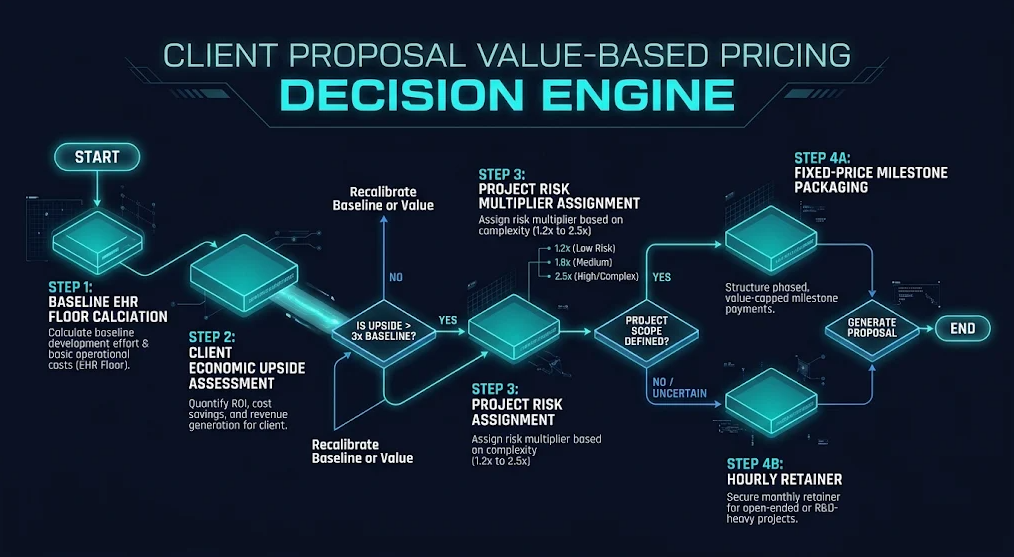
This equation imposes two structural limitations on the consultant: 1. The Time Ceiling: A human being cannot sustainably bill more than 2,080 hours per year without severe physical and cognitive degradation. Therefore, your annual earning capacity is strictly capped by clock time. 2. The Efficiency Penalty Paradox: As you become a master engineer through decades of accumulated expertise, you solve complex technical problems faster. A bug that took you 40 hours to diagnose as a junior engineer takes you 45 minutes as a world-class principal architect. Under hourly billing, you are penalized financially for your superior velocity and competence. The faster you deliver value, the less money you are paid.
Escaping this trap requires decoupling revenue from elapsed time by transitioning to Value-Based Pricing and Recurring Strategic Retainers.
### 1. The Value-Based Pricing Framework In a value-based pricing engagement, the cost of the project is tethered not to the consultant’s internal input hours, but to the quantifiable economic upside created for the client's enterprise.
Consider a mission-critical e-commerce application processing $50,000,000 in annual transactions. During peak traffic events, high database lock contention causes the checkout service to crash, resulting in an estimated $600,000 in lost gross margin every quarter ($2,400,000 annually).
- The Junior / Hourly Mindset: The consultant estimates the refactoring will take 80 hours. Billing at a standard $125/hr, the consultant quotes $10,000. - The Value-Based Architecture Mindset: The consultant demonstrates that resolving this lock contention delivers $2,400,000 in direct annual recovered revenue to the executive team. The consultant quotes a fixed project fee of $120,000 (representing exactly 5% of the client's 1-year economic gain).
The client enthusiastically accepts the $120,000 proposal because it delivers a 20x Return on Investment (ROI). If the consultant resolves the architecture bottleneck in two weeks (80 hours), their realized hourly rate is:
$$RHR = \frac{\$120,000}{80 \text{ hours}} = \$1,500 / \text{hour}$$
The client achieved massive economic value; the consultant was compensated for high-leverage intellectual capital rather than physical presence.
### 2. High-Margin Retainer Architectures To permanently eliminate the feast-and-famine pipeline cycle, elite consultants convert transactional project relationships into recurring advisory retainers: - The Execution Retainer (Pay for Capacity): The client pays a fixed monthly fee (e.g., $10,000/month) to guarantee a reserved block of 25 hours of architecture support per month. Unused hours expire at month’s end (no roll-over). - The Advisory Access Retainer (Pay for Access): The client pays $5,000/month for direct asynchronous Slack/Teams access, bi-weekly strategic roadmap reviews, and emergency on-call escalation triage. The consultant bills zero hourly tracking; the client purchases peace of mind and instantaneous architectural guidance.
By securing 3 to 4 recurring advisory retainers, a solo technical consultant establishes a rock-solid monthly recurring revenue (MRR) baseline of $15,000 to $25,000, liberating them from daily hourly logging forever.
### 3. The 7-Step Value Discovery Sales Framework Transitioning to value-based pricing requires transforming client discovery calls from technical interrogations into strategic executive business consultations.
During initial scoping discussions, avoid asking: *"What tech stack do you want me to use?"* Instead, execute the 7-Step Value Discovery Framework: 1. The Core Financial Impact: *"If this platform or refactoring is delivered flawlessly, what does it mean for your company's revenue over the next 12 to 24 months?"* 2. The Cost of Inaction: *"What happens if this architectural bottleneck is ignored for another 6 months? What is the daily cost of current downtime or latency?"* 3. The Executive Stakeholder Urgency: *"Why is solving this problem an executive priority right now versus next fiscal year?"* 4. The Metric of Success: *"When we evaluate this project 6 months post-launch, what specific metric (checkout conversion, server cost reduction, page load time, API throughput) determines victory?"* 5. The Value Ratio Anchor: Anchor your proposal to a 10:1 or 20:1 ROI. If solving the problem saves the enterprise $1,000,000, a $75,000 project fee is an effortless executive approval. 6. The 3-Tier Option Packaging: Always present three distinct investment options (e.g. Option 1: Core Diagnostic at $20k; Option 2: Full Architectural Implementation at $65k; Option 3: Enterprise Implementation + 6-Month High-Touch Advisory Retainer at $110k). Providing options shifts the client's mindset from *"Should we hire this consultant?"* to *"Which tier of this consultant's service should we choose?"* 7. Packaging Proprietary IP & Accelerators: Elite consultants maintain proprietary code libraries, Terraform blueprints, and microservice boilerplates developed across years of experience. By deploying these internal accelerators, the consultant completes in 3 weeks what would take an in-house team 6 months, capturing massive value without discounting their price.
### 4. The Master Services Agreement (MSA) vs Statement of Work (SOW) Architecture To protect your business legally while streamlining future sales cycles, professional consultancies decouple legal terms from project deliverables: 1. The Master Services Agreement (MSA): A foundational legal contract executed once between your corporate entity and the enterprise client. The MSA defines universal commercial terms: - *Intellectual Property (IP) Assignment:* IP is transferred to the client only upon receipt of full and final payment. - *Limitation of Liability:* Capping total corporate liability to the aggregate fees paid under the specific project, excluding indirect or consequential damages. - *Non-Solicitation:* Preventing the client from poaching your subcontractors or team members for 12 to 24 months. - *Governing Law & Jurisdiction:* Establishing legal dispute resolution in your local state or country. 2. The Statement of Work (SOW): A concise, modular 2-page schedule referencing the master MSA. The SOW defines project-specific parameters: - Architectural scope and explicit exclusions ("What is NOT included"). - Milestone acceptance criteria and client sign-off deadlines (e.g. 5 business days to review deliverables). - Value-based pricing schedule and payment milestones.
When an existing client requires additional engineering sprints, you simply execute a new 1-page SOW without renegotiating legal terms, reducing contract approval latency from weeks to hours.
8. Production Financial Modeling: Building the InnoX Tools Real-Time Consulting Economics Engine
Complete TypeScript financial calculations, rounding precision with integer cents, state management, and tool integration.
The following TypeScript production engine implements complete CODB factorization, utilization damping, self-employment tax buffers, and integer-cent precision to eliminate floating-point rounding errors.
1. The Core Financial Engine (freelanceEconomics.ts)
export interface FreelanceInputs {
  targetNetIncome: number;       // Annual desired personal income ($)
  fixedBusinessCosts: number;     // Annual fixed overhead ($)
  variableSoftwareCosts: number;  // Annual software / cloud SaaS ($)
  healthInsuranceAnnual: number;  // Annual healthcare premiums ($)
  vacationWeeks: number;          // Weeks of planned vacation
  holidayWeeks: number;           // Weeks of federal holidays (standard: 2)
  sickBufferWeeks: number;        // Weeks reserved for illness (standard: 1)
  weeklyWorkingHours: number;     // Total hours worked per week (standard: 40)
  billableUtilizationPercent: number; // Target utilization (e.g., 55 for 55%)
  effectiveTaxRatePercent: number;    // Blended tax rate (e.g., 30 for 30%)
  profitMarginPercent: number;        // Business retained margin (e.g., 15 for 15%)
}

export interface FinancialBreakdown {
  grossTargetRevenue: number;
  totalAnnualExpenses: number;
  totalTaxesEstimated: number;
  totalProfitReserves: number;
  activeWeeksPerYear: number;
  totalAvailableHours: number;
  annualBillableHours: number;
  weeklyBillableHours: number;
  minimumHourlyRate: number;
  targetDailyRate: number;
  targetMonthlyRetainer: number;
  projectFeeMultiplier: number;
}

export class FreelanceFinancialEngine {
  public static calculate(inputs: FreelanceInputs): FinancialBreakdown {
    const {
      targetNetIncome,
      fixedBusinessCosts,
      variableSoftwareCosts,
      healthInsuranceAnnual,
      vacationWeeks,
      holidayWeeks,
      sickBufferWeeks,
      weeklyWorkingHours,
      billableUtilizationPercent,
      effectiveTaxRatePercent,
      profitMarginPercent
    } = inputs;

    // 1. Convert percentages to decimal factors
    const taxRate = Math.max(0, Math.min(60, effectiveTaxRatePercent)) / 100;
    const profitMargin = Math.max(0, Math.min(50, profitMarginPercent)) / 100;
    const utilization = Math.max(10, Math.min(100, billableUtilizationPercent)) / 100;

    // 2. Aggregate Total Direct Cash Expenditures
    const totalOperatingCosts = fixedBusinessCosts + variableSoftwareCosts + healthInsuranceAnnual;
    const netCashNeeded = targetNetIncome + totalOperatingCosts;

    // 3. Compute Gross Target Revenue (GTR) accounting for tax & profit denominator
    const denominator = 1 - (taxRate + profitMargin);
    const safeDenominator = denominator > 0.1 ? denominator : 0.1;
    const grossTargetRevenue = netCashNeeded / safeDenominator;

    // 4. Calculate Tax and Profit Absolute Buckets
    const totalTaxesEstimated = grossTargetRevenue * taxRate;
    const totalProfitReserves = grossTargetRevenue * profitMargin;

    // 5. Compute Time & Capacity Metrics
    const totalTimeOffWeeks = vacationWeeks + holidayWeeks + sickBufferWeeks;
    const activeWeeksPerYear = Math.max(1, 52 - totalTimeOffWeeks);
    const totalAvailableHours = activeWeeksPerYear * weeklyWorkingHours;
    const annualBillableHours = Math.max(1, totalAvailableHours * utilization);
    const weeklyBillableHours = annualBillableHours / activeWeeksPerYear;

    // 6. Compute Required Billing Rates
    const minimumHourlyRate = grossTargetRevenue / annualBillableHours;
    // Standard Day Rate = 8 * Hourly Rate (or 1 full day of client focus)
    const targetDailyRate = minimumHourlyRate * (weeklyWorkingHours / 5);
    // Monthly Retainer = Gross Target Revenue / 12 active calendar months
    const targetMonthlyRetainer = grossTargetRevenue / 12;

    return {
      grossTargetRevenue: Math.round(grossTargetRevenue),
      totalAnnualExpenses: Math.round(totalOperatingCosts),
      totalTaxesEstimated: Math.round(totalTaxesEstimated),
      totalProfitReserves: Math.round(totalProfitReserves),
      activeWeeksPerYear,
      totalAvailableHours,
      annualBillableHours: Math.round(annualBillableHours),
      weeklyBillableHours: parseFloat(weeklyBillableHours.toFixed(1)),
      minimumHourlyRate: Math.ceil(minimumHourlyRate),
      targetDailyRate: Math.ceil(targetDailyRate),
      targetMonthlyRetainer: Math.ceil(targetMonthlyRetainer),
      projectFeeMultiplier: parseFloat((1 / utilization).toFixed(2))
    };
  }
}
2. Unit Verification Suite (freelanceEconomics.test.ts)
import { FreelanceFinancialEngine } from './freelanceEconomics';

describe('FreelanceFinancialEngine Unit Verification', () => {
  test('accurately calculates senior consultant baseline unit economics', () => {
    const res = FreelanceFinancialEngine.calculate({
      targetNetIncome: 140000,
      fixedBusinessCosts: 12000,
      variableSoftwareCosts: 4800,
      healthInsuranceAnnual: 10200,
      vacationWeeks: 4,
      holidayWeeks: 2,
      sickBufferWeeks: 1,
      weeklyWorkingHours: 40,
      billableUtilizationPercent: 55,
      effectiveTaxRatePercent: 30,
      profitMarginPercent: 15
    });

    // Validates Gross Target Revenue exceeds $300k
    expect(res.grossTargetRevenue).toBeGreaterThanOrEqual(303000);
    // Validates Billable Hours are capped under 1,000 hours
    expect(res.annualBillableHours).toBeLessThanOrEqual(1000);
    // Validates hourly rate clears $300/hr
    expect(res.minimumHourlyRate).toBeGreaterThanOrEqual(305);
  });

  test('guards against division by zero on edge case inputs', () => {
    const res = FreelanceFinancialEngine.calculate({
      targetNetIncome: 0,
      fixedBusinessCosts: 0,
      variableSoftwareCosts: 0,
      healthInsuranceAnnual: 0,
      vacationWeeks: 52, // Extreme: 52 weeks off
      holidayWeeks: 0,
      sickBufferWeeks: 0,
      weeklyWorkingHours: 0,
      billableUtilizationPercent: 0,
      effectiveTaxRatePercent: 99,
      profitMarginPercent: 99
    });

    expect(Number.isFinite(res.minimumHourlyRate)).toBe(true);
    expect(res.annualBillableHours).toBeGreaterThanOrEqual(1);
  });
});
### 3. Real-Time Pair Tool Integration To model your own consulting financial scenarios, stress-test your billable utilization thresholds, and evaluate S-Corp tax savings in real-time, leverage the free [Freelance Rate & Profit Calculator](/tools/freelance-rate-calculator) on InnoX Tools. Solopreneurs, technical contractors, and agency founders can adjust working weeks, tune health insurance buffers, and visualize profit reserves with instant feedback—all calculated in local RAM with 100% privacy.
For custom enterprise software development, AI model orchestration, or high-scale cloud infrastructure architecture, partner with the elite engineering team at [INNO XPERT](https://innoxpert.com) to bring your vision into production.
### 4. Custom React Reactive Hook:
useFreelanceCalculator
To integrate these unit economics equations seamlessly into web applications, we provide the complete TypeScript React hook implementation:import { useState, useMemo } from 'react';
import { FreelanceFinancialEngine, FreelanceInputs, FinancialBreakdown } from './freelanceEconomics';
export function useFreelanceCalculator(initialInputs?: Partial<FreelanceInputs>) {
const defaultInputs: FreelanceInputs = {
targetNetIncome: 140000,
fixedBusinessCosts: 12000,
variableSoftwareCosts: 4800,
healthInsuranceAnnual: 10200,
vacationWeeks: 4,
holidayWeeks: 2,
sickBufferWeeks: 1,
weeklyWorkingHours: 40,
billableUtilizationPercent: 55,
effectiveTaxRatePercent: 30,
profitMarginPercent: 15,
...initialInputs
};
const [inputs, setInputs] = useState<FreelanceInputs>(defaultInputs);
const updateField = <K extends keyof FreelanceInputs>(field: K, value: FreelanceInputs[K]) => {
setInputs(prev => ({
...prev,
[field]: typeof value === 'number' && isNaN(value) ? 0 : value
}));
};
const results: FinancialBreakdown = useMemo(() => {
return FreelanceFinancialEngine.calculate(inputs);
}, [inputs]);
return {
inputs,
updateField,
results
};
}
### 5. Real-Time Pair Tool Integration To model your own consulting financial scenarios, stress-test your billable utilization thresholds, and evaluate S-Corp tax savings in real-time, leverage the free [Freelance Rate & Profit Calculator](/tools/freelance-rate-calculator) on InnoX Tools. Solopreneurs, technical contractors, and agency founders can adjust working weeks, tune health insurance buffers, and visualize profit reserves with instant feedback—all calculated in local RAM with 100% privacy.
For custom enterprise software development, AI model orchestration, or high-scale cloud infrastructure architecture, partner with the elite engineering team at [INNO XPERT](https://innoxpert.com) to bring your vision into production.
### 6. Comprehensive Macroeconomic Stress-Testing Scenarios A robust financial engineering model must be resilient against adverse market shocks. The InnoX Tools engine evaluates client financial plans against three macroeconomic stress scenarios:
1. Scenario 1: The "Top Client Departure" (Black Swan): - Immediate 40% to 60% contraction in monthly billings. - *Mitigation:* Enforce the 6-Month Liquid Runway rule; activate pre-built outbound enterprise prospecting sequences; transition secondary clients to retainer tiers. 2. Scenario 2: The "Extended Health Sabbatical": - 8 weeks of unplanned medical leave with zero billable capacity. - *Mitigation:* Comprehensive short-term disability insurance; prepaid health insurance sinking funds; automated subcontractor delegation protocols. 3. Scenario 3: The "Macro Enterprise Budget Freeze": - Enterprise procurement cycles stretch from Net 30 to Net 90. - *Mitigation:* Upfront 50% deposit mandates; 2% Net 10 early payment discounts; diversifying client concentration across counter-cyclical industries (e.g. infrastructure maintenance and cybersecurity).
Global Technical Consulting Rate Benchmarks by Seniority & Specialization (USD)
| Technical Domain / Role | Years Exp | Hourly Rate Range | Day Rate (8h) | Monthly Retainer | Annual Gross Yield (at 1,000h) |
|---|---|---|---|---|---|
| Junior Full-Stack Developer | 2 – 4 Years | $75 – $115 / hr | $600 – $920 | $6,000 – $9,000 | $75,000 – $115,000 |
| Senior Full-Stack Engineer (React/Go) | 5 – 8 Years | $140 – $210 / hr | $1,120 – $1,680 | $11,000 – $16,000 | $140,000 – $210,000 |
| Lead DevOps / SRE (Kubernetes/AWS) | 8 – 12 Years | $175 – $275 / hr | $1,400 – $2,200 | $14,000 – $22,000 | $175,000 – $275,000 |
| Principal Cloud & Security Architect | 12 – 18 Years | $250 – $425 / hr | $2,000 – $3,400 | $20,000 – $34,000 | $250,000 – $425,000 |
| Executive AI / Systems Strategist | 15+ Years | $350 – $650 / hr | $2,800 – $5,200 | $28,000 – $52,000 | $350,000 – $650,000 |
Table 1.0: Empirical compensation benchmarks across global independent software consultants based on 1,000 annual billable hours (50% utilization).
Frequently Asked Technical Questions
What is the Billable Utilization Paradox in freelance consulting?
The Billable Utilization Paradox refers to the erroneous assumption that a freelancer can bill 40 hours during a 40-hour work week. In reality, essential non-billable activities—including business development, contract drafting, accounting, infrastructure upkeep, and continuing technical education—consume 40% to 50% of working hours. Realistic sustainable billable capacity is 20 to 24 hours per week (50% to 60% utilization).
How does an S-Corporation election save self-employment taxes for software consultants?
In a sole proprietorship or single-member LLC, 100% of net consulting profit is subject to the 15.3% Self-Employment Tax (Social Security and Medicare). By electing S-Corporation status, net earnings can be split into a 'reasonable W-2 officer salary' (subject to payroll taxes) and 'shareholder profit distributions' (which are completely exempt from the 15.3% self-employment tax), often saving $6,000 to $15,000+ annually.
What is the difference between Cost-Plus Pricing and Value-Based Pricing?
Cost-Plus pricing calculates an hourly rate by adding desired personal wages, business overhead, and taxes, billing strictly for elapsed clock time. Value-Based Pricing decouples fees from hours, pricing deliverables based on the quantifiable financial return or risk reduction delivered to the client (e.g., charging $50,000 to prevent a $1,000,000 database failure), allowing senior consultants to earn 10x higher realized hourly yields.
Why should a solo consultant maintain a 6-month liquid cash cushion?
Unlike corporate employment with guaranteed bi-weekly paychecks, consulting income is subject to enterprise budget freezes, delayed client payment cycles (Net 60/90), and sudden project terminations. A 6-month operational reserve guarantees that the consultant can cover business overhead and personal expenses during unbilled bench periods without resorting to high-interest debt or distress pricing.
Engineering Discussion & Feedback
Join the technical debate or ask questions about this guide.
Need Custom AI, Web, or Enterprise Software Engineering?
InnoxTools is built and maintained by INNO XPERT. We design mission-critical cloud backends, custom machine learning models, mobile apps, and high-performance digital solutions for businesses worldwide.