How to Calculate Your True Freelance Hourly Rate & Project Estimates in 2026: The Comprehensive Financial Blueprint
From Billable Hour Utilization and Tax Overheads to Value-Based Pricing, Scope Creep Buffers, and Cash Reserve Models—The Complete Financial Engineering Handbook for Independent Software Engineers & Creatives.

INNO XPERT Financial Engineering DivisionVERIFIED
Freelance Economics & Enterprise Cost Modeling
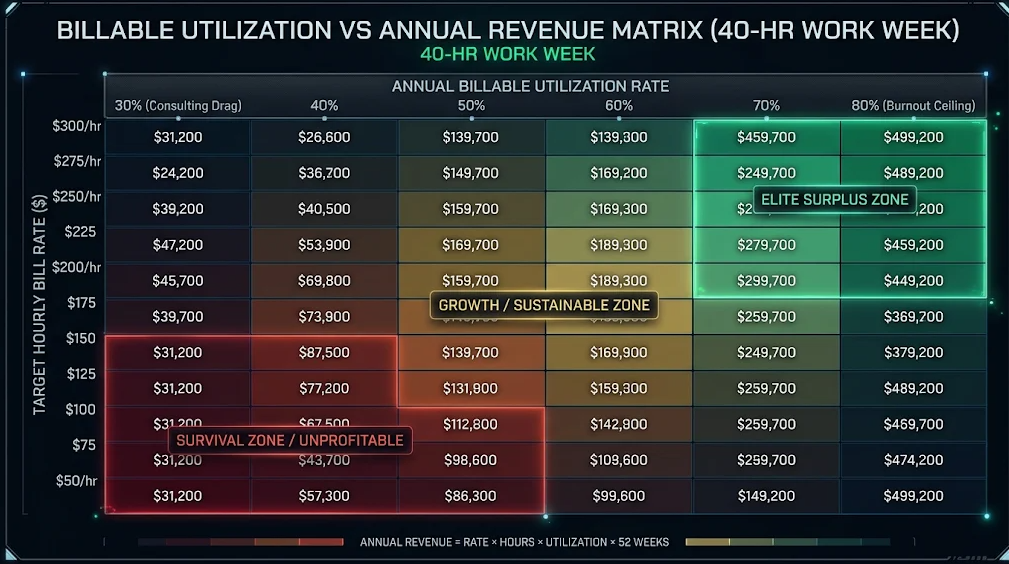
To calculate your true freelance hourly rate in 2026, never simply divide your desired annual income by 2,080 hours. In reality, independent professionals only achieve a 50% to 60% billable utilization rate (~1,000 to 1,200 billable hours per year) due to administrative tasks, client acquisition, invoicing, and professional development. Your minimum hourly rate must account for Personal Net Income Target + Self-Employment Taxes (25-35%) + Operating Expenses (software, hardware, insurance) + Sinking Funds (vacation, sick days, retirement) divided by Realistic Billable Hours.
Freelance Rate & Profit Calculator
Calculate your true hourly rate, day rate, and project quote buffers based on living expenses, tax reserves, non-billable overheads, and target profit.
Table of Contents & Chapter Index
- 1. The Freelance Pricing Paradox
- 2. The 2,080-Hour Myth & 55% Utilization
- 3. The Financial Equilibrium Formula
- 4. The Invisible Drain: Taxes, Healthcare & Sinking Funds
- 5. Hourly vs. Fixed-Price vs. Value-Based Pricing
- 6. Engineering Risk Buffers & Scope Creep Protection
- 7. Client Negotiation & Price Anchoring Psychology
- 8. Step-by-Step Calculator Implementation Guide
1. The Freelance Pricing Paradox: Why 92% of Independents Severely Underprice Their Labor
The cognitive trap of employee-to-contractor salary translation and the systemic risk of financial burnout.
Yet, rigorous empirical surveys conducted across independent contractor networks reveal a sobering reality: over 92% of newly independent knowledge workers severely underprice their professional services during their first three years of operation. Even experienced consultants routinely operate at effective hourly rates below standard entry-level corporate salaries once taxes, unpaid administrative labor, and healthcare overheads are factored into the balance sheet.
This systemic underpricing stems from a profound cognitive trap known as the Employee Salary Translation Fallacy. When a salaried senior software engineer earning $120,000 per year decides to transition into freelance consulting, their naive pricing calculation proceeds as follows:
\( \text{Naive Rate} = \frac{\$120,000}{52 \text{ weeks} \times 40 \text{ hours}} = \frac{\$120,000}{2,080 \text{ hours}} \approx \$57.69 / \text{hour} \)
Confident that charging $60 or even $70 per hour represents a premium over their previous employment, the engineer begins pitching clients. Within twelve months, they encounter a devastating financial liquidity crunch. Why? Because an employee's gross nominal salary represents only a fraction of their true total compensation package. In a corporate environment, the employer pays mandatory payroll taxes, matches retirement contributions, provides comprehensive medical/dental/vision coverage, supplies high-end hardware, licenses enterprise software tools, funds paid vacations, and most critically: absorbs 100% of the operational overhead associated with sales, client prospecting, contract drafting, and accounting.
When you transition to independent contracting, you are no longer merely an engineer selling hours—you are a solo enterprise operating a professional services firm. You are simultaneously the Chief Executive Officer, the Lead Architect, the Business Development Manager, the Accounts Receivable Clerk, the DevOps Administrator, and the Legal Counsel. Every hour spent updating your portfolio, pitching prospective clients, negotiating master services agreements, debugging billing discrepancies, or learning new frameworks is completely unbillable. If your hourly rate does not explicitly subsidize these non-billable operational hours and enterprise overheads, you are actively subsidizing your clients' profit margins with your personal life energy.
2. The 2,080-Hour Myth: Deconstructing Real-World Billable Utilization Rates (The 55% Law)
Why the standard 40-hour work week does not exist in professional services and how to calibrate your capacity.
\( \text{Utilization Rate } (\%) = \left( \frac{\text{Total Billable Hours Invoiced}}{\text{Total Available Working Hours}} \right) \times 100 \)
In a traditional 40-hour corporate work week across 52 weeks, the nominal theoretical capacity is 2,080 hours per year. However, no sustainable human consulting business can bill 2,080 hours annually without precipitating catastrophic physical illness, mental exhaustion, and client relationship decay.
The Calendar Reality Breakdown: Let us construct a realistic, sustainable annual calendar for a professional consultant: - Total Calendar Year: 52 weeks (365 days) - Paid Time Off & Holidays: 4 weeks vacation / family rest (20 days) + 10 recognized public holidays = 30 days off (6 weeks). - Sick Leave, Health & Personal Wellness Buffer: 10 days (2 weeks). - Net Available Working Weeks: 44 weeks per year. - At 40 hours per week, total available operational capacity is: \( 44 \times 40 = 1,760 \text{ hours} \).
The 55% Law of Billable Allocation: Of those 1,760 operational hours, how many can realistically be dedicated to deep, billable client deliverables? Rigorous time-tracking audits across thousands of high-earning independent software developers and creative directors demonstrate that non-billable overhead inevitably consumes between 40% and 50% of your total working time: - Business Development & Sales: Crafting custom project proposals, discovery calls, scoping requirements, and preliminary client onboarding (~6 hours/week). - Invoicing, Bookkeeping & Admin: Tracking receivables, managing receipts, reconciliations, filing sales/VAT taxes, and legal contracts (~3 hours/week). - Infrastructure & Tooling: Operating system maintenance, software updates, setting up local developer environments, backups, and security patching (~2 hours/week). - Marketing & Thought Leadership: Writing technical case studies, contributing to open source, speaking, and updating agency profiles (~4 hours/week). - Continuous Learning & Professional Development: Reading documentation, learning new libraries, taking certifications, and exploring AI tooling to remain competitive (~3 hours/week).
Total Non-Billable Overhead: Approximately 18 hours per week out of 40. This leaves exactly 22 hours per week of true, focused, billable client output—a realistic utilization rate of 55%:
\( \text{Realistic Annual Billable Hours} = 44 \text{ working weeks} \times 22 \text{ billable hours/week} = 968 \text{ billable hours} \)
If your annual personal take-home target is $120,000, and you base your rate on 2,080 hours, you calculate $58/hour. But when you only bill 968 hours at $58/hour, your gross revenue is only $56,144! After self-employment taxes and business expenses, your actual take-home income plummets to under $35,000. Understanding the 55% Law is the foundational prerequisite to establishing true financial solvency.
3. The Freelance Financial Equilibrium Formula: Calculating True Hourly Rate from Baseline Expenses
The definitive mathematical equation balancing personal lifestyle needs, business overheads, tax reserves, and enterprise profit.

1. Personal Net Living Target (\( N \)): The exact net after-tax income required to support your desired lifestyle, family expenses, housing, savings, and investments. 2. Annual Business Operating Expenses (\( E \)): All direct overhead required to operate your business (software subscriptions, hardware depreciation, legal/accounting fees, office space, hosting). 3. Self-Employment & Income Tax Reserve Rate (\( T \)): The effective blended tax rate applied by federal, state, and local governments to sole proprietorships and LLCs (typically 25% to 35% in most Western jurisdictions). 4. Business Profit & Risk Sinking Margin (\( P \)): An intentional commercial profit margin (15% to 25%) retained inside the business entity to absorb late client payments, unpaid invoices, client dry spells, and strategic R&D.
The Mathematical Formulation: To calculate the Required Gross Annual Revenue (\( R_{\text{gross}} \)), we formulate the relationship as:
\( R_{\text{gross}} = \frac{N + E}{(1 - T)} \times (1 + P) \)
Once Required Gross Revenue (\( R_{\text{gross}} \)) is established, the True Minimum Hourly Rate (\( H_{\text{rate}} \)) is derived by dividing across Realistic Annual Billable Hours (\( B_{\text{hours}} = W_{\text{weeks}} \times H_{\text{weekly}} \times U_{\text{utilization}} \)):
\( H_{\text{rate}} = \frac{R_{\text{gross}}}{B_{\text{hours}}} = \frac{\left[ \frac{N + E}{1 - T} \right] \times (1 + P)}{W_{\text{weeks}} \times H_{\text{weekly}} \times U_{\text{utilization}}} \)
Worked Real-World Engineering Example: Let us calculate the true hourly rate for a Senior Full-Stack Engineer based in North America or Western Europe: - Desired Personal Net Take-Home (\( N \)): $120,000 / year - Annual Business Expenses (\( E \)): $15,000 / year (MacBook Pro amortized, JetBrains/GitHub/AWS licenses, coworking desk, accounting, professional liability insurance) - Blended Effective Tax Rate (\( T \)): 30% (0.30) - Business Profit & Buffer Margin (\( P \)): 20% (0.20) - Working Weeks (\( W_{\text{weeks}} \)): 44 weeks (allowing 6 weeks vacation/holidays + 2 weeks sick leave) - Total Weekly Hours: 40 hours - Realistic Billable Utilization (\( U_{\text{utilization}} \)): 55% (yielding 22 billable hours/week) - Total Annual Billable Hours (\( B_{\text{hours}} \)): \( 44 \times 22 = 968 \text{ hours} \)
Step 1: Calculate Pre-Tax Baseline Revenue Needed: \( \text{Pre-Tax Baseline} = \frac{\$120,000 + \$15,000}{1 - 0.30} = \frac{\$135,000}{0.70} = \$192,857.14 \)
Step 2: Apply 20% Commercial Profit & Risk Margin: \( R_{\text{gross}} = \$192,857.14 \times 1.20 = \$231,428.57 \)
Step 3: Derive True Minimum Hourly Rate: \( H_{\text{rate}} = \frac{\$231,428.57}{968 \text{ billable hours}} = \$239.08 / \text{hour} \)
The Revelation: To legitimately match a $120,000 corporate salary while maintaining 6 weeks of time off, covering business expenses, paying full self-employment taxes, and retaining a 20% business safety margin, our engineer must charge approximately $240 per hour—not the naive $58 or $75 per hour! Charging $240/hr is not greedy; it is the mathematical baseline of sustainable commercial viability.
4. The Invisible Drain: Factoring Self-Employment Taxes, Health Insurance, Hardware Depreciation, and Sinking Funds
A comprehensive audit of hidden operating overheads that drain solo enterprise cash reserves.
To establish absolute financial resilience, every independent professional must systematically categorize and fund four invisible overhead categories:
1. Self-Employment & Statutory Payroll Taxes (FICA): In standard corporate employment, employers are legally required to pay half of your statutory Social Security and Medicare taxes (in the United States, 7.65%), while the remaining 7.65% is deducted from your paycheck. When operating as an independent contractor or single-member LLC, you are both employer and employee: you must pay the full 15.3% Self-Employment Tax on net earnings, in addition to progressive federal, state, and provincial income taxes. As an ironclad rule of thumb, immediately transfer 30% to 35% of every incoming client invoice into a dedicated, isolated high-yield business tax escrow account.
2. Comprehensive Private Healthcare & Disability Insurance: Corporate employers frequently subsidize 70% to 90% of comprehensive group health, dental, and vision insurance premiums. As an independent consultant, purchasing individual health insurance policies directly on open exchanges typically costs between $450 and $1,200 per month ($5,400 to $14,400 annually) depending on age and geographic location. Furthermore, independent contractors lack statutory worker's compensation and paid disability leave. Securing long-term disability insurance to protect your income in the event of severe illness or accident requires allocating an additional $1,000 to $2,500 annually.
3. Hardware Amortization & Enterprise SaaS Subscriptions: High-performance knowledge work requires professional tools: - Developer Hardware Stack: A fully loaded developer workstation (e.g., M-Series MacBook Pro or high-spec workstation, 4K color-accurate dual displays, ergonomic seating, studio audio/video for client presentations) costs ~$5,000 to $7,000. Amortized over a 3-year replacement lifecycle, hardware depreciation costs ~$2,000 per year. - Professional Software & Cloud Tooling: GitHub Team, JetBrains All Products Pack, Figma Professional, Slack Pro, Google Workspace Enterprise, AWS/Vercel staging environments, 1Password, Adobe Creative Cloud, and generative AI subscriptions (ChatGPT Plus, Claude Pro, Cursor) total between $250 and $500 per month ($3,000 to $6,000 per year). - Professional Services: A certified public accountant (CPA) for quarterly filings and corporate tax returns, combined with annual legal reviews for client master services agreements, adds $2,000 to $4,000 annually.
4. The Sinking Fund (The 6-Month War Chest): Corporate enterprises maintain revolving lines of credit and liquid cash reserves. Freelance cash flow is inherently volatile: enterprise clients frequently operate on Net-30, Net-60, or even Net-90 payment terms. If a client delays paying a $20,000 invoice by 45 days, an independent consultant without reserves risks missing mortgage or personal living commitments. Every freelance pricing structure must fund a Sinking Fund—a dedicated liquid business cash reserve containing 6 months of combined business operating expenses and personal living costs.
5. Hourly Billing vs. Fixed-Price Milestone vs. Value-Based Pricing: When to Deploy Each
A comparative evaluation of pricing architectures to escape the hourly billing ceiling.
To maximize commercial earnings, independent professionals must understand the three primary pricing architectures and know exactly when to deploy each:
1. Hourly Billing (T&M - Time and Materials): - How It Works: The client is billed a fixed dollar amount for each logged hour of labor, typically tracked using software tools and invoiced weekly or bi-weekly. - Best Deployed For: Ambiguous, exploratory, or poorly scoped engagements; open-ended legacy codebase refactoring; bug fixing; staff augmentation; emergency DevOps triage where project scope cannot be accurately estimated in advance. - Pros: Complete protection against scope creep; every extra minute of client meetings or revisions is compensated. - Cons: Zero incentive for speed; continuous client micromanagement and scrutiny of timesheets; hard income ceiling.
2. Fixed-Price Milestone Billing: - How It Works: The project is divided into distinct, measurable deliverables with predetermined price tags (e.g., Phase 1: Architecture & Database Schema - $8,000; Phase 2: Core API & Auth Integration - $14,000; Phase 3: UI Implementation & Testing - $12,000). - Best Deployed For: Well-defined, predictable projects with strict specifications, wireframes, and clear acceptance criteria. - Pros: Decouples time from revenue. If you build specialized internal starter kits, design systems, or AI automation that allows you to complete a $15,000 milestone in 20 hours instead of 60 hours, your effective hourly rate triples to $750/hour. - Cons: High risk of scope creep if specifications are vague. If the client demands endless revisions, you absorb the financial loss unless your contract contains ironclad change-order clauses.
3. Value-Based Pricing (The Enterprise Tier): - How It Works: Pricing is calculated not based on your time or costs, but as a percentage of the measurable economic value created for the client's business. - Best Deployed For: High-impact commercial initiatives for mid-market and enterprise clients with substantial revenue streams. - The Value Formula: If an enterprise e-commerce brand processes $40,000,000 in annual revenue, and your architectural overhaul to their checkout flow increases checkout conversion rate by 1.5%, you generate an additional $600,000 in annual recurring gross profit for the client. Quoting $60,000 for this 3-week project represents a phenomenal 10x ROI for the client, while yielding you an astronomical effective hourly rate of over $700/hour. - Pros: Maximum profitability; positions you as an indispensable strategic partner rather than an interchangeable tactical vendor. - Cons: Requires deep commercial business acumen, sales discovery expertise, and access to decision-makers who manage P&L budgets.
6. Engineering Risk Buffers & Scope Creep Protection: The Mathematical Multiplier
How to insulate fixed-price project estimates against unpredictable client revisions and technical debt.
In commercial reality, Murphy's Law dominates software engineering: what can go wrong, will go wrong. Third-party APIs deprecate endpoints without notice, client marketing teams change color palettes mid-sprint, and legacy databases contain corrupted records. If your fixed-price estimate contains zero risk buffer, every unexpected delay directly erodes your hourly profit margin.
The Risk-Adjusted Estimation Formula (PERT Method): To eliminate estimation bias, deploy the Program Evaluation and Review Technique (PERT) weighted average formula. For each project deliverable, calculate three distinct time estimates: 1. Optimistic Estimate (\( O \)): The time required if everything proceeds flawlessly without a single hitch. 2. Most Likely Estimate (\( M \)): The realistic time required under normal working conditions with typical friction. 3. Pessimistic Estimate (\( P_{\text{est}} \)): The worst-case time required if third-party libraries break and major refactoring is required.
The Expected Time (\( E_{\text{time}} \)) is calculated using the weighted beta distribution:
\( E_{\text{time}} = \frac{O + 4M + P_{\text{est}}}{6} \)
Applying the Commercial Scope Creep Multiplier: Once you have computed the base expected hours using the PERT formula, apply a Commercial Risk Multiplier based on the client's organizational maturity: - Tier 1 Client (Repeat Client, Seasoned Technical Product Manager, Strict PRD): Multiply base estimate by 1.20 (20% contingency buffer). - Tier 2 Client (New Client, Non-Technical Founder, Standard Wireframes): Multiply base estimate by 1.35 (35% contingency buffer). - Tier 3 Client (Early-Stage Committee, Multiple Unaligned Stakeholders, Vague Vision): Multiply base estimate by 1.50 to 1.75 (50% to 75% contingency buffer) or decline fixed-price billing and insist on weekly time-and-materials sprints.
Contractual Scope Defenses: Never send a fixed-price quote without three mandatory contractual guardrails: 1. Explicit Exclusions Section: In writing, list what is NOT included (e.g., 'Does not include legacy data migration of pre-2023 customer records; does not include custom native iOS camera SDKs'). 2. Bounded Revision Cycles: Define exact limits on creative iterations (e.g., 'Includes exactly two (2) rounds of consolidated revision feedback within 5 business days of milestone submission. Additional revision requests will be invoiced under our standard change-order rate of $200/hour'). 3. Minimum Change-Order Threshold: Specify that any feature addition exceeding 2 hours of engineering labor triggers a formal written Change Order with separate budget authorization before work commences.
7. The Psychology of High-Ticket Client Negotiation: Justifying Premium Rates and Eliminating Price Resistance
How elite independent consultants frame pricing, anchor authority, and turn price resistance into enthusiastic closes.
To enterprise executives and funded startup founders, a cheap $35/hour developer is terrifying. They understand that a poorly written codebase, insecure authentication flow, or botched database schema will cost them $100,000+ in emergency refactoring, lost customer trust, and security vulnerabilities later. High prices signal competence, seniority, and peace of mind.
1. The Art of Price Anchoring: Never present your price in isolation. If you state 'This API integration will cost $18,000', the client's brain naturally compares that number to zero, perceiving it as a large expense. Instead, anchor your price against the costly alternative solutions available to the client: - The In-House Full-Time Hire Alternative: 'To recruit, hire, and onboard a full-time Senior React/Node Architect in today's market costs approximately $160,000 base salary, plus $35,000 in benefits, healthcare, and payroll taxes, plus $25,000 in recruiter agency fees—totaling over $220,000 with a 3-month hiring ramp-up. We can architect, build, and deploy this complete production module in 6 weeks for a flat investment of $32,000—delivering full production capability immediately with zero long-term payroll liabilities.' By framing your $32,000 project quote against a $220,000 hiring alternative, your price immediately transforms into an astonishing $188,000 cost-saving bargain!
2. Provide Three Tiered Pricing Options (The Decoy Effect): Never submit a binary 'Take it or Leave it' single-option proposal. When presented with one price, the client's choice is: 'Do I hire this person, or do I not hire them?' Instead, always provide three tiered packages: - Option 1: Minimum Viable Scope (Baseline MVP - e.g., $12,000) - Option 2: Full Recommended Solution (Complete Implementation + Testing + Staging Setup - e.g., $24,000) - Option 3: Premium Concierge Enterprise Tier (Complete Implementation + Priority SLA + 90 Days Maintenance + Performance Tuning - e.g., $38,000)
Psychological Impact: By presenting three options, the client's mental deliberation shifts from 'Should I hire them?' to 'Which tier best fits our budget and timeline?' Over 65% of enterprise clients choose the middle Option 2, while approximately 20% choose the premium Option 3.
3. Eliminate Price Resistance with 'Value Discovery' Questions: Before discussing pricing on an initial discovery call, uncover the client's financial pain points by asking diagnostic questions: - 'What happens if this system is NOT built or launched by Q3?' - 'How much manual staff time or lost revenue is this bottleneck currently costing your operations every month?' - 'What does success look like in measurable business metrics 6 months post-launch?' When the client articulates that their current bottleneck is losing them $30,000 per month, your $20,000 project price is instantly justified as a no-brainer investment that pays for itself in under thirty days.
8. Step-by-Step Financial Handbook: How to Calibrate Your Rate Using InnoxTools Freelance Rate Calculator
A practical walkthrough of configuring target income, operating expenses, tax percentages, and billable utilization using InnoxTools.
Step-by-Step Calibration Walkthrough:
Step 1: Input Your Desired Annual Net Income: Navigate to the InnoxTools Freelance Rate Calculator. In the 'Target Net Annual Income' field, enter your desired take-home income after all taxes have been paid (e.g., $120,000). Be ambitious yet realistic—factor in personal living costs, family support, personal travel, and emergency savings contributions.
Step 2: Enter Annual Business Operating Expenses: Itemize your recurring annual business costs: - Hardware, monitors, and device upgrades ($2,000 - $3,500) - Software licenses, IDEs, and AI coding subscriptions ($1,800 - $4,000) - Home office or coworking desk lease ($3,000 - $6,000) - Professional accounting and legal fees ($1,500 - $3,000) - Professional liability and cyber insurance ($1,200) Sum these overheads and enter the total (e.g., $15,000) into the 'Annual Business Expenses' field.
Step 3: Calibrate Your Estimated Tax Withholding Percentage: Configure your combined effective tax rate (Self-employment tax + Federal/State income tax). For most freelancers operating as sole proprietorships or single-member LLCs, this ranges between 25% and 35%. Entering 30% ensures that your take-home pay is fully protected from year-end tax surprises.
Step 4: Define Realistic Working Capacity: - Weeks Worked per Year: Enter 44 to 46 weeks (reserving 4 to 6 weeks for vacation, family holidays, and unexpected sick days). - Weekly Working Hours: Enter 40 hours. - Billable Utilization Percentage: Set this slider to 50% to 60% (typically 55%). The calculator will instantly derive your actual annual billable hours (e.g., ~968 hours).
Step 5: Review Your Real-Time Rate Matrix: The InnoxTools engine immediately computes your financial cockpit: - Minimum Hourly Rate: The exact break-even hourly rate required to hit your net income target. - Standard Day Rate (8 Billable Hours Equivalent): Ideal for corporate retainers and on-site consulting sprints. - Minimum Project Week Rate (22-25 Billable Hours): The baseline price for dedicated weekly client sprints. - Minimum 30-Day Retainer Quote: Recommended recurring monthly advisory retainer.
By anchoring your commercial pricing to this mathematical framework, you insulate your career against inflation, eliminate underpricing anxiety, and build an independent business that delivers genuine financial freedom.
Freelance Pricing Model & Commercial Risk Comparative Analysis
| Pricing Model Architecture | Risk Bearer | Incentive Alignment | Income Ceiling | Administrative Overhead | Ideal Project Scope |
|---|---|---|---|---|---|
| Hourly (Time & Materials) | Client (Bears Scope Risk) | Misaligned (Penalizes Speed) | Hard Ceiling (Max Billable Hours) | High (Time Tracking Audits) | Unclear / Open-Ended Bug Triage |
| Fixed-Price Milestones | Freelancer (Bears Scope Risk) | Aligned on Completion | Scalable (Efficiency Multiplier) | Medium (Milestone Sign-Offs) | Strict PRD / Well-Defined MVP |
| Value-Based Pricing | Shared Enterprise Commercial Risk | Perfect Alignment on Revenue ROI | Virtually Unlimited Upside | Low (Executive Stakeholder Reviews) | High-Impact Commercial Overhaul |
| Monthly Dedicated Retainer | Client (Pays for Availability) | Aligned on Proactive Advisory | Predictable Recurring Cash Flow | Minimal (Monthly Status Recaps) | Ongoing Technical Architecture Support |
Table 1.0: Strategic evaluation of freelance pricing structures comparing financial risk distribution, client friction, and earnings potential.
Frequently Asked Technical Questions
Why does the InnoxTools calculator recommend charging significantly more than dividing salary by 2,080 hours?
Because corporate employees receive paid benefits, health insurance, paid vacation, paid sick leave, and employer payroll tax subsidies that cost companies an extra 25-40% on top of base salary. Furthermore, freelancers spend 40-50% of their time on unbillable business operations (sales, invoicing, admin, learning). The calculator mathematically accounts for these realities so your true take-home pay is guaranteed.
What is a healthy billable utilization rate for a solo freelancer?
For most solo knowledge workers (developers, designers, writers), a sustainable long-term billable utilization rate is between 50% and 60% (approximately 20 to 24 billable hours per 40-hour work week). Billing more than 30 hours per week consistently leads to severe burnout, client management failures, and neglected marketing pipelines.
How much should I set aside for taxes on every client invoice?
As an ironclad rule of thumb, transfer between 25% and 35% of every incoming client invoice directly into a dedicated, isolated high-yield tax savings account. This covers self-employment tax (FICA), federal income tax, and state/local income taxes.
Should I publish my hourly rates publicly on my website or portfolio?
In general, no. Publishing static hourly rates anchors clients on price rather than value and encourages price-shopping. It is vastly superior to state that projects are customized based on scope, allowing you to deploy tiered milestone pricing and value-based proposals during discovery calls.
How do I transition existing clients from a low hourly rate to my new higher rate?
Provide existing clients with 60 to 90 days advance written notice. Frame the increase professionally: explain that due to increased demand, expanded capabilities, and cost of operations, your rates are updating. Offer to lock in their existing rate for one final project or for the next 60 days as a loyal client courtesy.
How many months of living expenses should a freelancer keep in an emergency fund?
Independent professionals should maintain a minimum of 6 months of combined living and business operating expenses in liquid cash reserves. This buffer allows you to comfortably weather client dry spells, late invoice payments, and walk away from toxic, low-paying clients.
What is the difference between an hourly rate and a day rate?
An hourly rate charges clients for incremental clocked hours, whereas a day rate books your exclusive full-day focus (typically 6-8 dedicated hours) for a flat fee. Day rates are ideal for high-ticket consulting, sprint workshops, code audits, and on-site architecture reviews.
Can I use the InnoxTools Freelance Rate Calculator for agency pricing?
Yes! By adjusting the annual expense field to include subcontractor costs, payroll, and office overhead, and setting target profit margins to 25-35%, small agencies and dev studios can accurately price team capacity and project milestones.
Is my personal financial information stored on InnoxTools servers?
No, never. InnoxTools executes 100% locally inside your web browser's RAM memory using client-side JavaScript. Zero financial figures, salary targets, or expense amounts are ever sent to or stored on any external server.
What should I do if a prospective client says my calculated rate is too expensive?
Never immediately discount your hourly rate—doing so signals that your initial quote was arbitrary. Instead, adjust the scope: 'I understand that figure exceeds your current Q2 allocation. To meet your target budget, we can remove the automated reporting module and custom admin dashboard from Phase 1 while keeping the core API architecture intact.'
Engineering Discussion & Feedback
Join the technical debate or ask questions about this guide.
Need Custom AI, Web, or Enterprise Software Engineering?
InnoxTools is built and maintained by INNO XPERT. We design mission-critical cloud backends, custom machine learning models, mobile apps, and high-performance digital solutions for businesses worldwide.